Mandelbrot set poster a zoom into its edge, a Julia set or a phase portrait
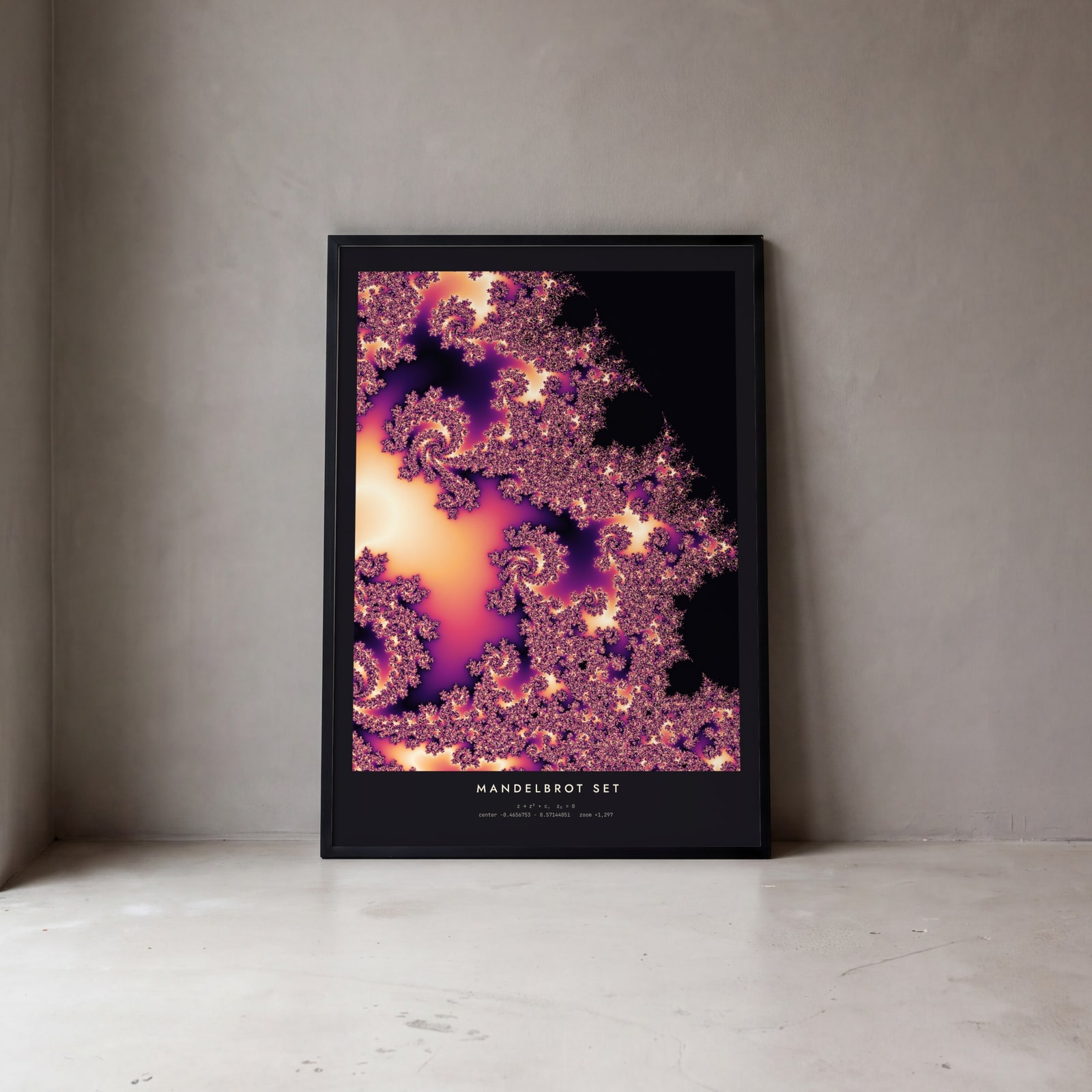
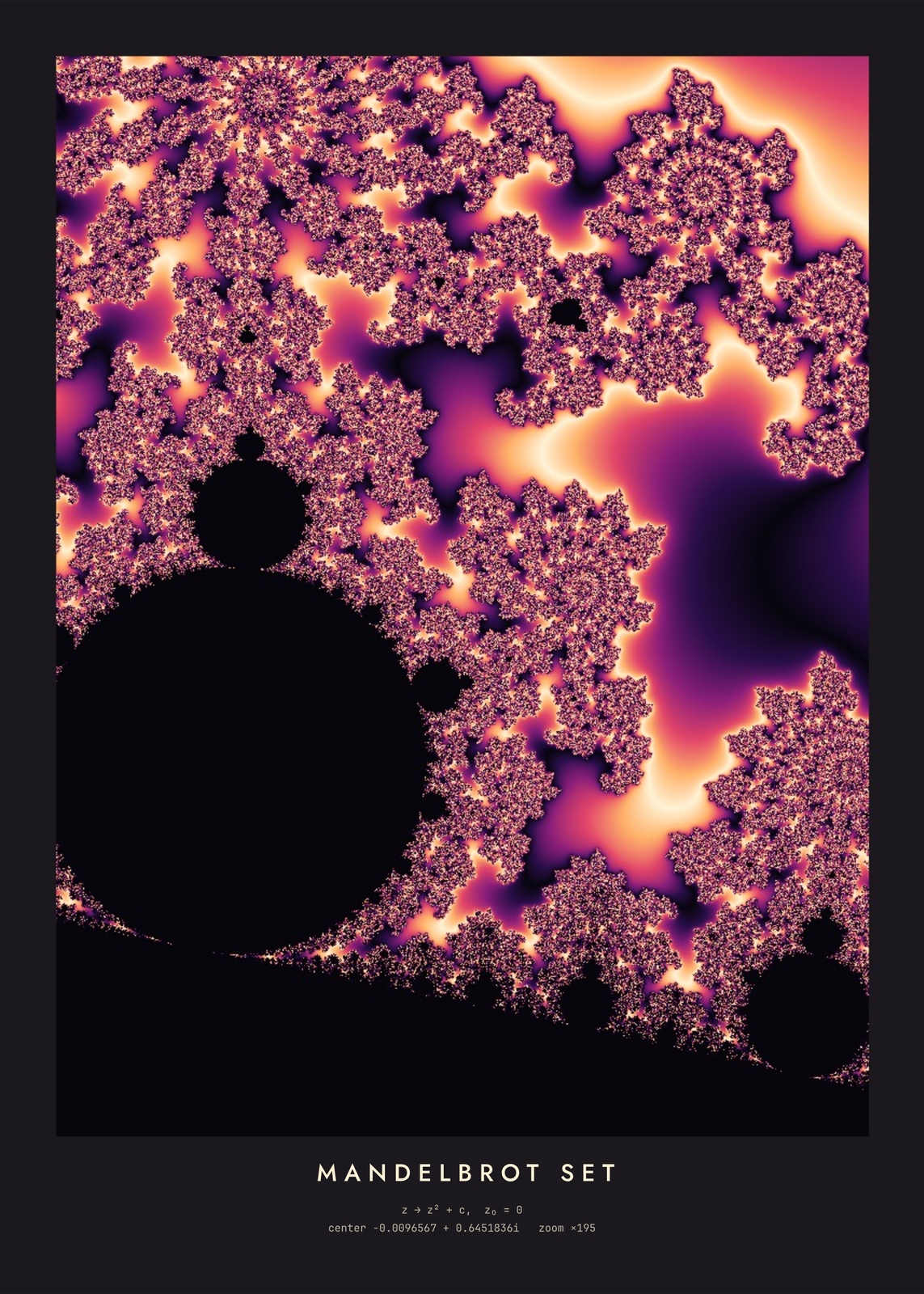
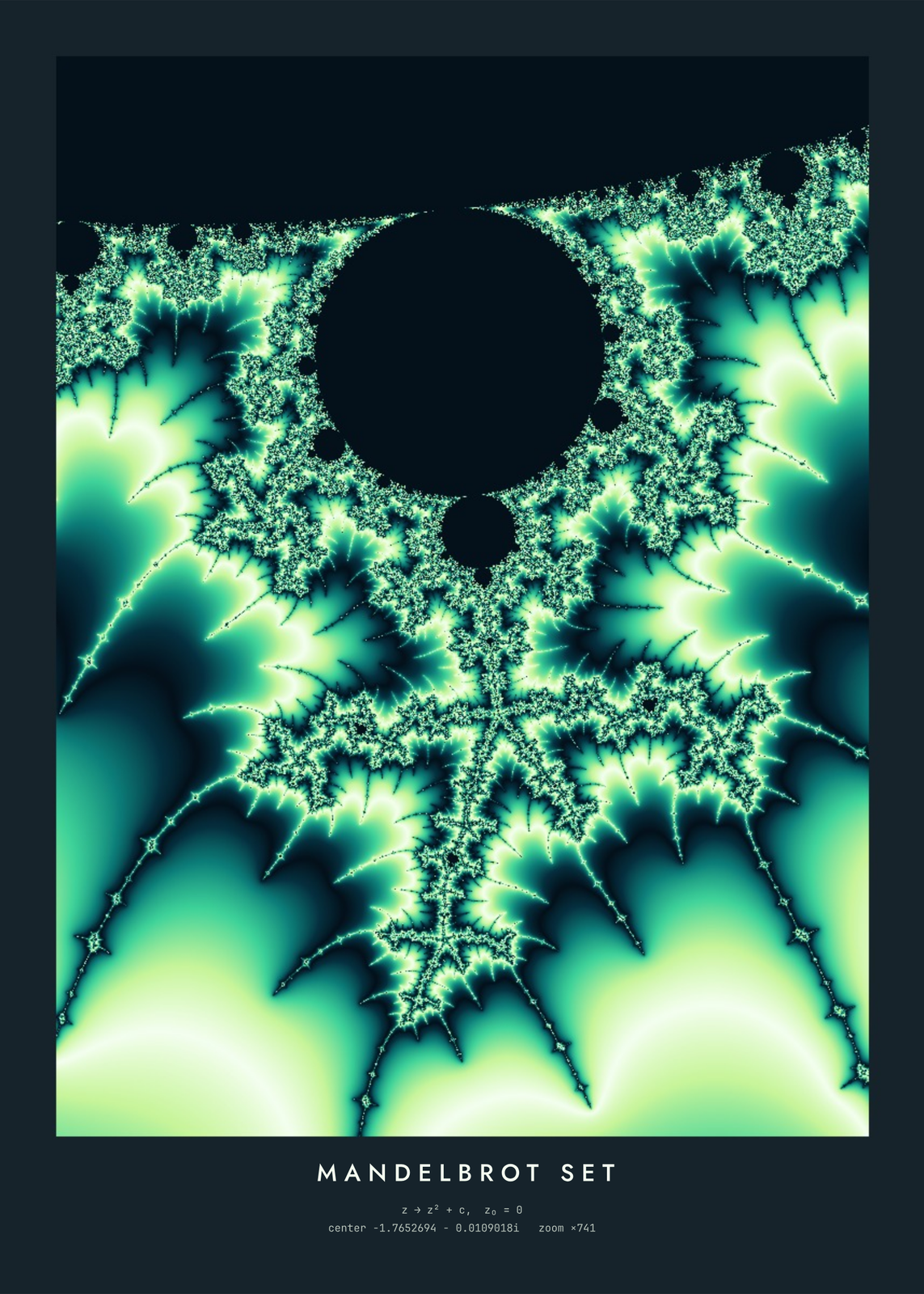
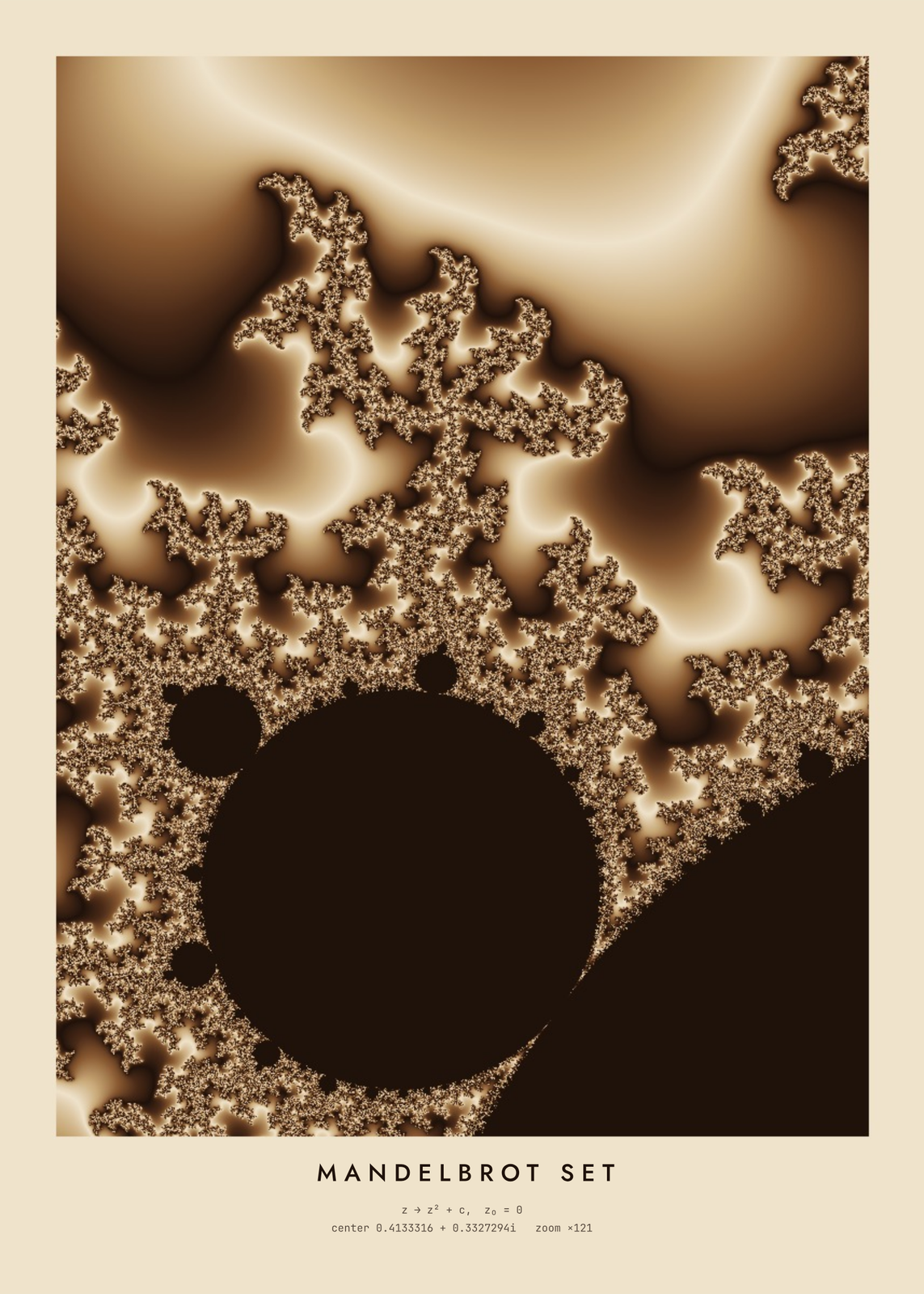
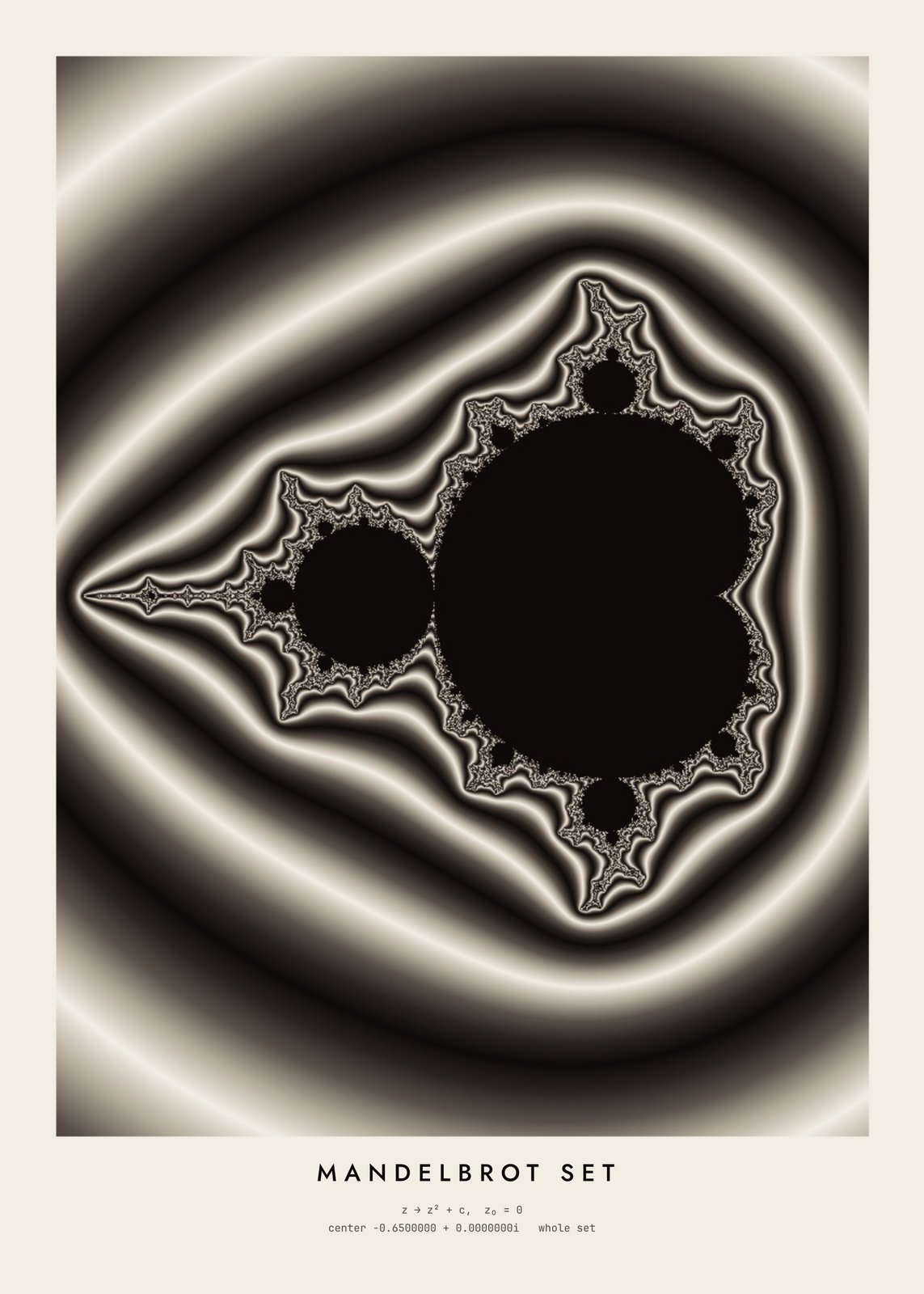
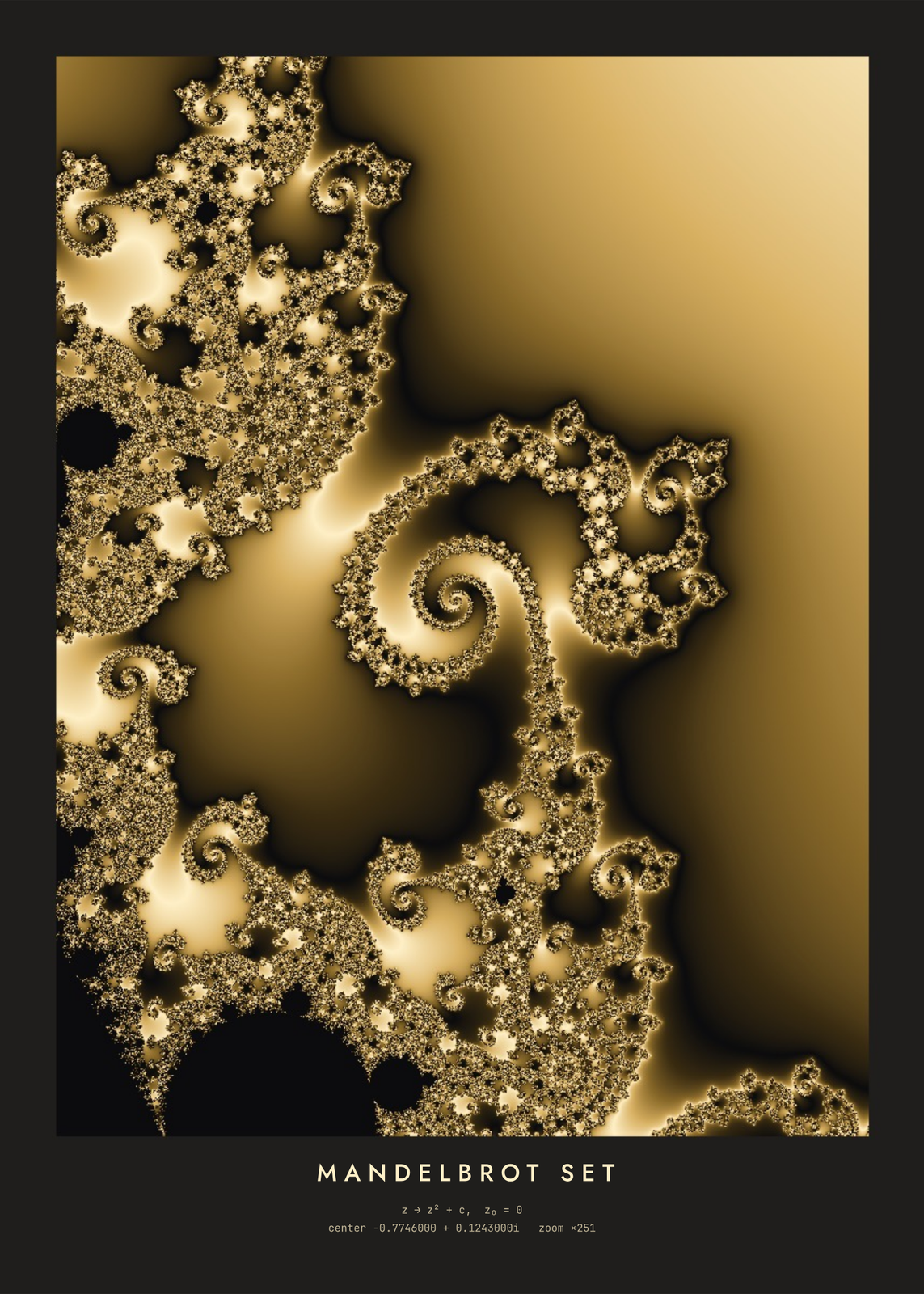
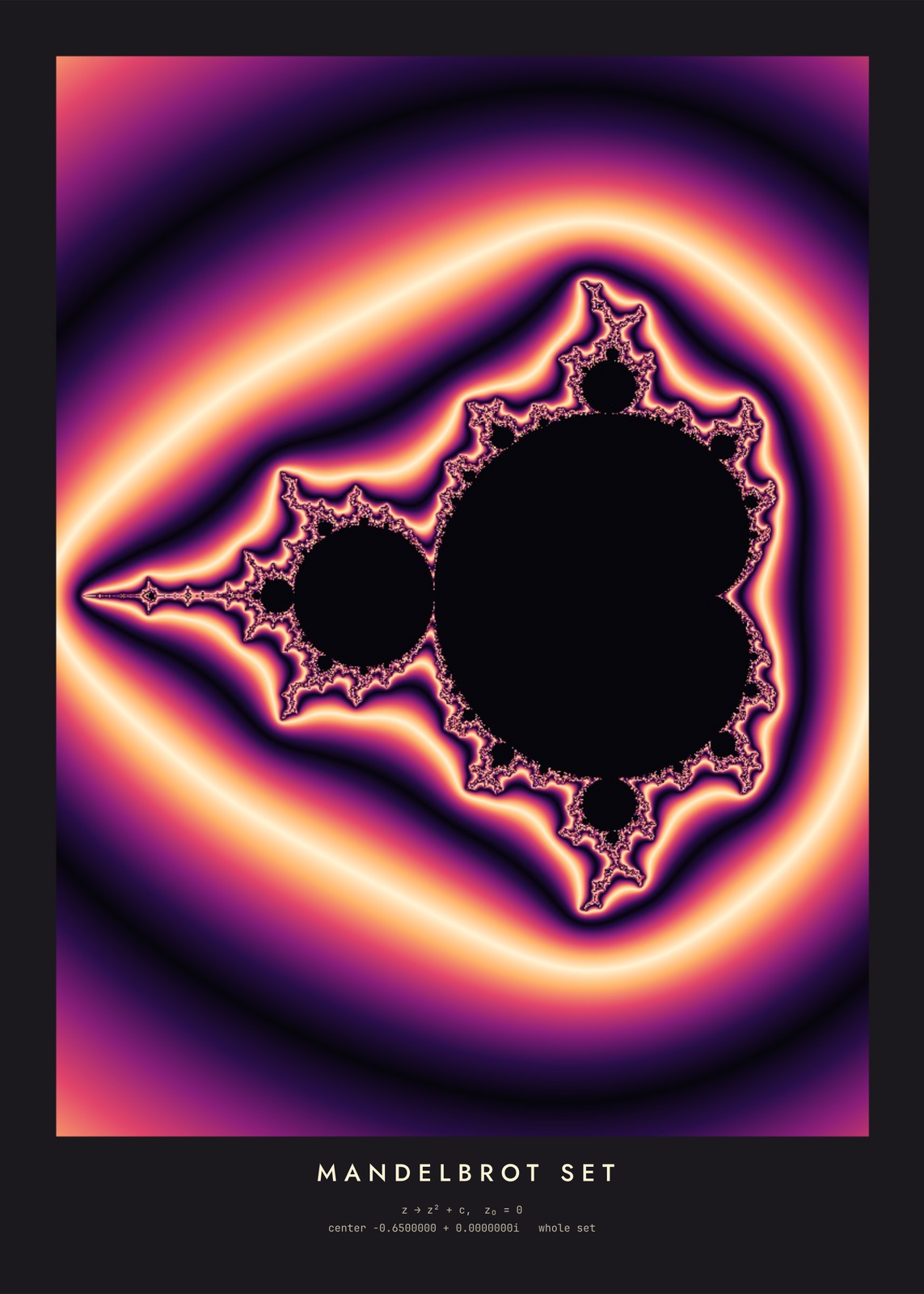
Every point c of the plane gets the same test: start from z = 0, square it and add c, again and again, and see whether z flies off. The points that never escape are the Mandelbrot set; the rest are colored by how fast they leave. Each seed zooms into a different stretch of the edge, or you type the center and the zoom yourself, and the formula and the view print small under the title.
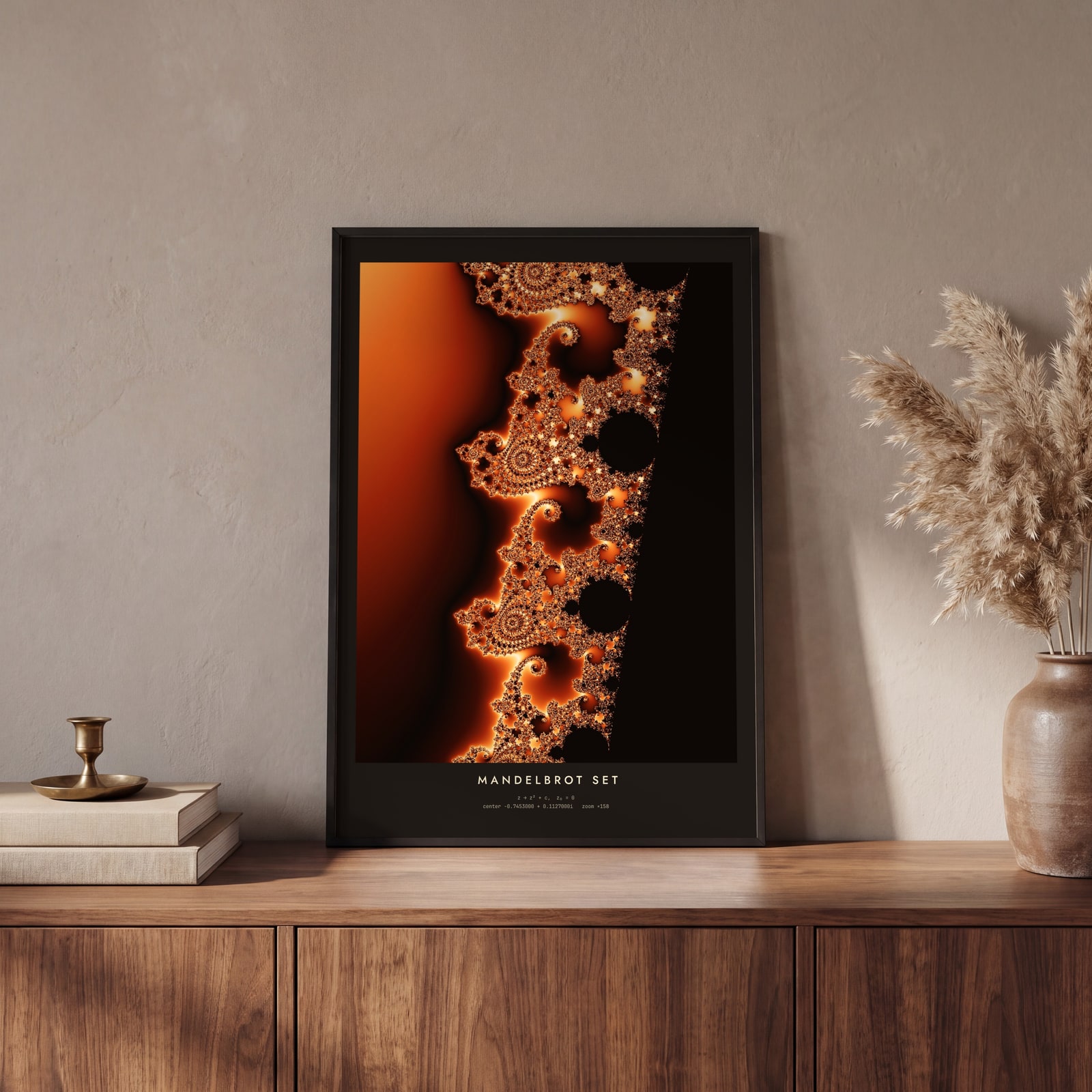
On the wall
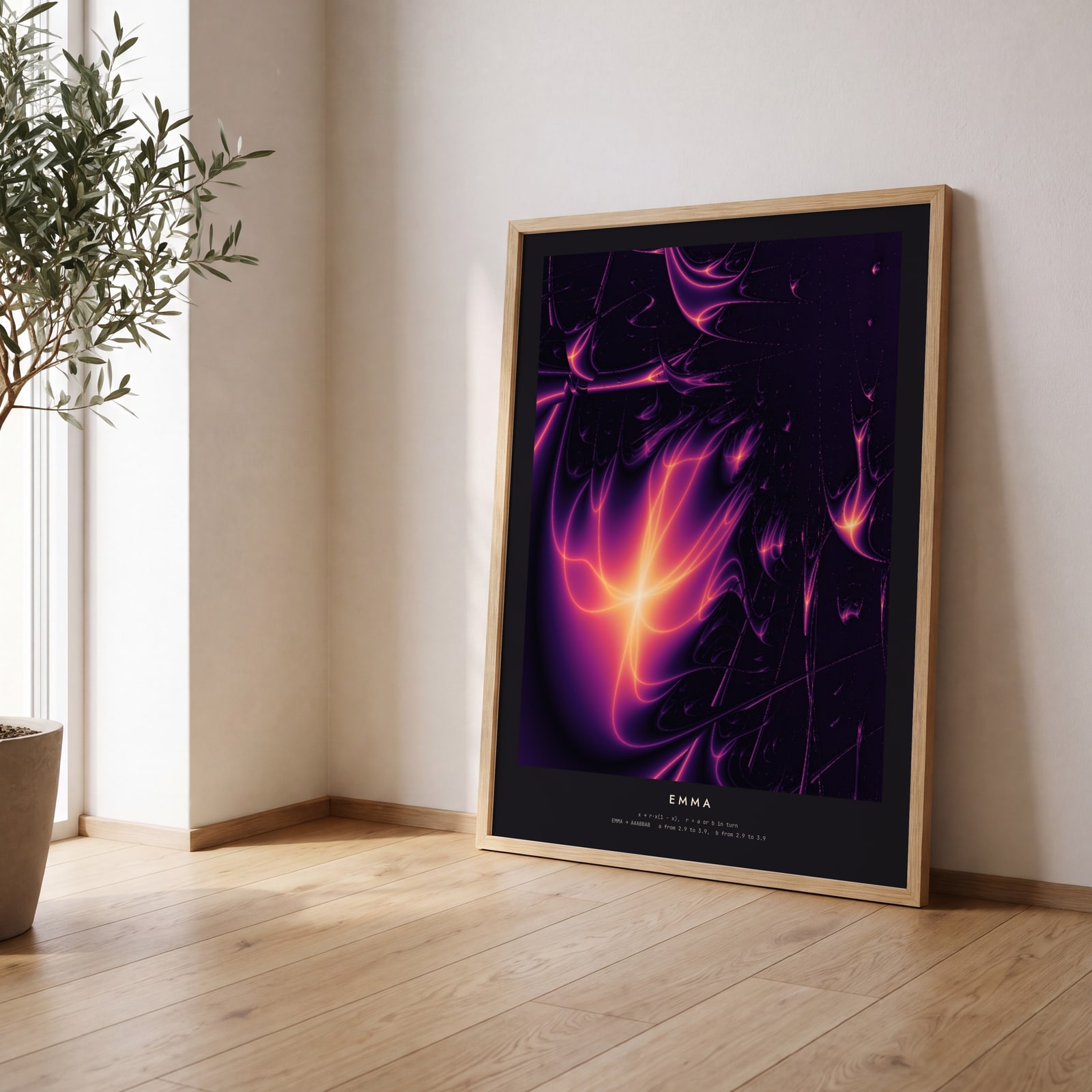
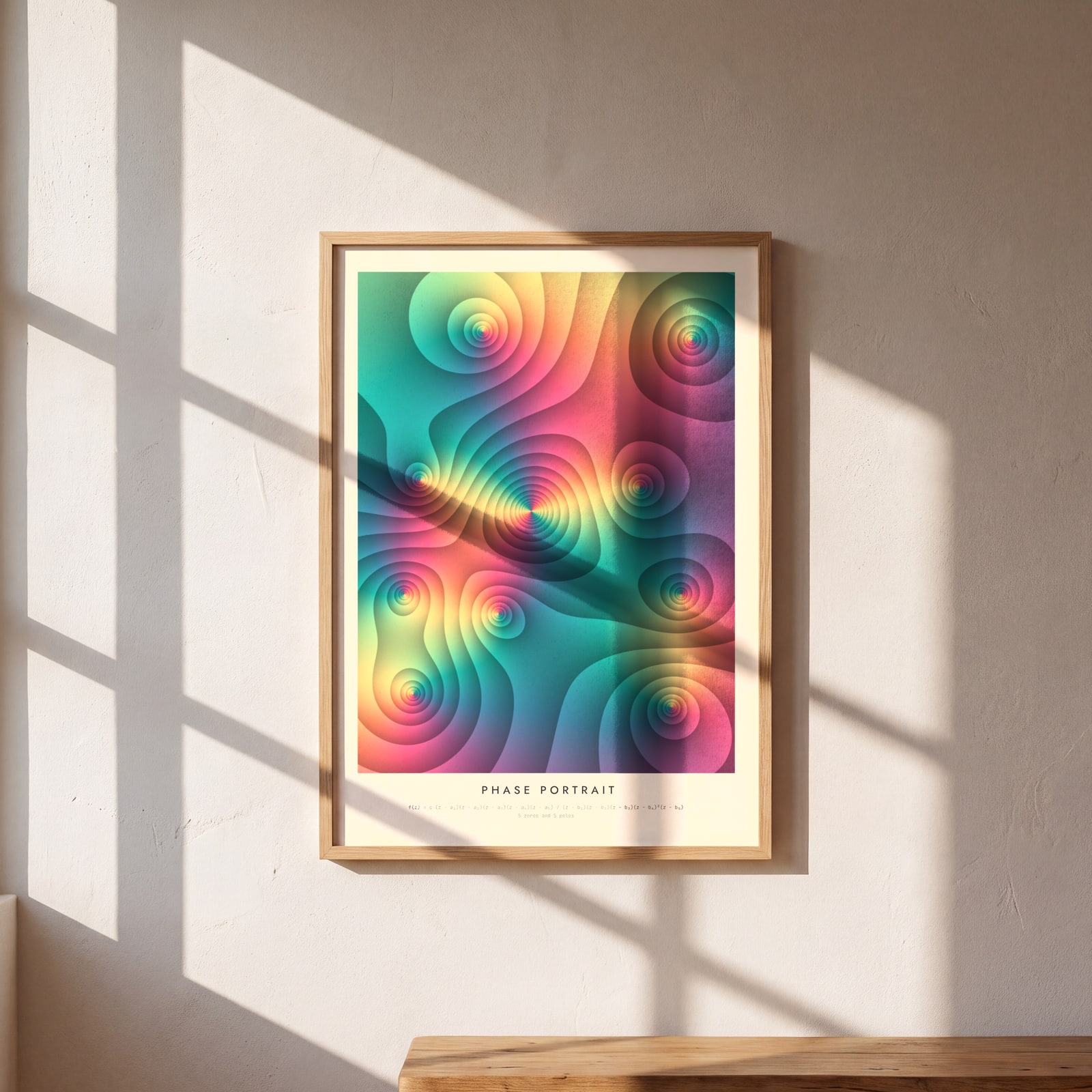
A few of them framed at home. Open any one to make it yours.
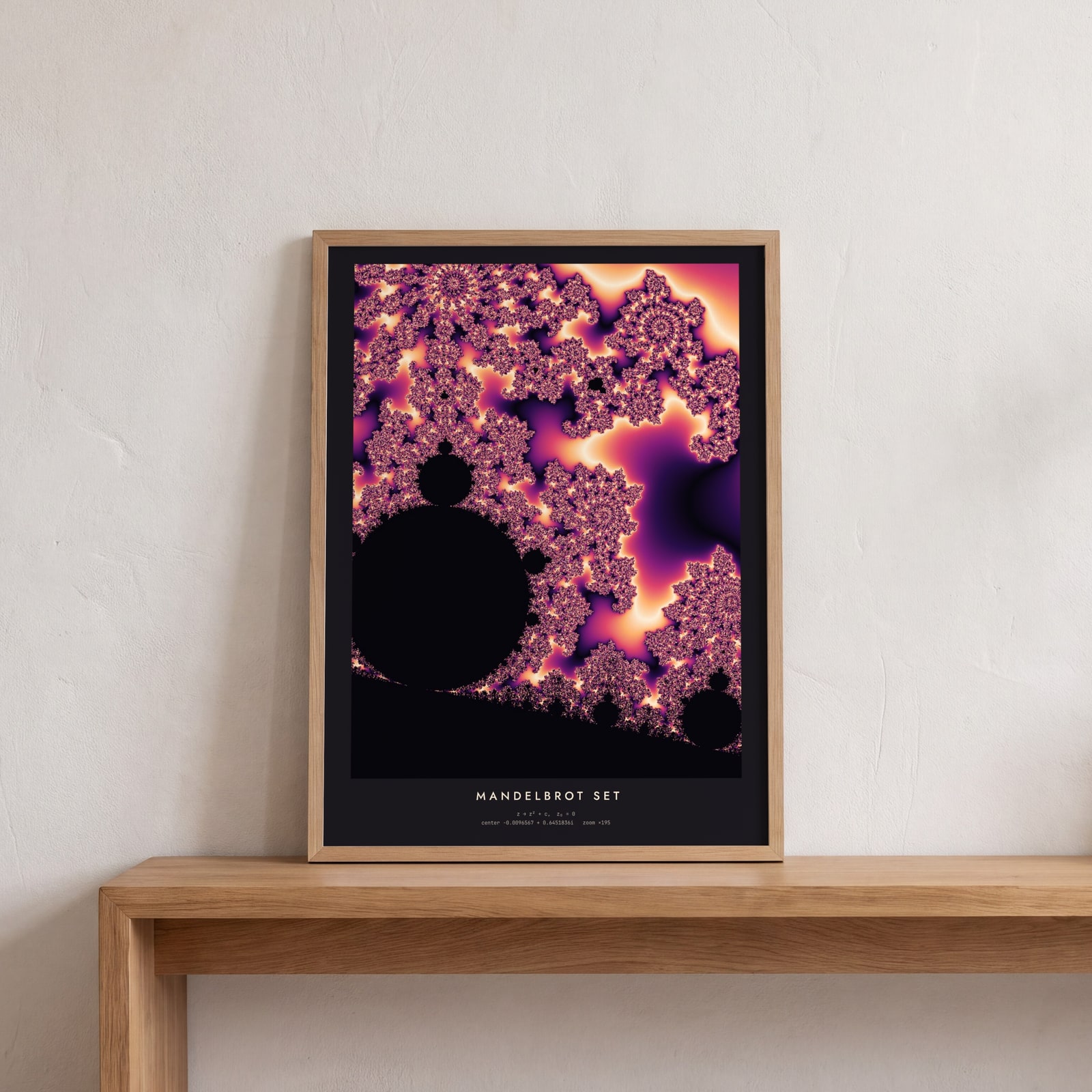
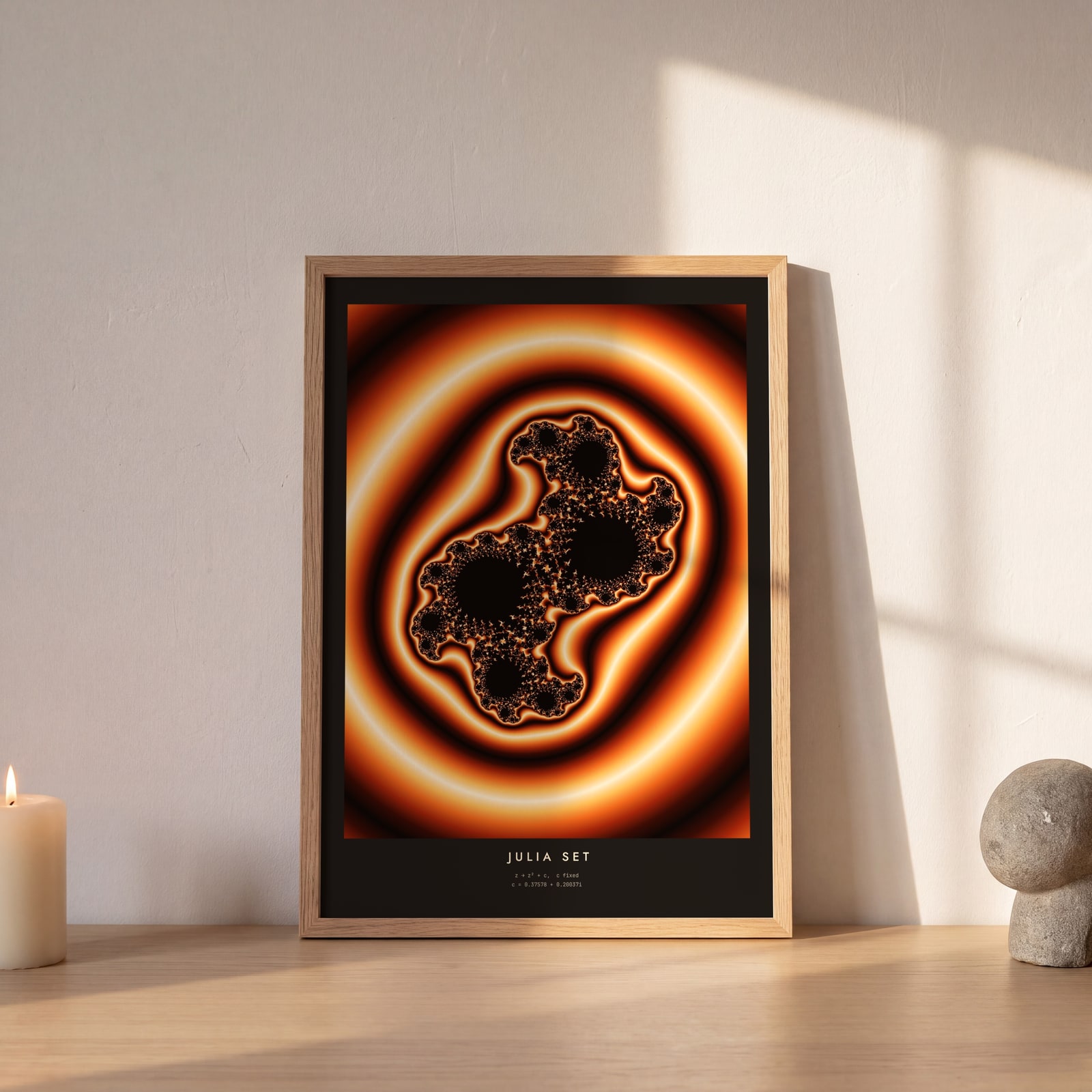
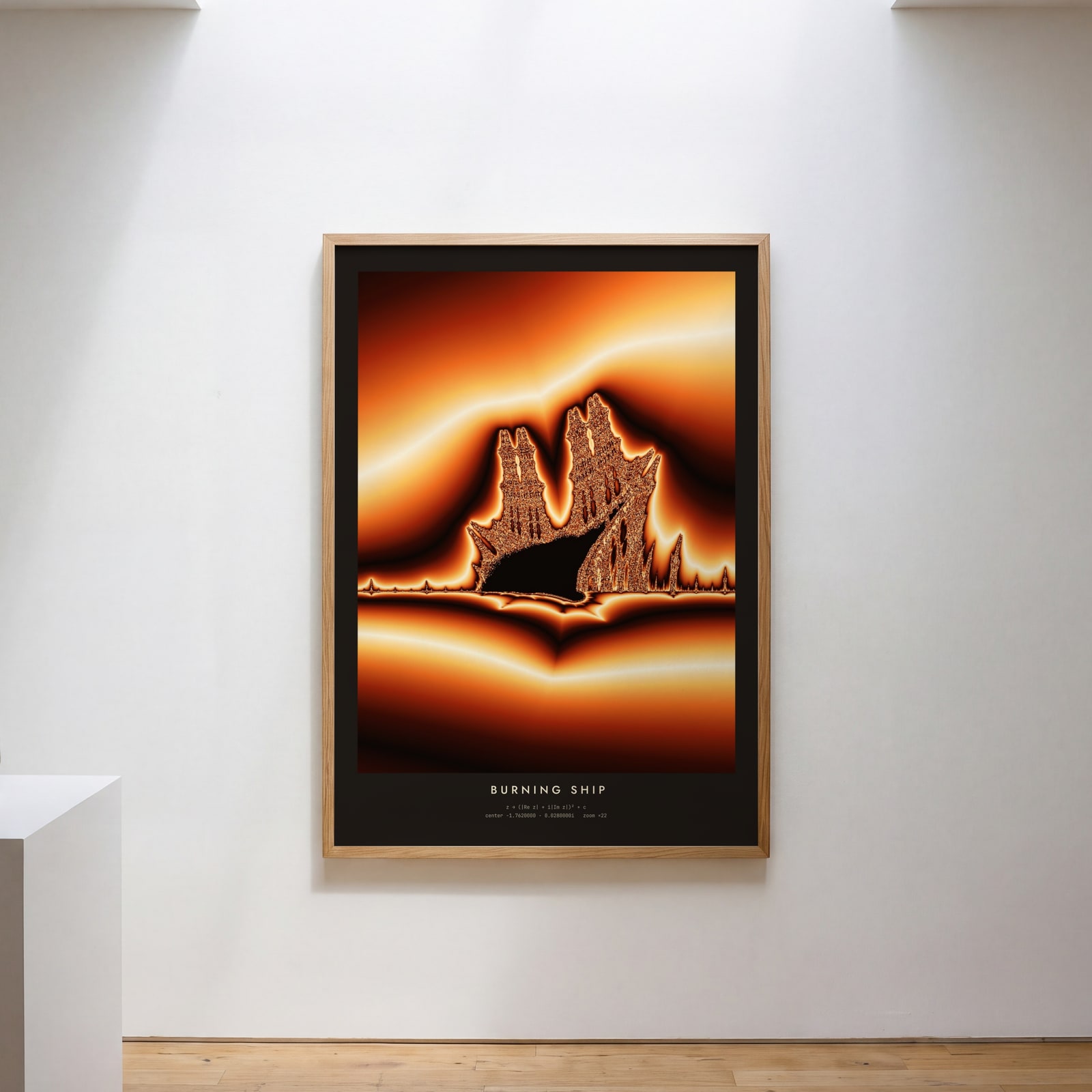
Examples
Open any of them to change the words, the place, the date and the style, then download the print file.
The Mandelbrot set
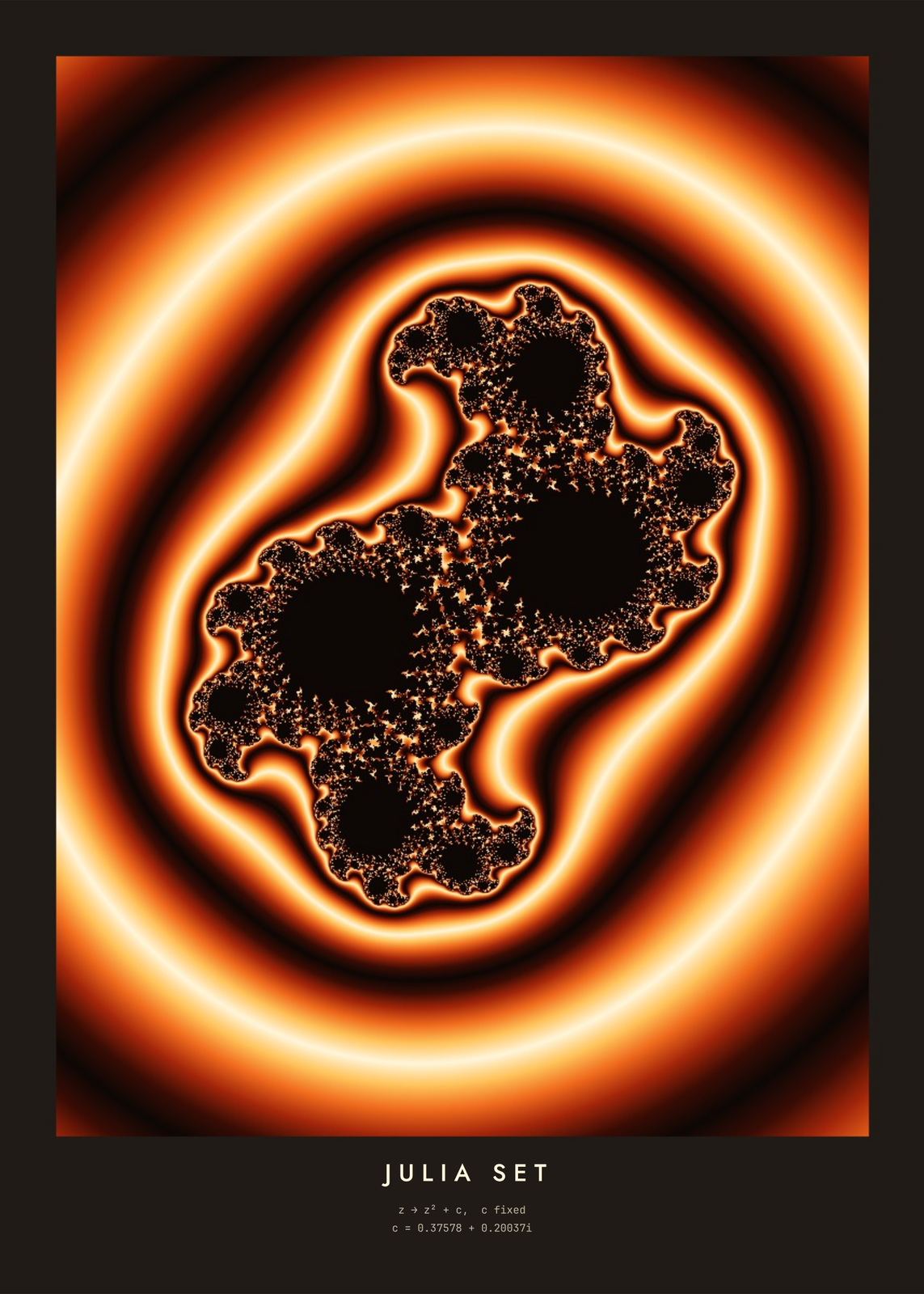
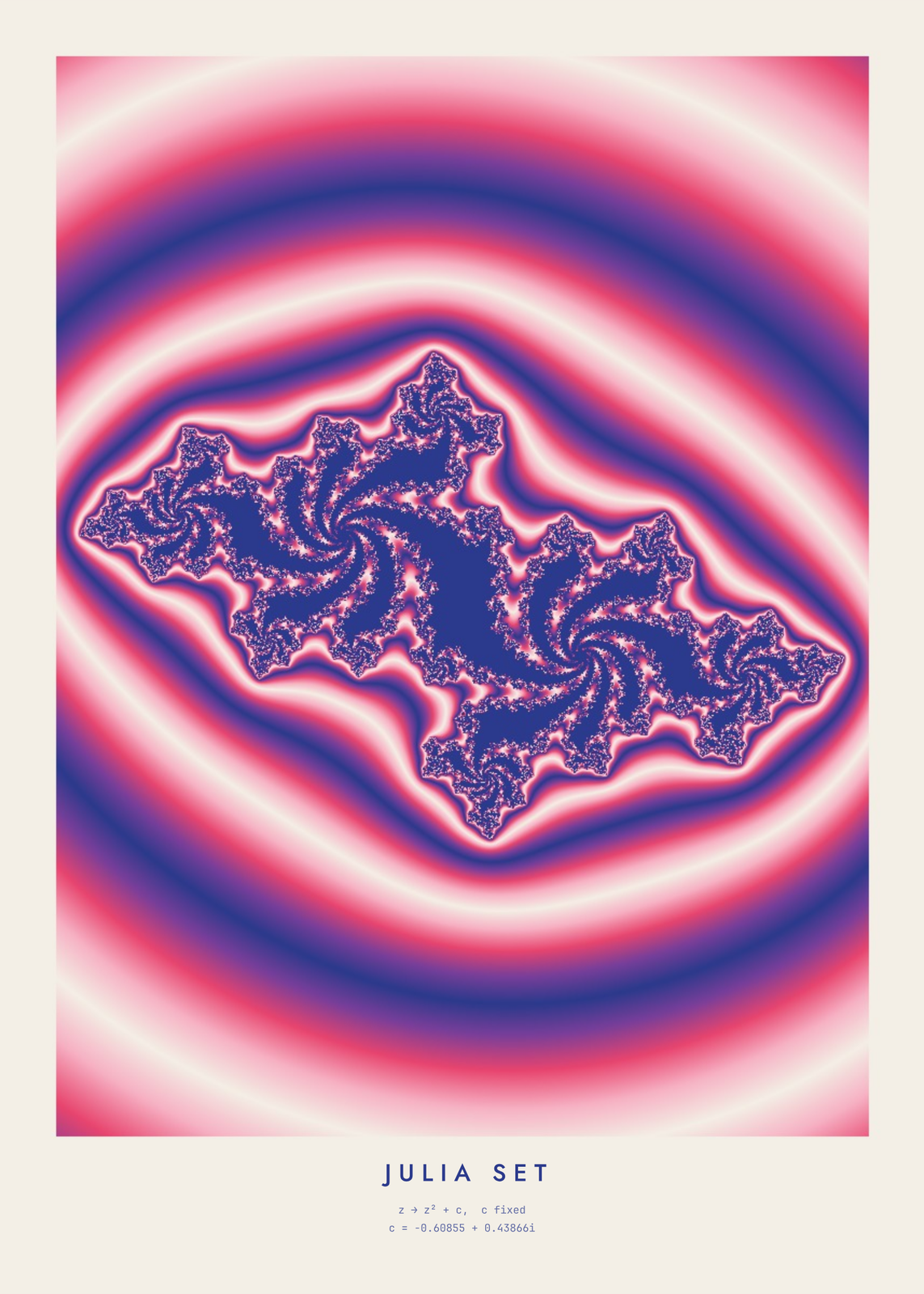
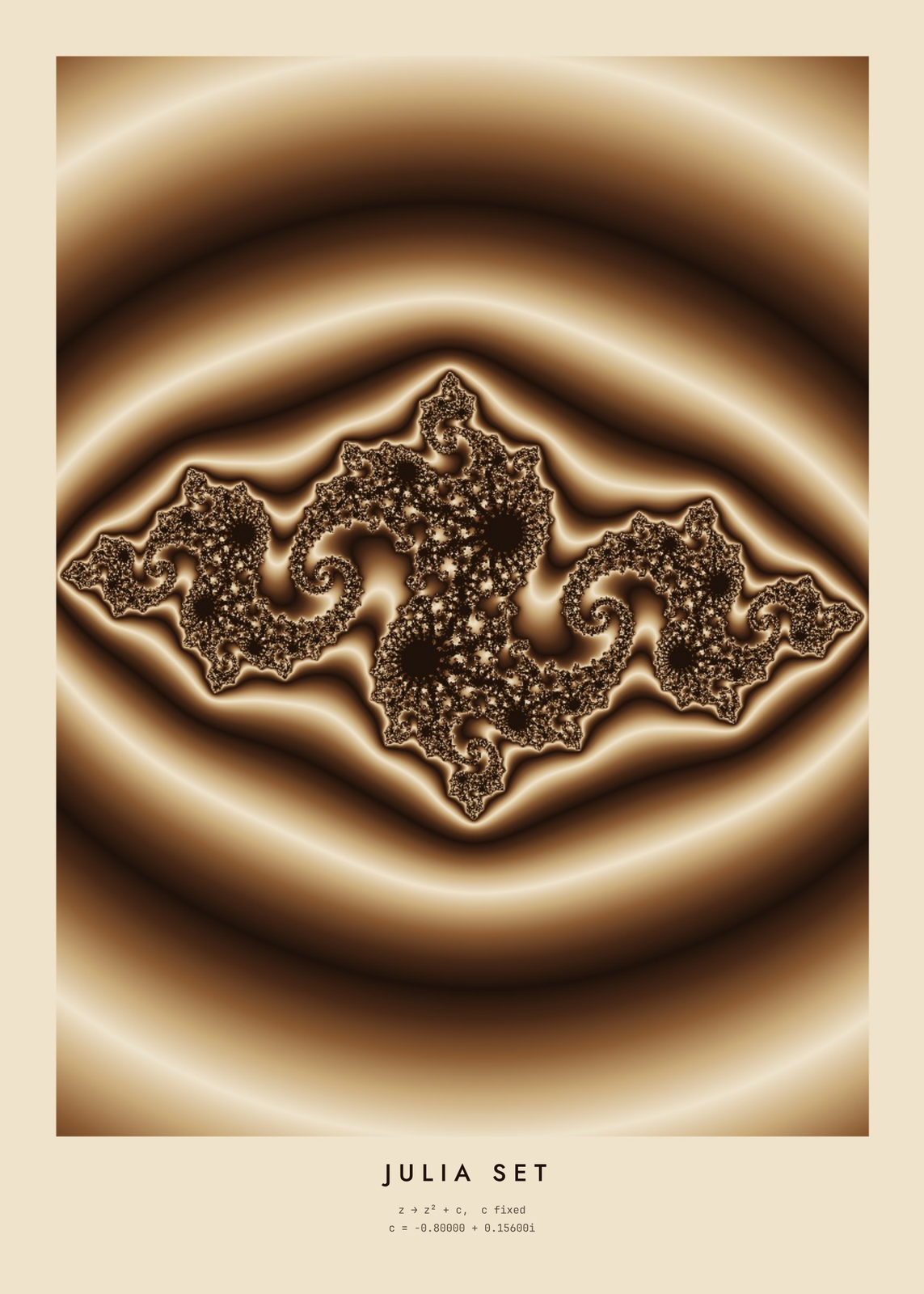
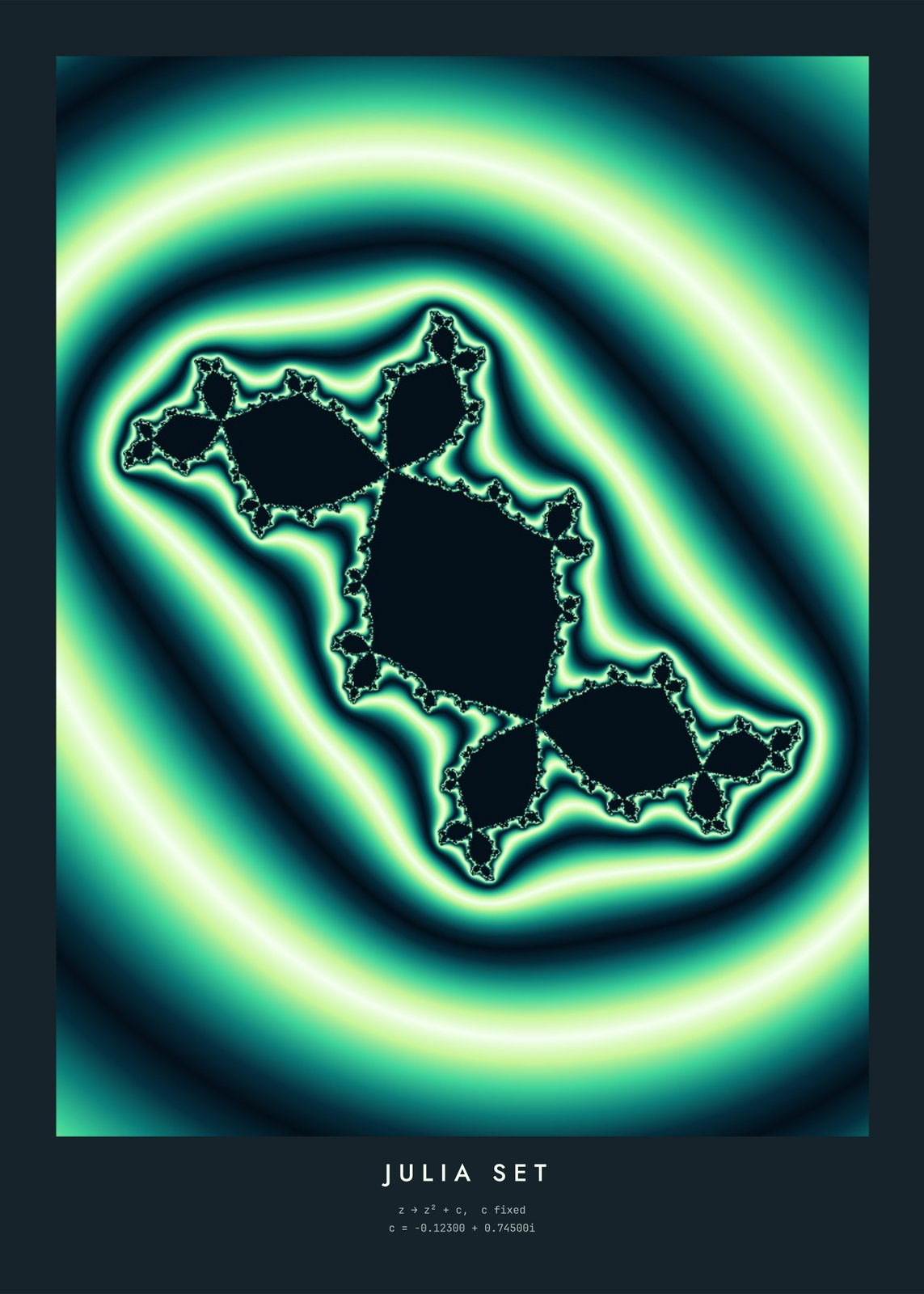
Julia sets
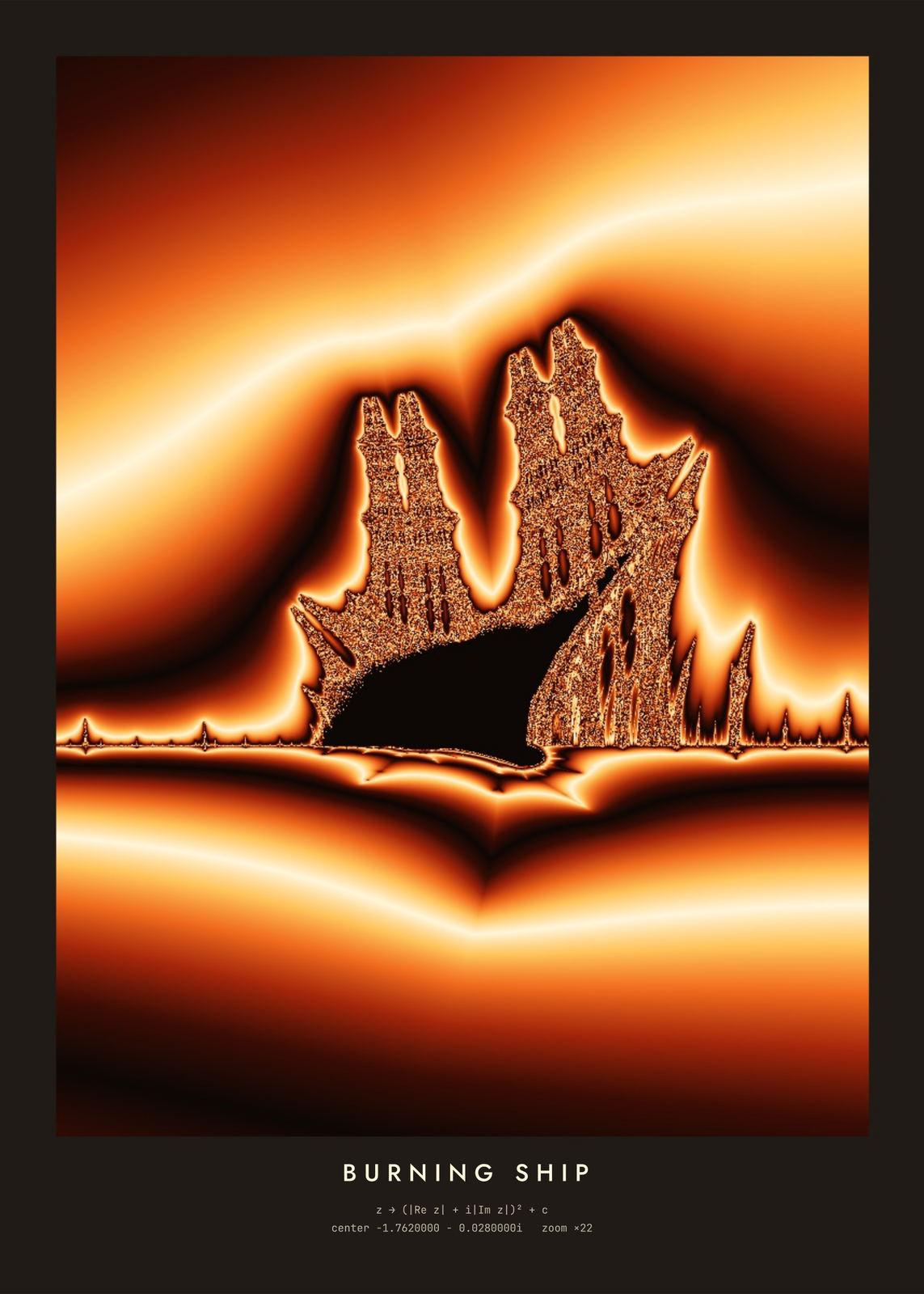
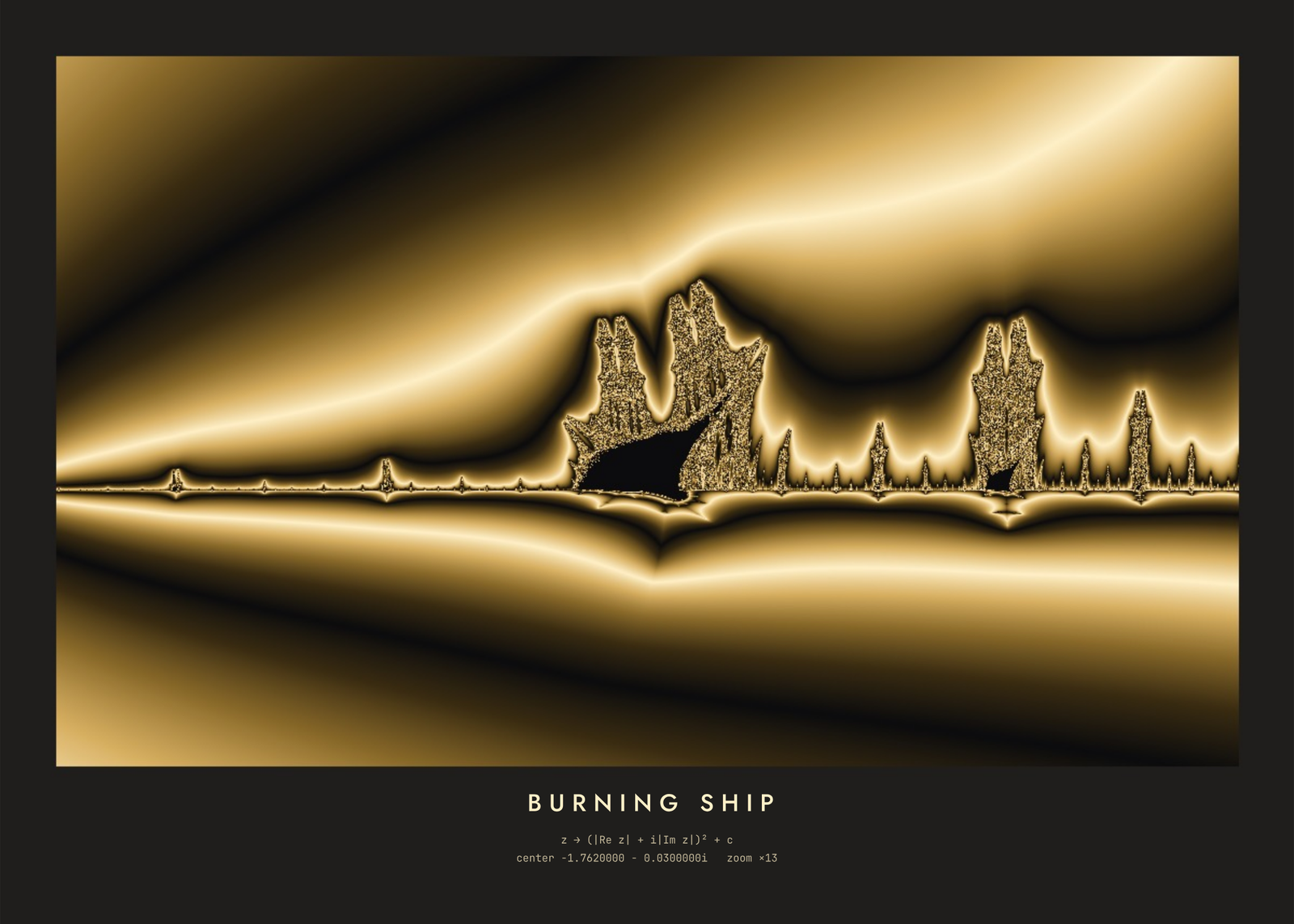
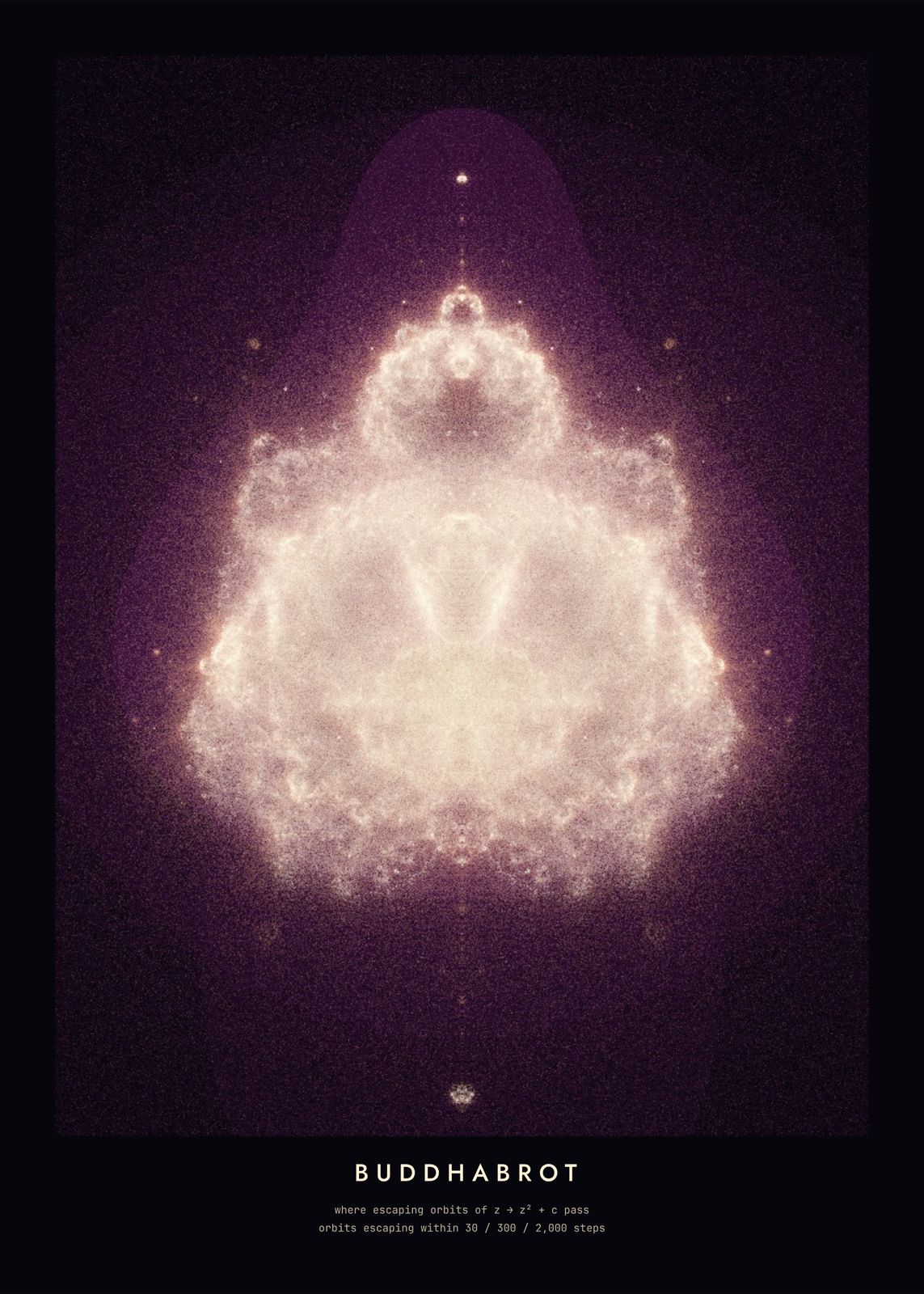
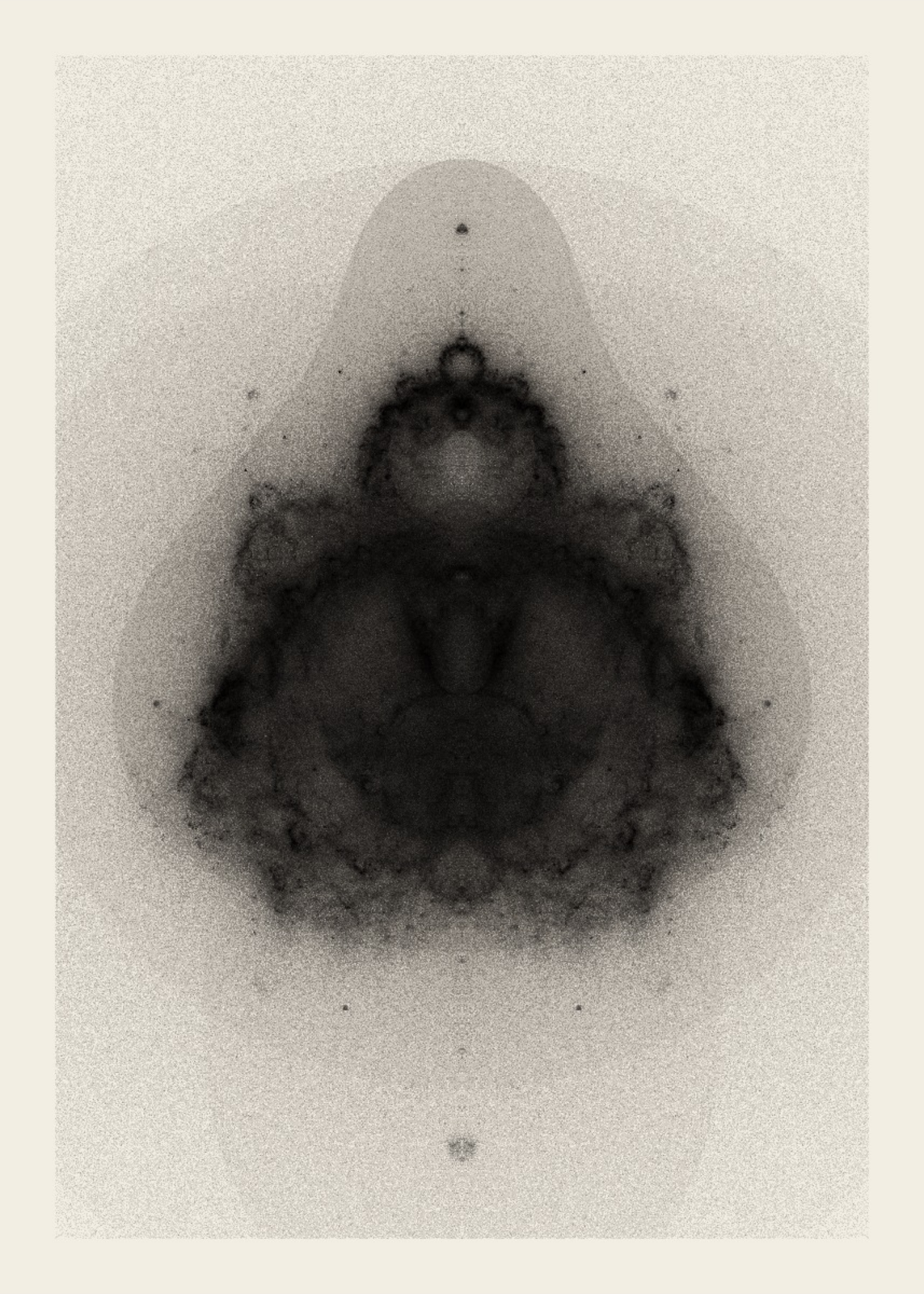
Burning Ship and Buddhabrot
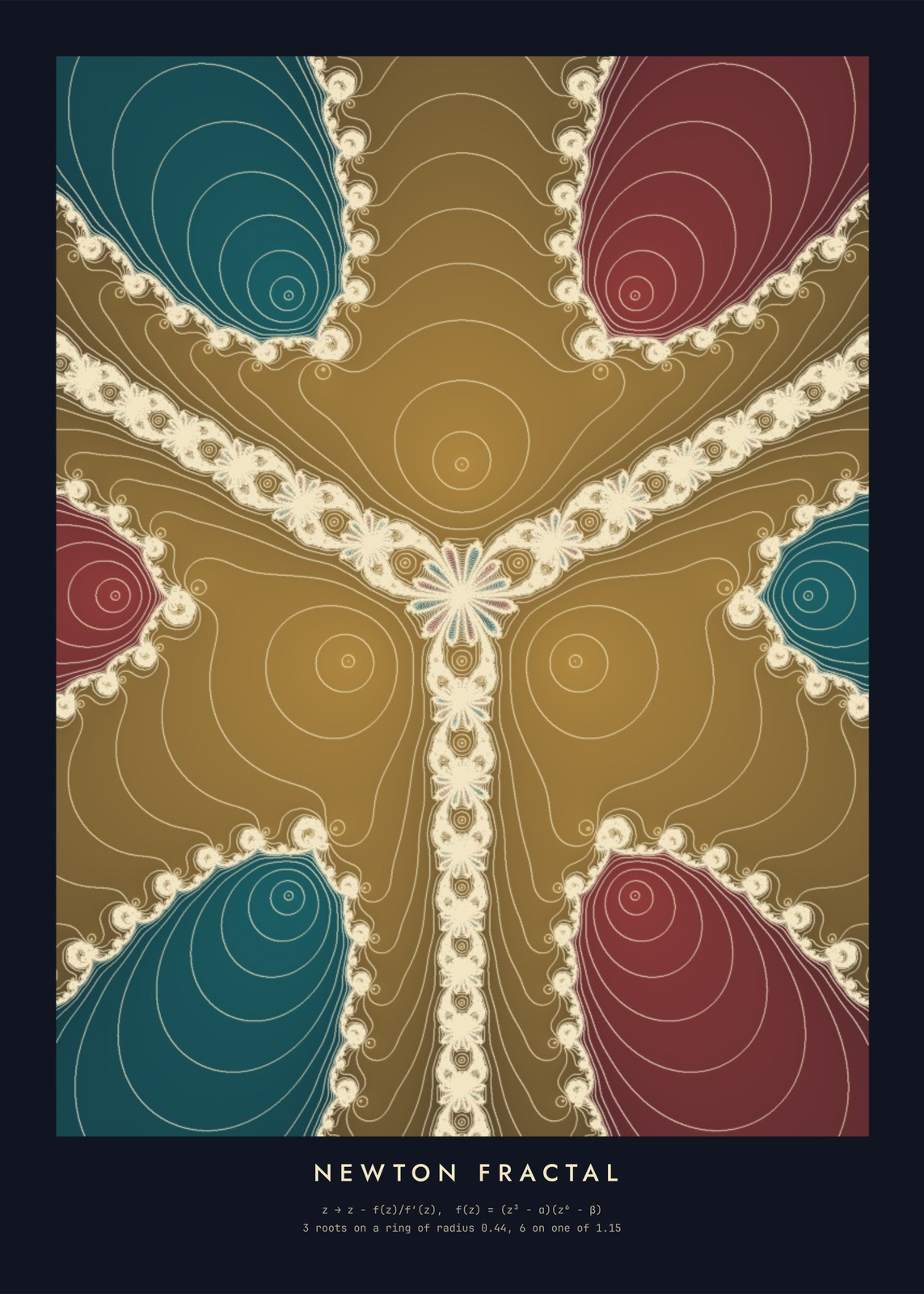
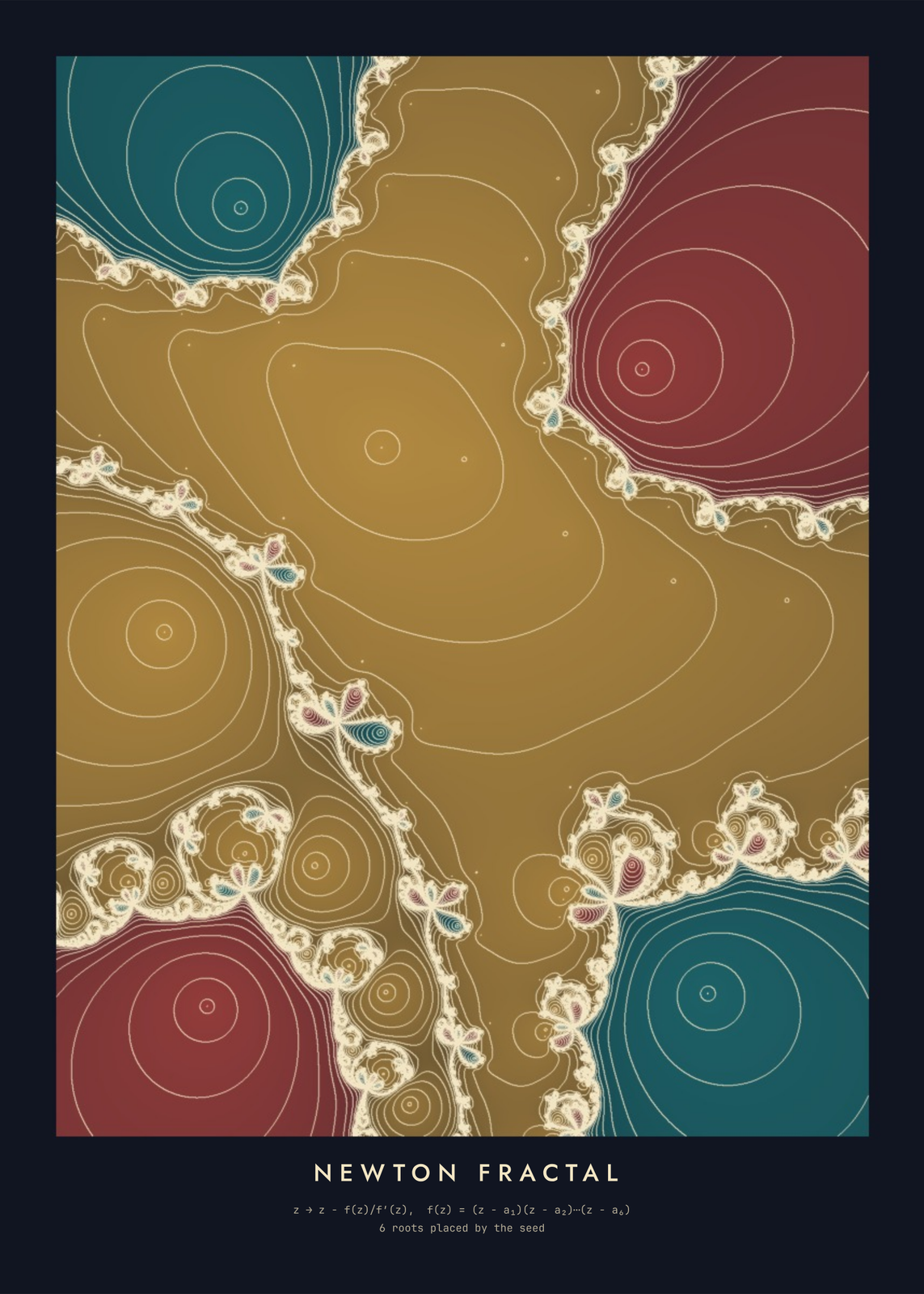
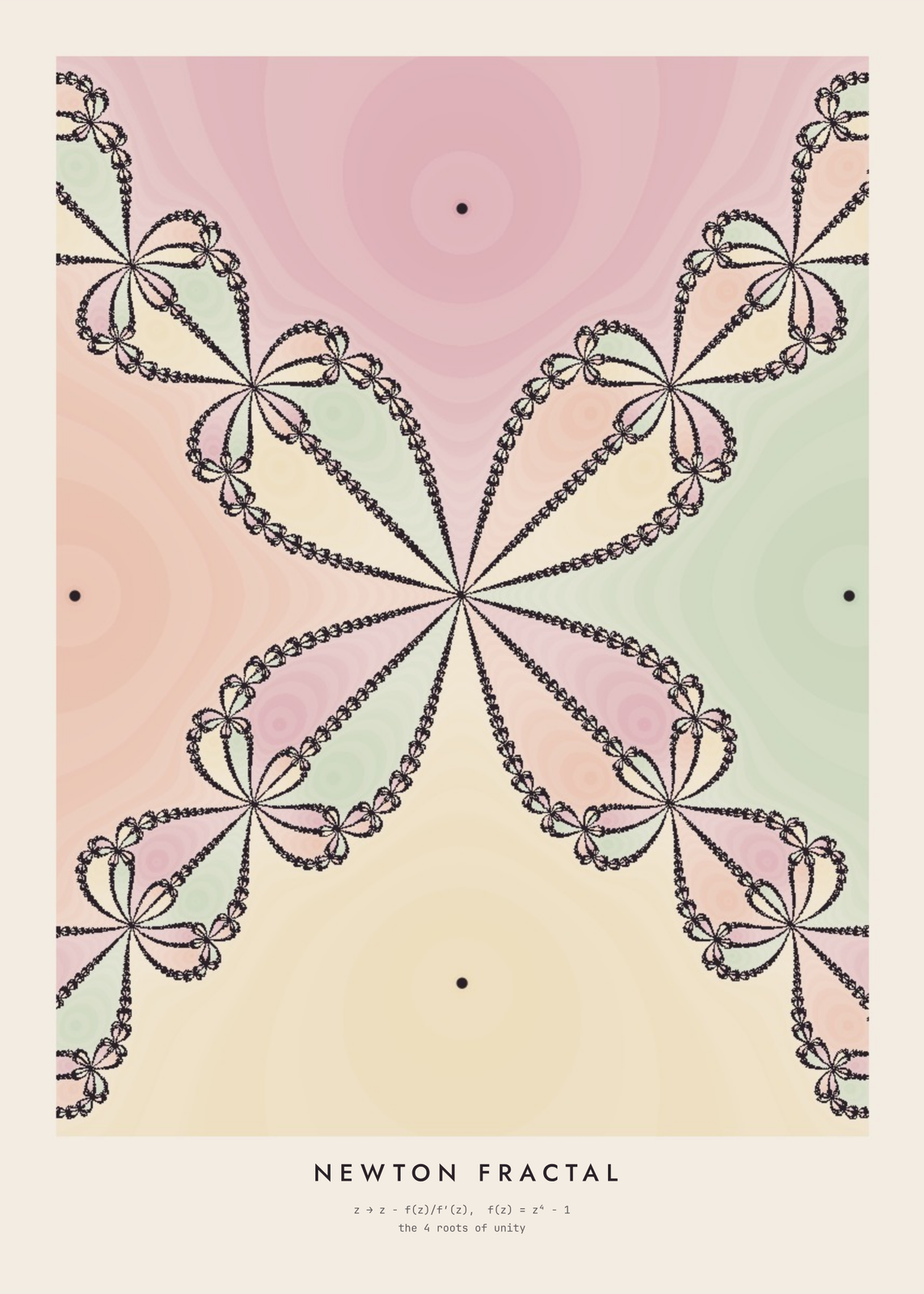
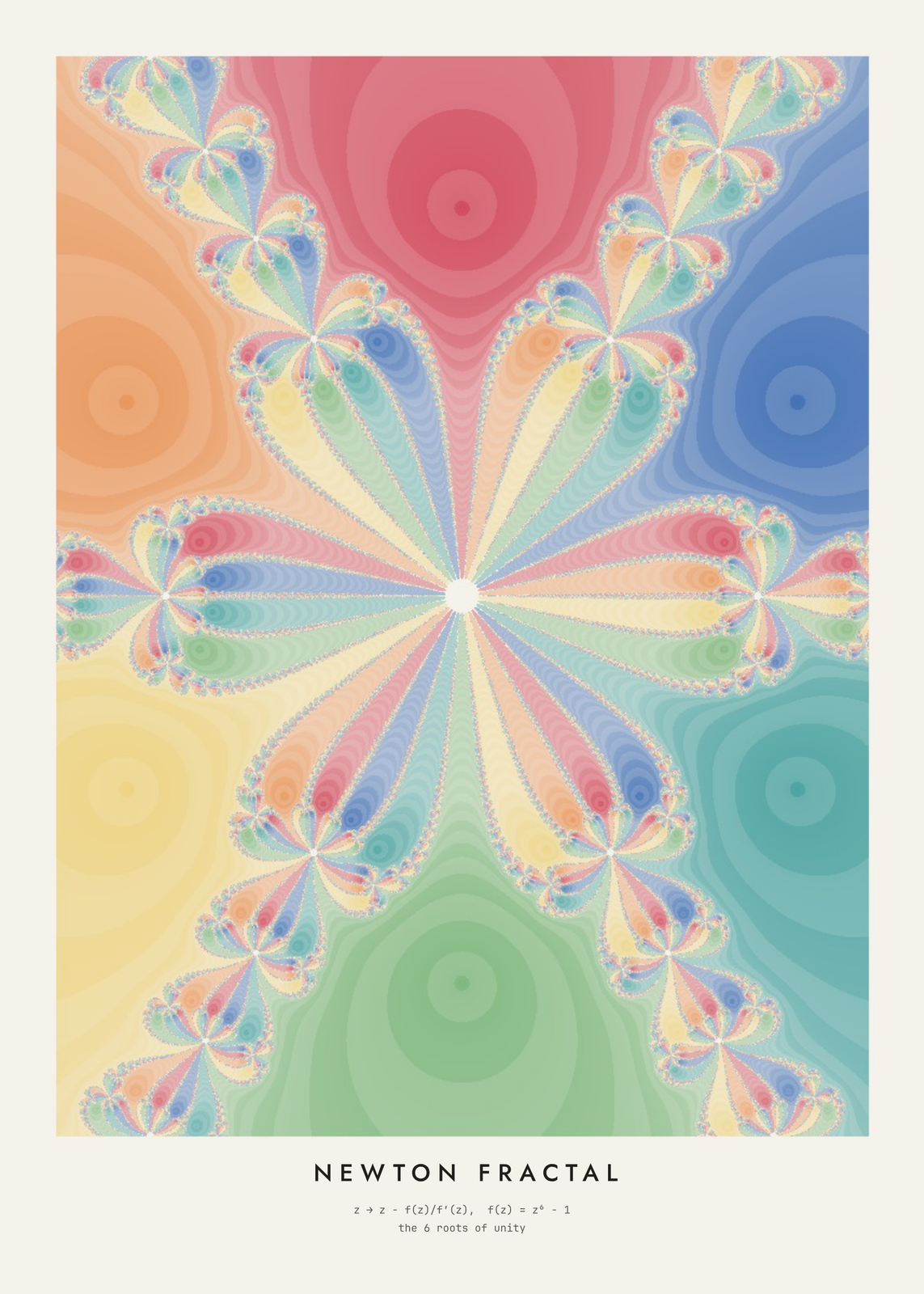
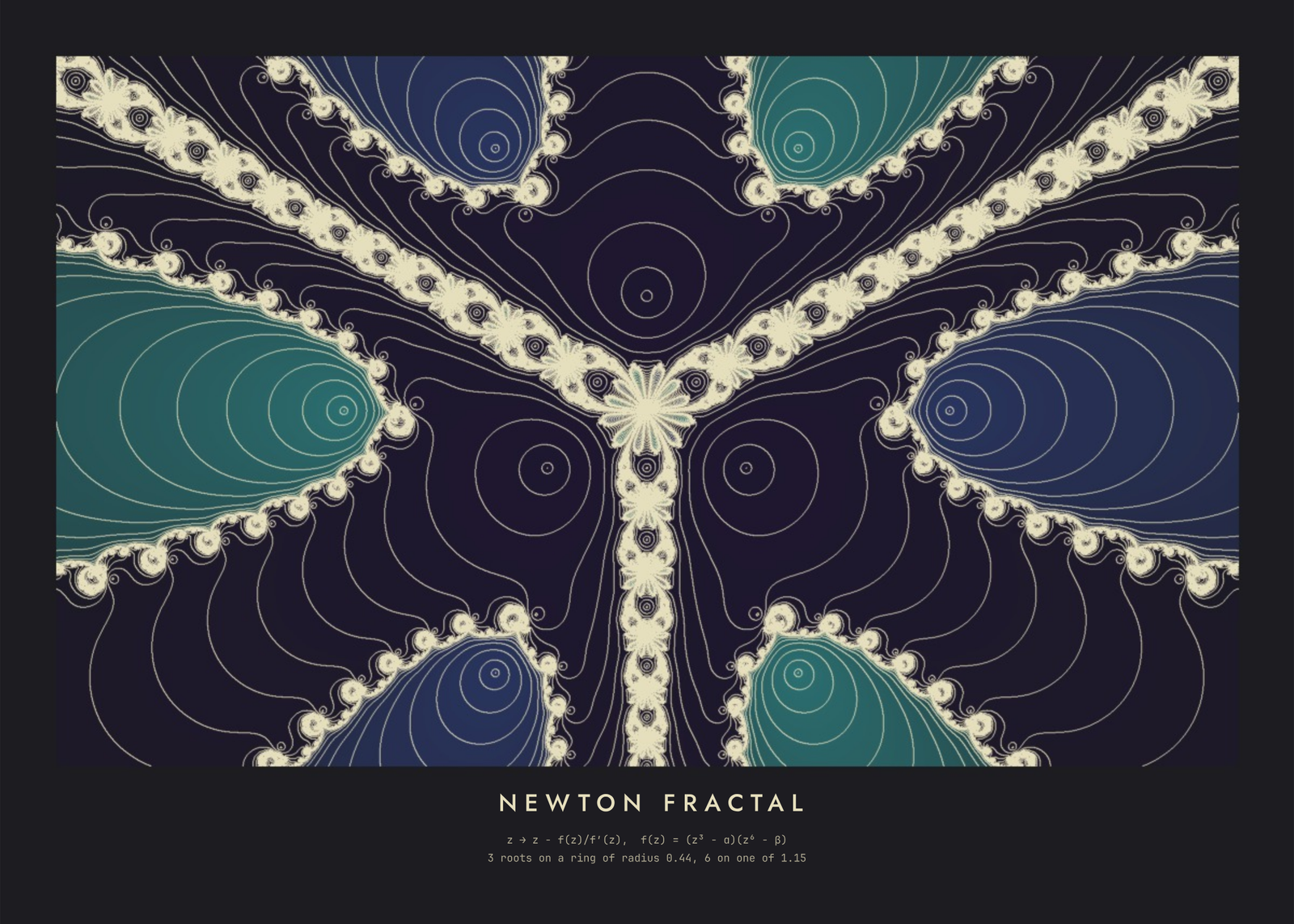
Newton fractals
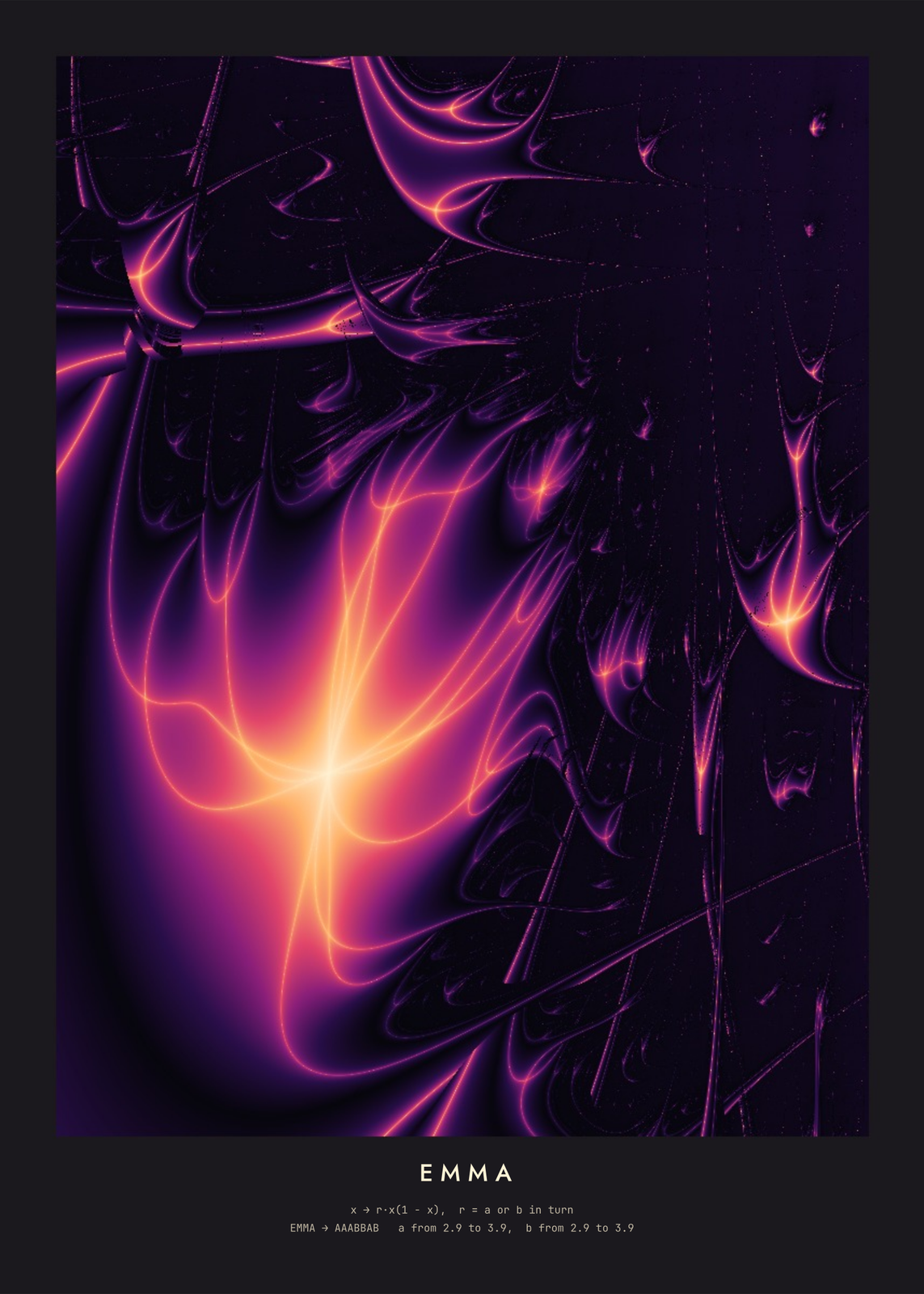
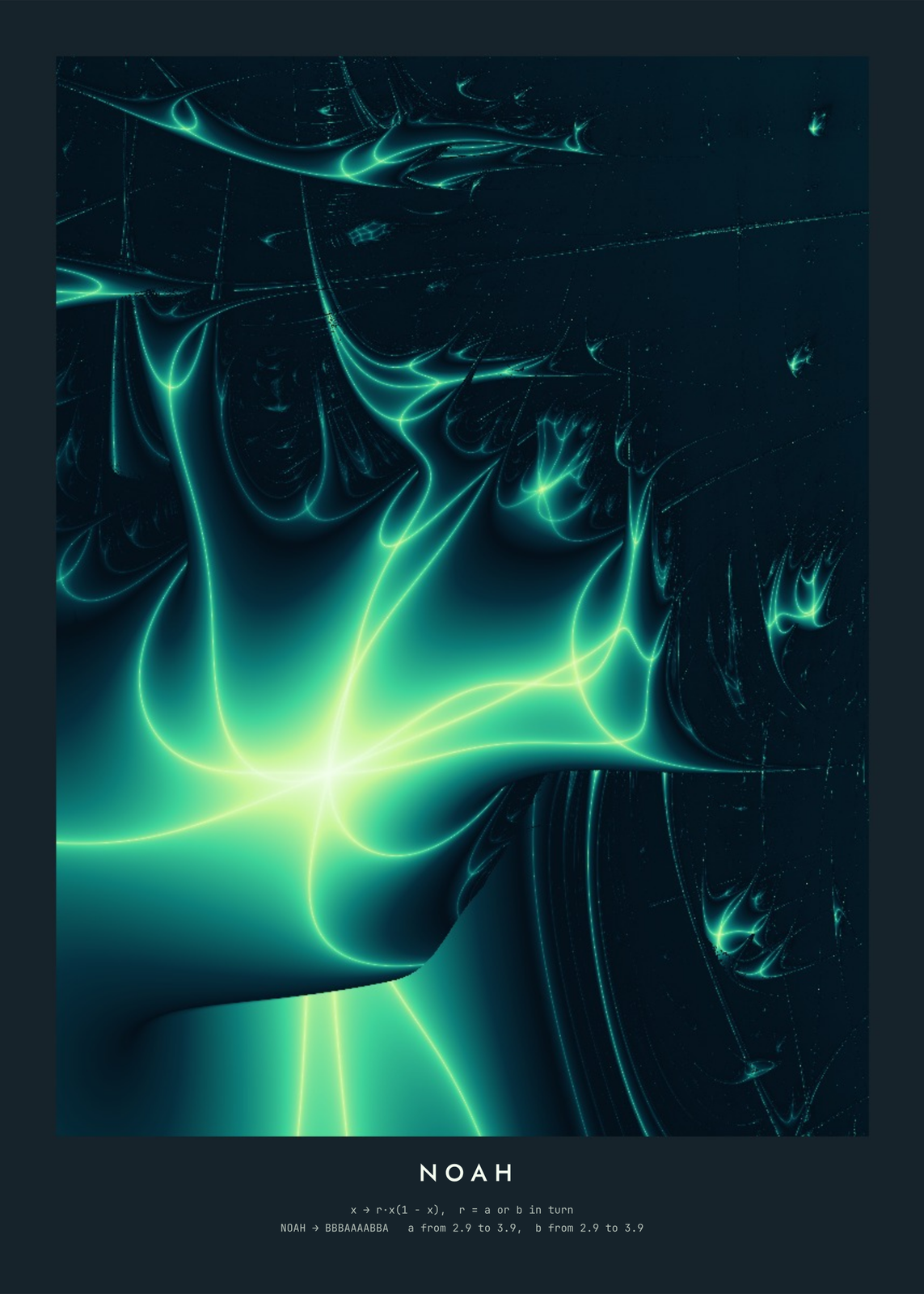
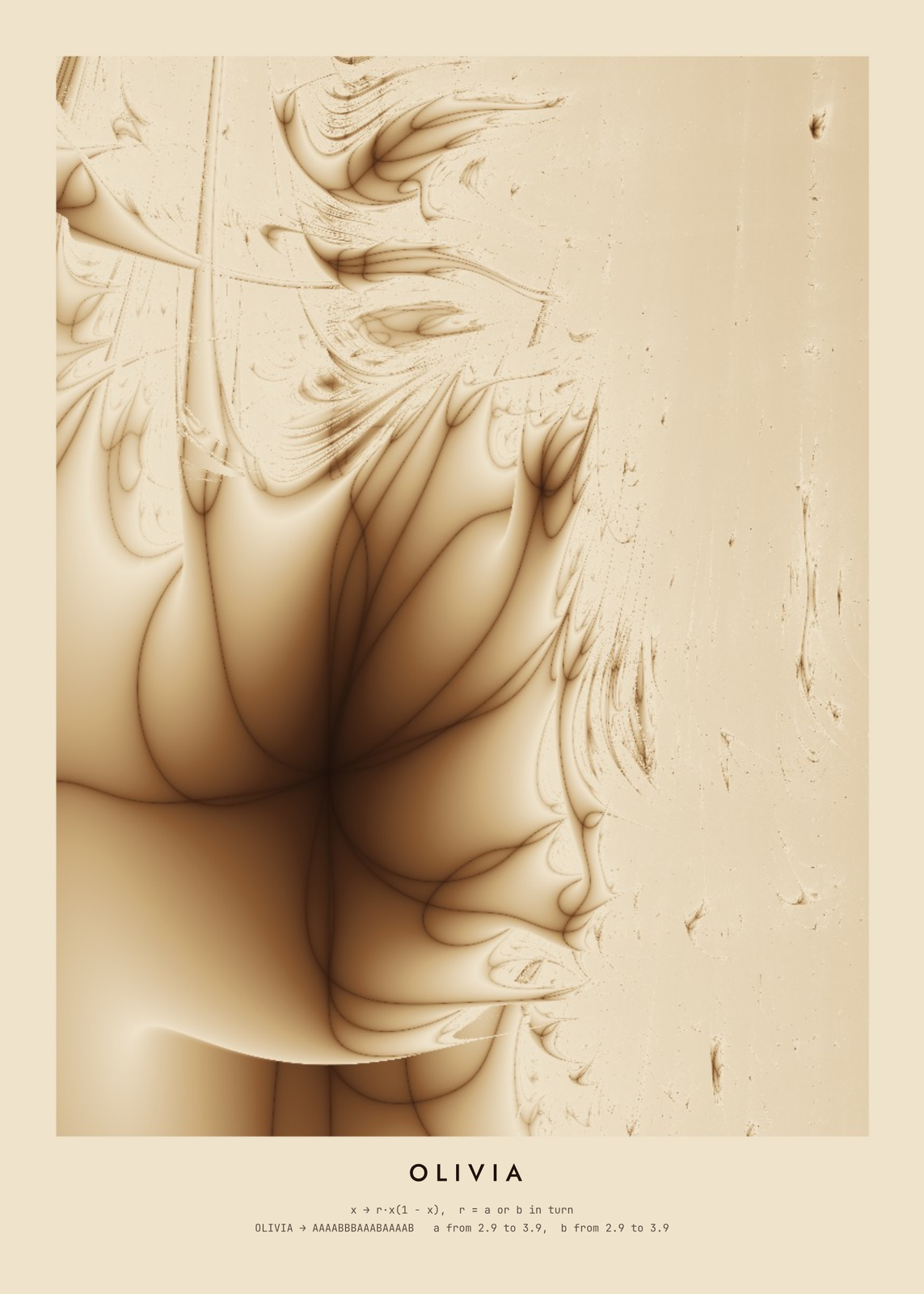
Lyapunov fractals
Phase portraits
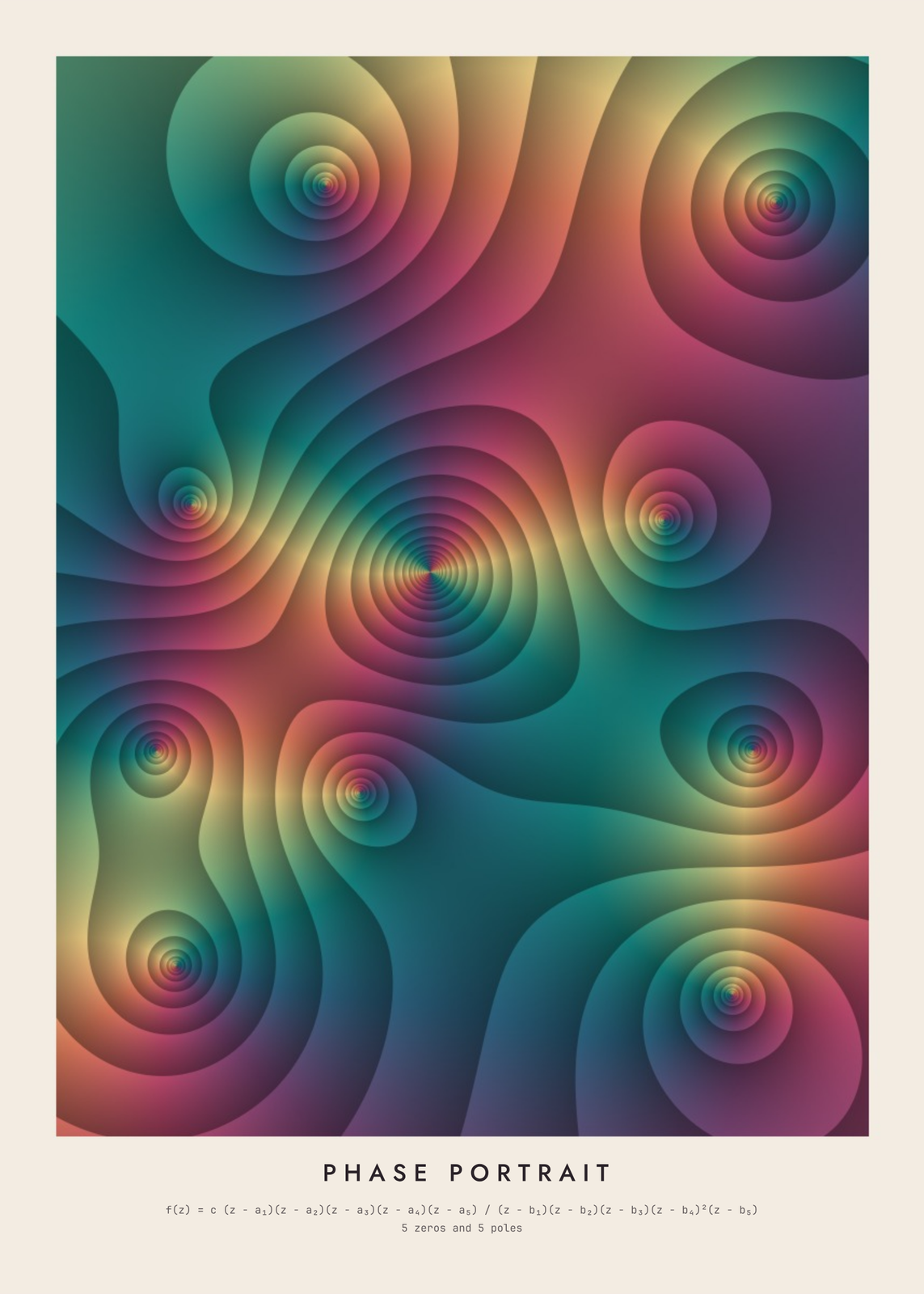 A seeded phase portraitEdit this →
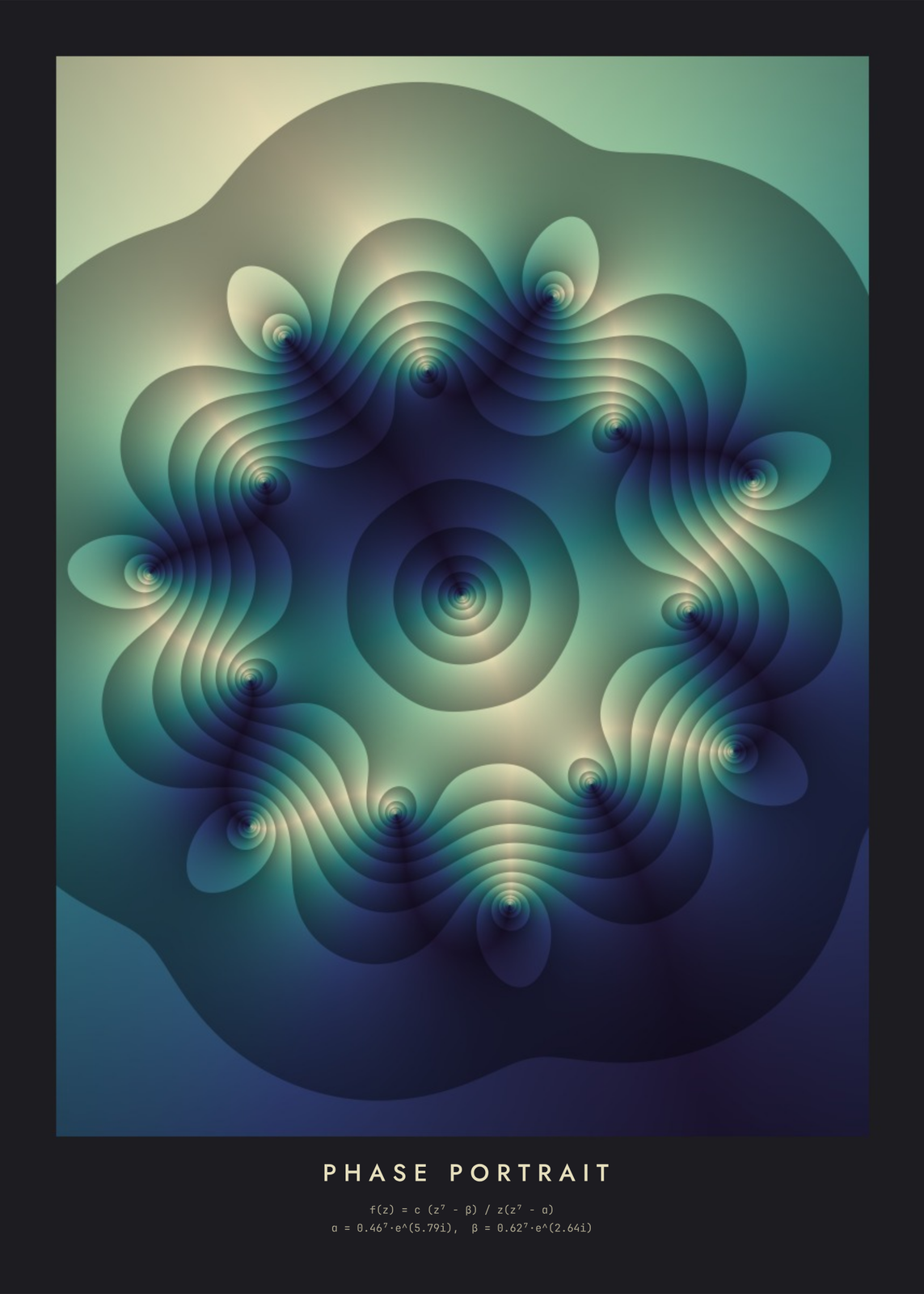 A rosette at duskEdit this →
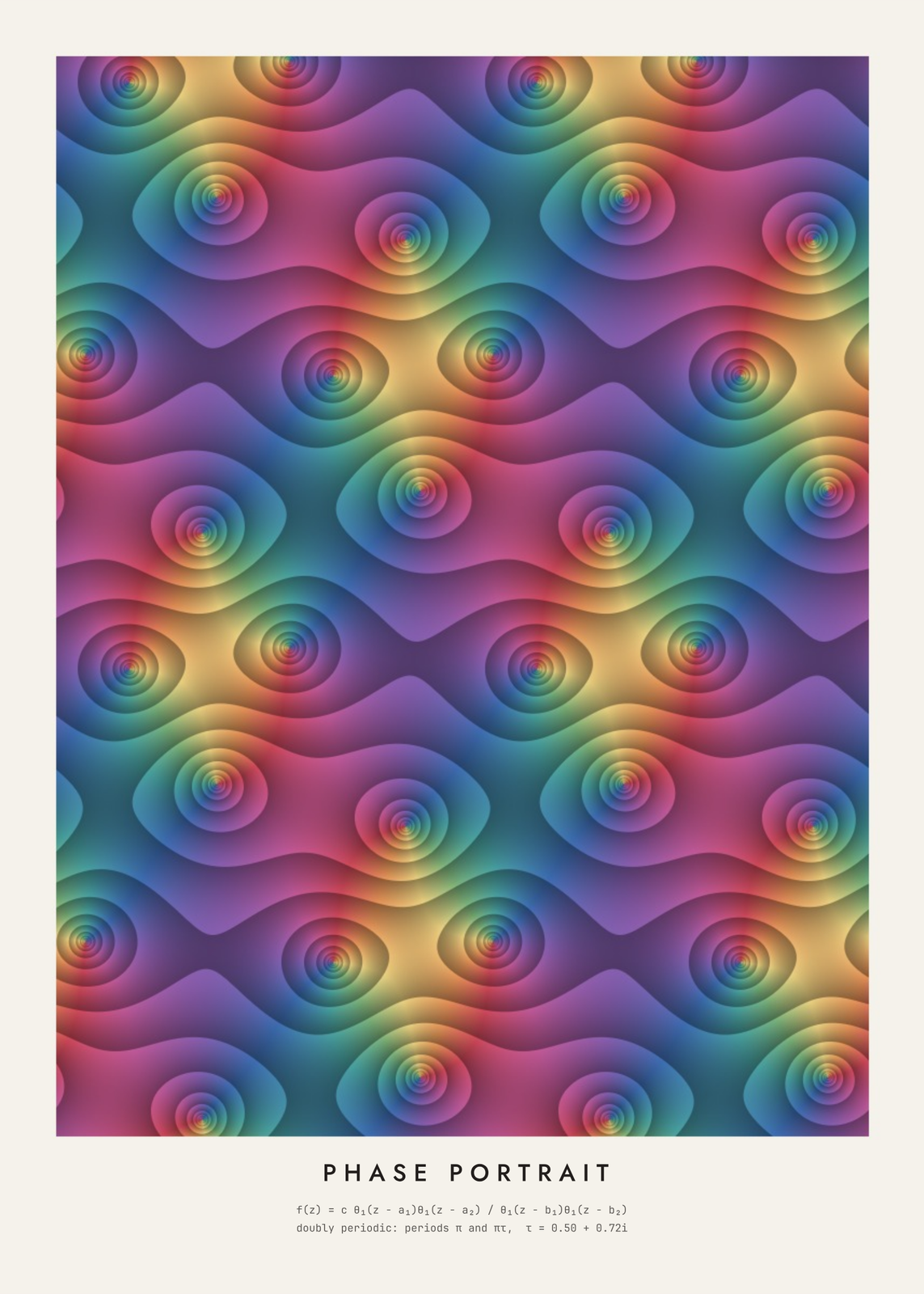 An elliptic function's latticeEdit this →
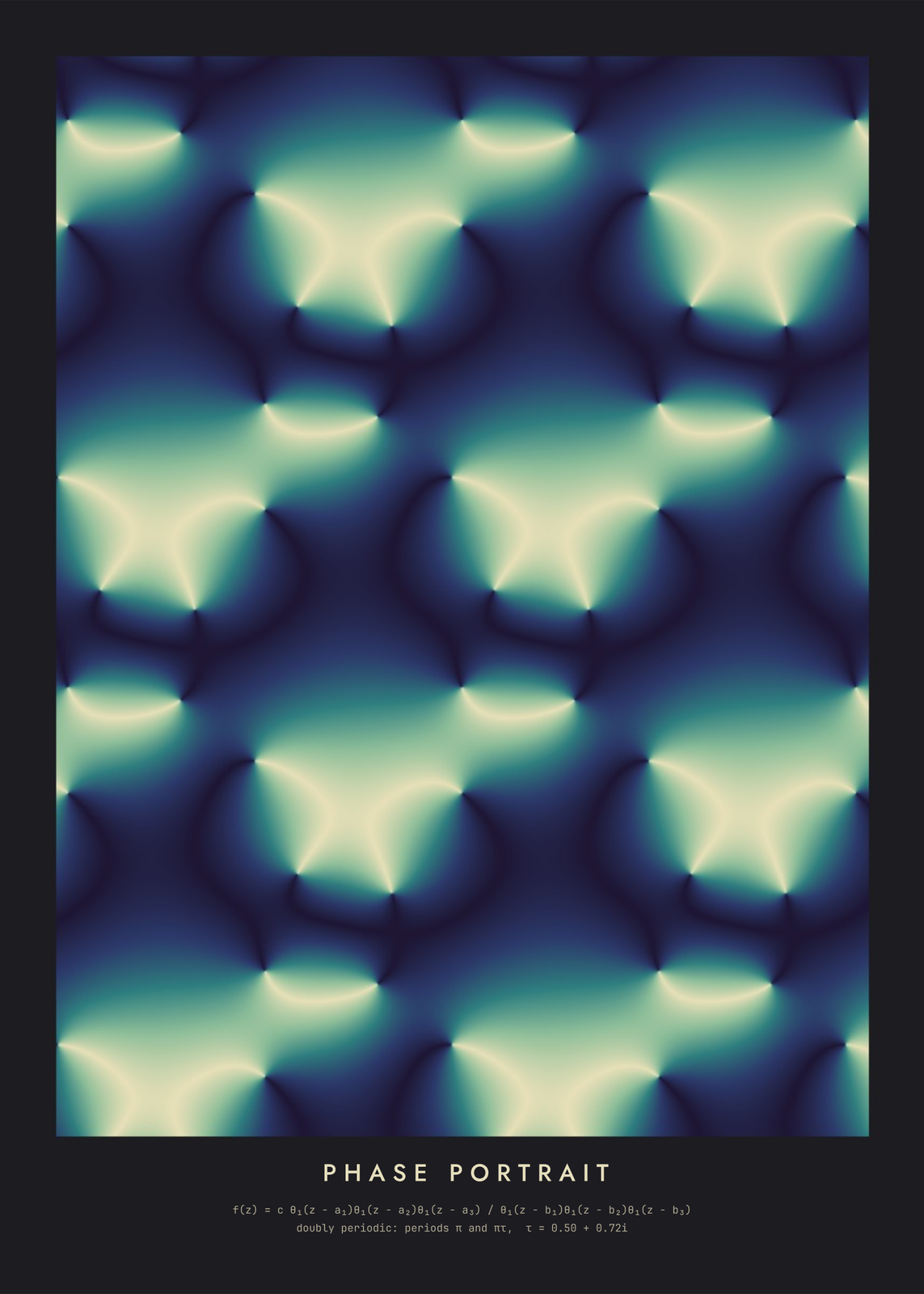 The lattice, phase onlyEdit this →
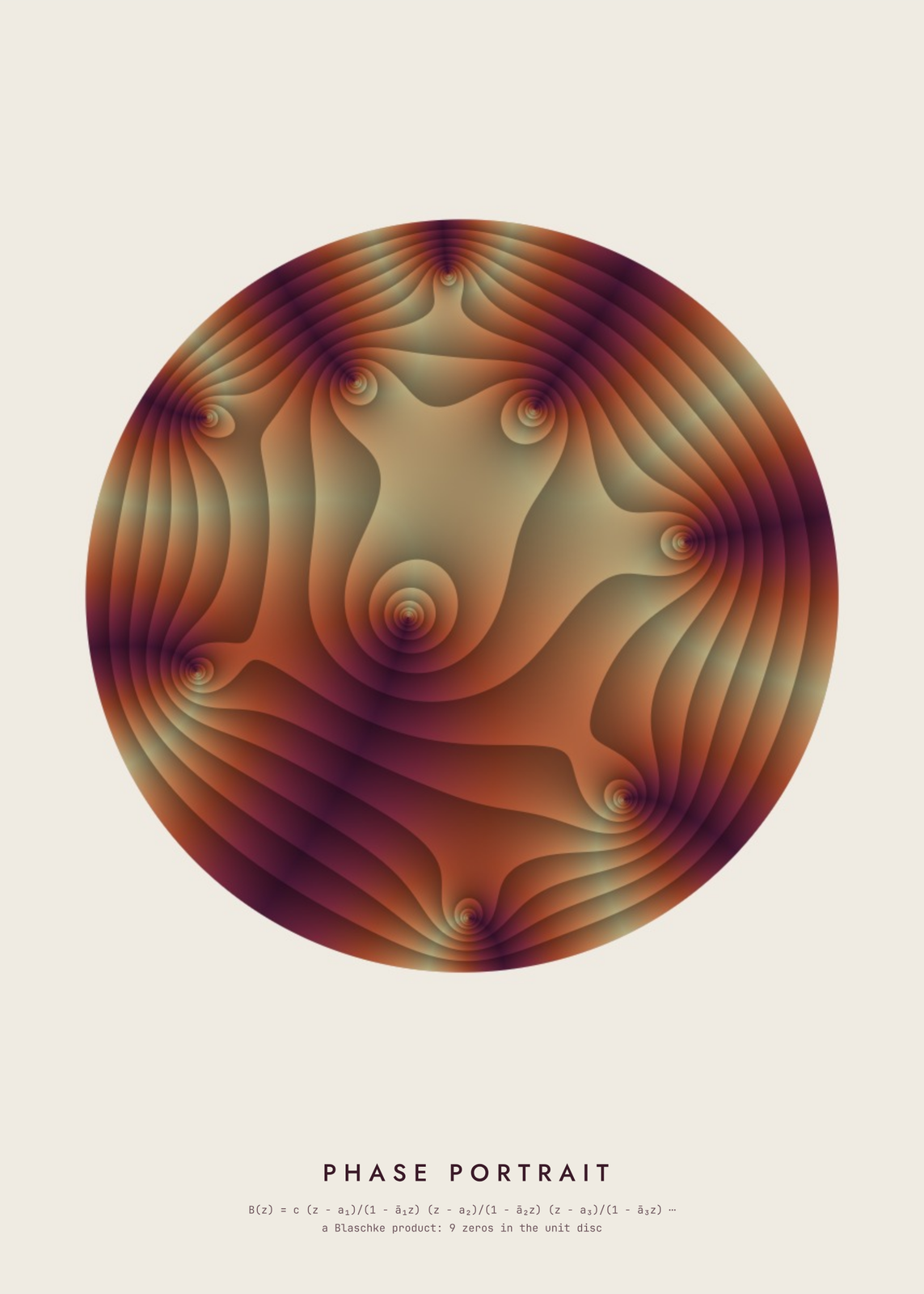 A Blaschke disc in clayEdit this →
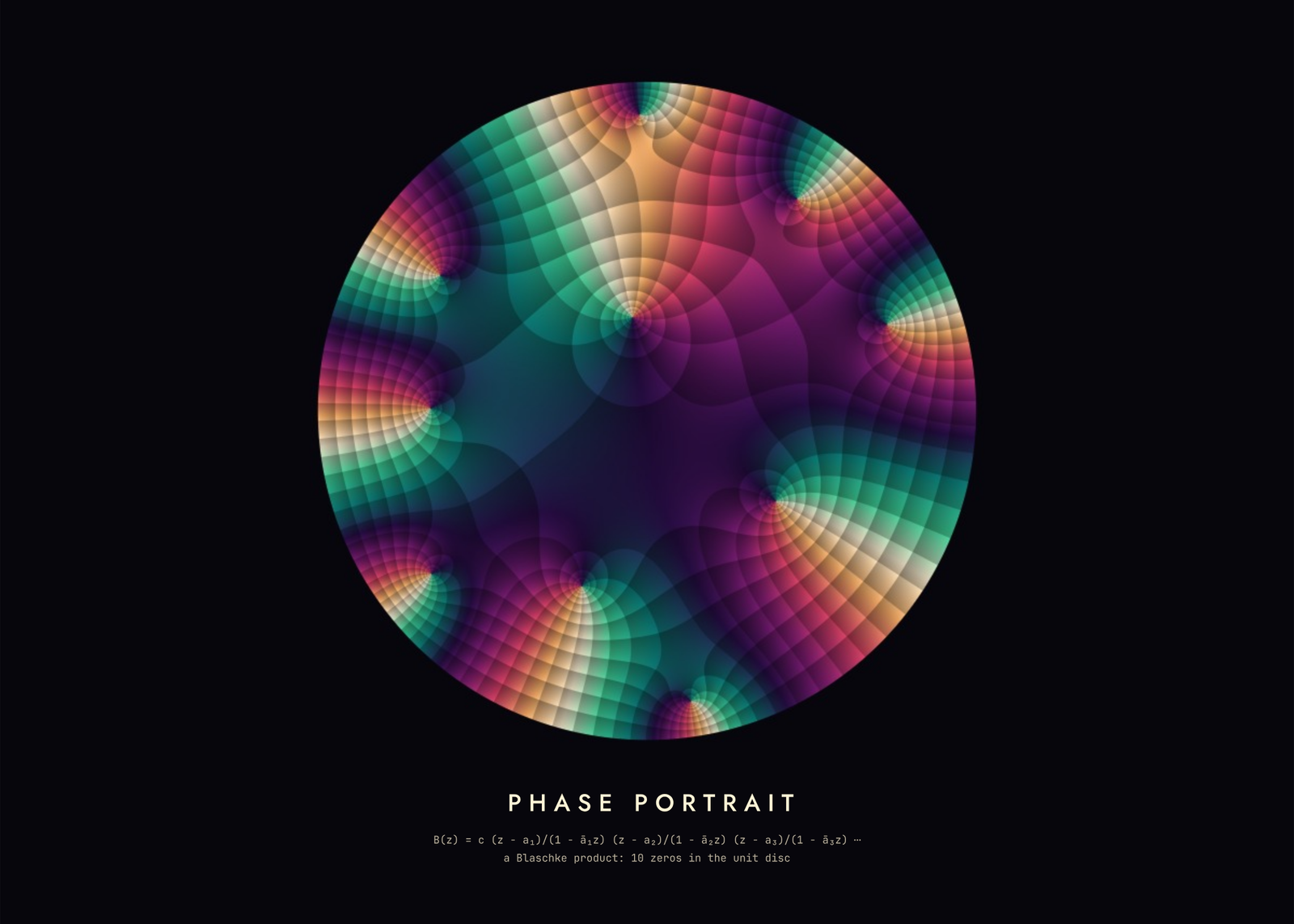 Blaschke disc, tiles at nightEdit this →
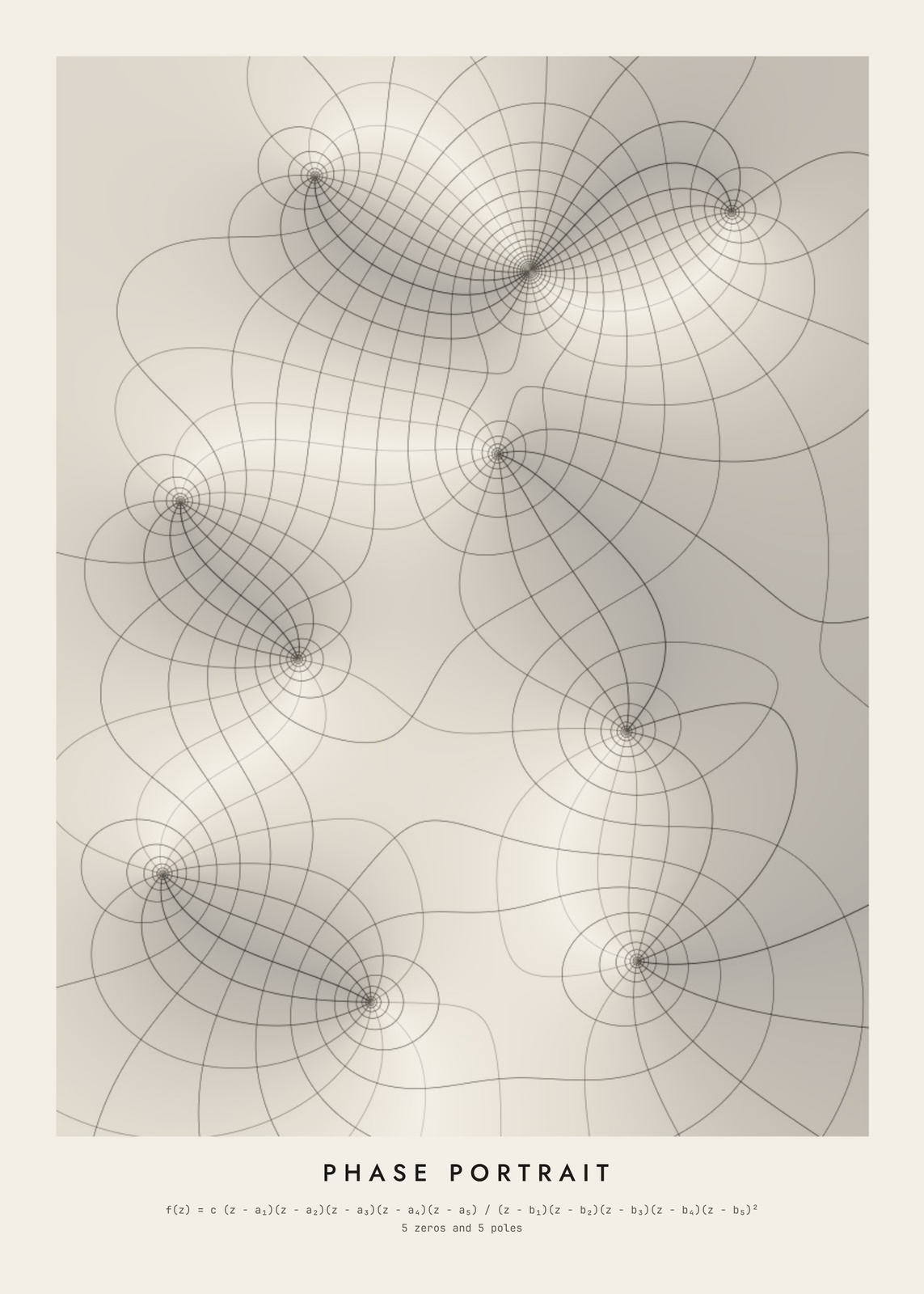 Pen lines in inkEdit this →
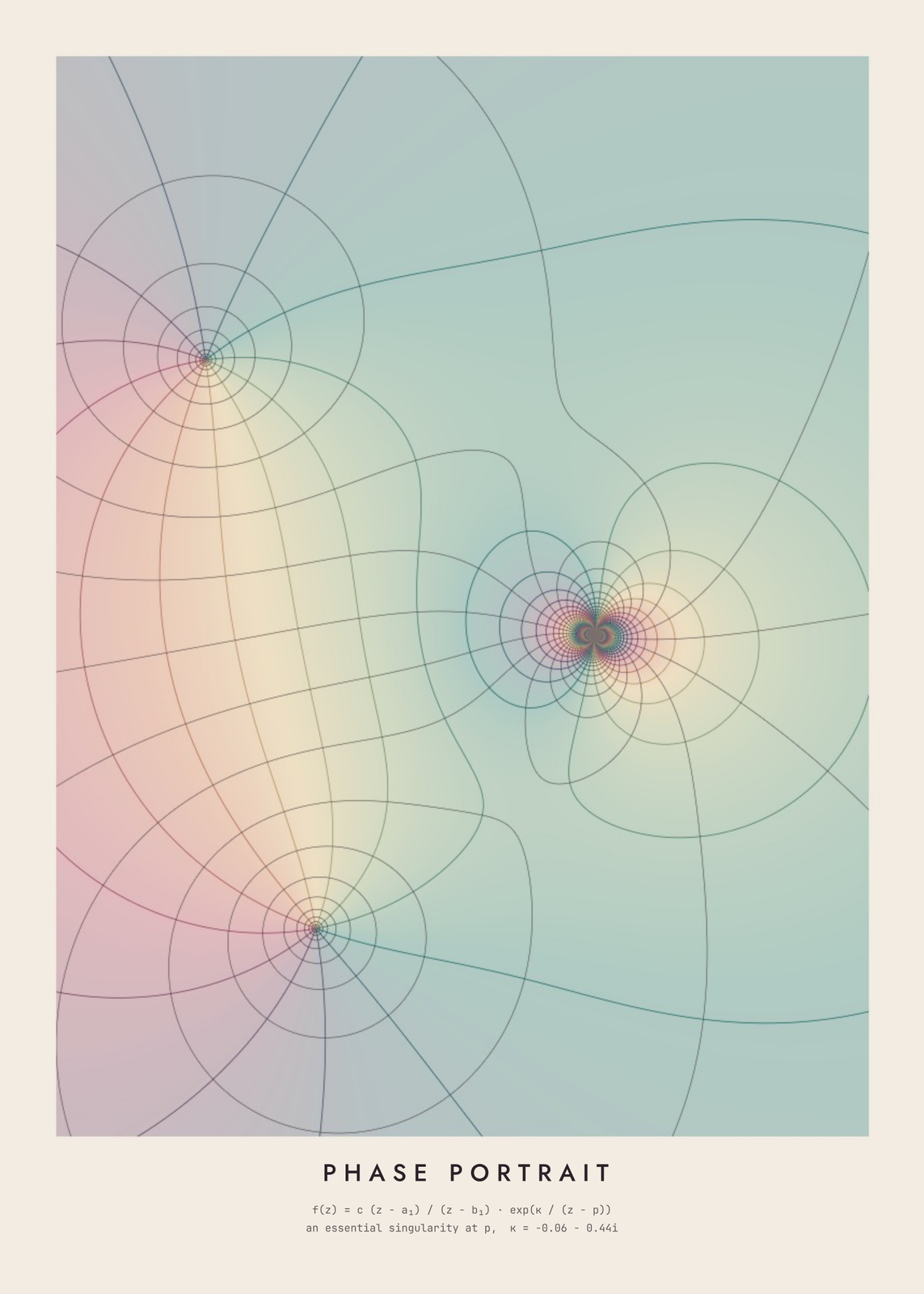 A whirl round an essential singularityEdit this →
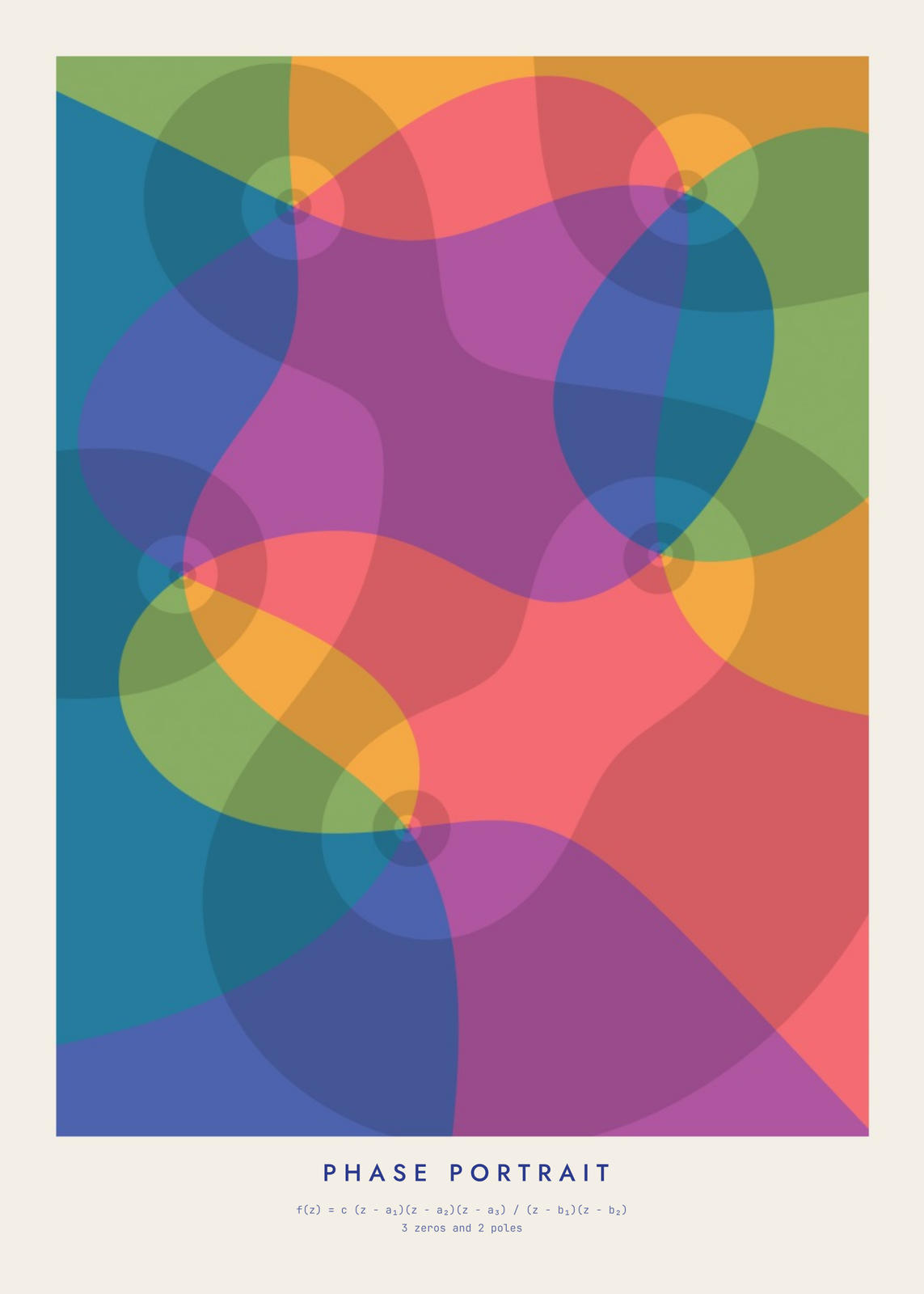 Terraces in risoEdit this →
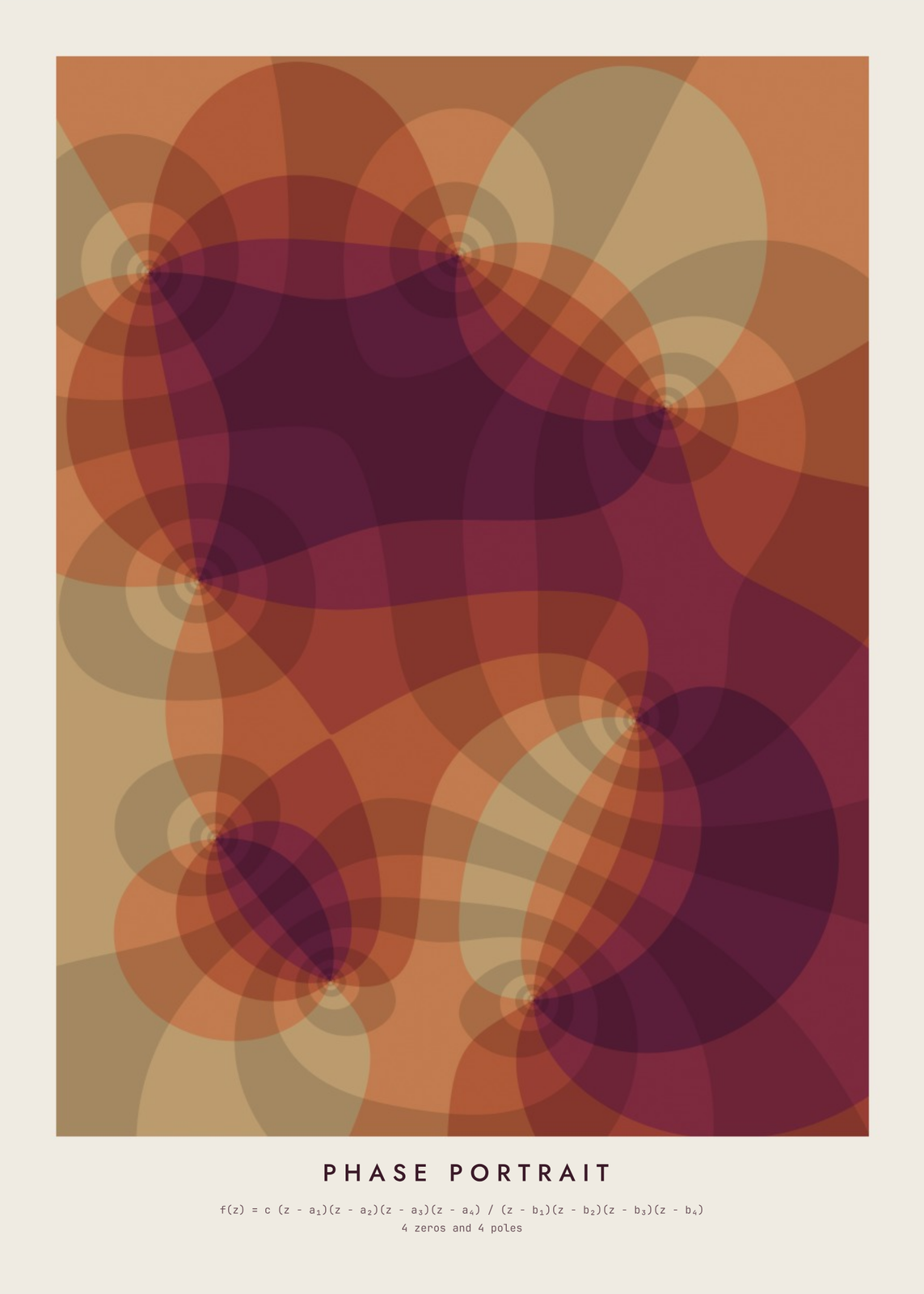 Terraces in clayEdit this →
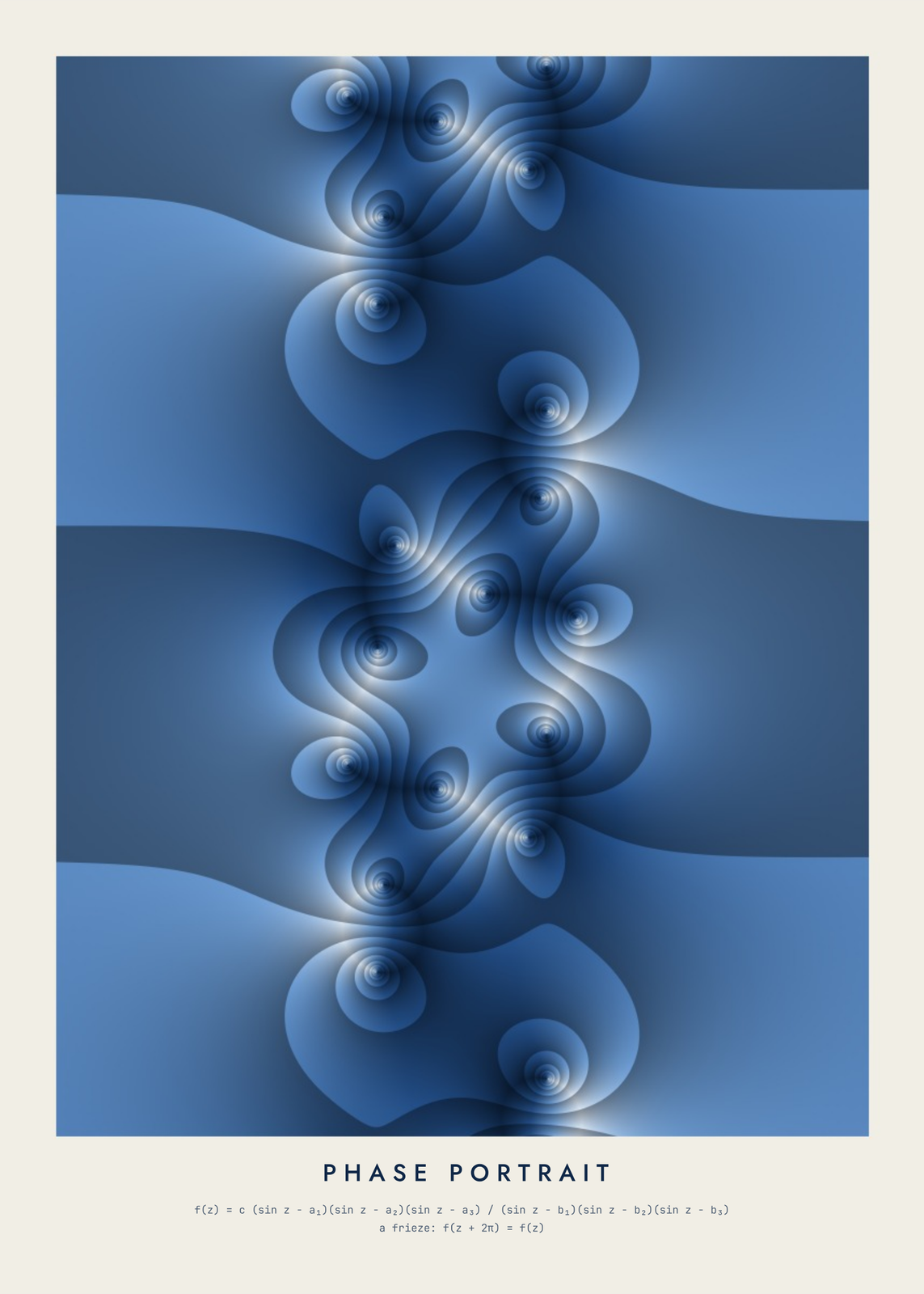 A frieze of sin zEdit this →
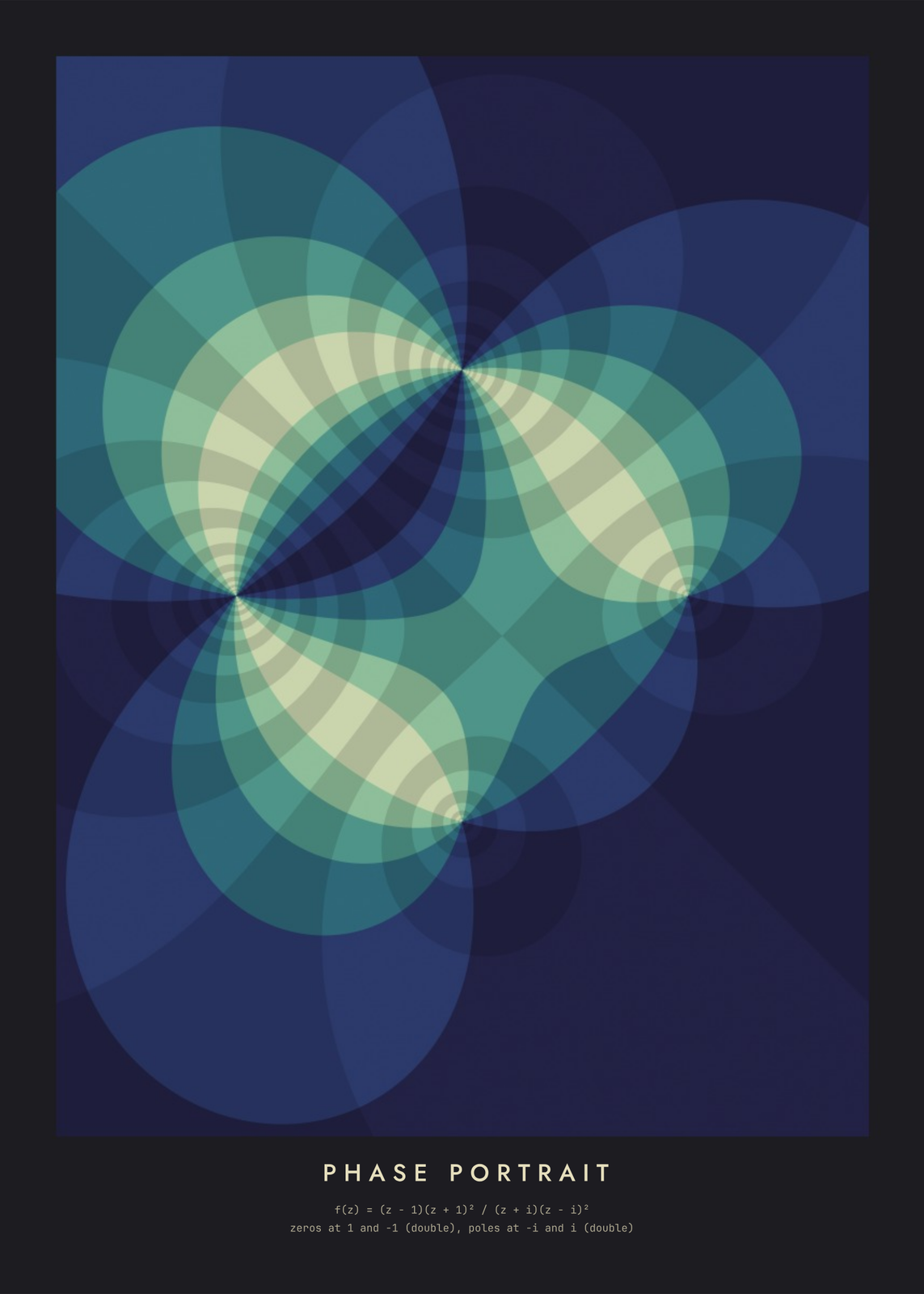 The same, in terraces at duskEdit this →
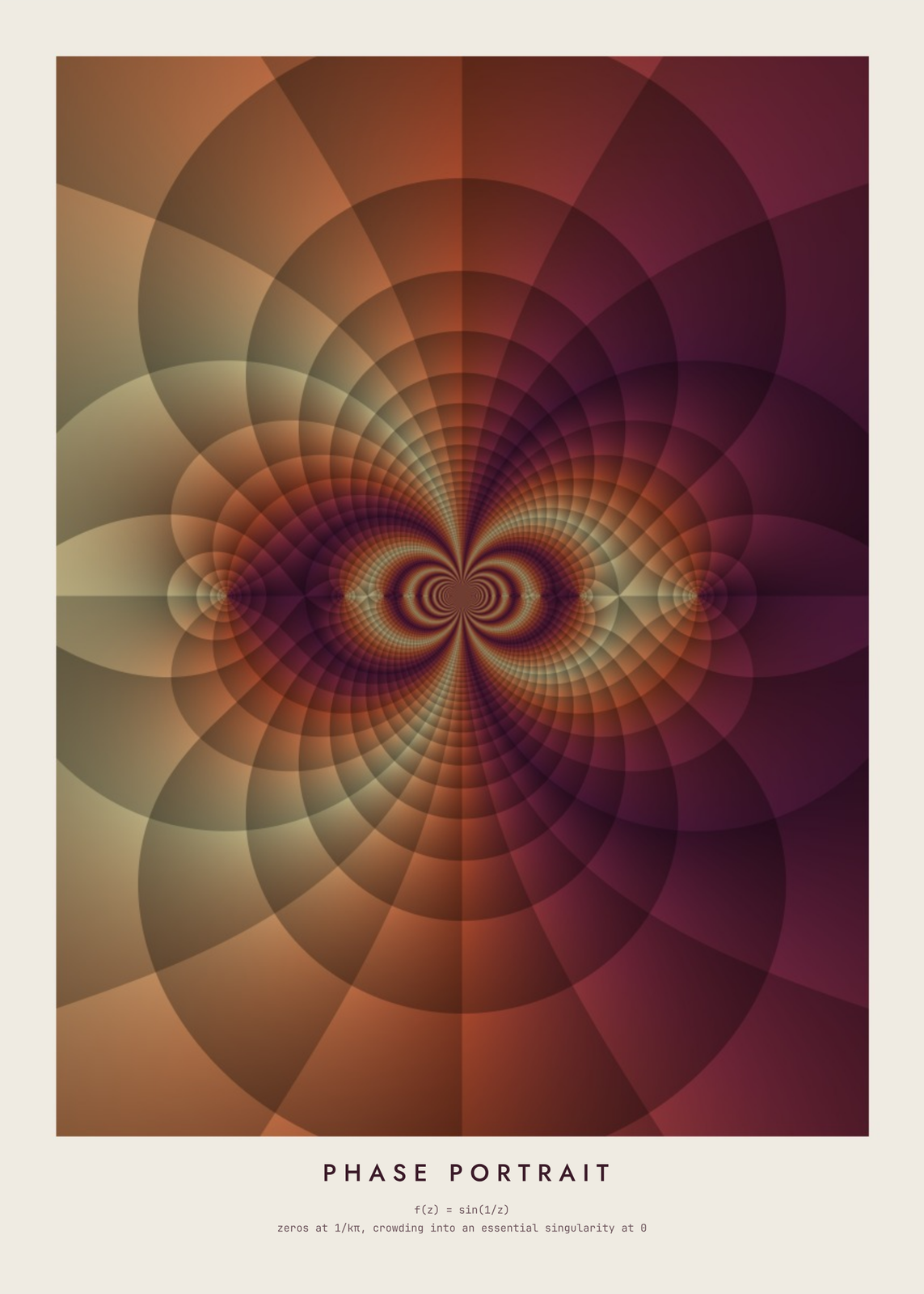 sin(1/z) in tilesEdit this →
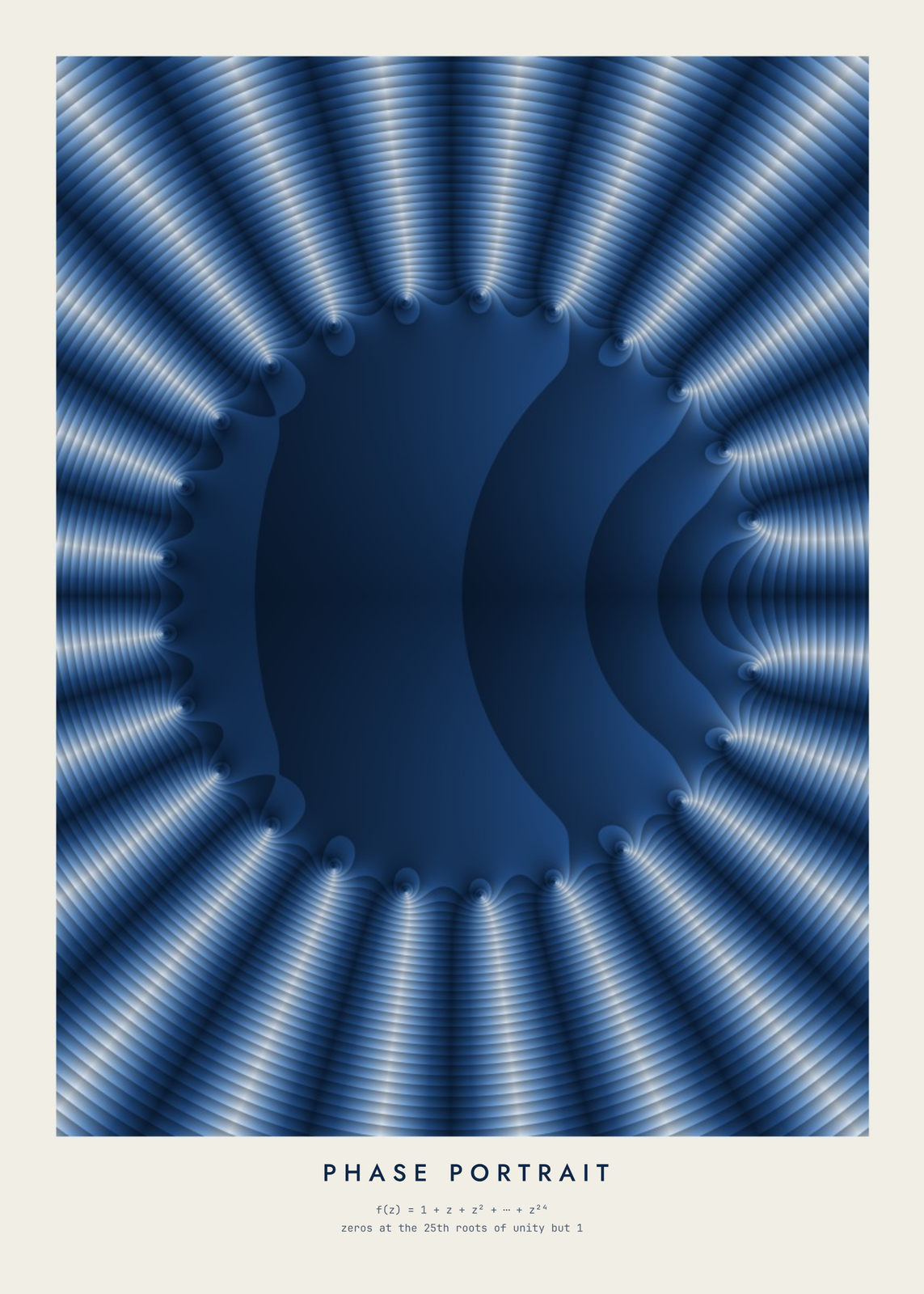 1 + z + ⋯ + z²⁴Edit this →
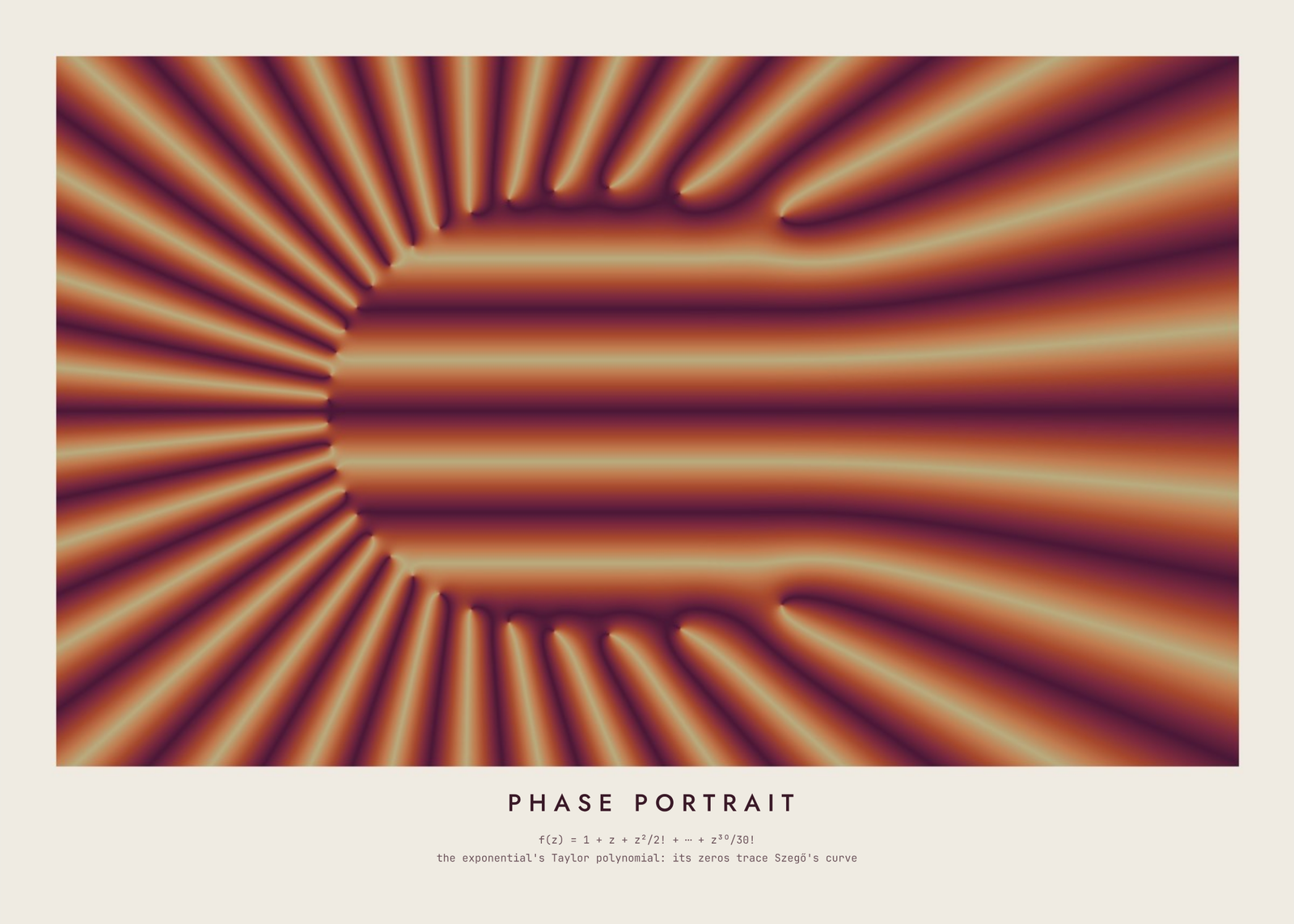 The exponential's Taylor polynomialEdit this →
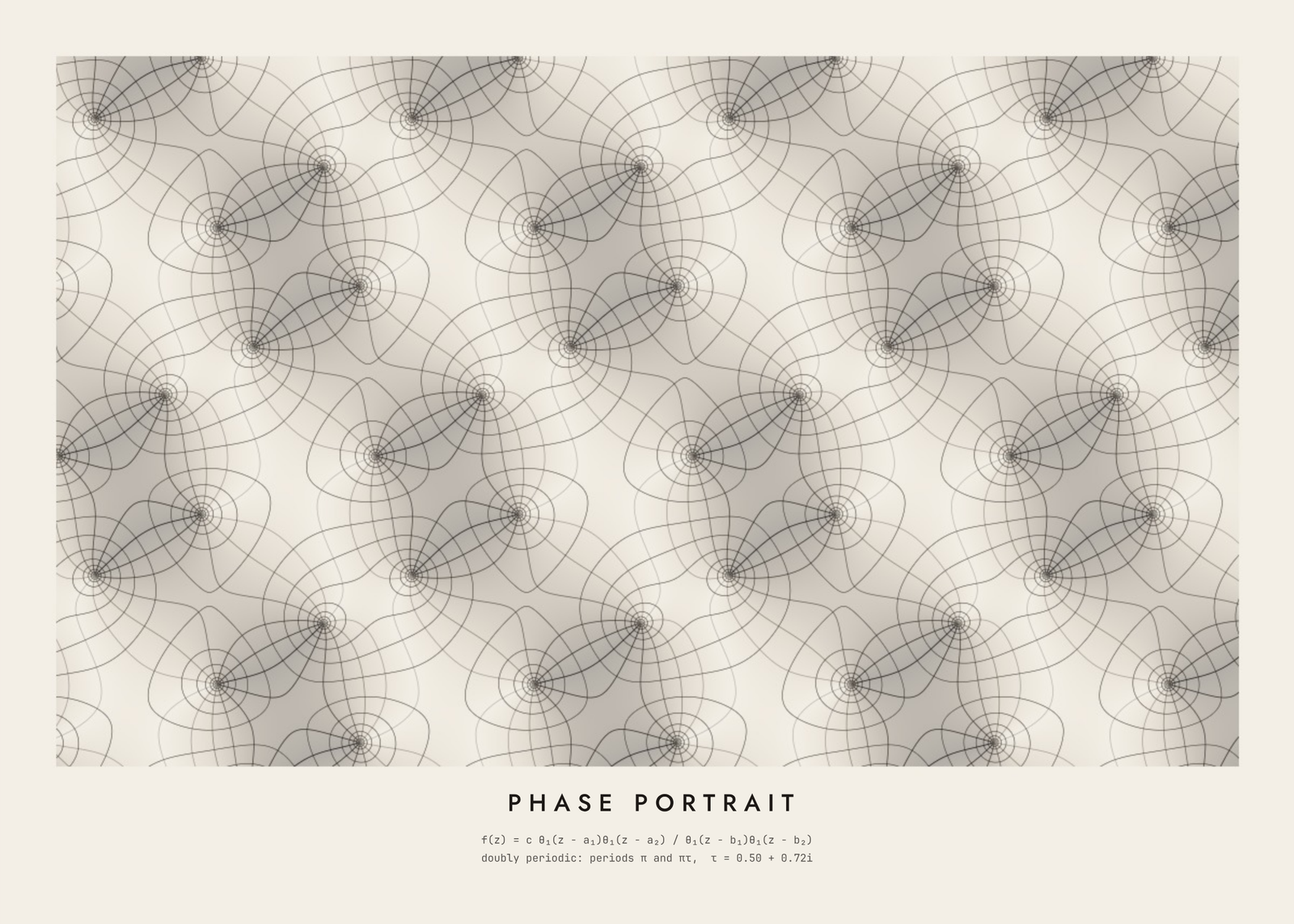 A lattice in pen linesEdit this →
Six fractals and the phase portraits
- The Mandelbrot set: z → z² + c from z = 0, one c per point. Its edge has new detail at every zoom, with copies of the whole set hidden all along it.
- Julia sets: the same map with c held fixed, started from each point. A constant near the Mandelbrot set's rim gives the richest shapes: Douady's rabbit at c = −0.123 + 0.745i, a dendrite at c = −0.8 + 0.156i.
- The Burning Ship: take the absolute values of z's parts before squaring, and the set turns into a fleet of masts and flames.
- The Buddhabrot: instead of coloring each point, it traces where millions of escaping orbits pass, and a seated figure appears.
- Newton fractals: run Newton's method from every point and color it by the root it finds. Where the basins meet, every color chains along the border, drawn as lace, outlines or bright bands.
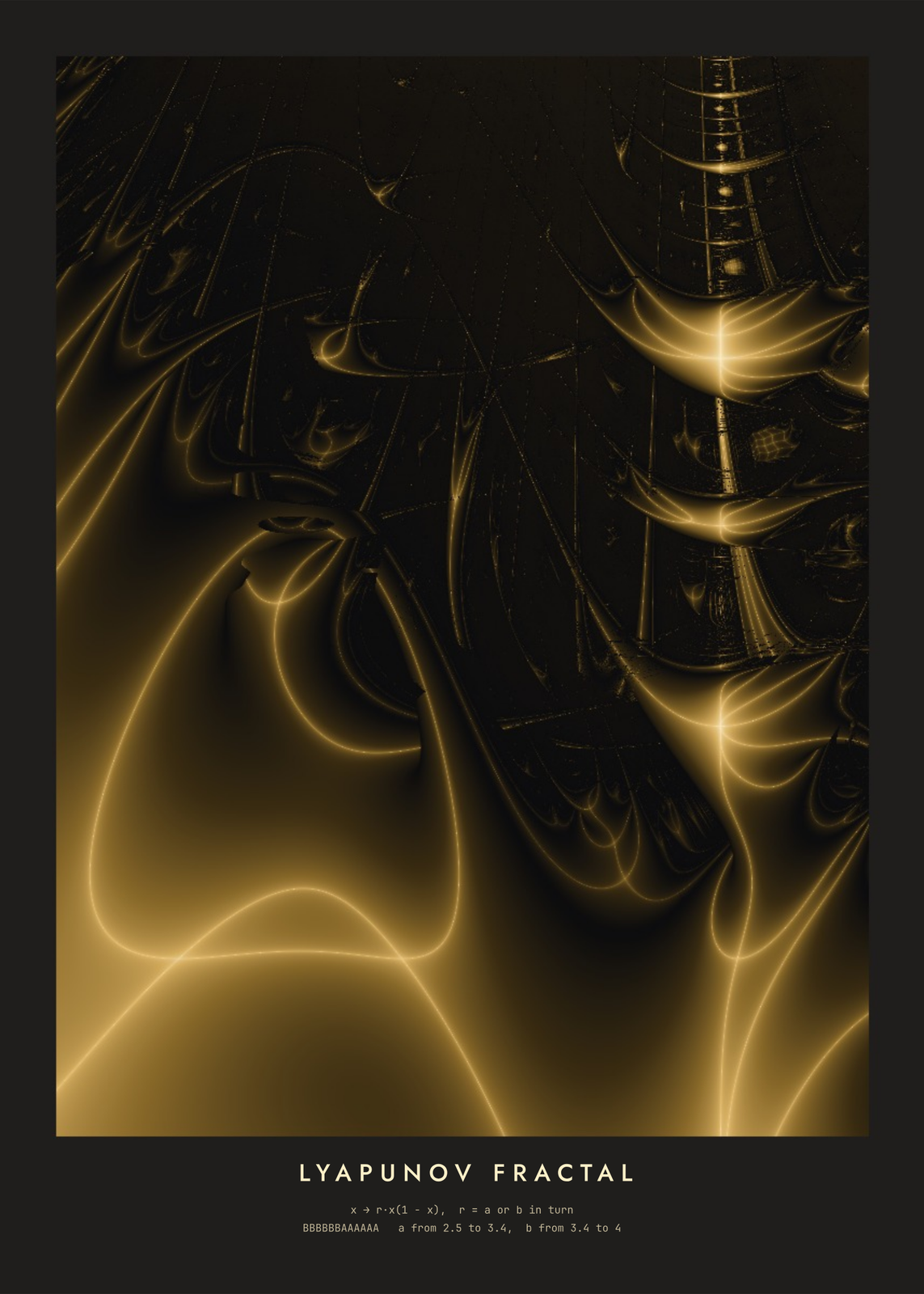
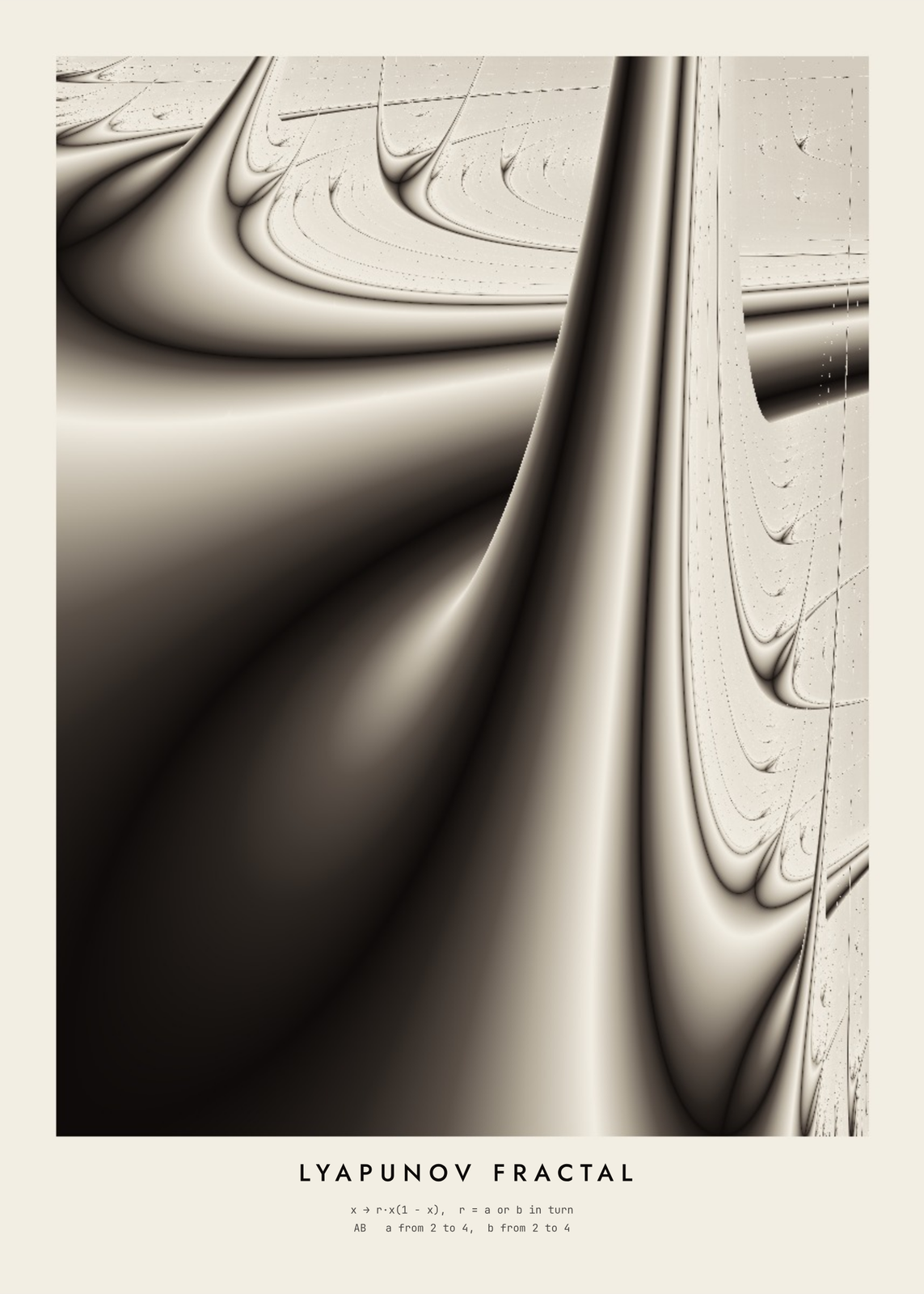
- Lyapunov fractals: the logistic map stepped with two rates, a and b, in a fixed order, colored by how stable it is. Type a name and its vowels and consonants become that order, so the poster is theirs alone.
- Phase portraits: a complex function colored by its argument, so every color meets at a zero or a pole, shaded with contours, tiles, terraces or pen lines. Rosettes, elliptic functions, Blaschke discs, sin(1/z) and the Taylor polynomials of eᶻ.
Smooth color or cut paper
Smooth colors flow along the escape count, from the dark set out through bands of light. Layers stacks one cut-paper sheet for each step of the count, each in a color of its own, falling toward the set in shadow and light. Pick how many sheets and how deep the shadows go.
Finding a view
From the seed, every press of “Surprise me” finds a busy stretch of the edge, a new Julia constant or a new function. By hand, type the center and the zoom, in powers of ten, up to ten billion times closer than the whole set. Seahorse Valley lies near −0.745 + 0.113i, the double spirals near −0.775 + 0.124i.
Turn the view, raise the detail for deep zooms, and print the coordinates under the title so anyone can find the spot again.
Questions
What is the Mandelbrot set?
The complex numbers c for which z → z² + c, started from z = 0, never runs off to infinity. Benoit Mandelbrot's computer pictures made it famous around 1980. Its edge is a fractal: zoom in anywhere and there is more to see.
What's the difference between the Mandelbrot set and a Julia set?
Both use z → z² + c. The Mandelbrot set lets c change from point to point and always starts at z = 0; a Julia set fixes c and starts at each point. Every c has its own Julia set, in one piece exactly when c lies in the Mandelbrot set.
Can I print the coordinates?
Yes. “Coordinates” sets the formula and the view small under the title: the center and the zoom, the constant c for a Julia set, or a phase portrait's zeros and poles. Turn it off for the picture alone.
What sizes can I print?
US Letter, 8 × 10, 11 × 14, 12 × 16 and 12 × 18 in, A4 and A3, free. You download a 300 DPI JPEG drawn at the size you pick. Larger prints, up to 24 × 36 in, are coming soon.
Related
Gift ideas by occasion
Every example is made with the Posterage generators. Change anything, then download it as a 300 DPI JPEG.