Space art planets, galaxies and moons, from atlas plates to retro travel posters
Space art takes in everything past the sky: ringed planets, spiral galaxies, the Moon, eclipses, the stars overhead and the astronauts who went up to look. Solar System draws the planets fifteen ways, from an engraved atlas plate to a retro travel poster; Galaxy winds a spiral out of thousands of paper pieces; Star Map charts the stars over a place on a night you choose; Space Age Paperback makes up a 1970s science-fiction cover. Pick the colors, add a title if you like, and download it ready to print.
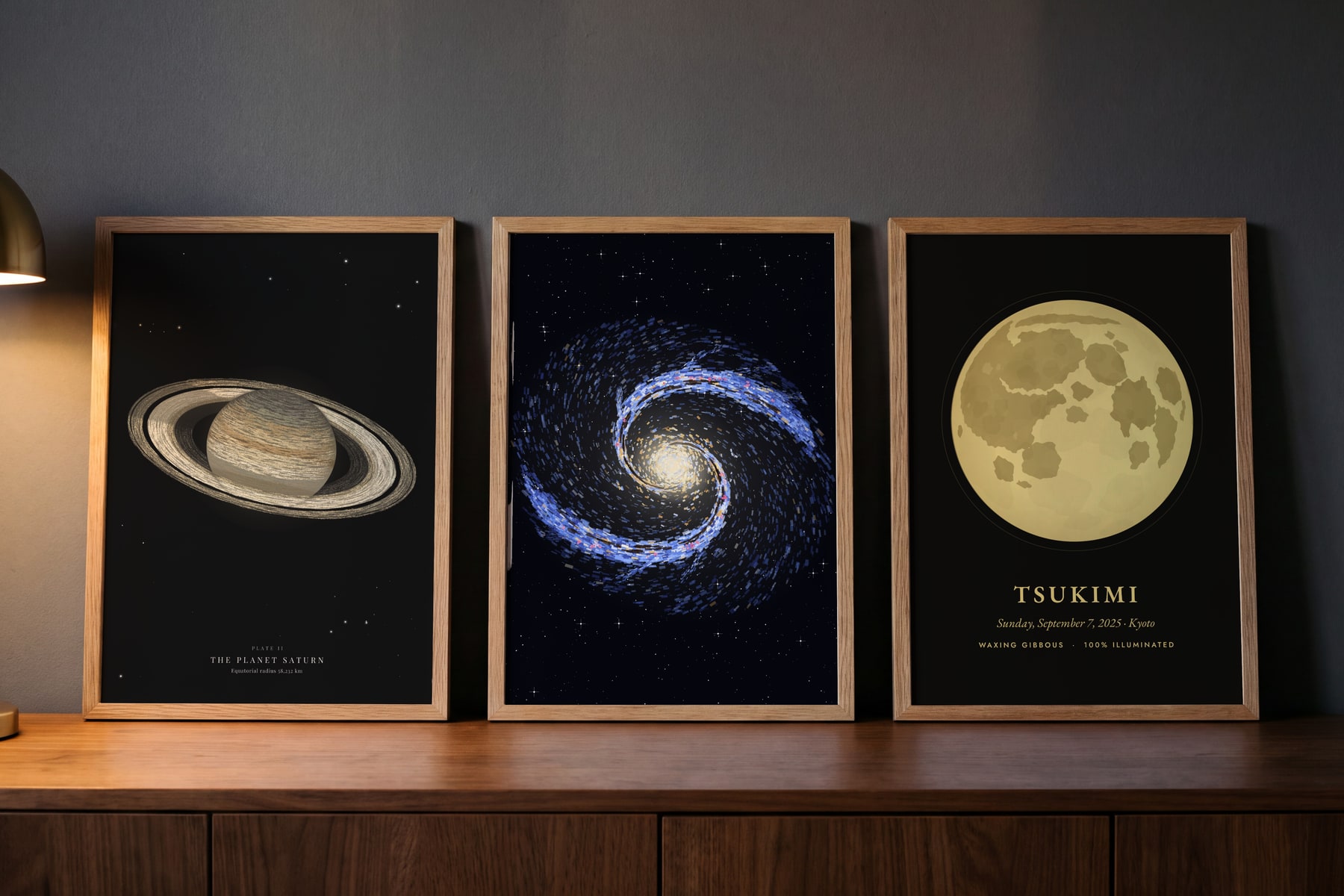
On the wall
A few of them framed at home. Open any one to make it yours.
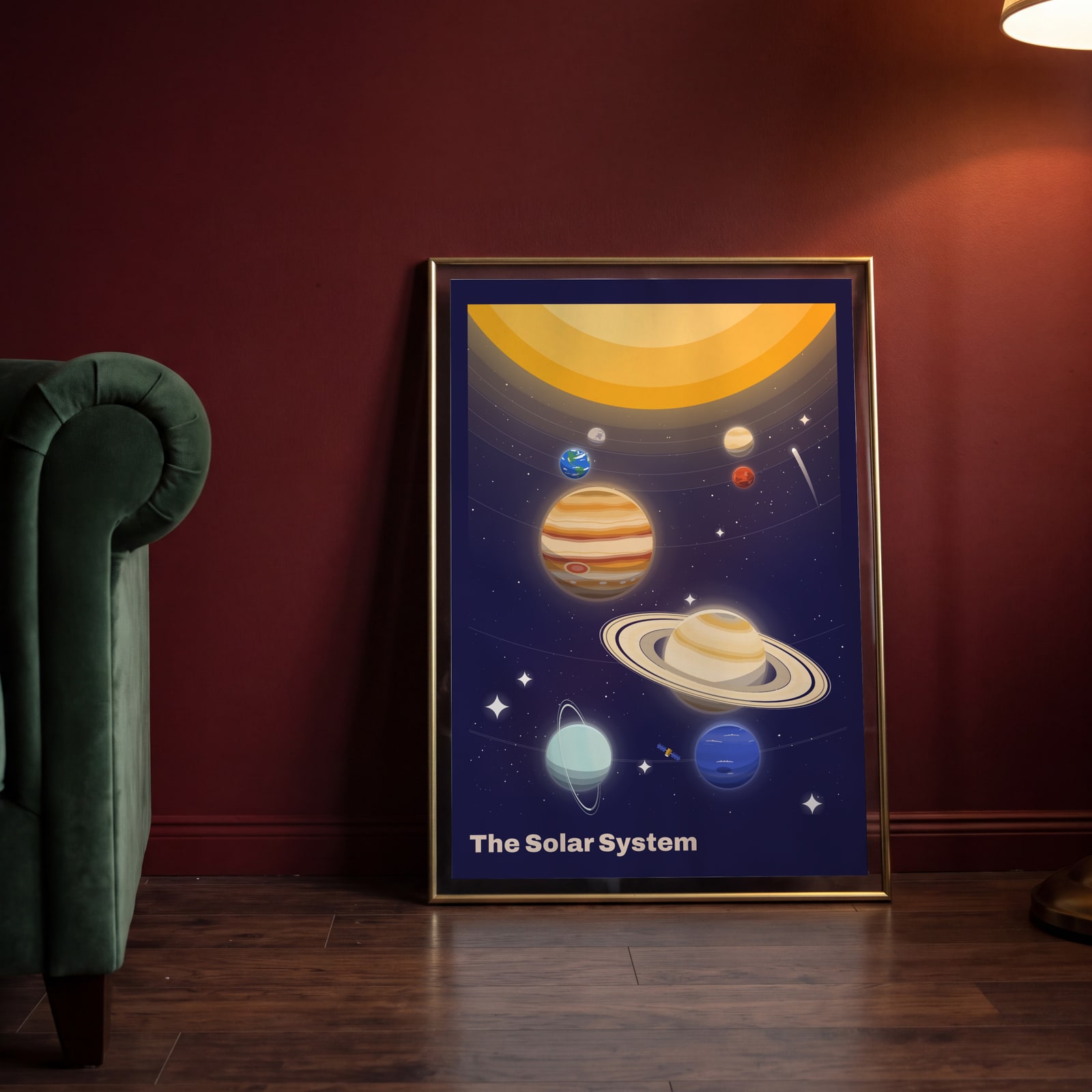 Planet poster of the eight planets falling in a curve from a big yellow Sun, flat and glowing on a starry navy sky, titled The Solar SystemEdit this →
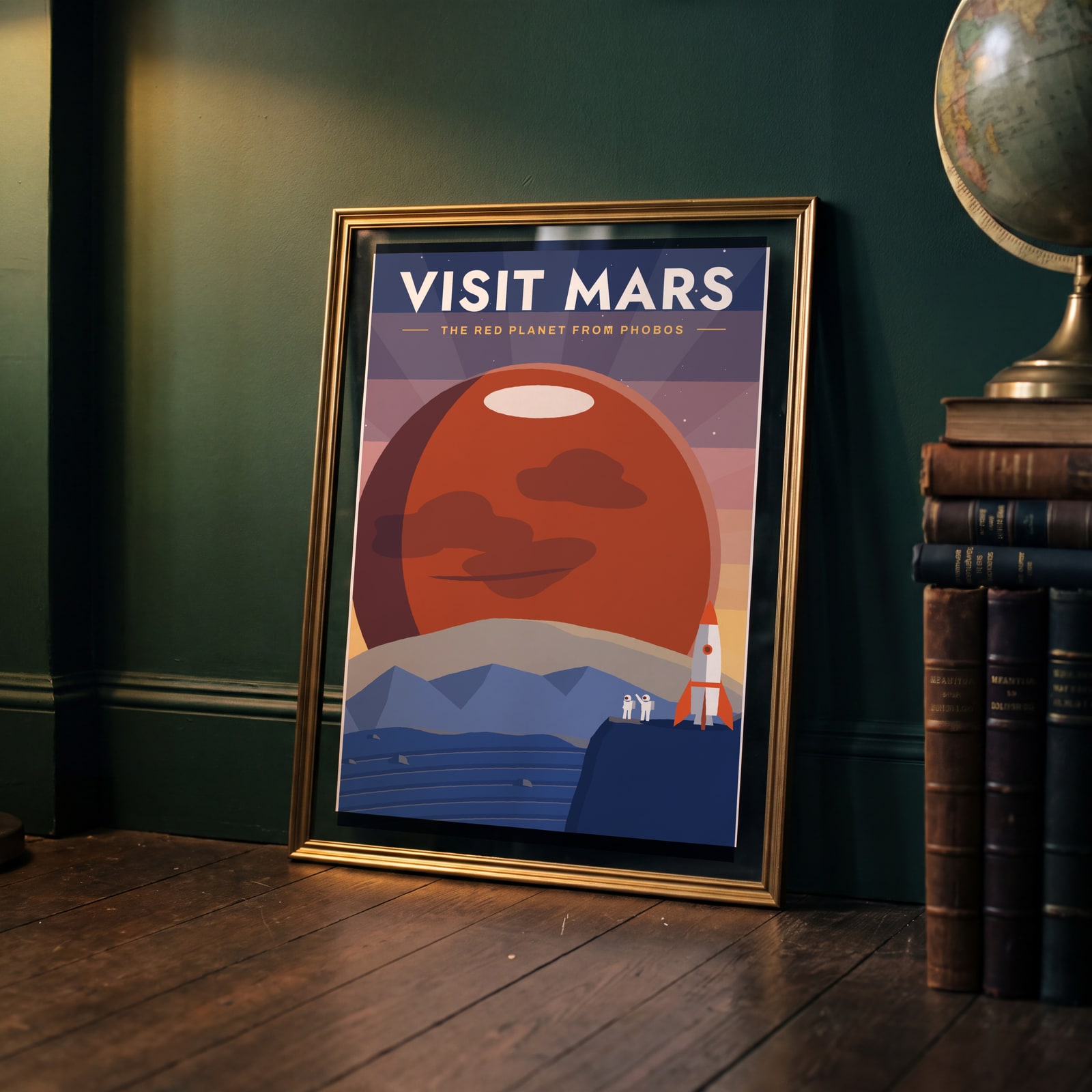 Retro space travel poster: a huge red Mars over the blue hills of Phobos, a white rocket and two tiny travelers on a cliff, headlined Visit MarsEdit this →
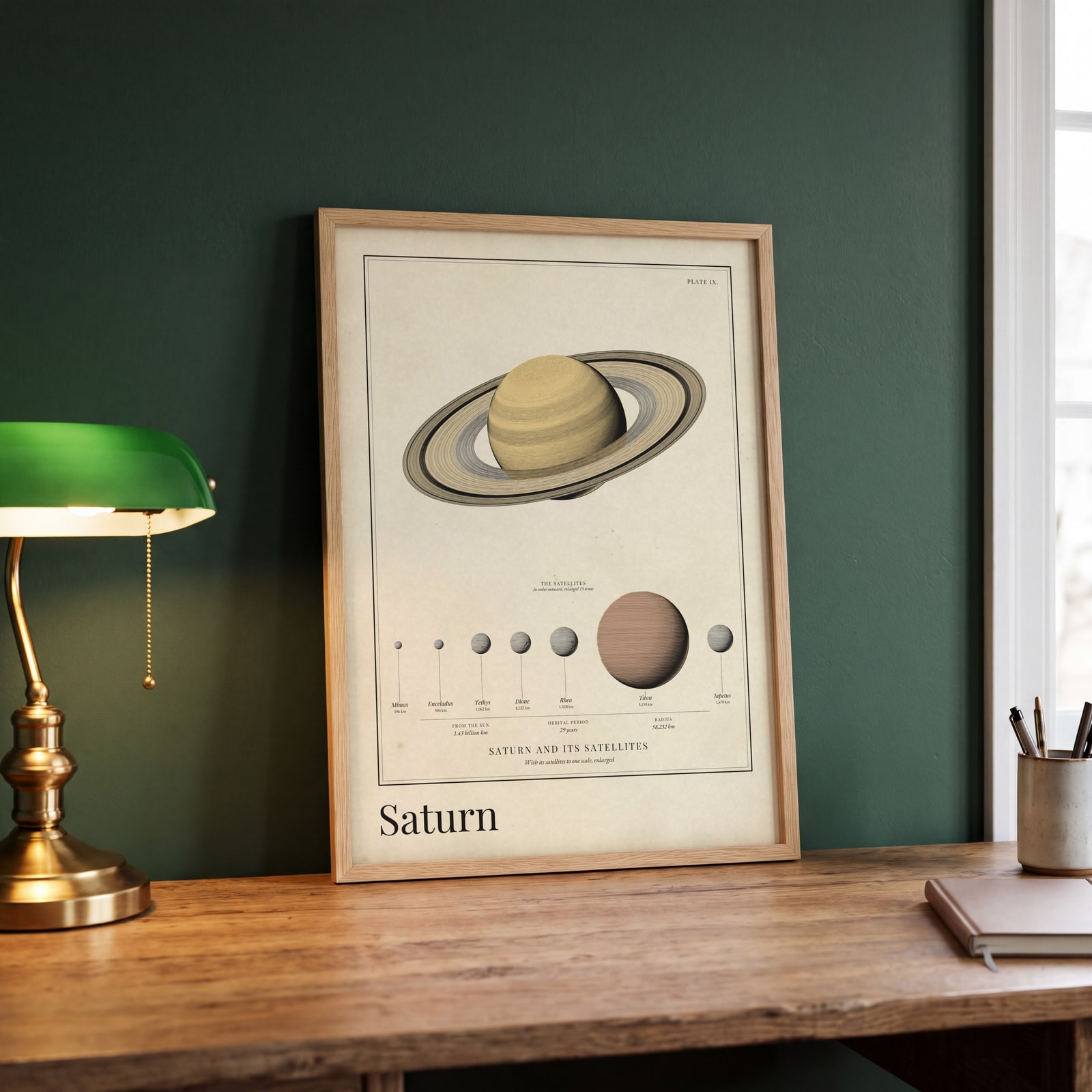 Antique astronomy plate of Saturn: the ringed planet engraved and hand colored over a row of its moons by size, on aged cream paperEdit this →
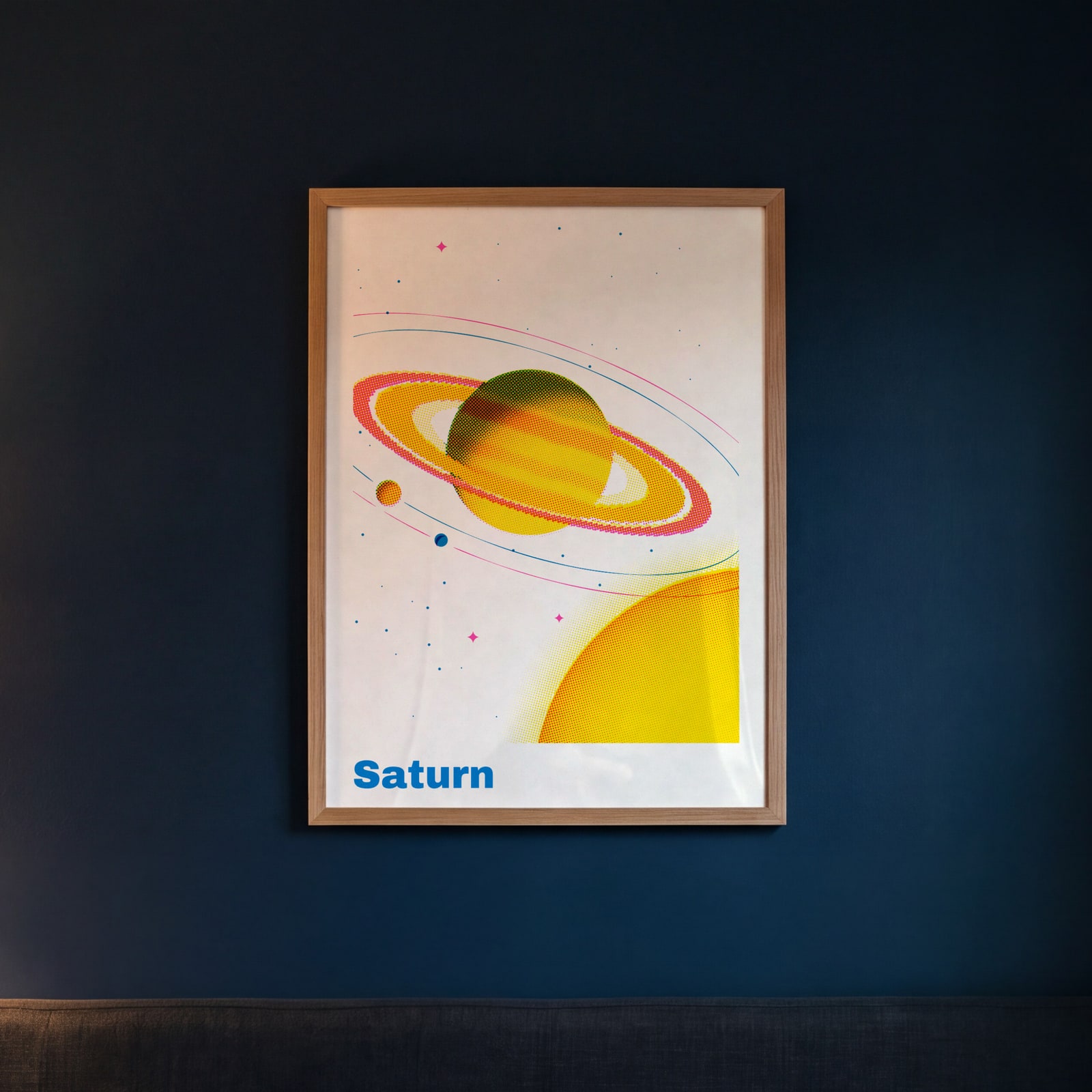 Riso print of Saturn in yellow and pink halftone dots with its rings tilted across, a big yellow Sun in the corner and small planets around, titled Saturn in blueEdit this →
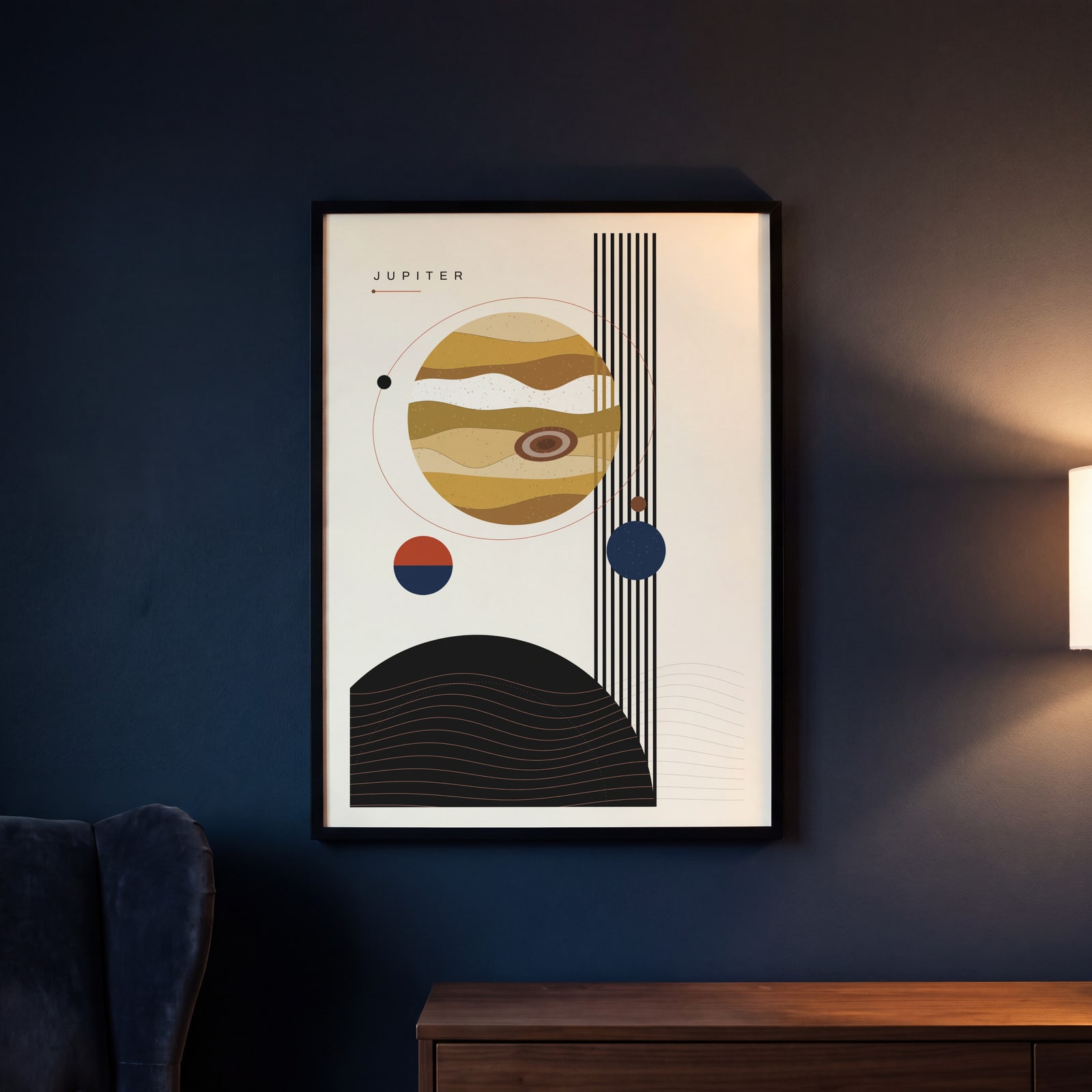 Mid-century print of Jupiter with its belts and red spot beside a block of tall black bars, small moons on thin orbits and a dark striped world rising below, on creamEdit this →
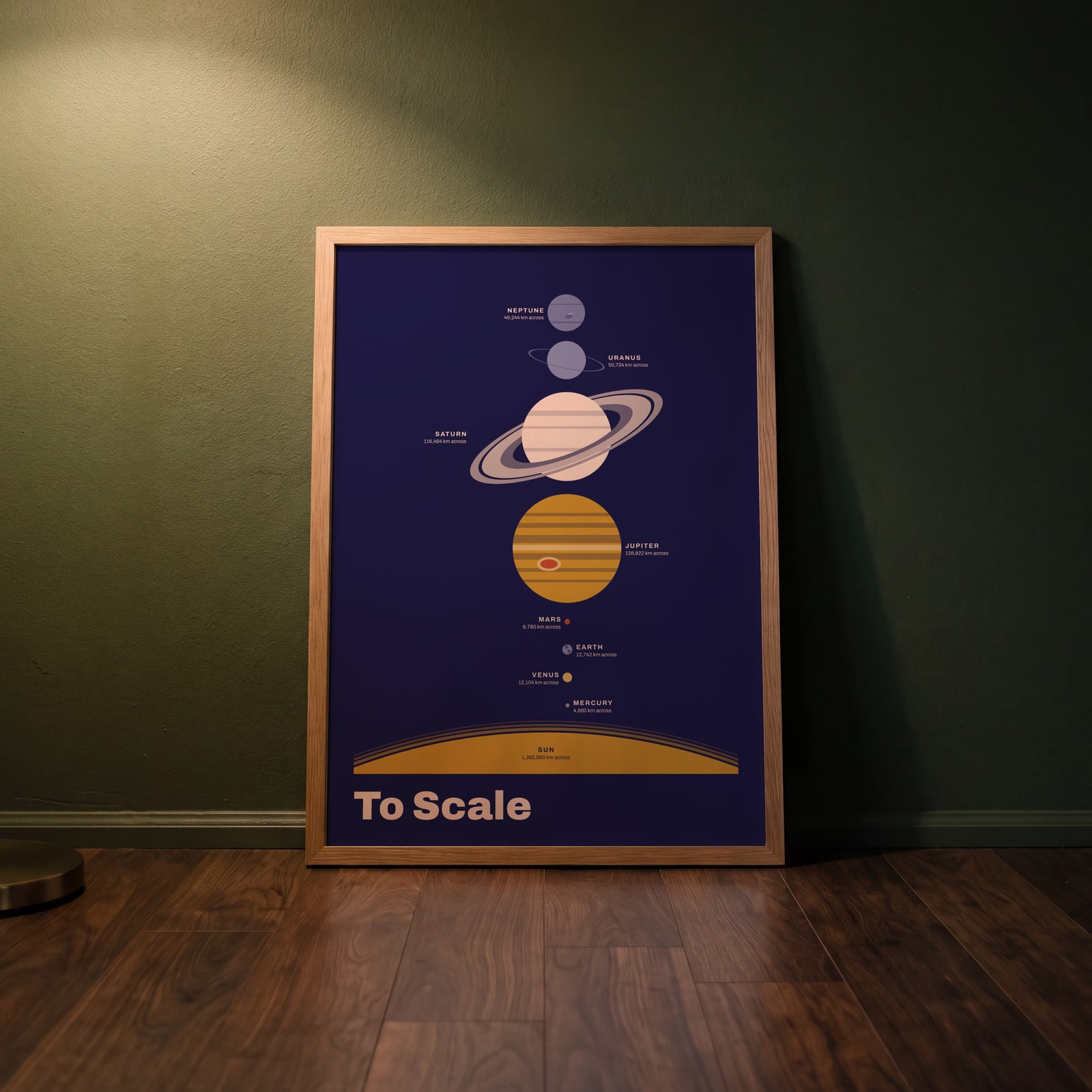 The planets to scale on navy: Neptune and Uranus down to Mercury stacked over the Sun's orange rim, Saturn and Jupiter the biggest, each named with its size, titled To ScaleEdit this →
Examples
Open any of them to change the words, the place, the date and the style, then download the print file.
Planets, from atlas plates to travel posters
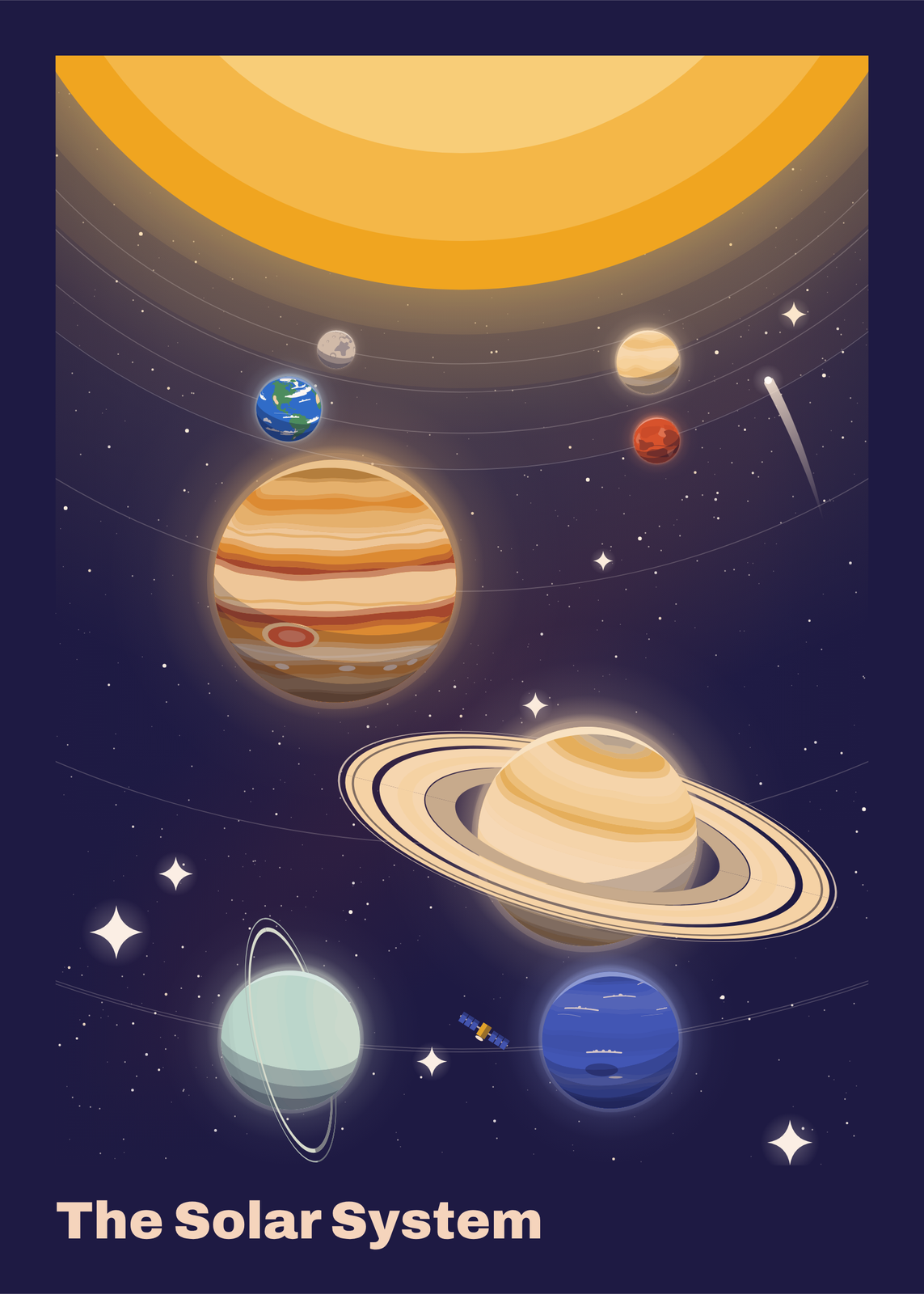 Planet poster of the eight planets falling in a curve from a big yellow Sun, flat and glowing on a starry navy sky, titled The Solar SystemEdit this →More solar system posters →
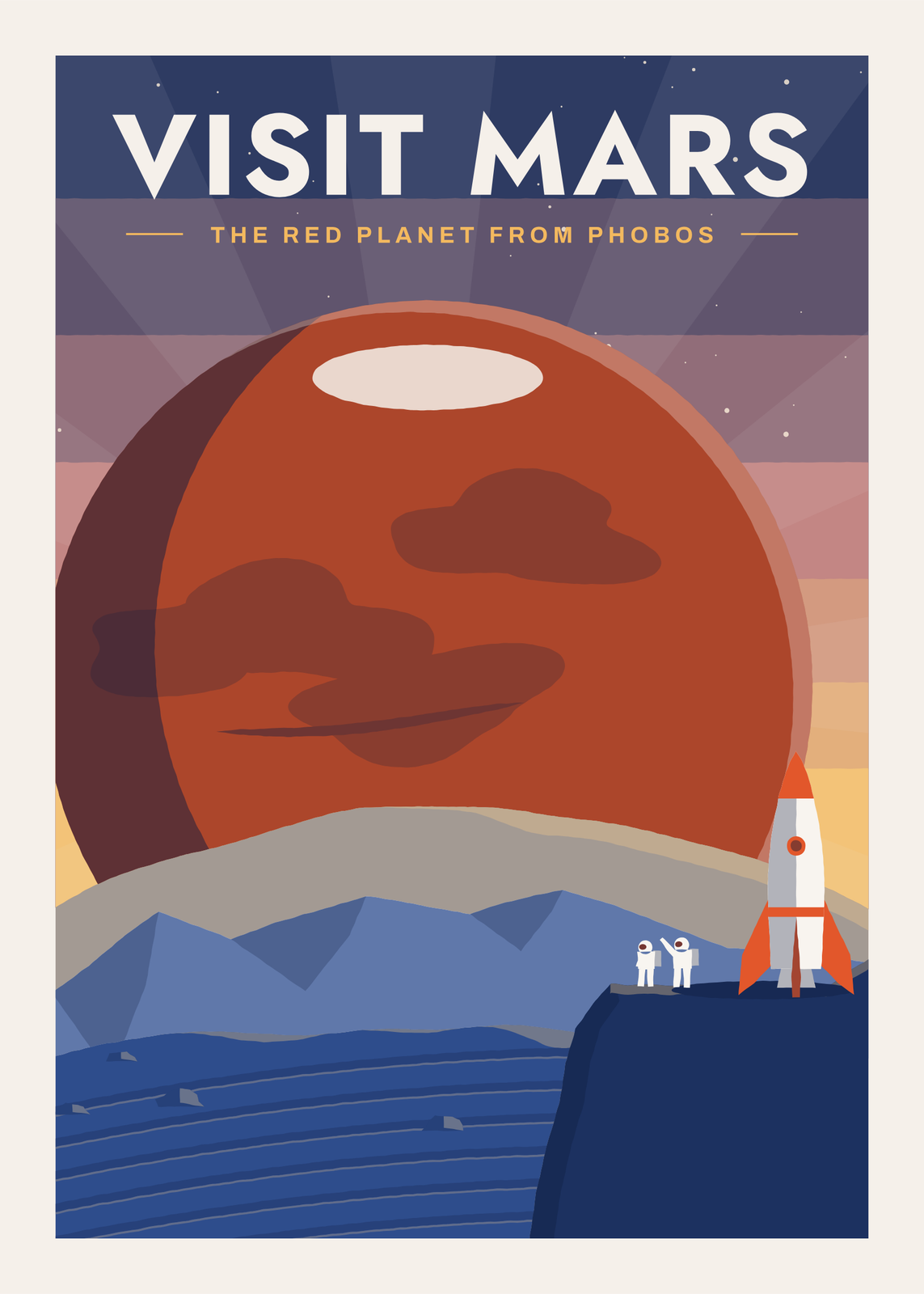 Retro space travel poster: a huge red Mars over the blue hills of Phobos, a white rocket and two tiny travelers on a cliff, headlined Visit MarsEdit this →More solar system posters →
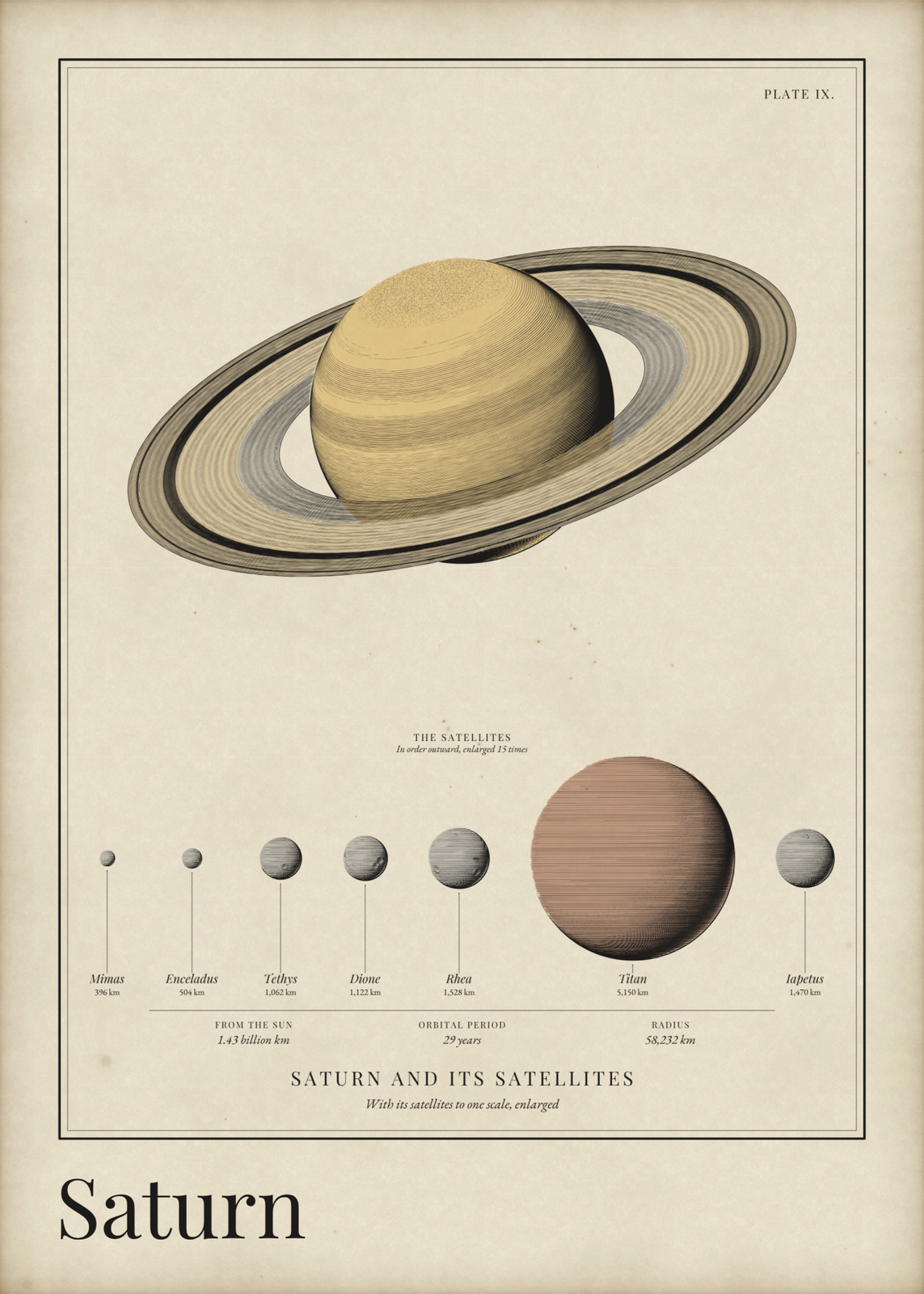 Antique astronomy plate of Saturn: the ringed planet engraved and hand colored over a row of its moons by size, on aged cream paperEdit this →More solar system posters →
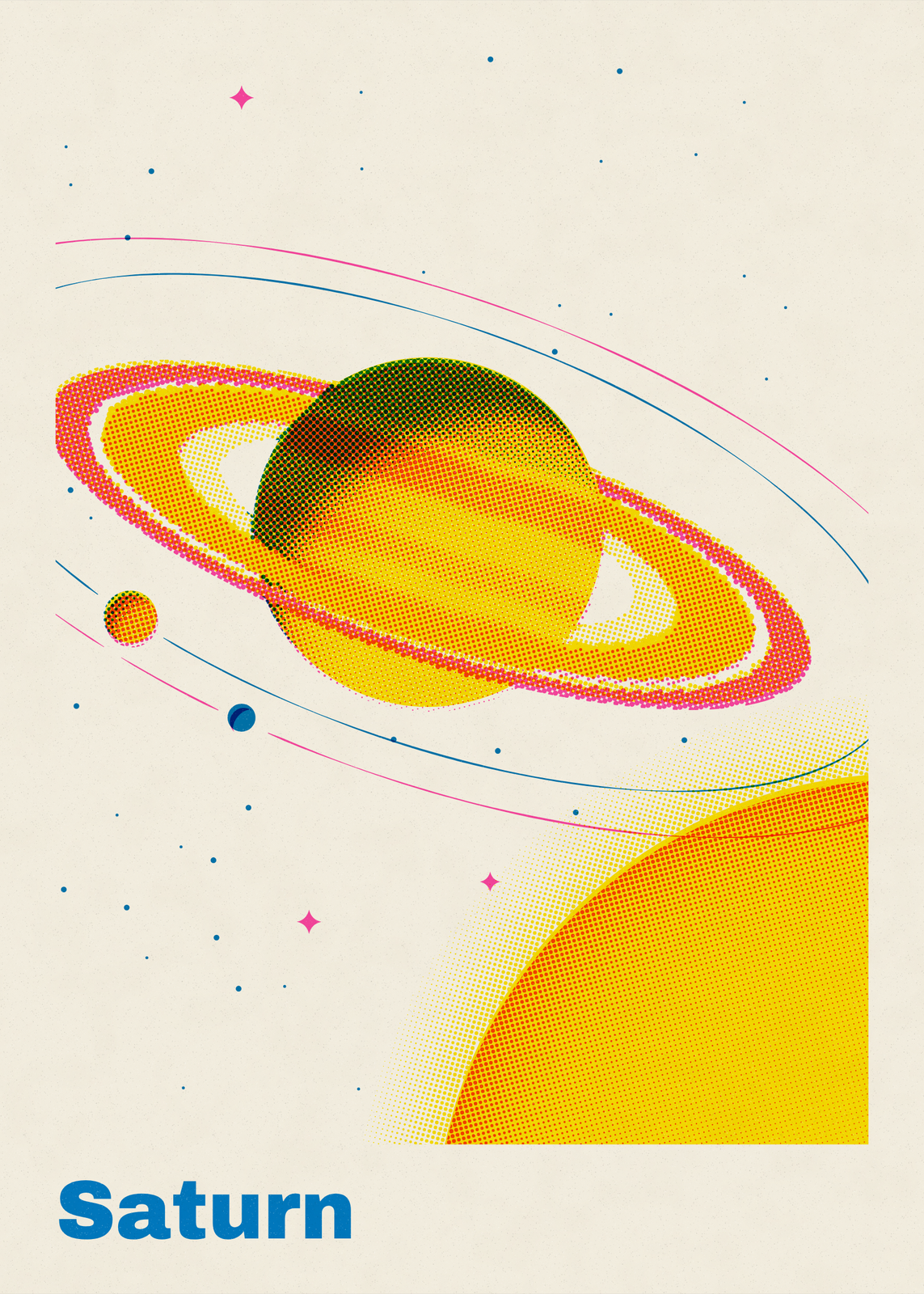 Riso print of Saturn in yellow and pink halftone dots with its rings tilted across, a big yellow Sun in the corner and small planets around, titled Saturn in blueEdit this →More solar system posters →
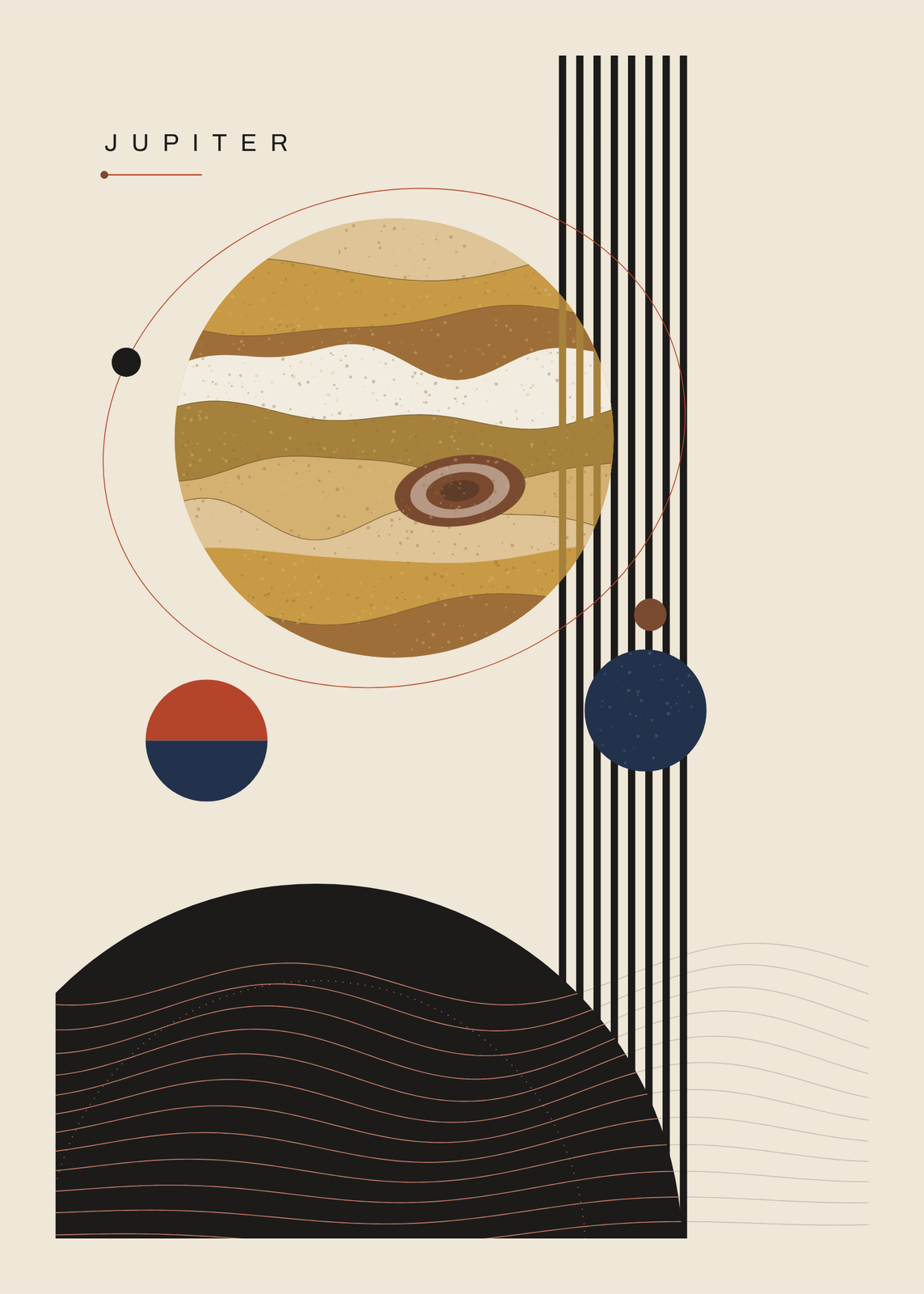 Mid-century print of Jupiter with its belts and red spot beside a block of tall black bars, small moons on thin orbits and a dark striped world rising below, on creamEdit this →More solar system posters →
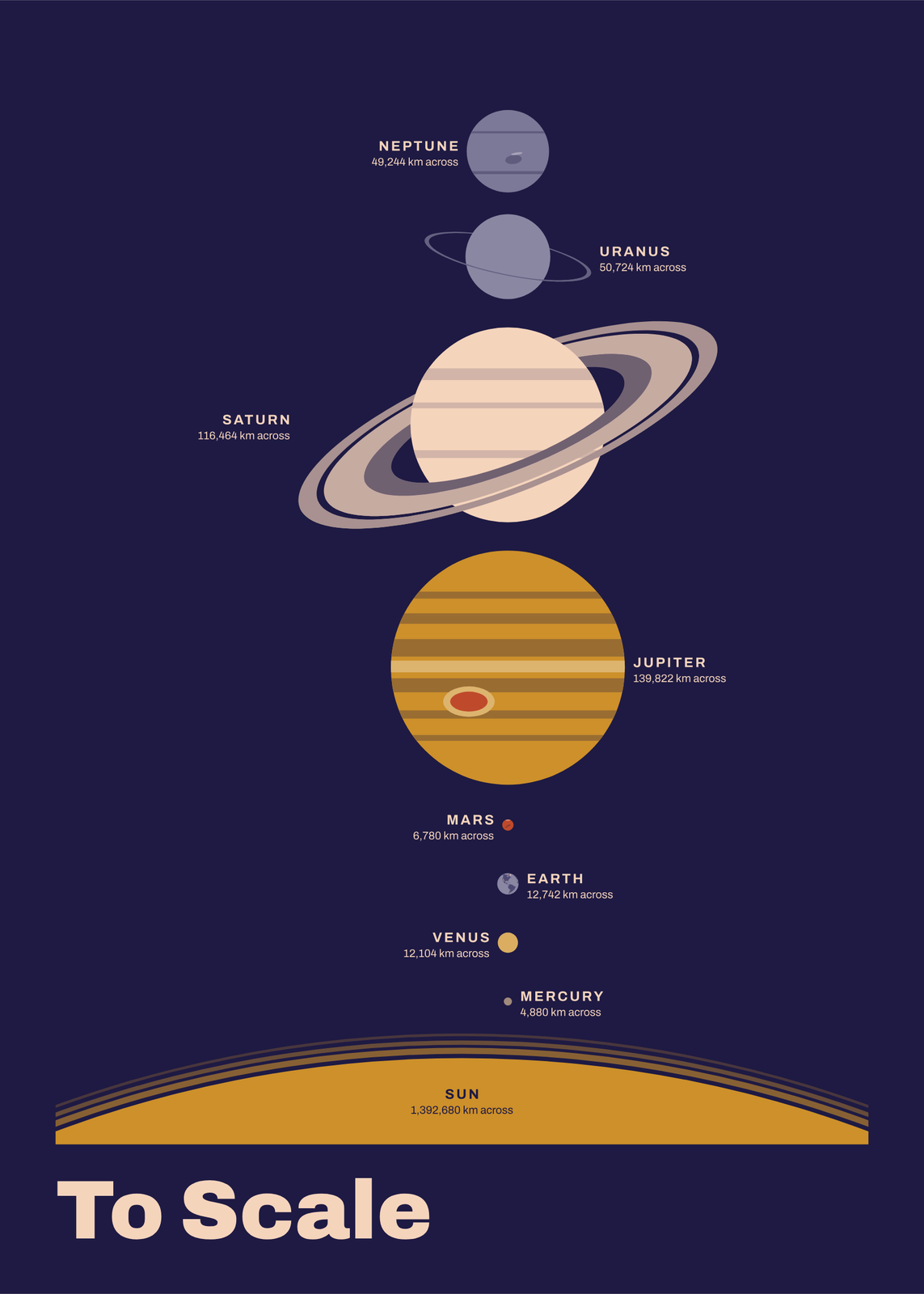 The planets to scale on navy: Neptune and Uranus down to Mercury stacked over the Sun's orange rim, Saturn and Jupiter the biggest, each named with its size, titled To ScaleEdit this →More solar system posters →
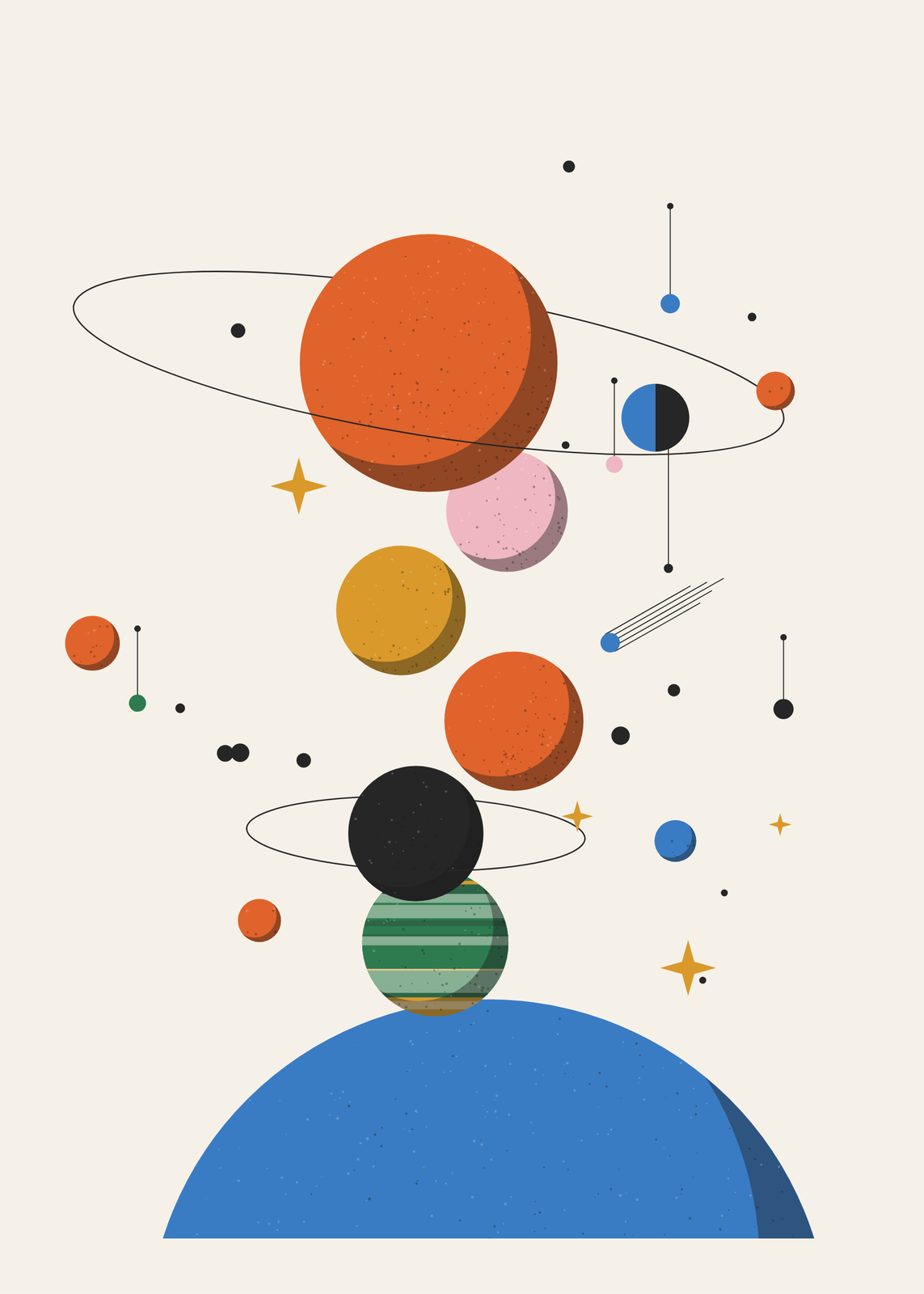 Cosmic collage: a stack of flat planets in orange, pink, mustard, black and striped green rising from a blue world, with thin orbits, stars and a comet, on creamEdit this →More solar system posters →
Galaxies, the Moon and the night sky
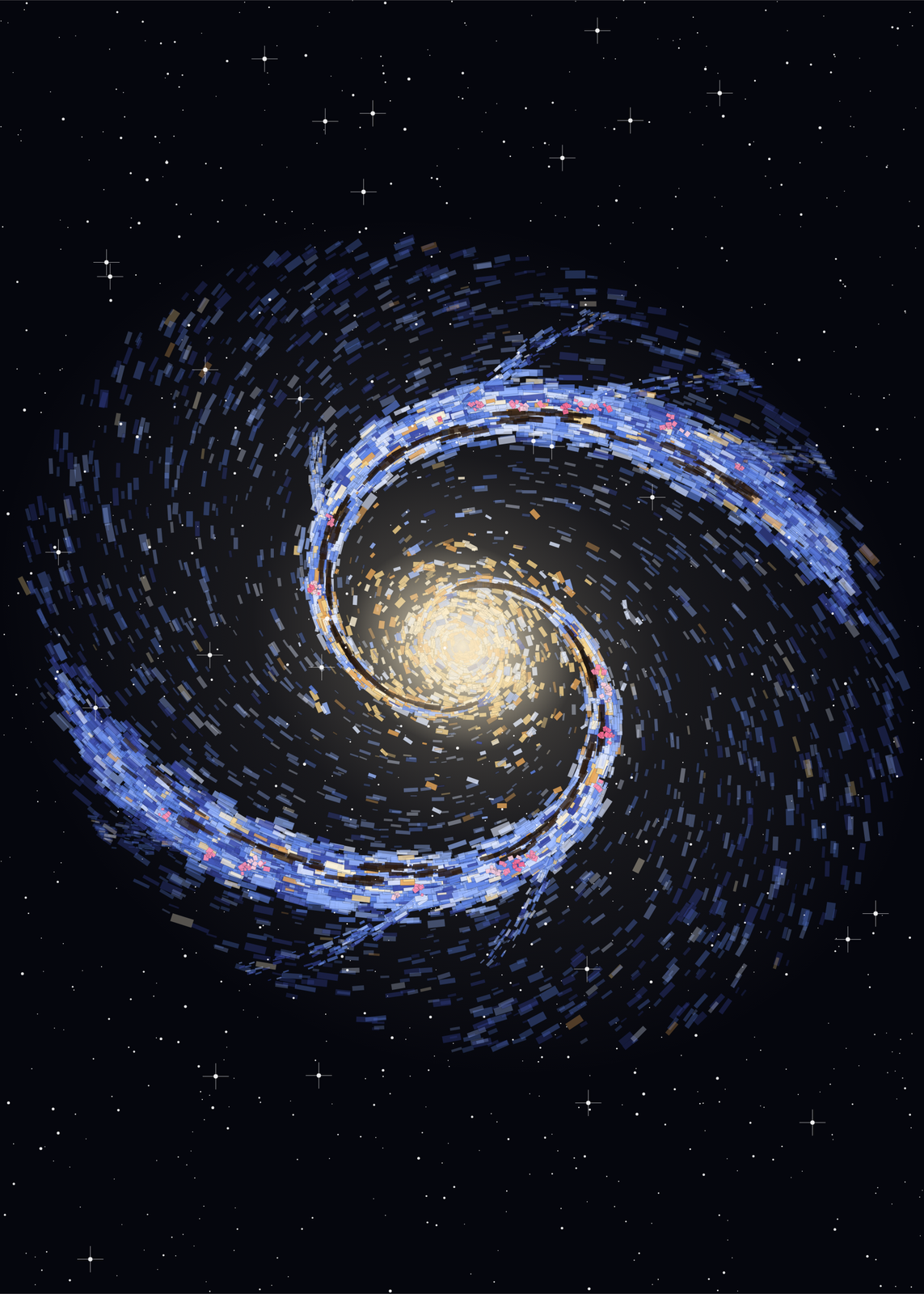 Galaxy art: a two-armed spiral of blue paper pieces winding out of a glowing cream core, on a black sky full of small starsEdit this →More galaxy art →
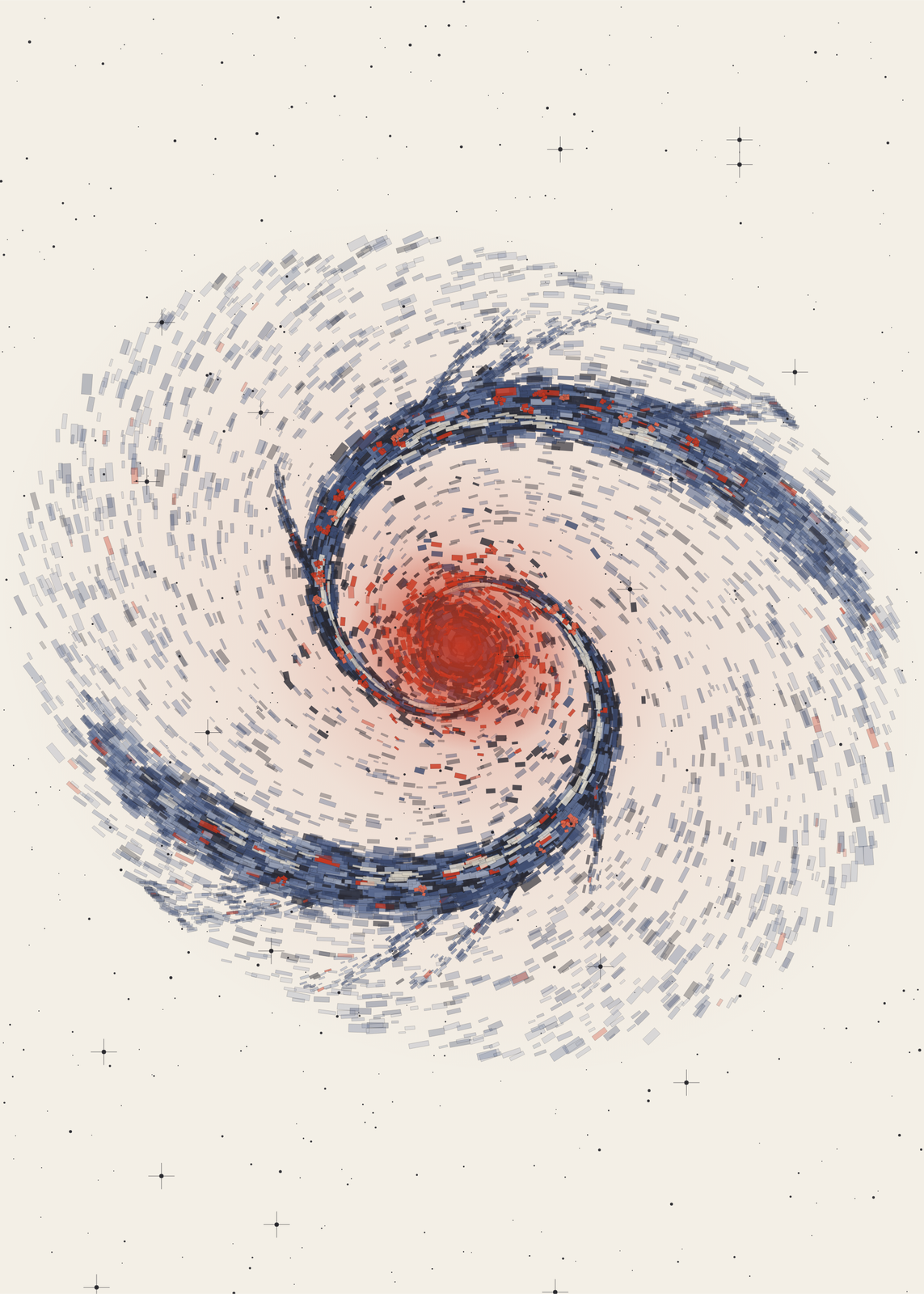 Spiral galaxy in ink on paper: dark blue arms of small strokes curling round a red core, on creamEdit this →More galaxy art →
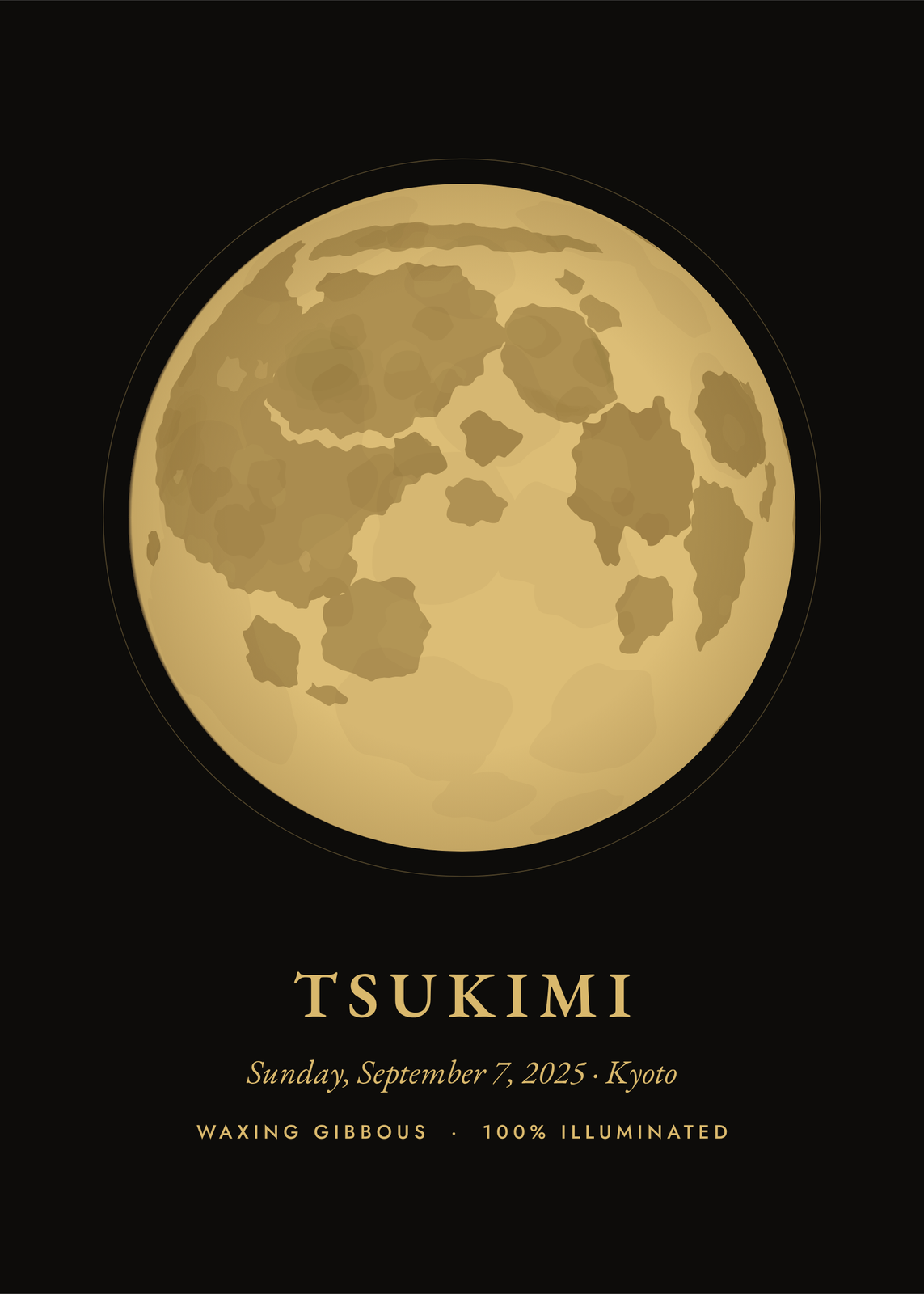 Full moon in gold on black, only its dark seas marked, titled Tsukimi with the date and Kyoto belowEdit this →More moon phase posters →
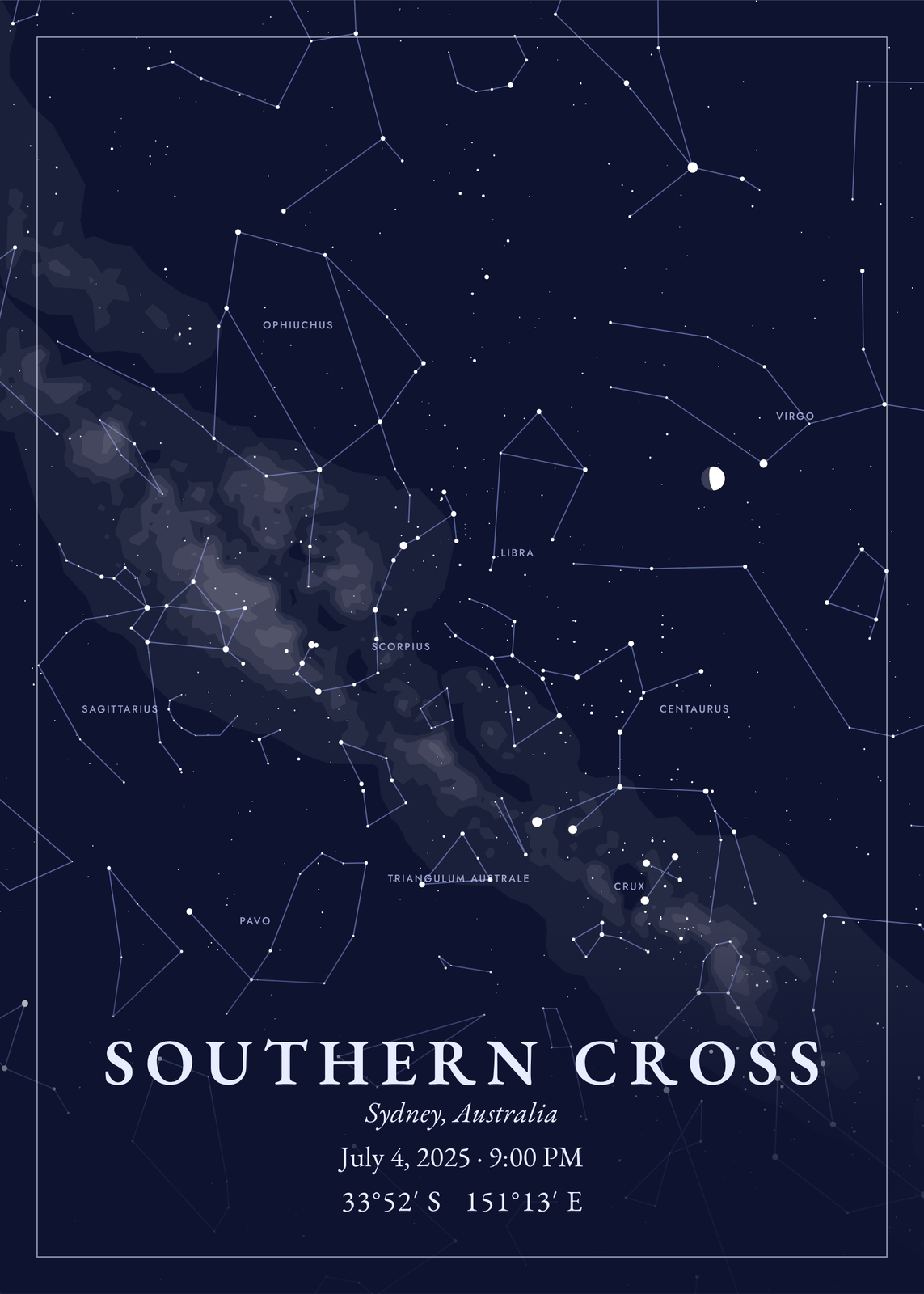 Star chart filling the sheet in midnight blue: the Milky Way, constellation lines and their names over Sydney, titled Southern Cross with the date and coordinatesEdit this →More star maps →
 Graphic eclipse: a cobalt blue disc ringed by a corona of fine orange and blue rays, on pale grayEdit this →More circle art →
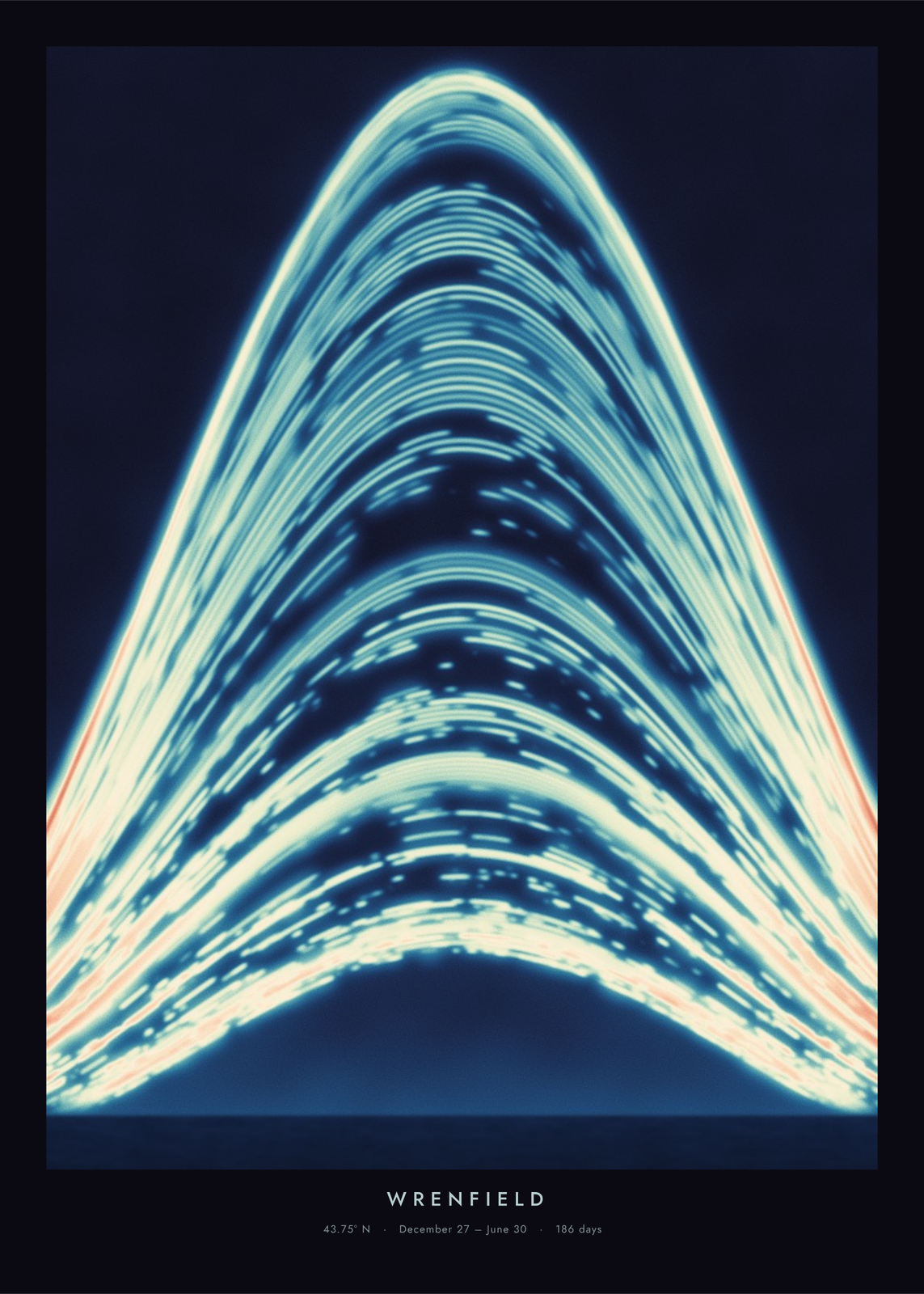 Solargraph of half a year of sun: pale blue arcs of the Sun's daily paths stacked over a dark horizon on deep navy, a place name belowEdit this →More solargraphy →
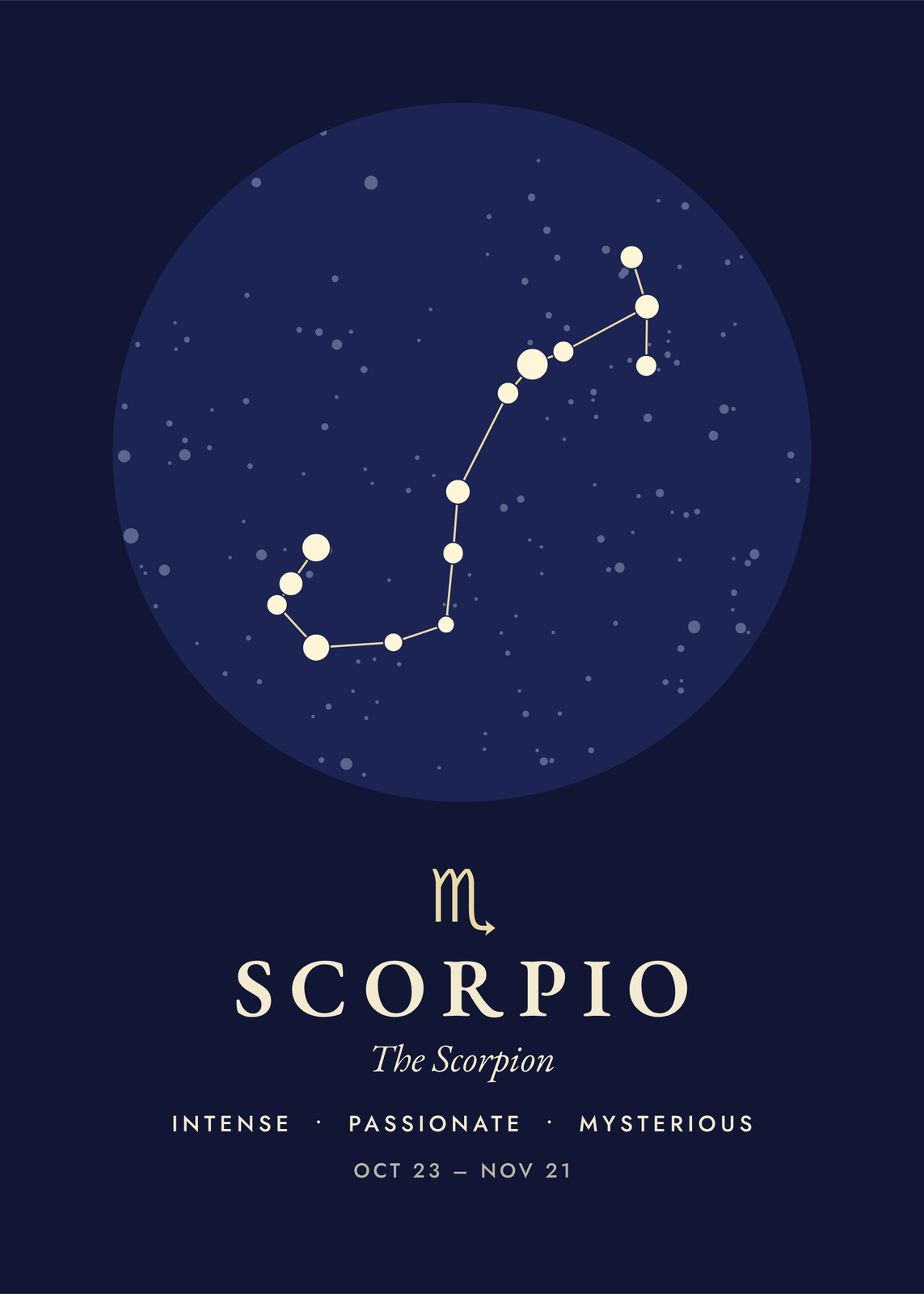 Constellation poster of Scorpio: its stars joined by fine lines in a navy disc speckled with stars, the glyph and Scorpio, The Scorpion, below in gold on midnight blueEdit this →More zodiac constellation art →
Sci-fi covers, comics and astronauts
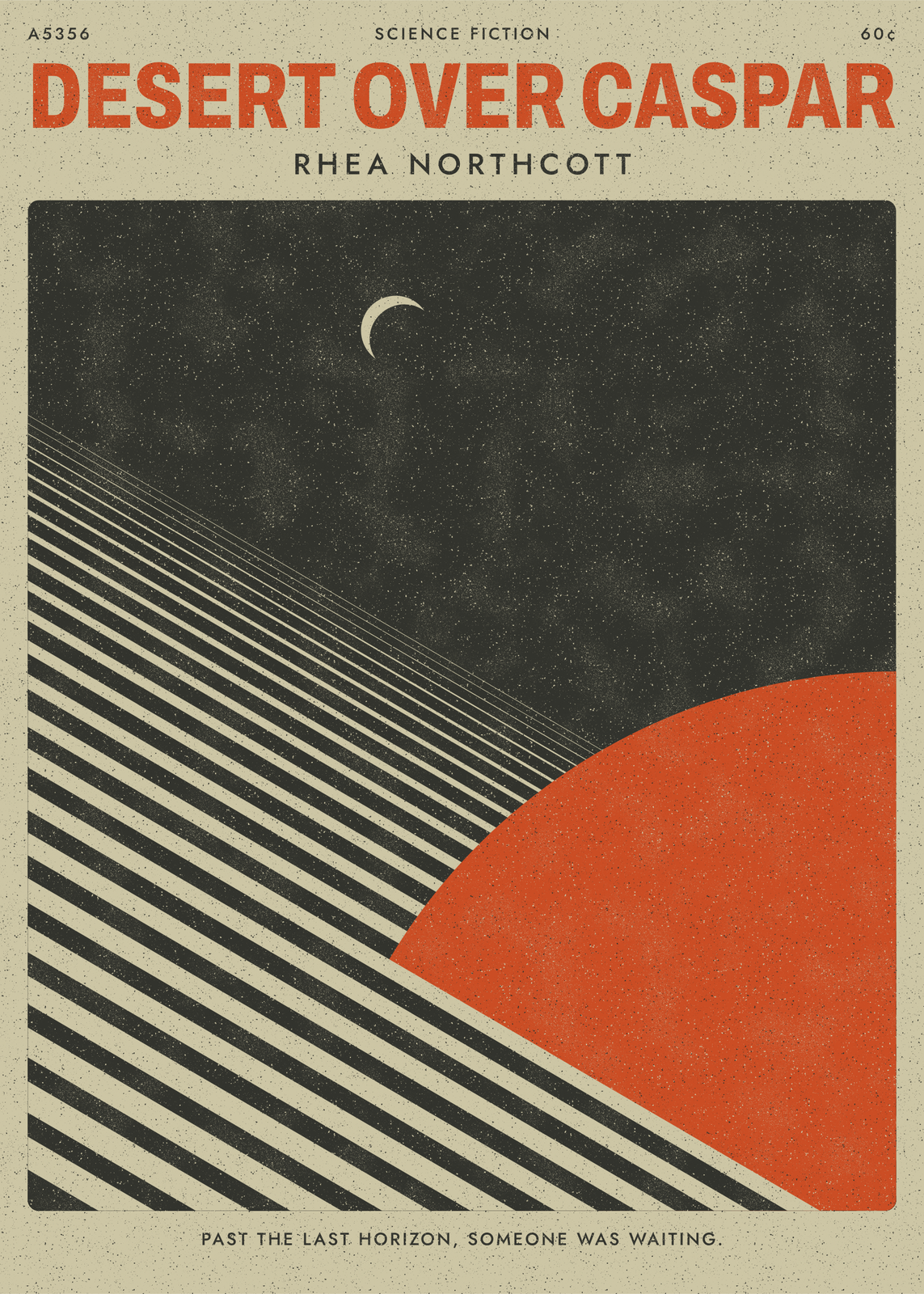 1970s science-fiction paperback cover, Desert over Caspar: a giant orange planet rising over a striped plain under a thin crescent, on a grainy dark cardEdit this →More 70s sci-fi art →
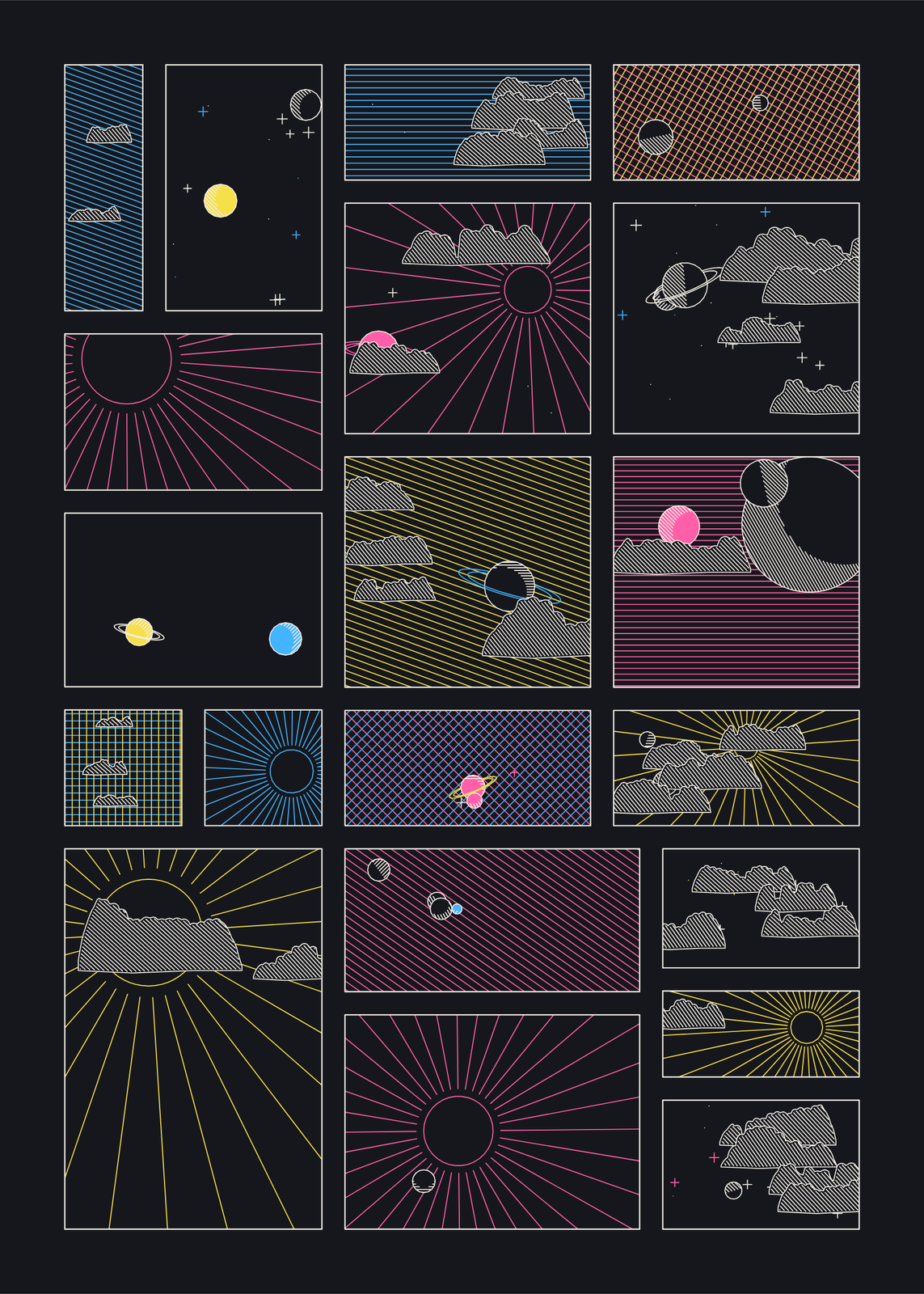 Space comic page on black: twenty panels of suns, ringed planets, rays and hatched clouds drawn in fine neon pen linesEdit this →More space comic art →
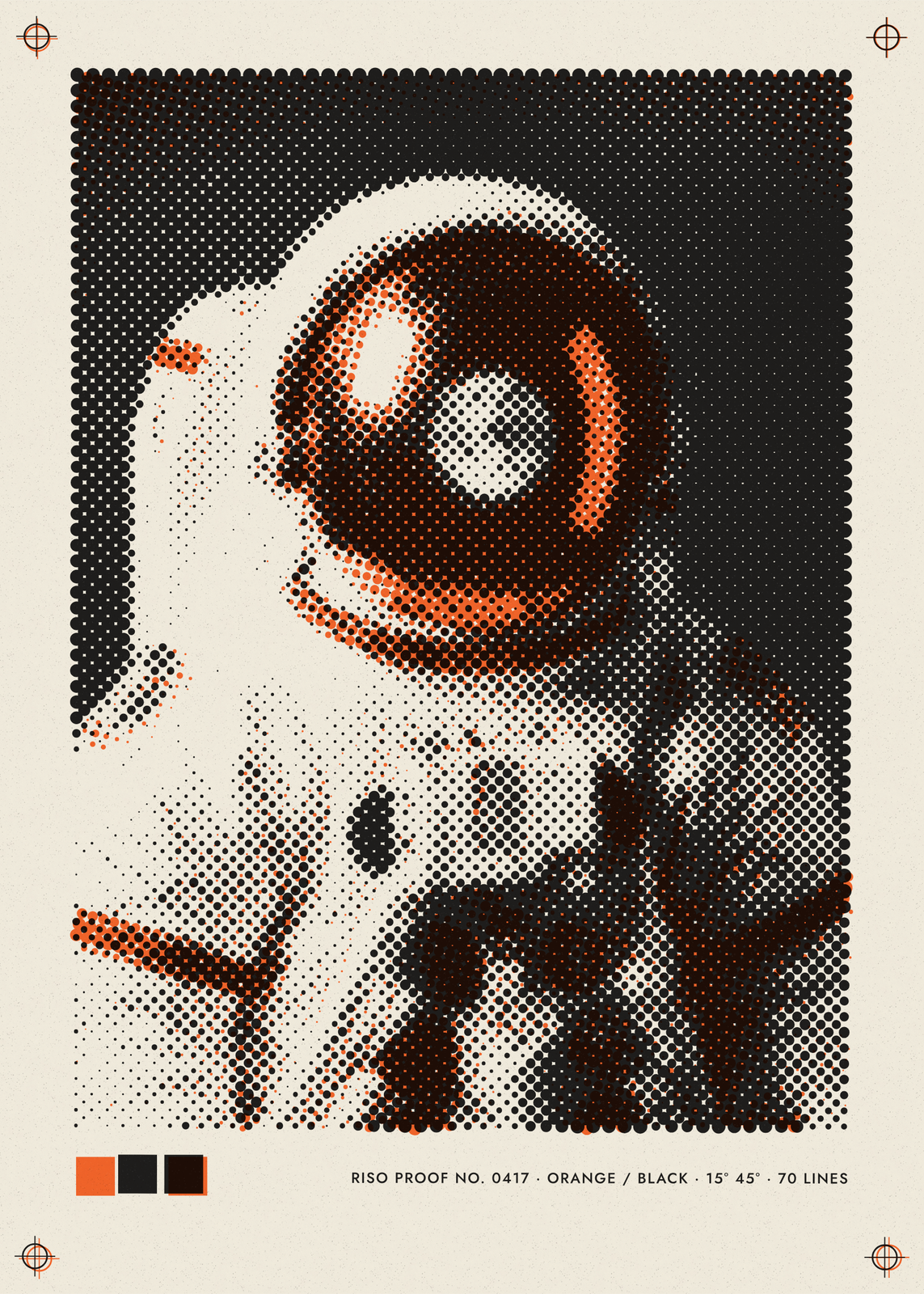 Riso print of an astronaut in a spacesuit, the Earth reflected in the visor, in orange and black halftone on white with printer's marksEdit this →More risograph print →
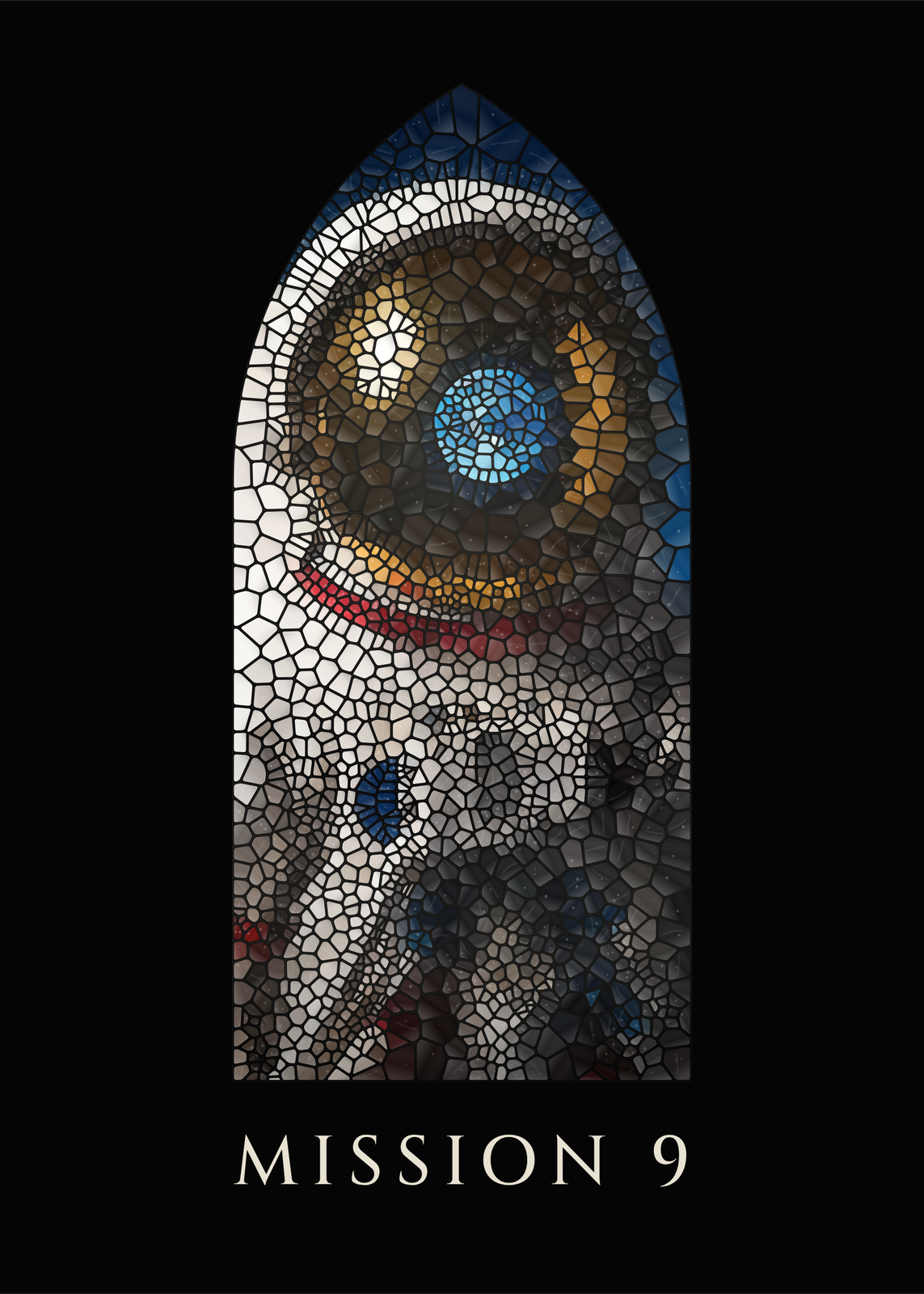 Stained glass window of an astronaut's helmet and suit in small panes of gray, blue and gold, an arched lancet on black, titled Mission 9Edit this →More stained glass art →
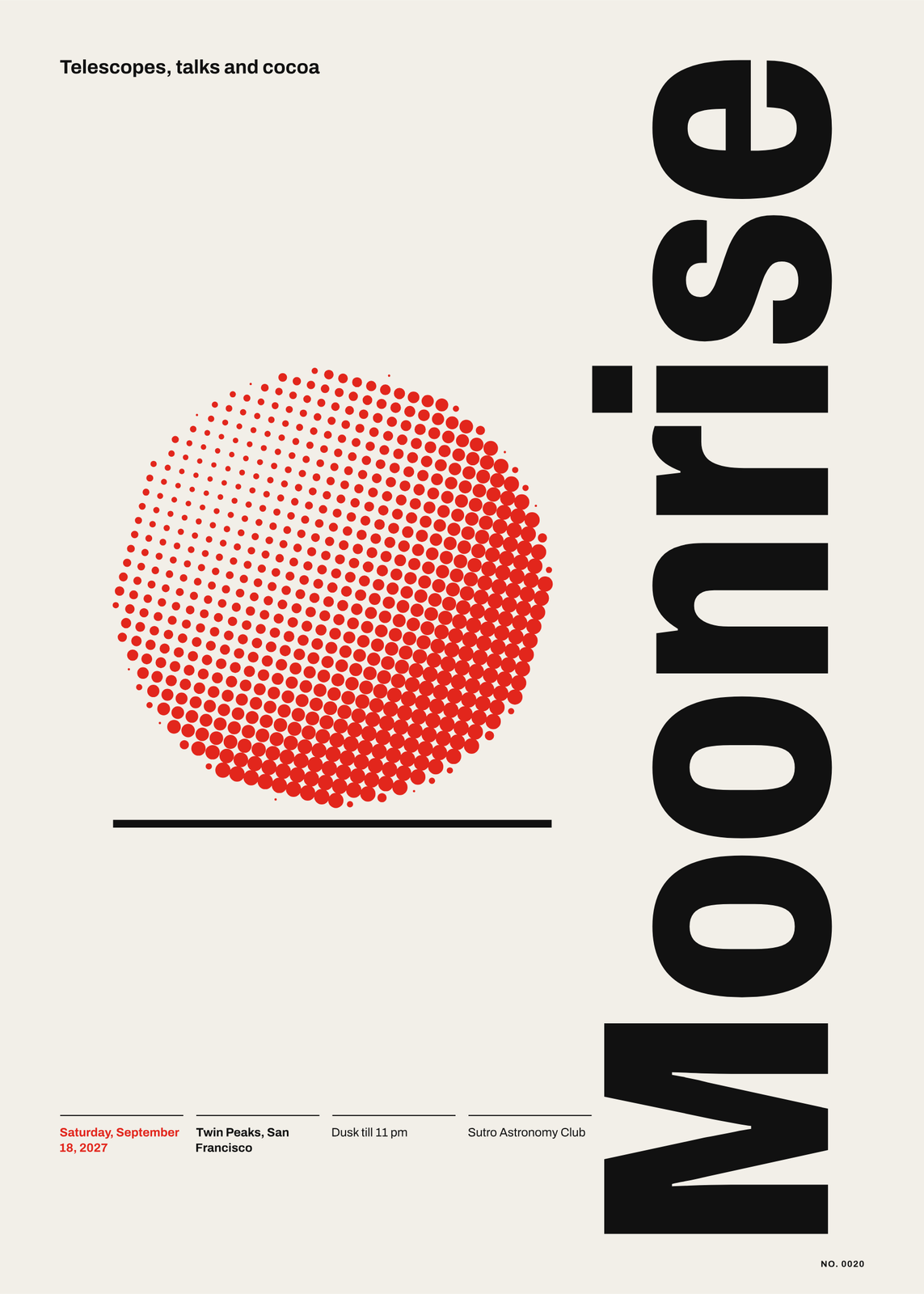 Swiss style poster for a planetarium night: a red halftone sphere over a black line, Moonrise set big and sideways in blackEdit this →More swiss style poster →
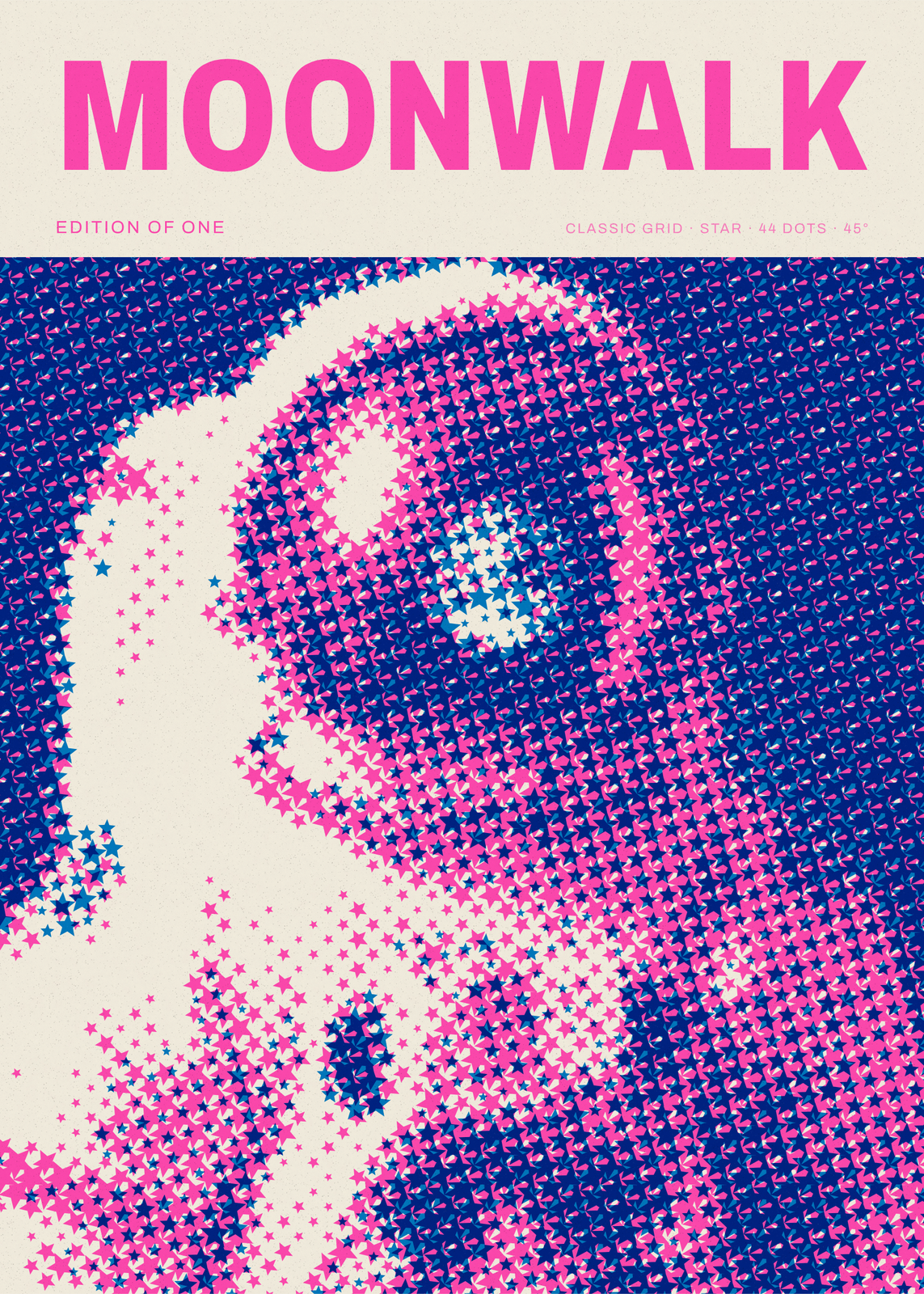 Halftone astronaut in pink and blue star-shaped dots, helmet and suit filling the sheet under the headline Moonwalk in pinkEdit this →More halftone generator →
Planets and rockets for a child's room
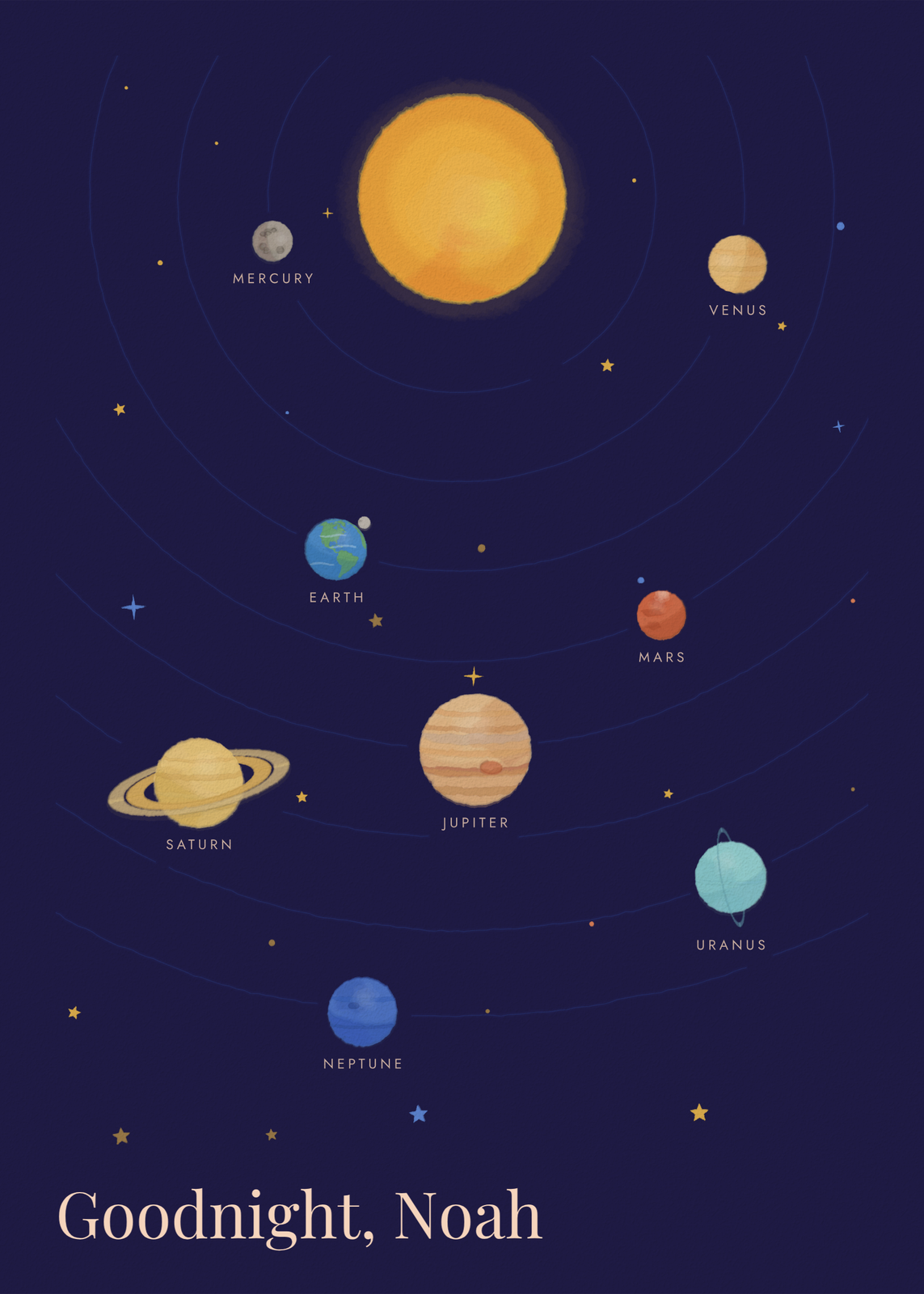 Watercolor planets on navy: the Sun and eight planets painted along faint orbits, each named in small letters, titled Goodnight, NoahEdit this →More solar system posters →
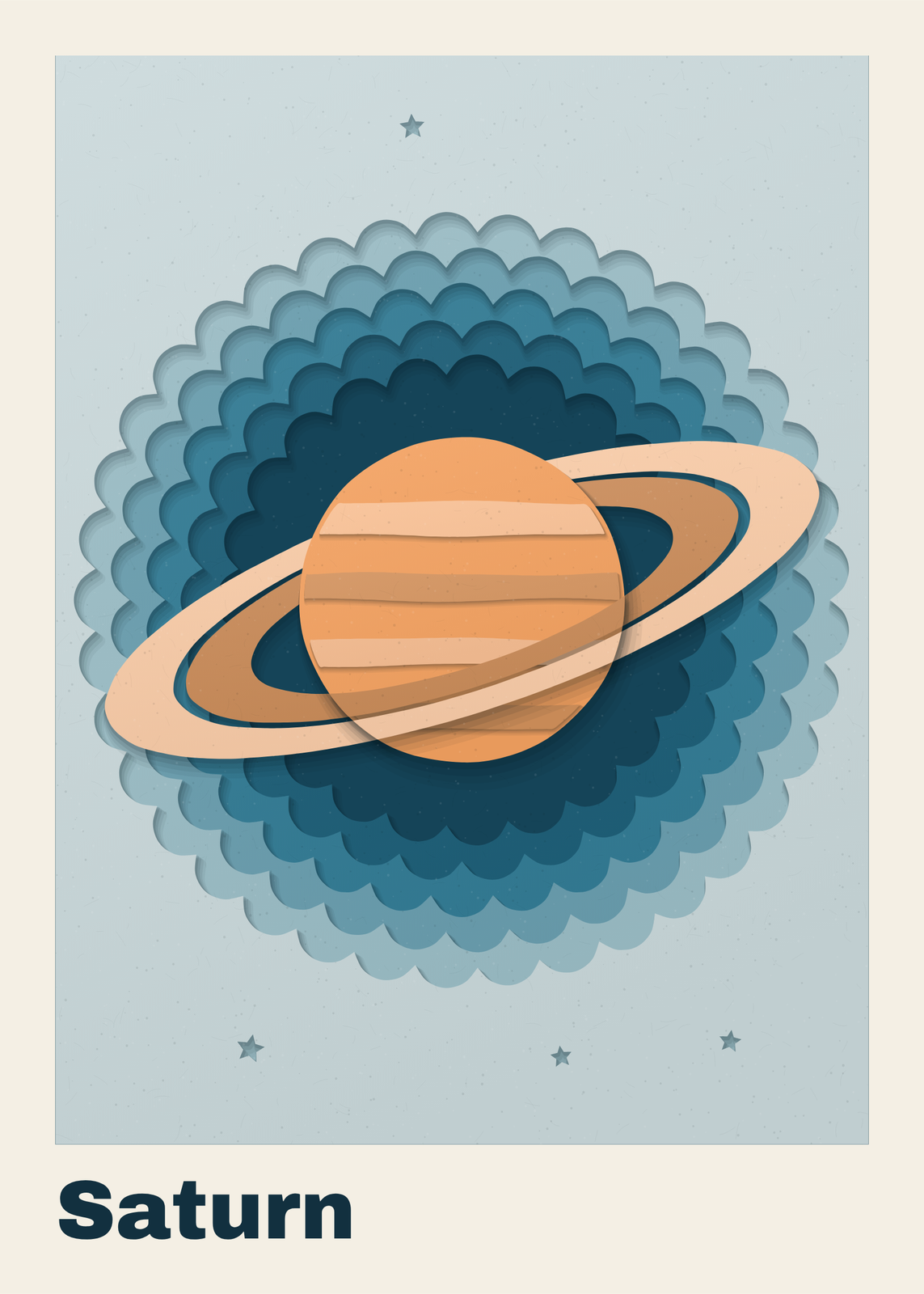 Paper-cut Saturn: a ringed planet in peach and orange inside a scalloped frame of layered blue card, small stars on pale blue, titled SaturnEdit this →More solar system posters →
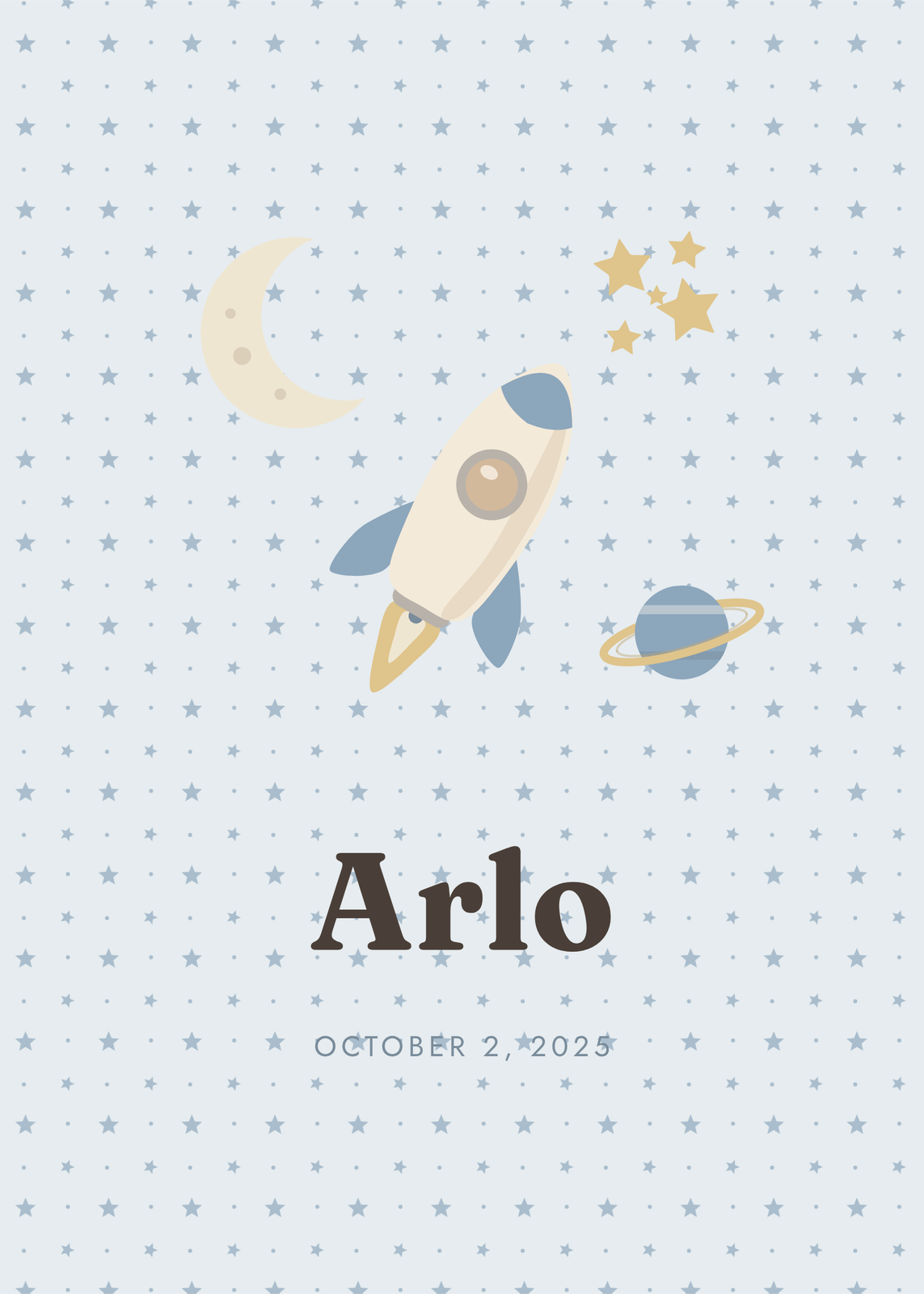 Nursery print of a little rocket, a crescent moon, a ringed planet and gold stars on star-dotted pale blue paper, above the name Arlo and a dateEdit this →
Measured skies and made-up ones
Some of these posters are measured and some are invented. Star Map draws the stars over a city at the hour you enter, Moon Phase the Moon's real phase that night, and Solar System's orbit charts put the planets where they stood round the Sun on your date. Zodiac Constellation joins the stars of your sign. Galaxy builds a spiral of your own design from its arms, winding and tilt, and Space Age Paperback and Comic Skies invent whole scenes from a seed.
The measured ones double as keepsakes: the sky on the night a child was born, the Moon over a first date, the planets on a wedding day. The invented ones chase the look alone, so step through seeds until a spiral or a cover feels right.
From observatory drawings to space-age posters
Before cameras could catch the planets, astronomers drew what they saw at the eyepiece. In the 1870s Étienne Léopold Trouvelot drew Saturn, Jupiter and the Sun's corona in pastel at Harvard, and the astronomy atlases of the century printed the planets as engraved plates colored by hand. Solar System's pastel and atlas styles work in those two manners.
The space age brought flat, bright illustration of rockets and ringed planets, and in the 1970s the minimal, grainy covers of science-fiction paperbacks. In 2016 NASA's Jet Propulsion Laboratory revived the retro travel poster for real places in the solar system; Solar System's travel posters play the same game, a giant planet over one of its moons with a rocket and an invitation to visit.
Hanging space art
Dark grounds carry space art. Saturn in pastel, the blue spiral galaxy and the gold Moon, all on black, hang well as a row of three because their blacks match from frame to frame. In a bright room the light-ground looks hold up better: the atlas plate on aged paper, the galaxy in ink on cream, the riso Saturn and the eclipse on pale gray.
In a child's room, the glowing lineup of planets and the Visit Mars travel poster read from across the room, and the watercolor goodnight planets, the paper-cut Saturn and the Nursery rocket carry a child's name. Over a desk, a star chart or the engraved Saturn rewards a closer look.
Questions
Are the stars and planets in the right places?
On the posters that take a date, yes: Star Map draws the stars over the place and time you enter, Moon Phase shows the Moon's phase that night, and Solar System's orbit charts, engraved orrery and blueprint plan put the planets where they stood that day. Galaxy, Space Age Paperback and Comic Skies are made up: no telescope saw them.
Which maker should I start with?
Solar System for the planets, in fifteen styles; Galaxy for a spiral galaxy; Star Map for the night sky over a place and date; Moon Phase for the Moon; Space Age Paperback for a 1970s sci-fi cover. Click any example to open it with its settings and change from there.
Can I add a name or a date?
Solar System, Star Map and Moon Phase print a title, a line of your own and the date. Space Age Paperback puts your name on the cover as the author.
Can I use my own photo?
Riso Lab, Stained glass and Halftone Studio work from a picture: the astronaut is one of their starter images, and you can upload a photo of your own instead.
What sizes can I print?
US Letter, 8 × 10, 11 × 14, 12 × 16 and 12 × 18 in, A4 and A3, free. You download a 300 DPI JPEG drawn at the size you pick. Larger prints, up to 24 × 36 in, are coming soon.
Related
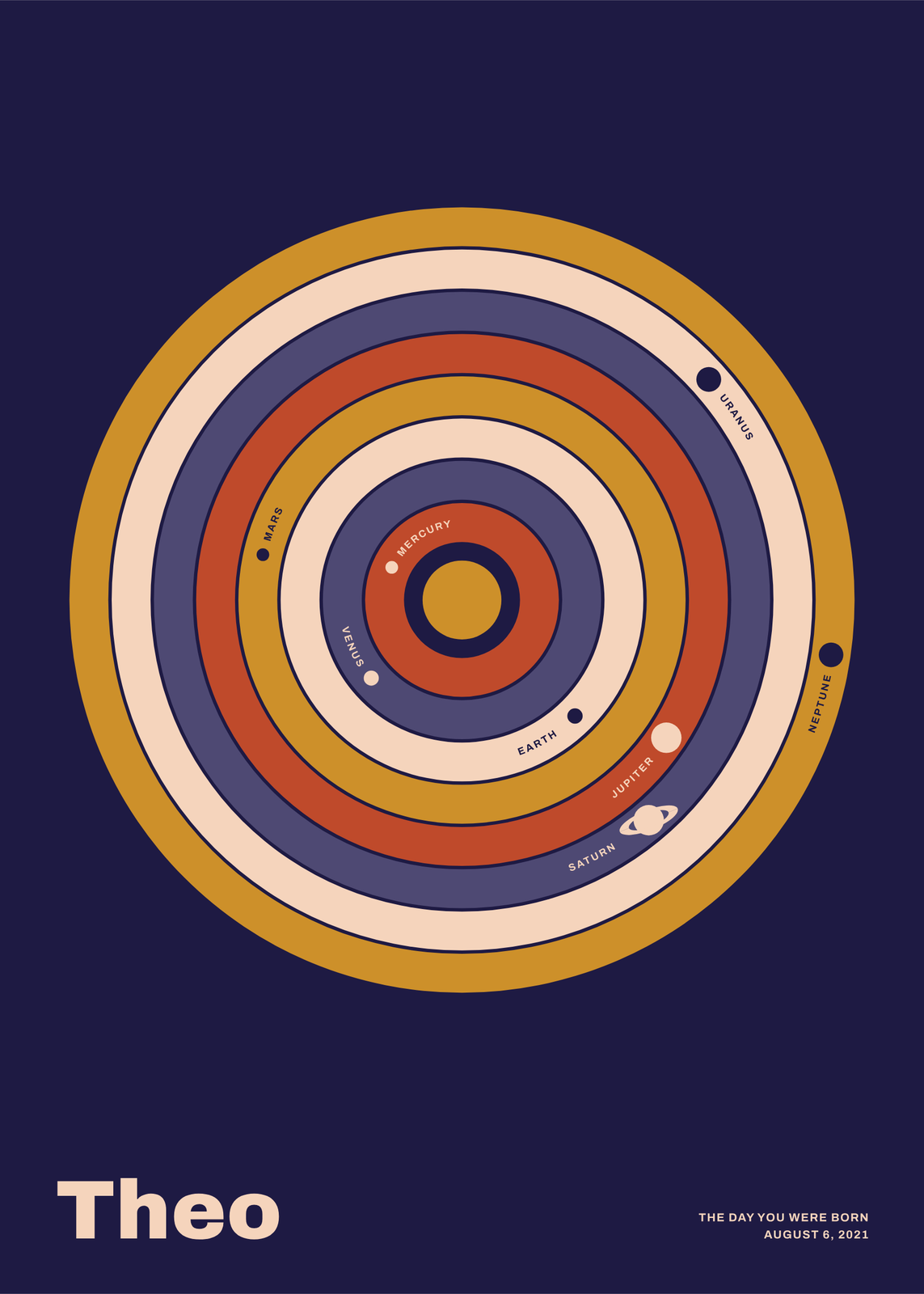 Solar system posterthe planets where they stood on your day
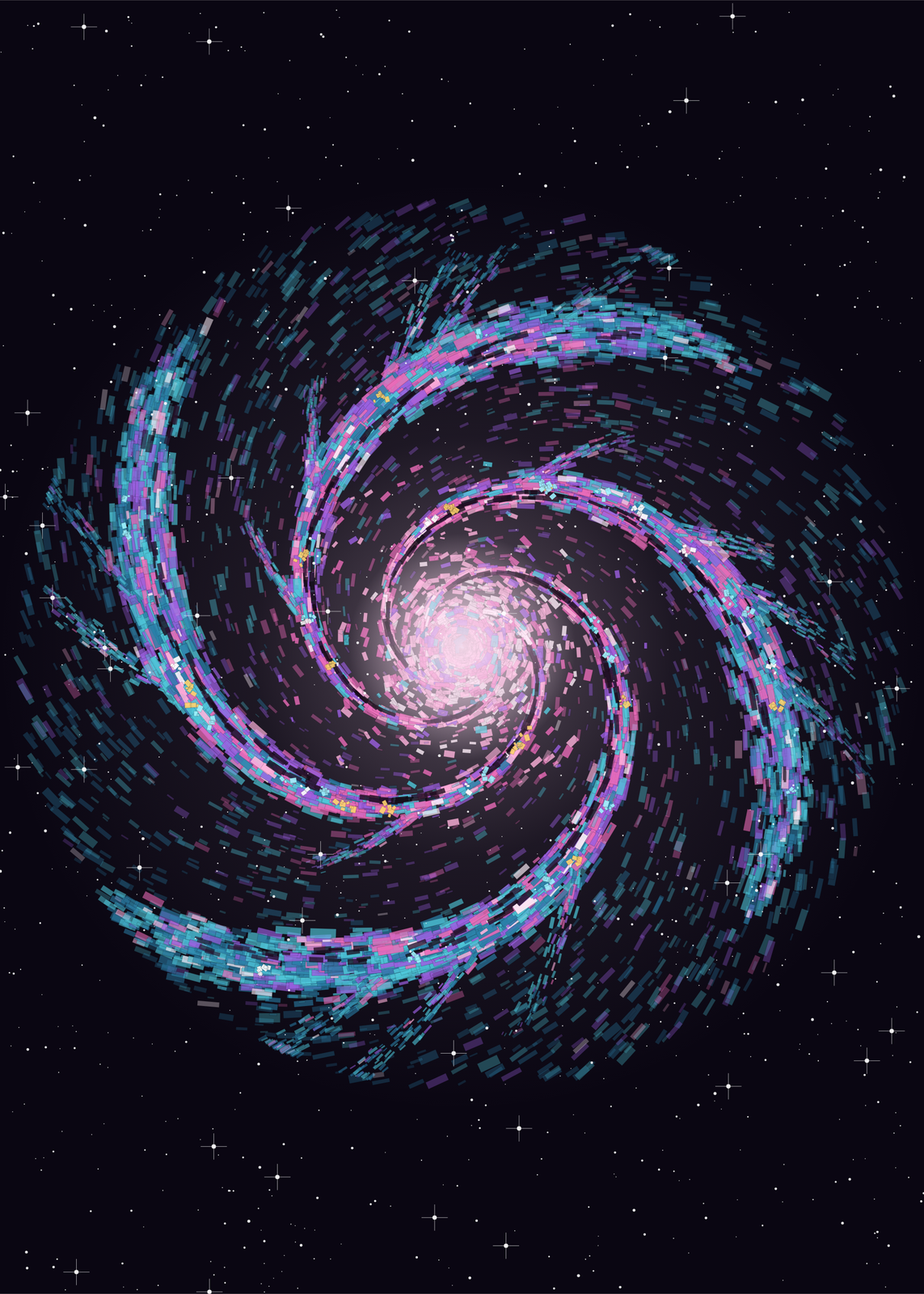 Galaxy arta spiral galaxy cut from thousands of paper pieces
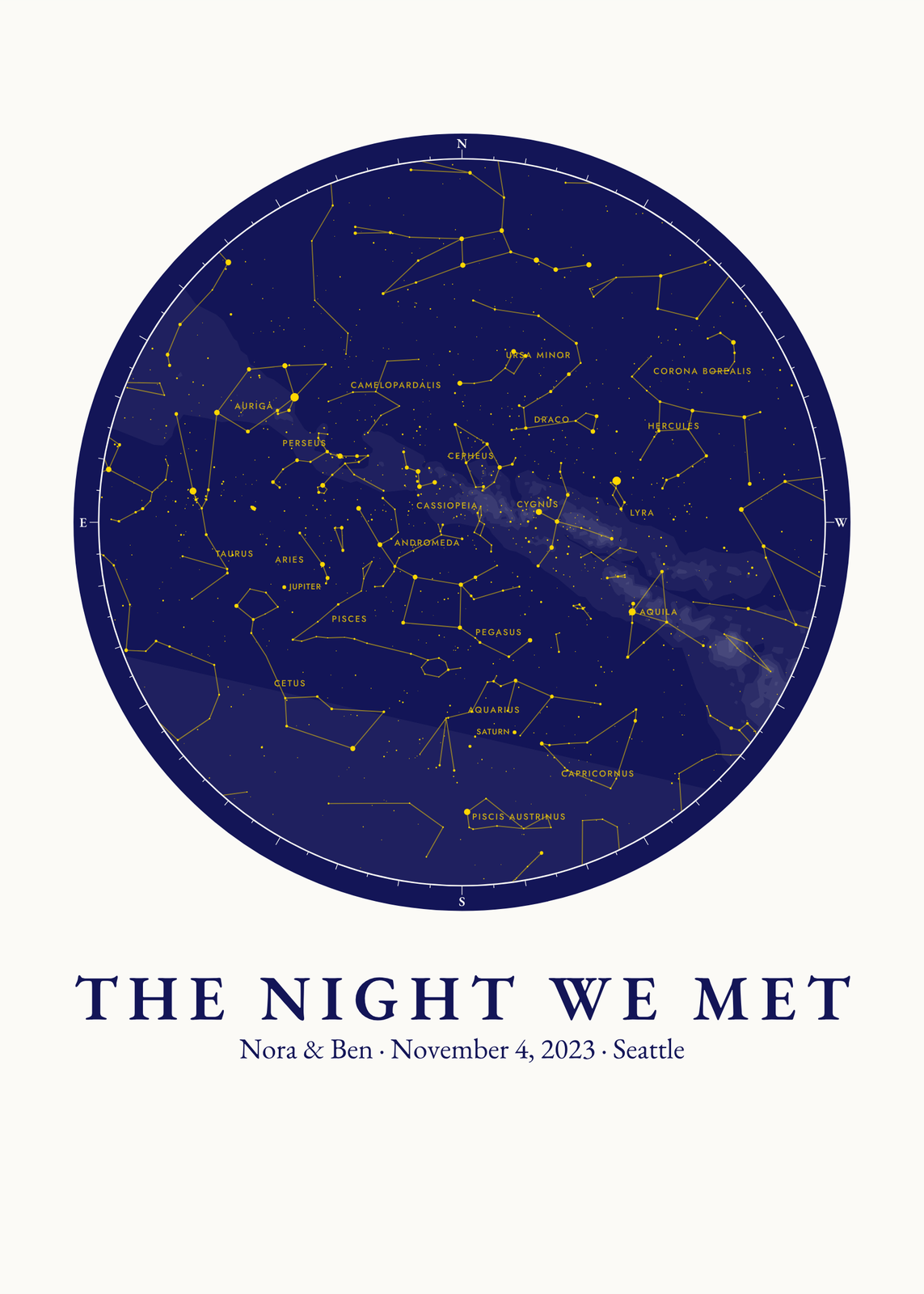
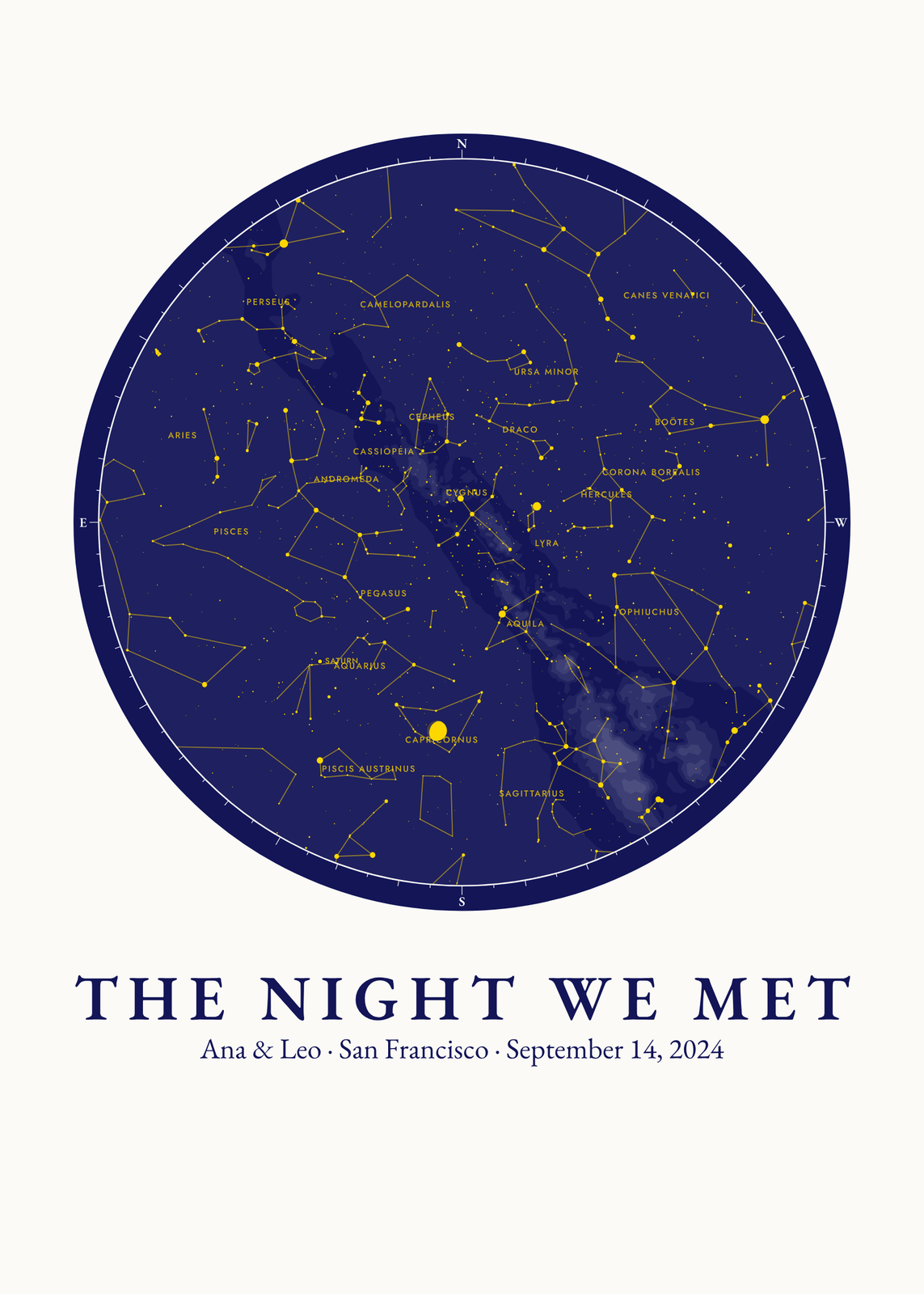 Custom star mapthe sky over any place, on any night
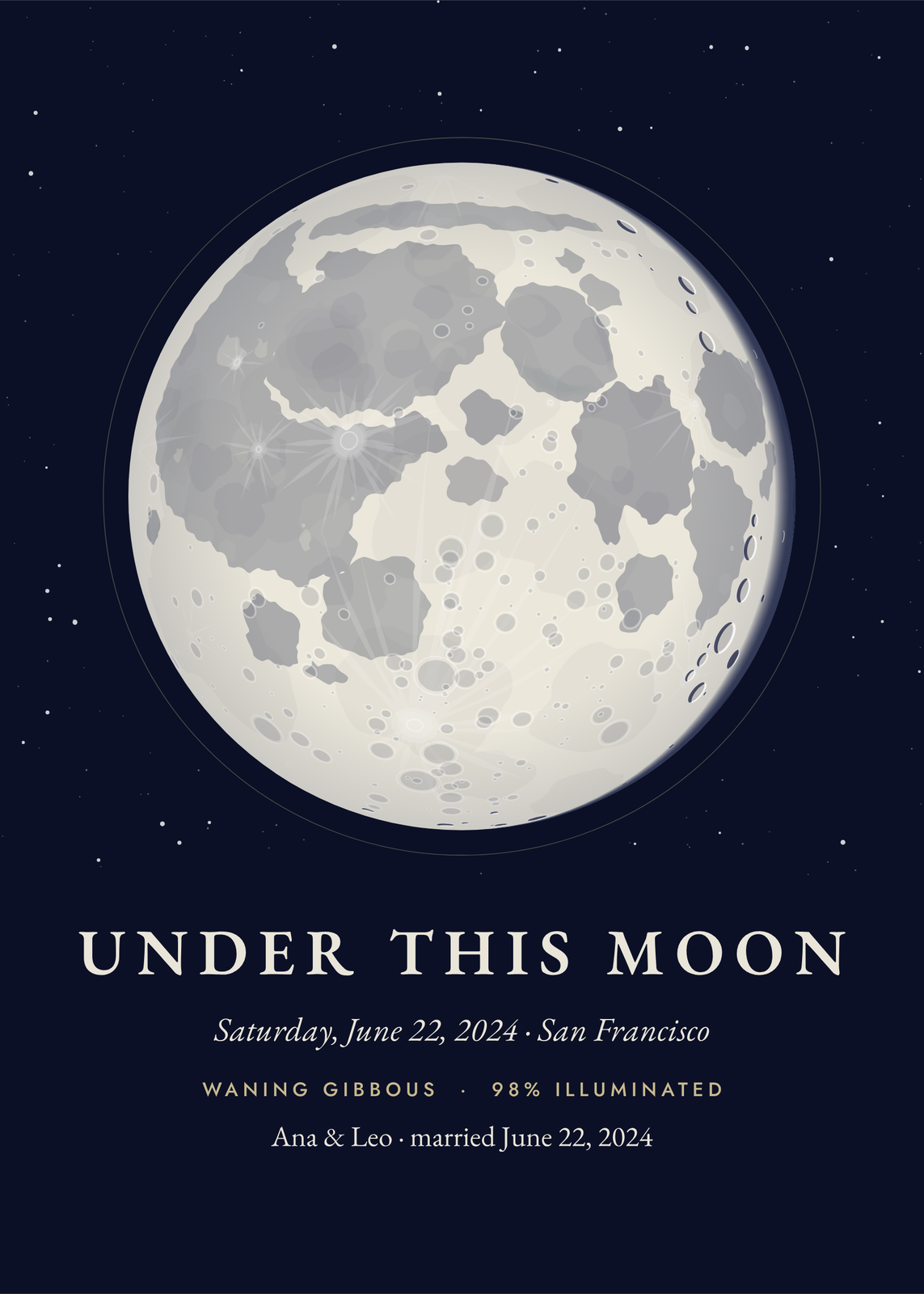 Moon phase posterthe Moon as it was on your date
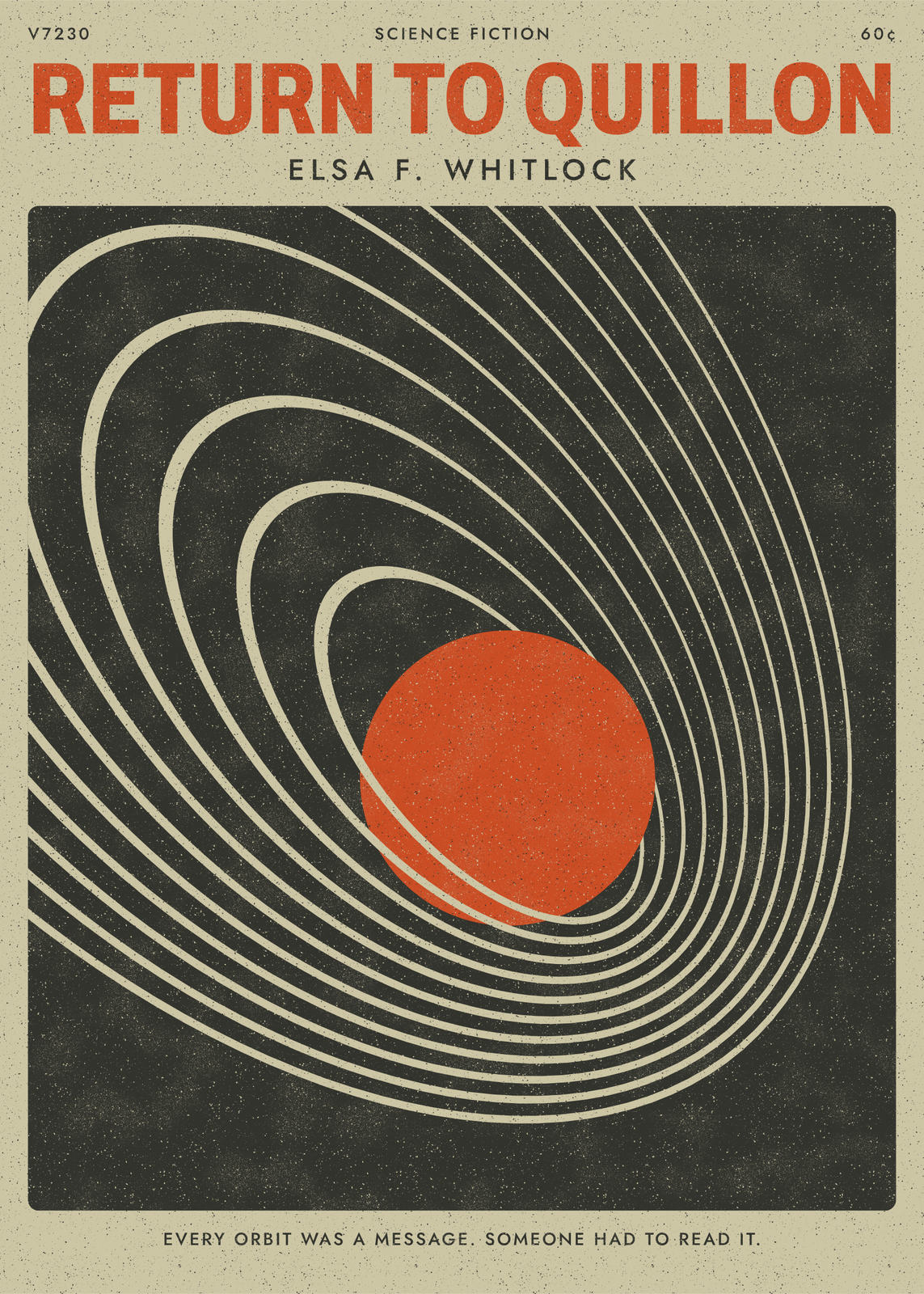 70s sci-fi artthe cover of a science-fiction paperback that never was, with your name as the author
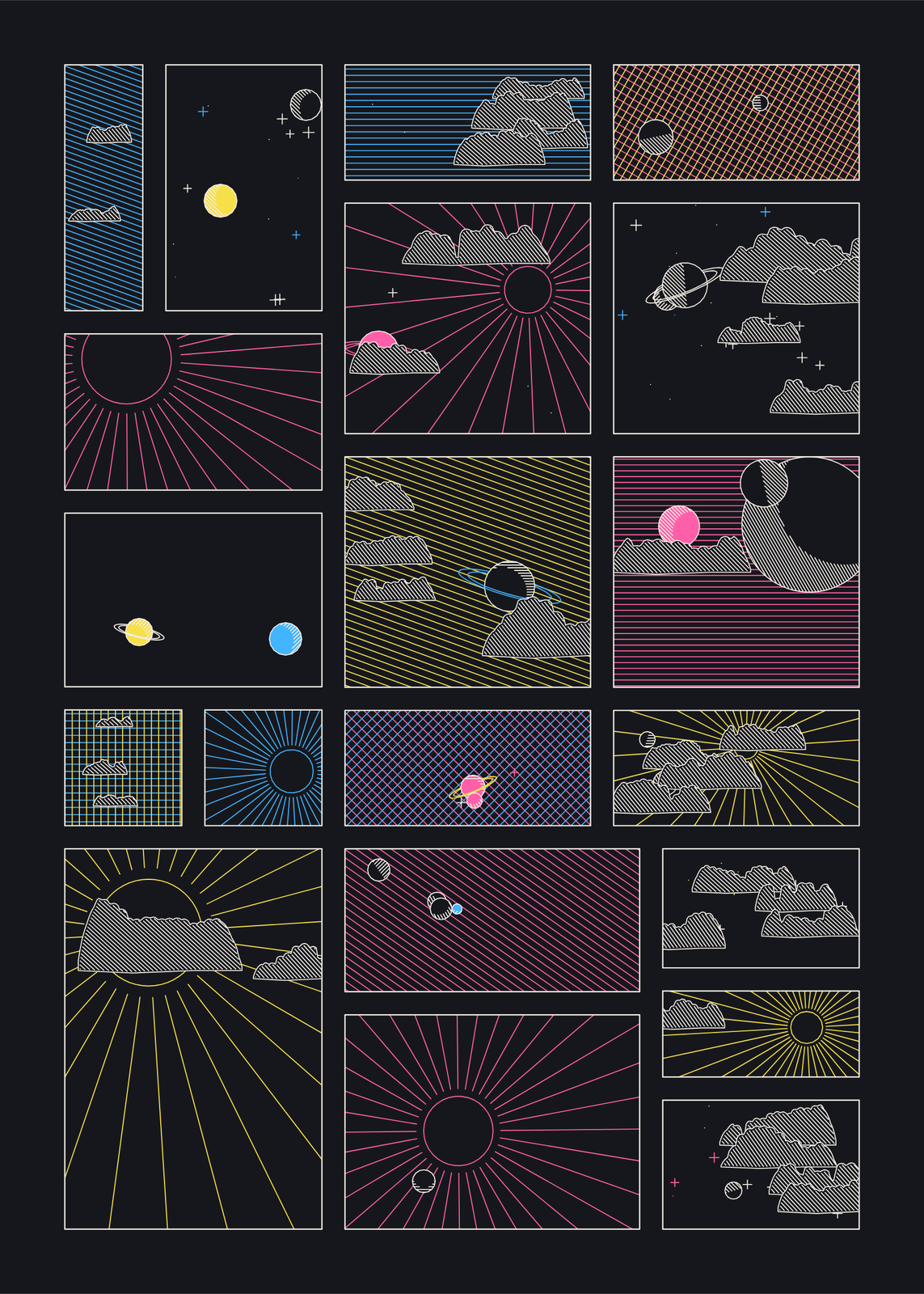 Space comic arta comic page of tiny skies, every one drawn in pen lines
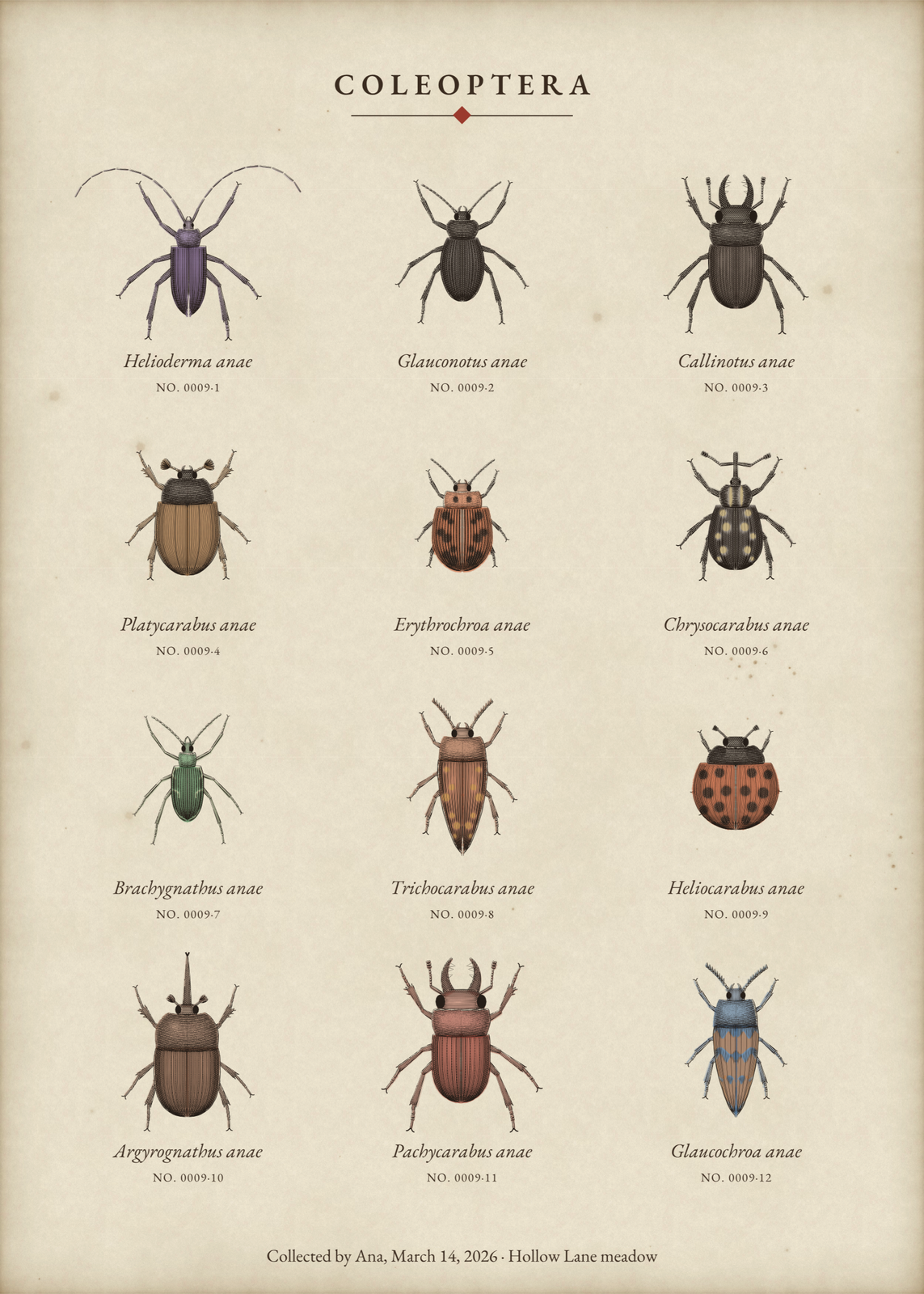 Scientific illustrationinsects, fish, plants and planets laid out like plates from an old science book
Gift ideas by occasion
Every example is made with the Posterage generators. Change anything, then download it as a 300 DPI JPEG.