Scientific illustration insects, fish, plants and planets laid out like plates from an old science book
Scientific illustration draws a thing so you can learn it: every part in place, labeled, often with a scale or a Latin name. The makers here borrow that look. Entomology Plate pins invented beetles and butterflies on an aged plate, Ichthyology Plate and Herbarium Specimen do the same for fish and plants, and Local Birds lays out the real birds of a place from old hand-colored books; others chart what you can't hold, from a DNA double helix and a dish of reaction-diffusion to layers of rock, a year of climate stripes, particle tracks, the planets to scale, a strange attractor and tilings that never repeat. Pick one, put your name on the label where there is one, and download it ready to print.
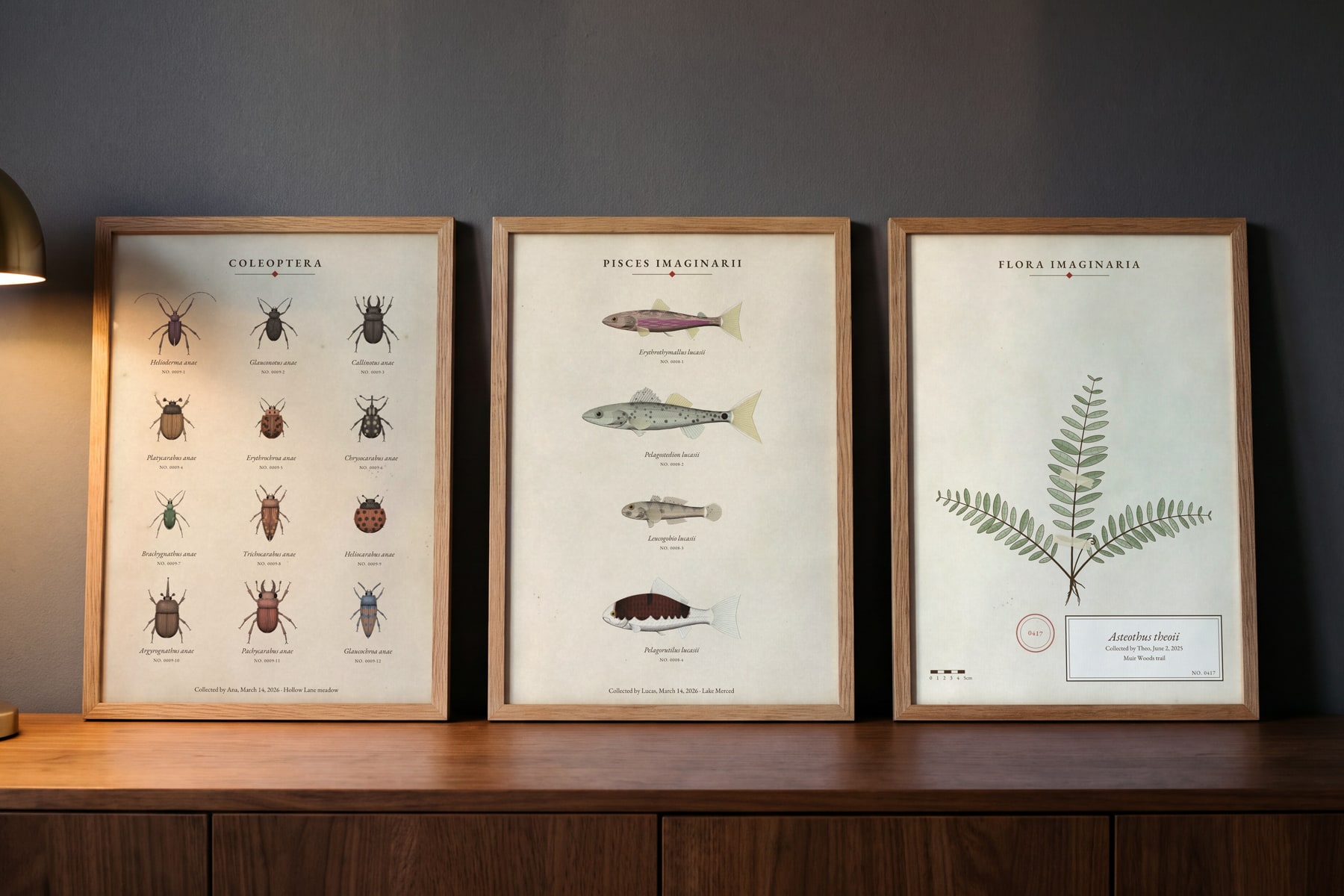
On the wall
A few of them framed at home. Open any one to make it yours.
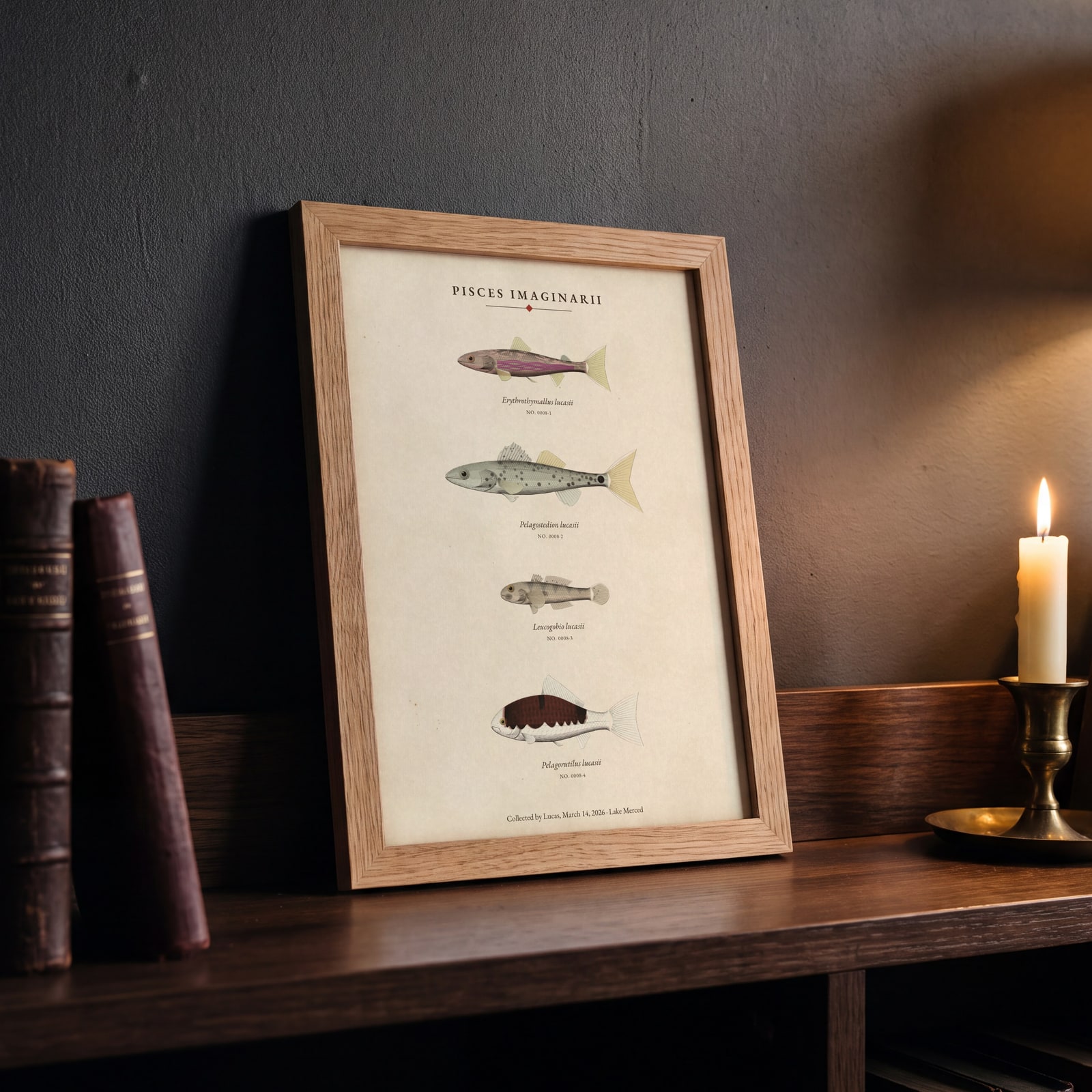 Hand-colored engraving of four invented freshwater fish stacked down an aged plate titled Pisces Imaginarii, each with its Latin nameEdit this →
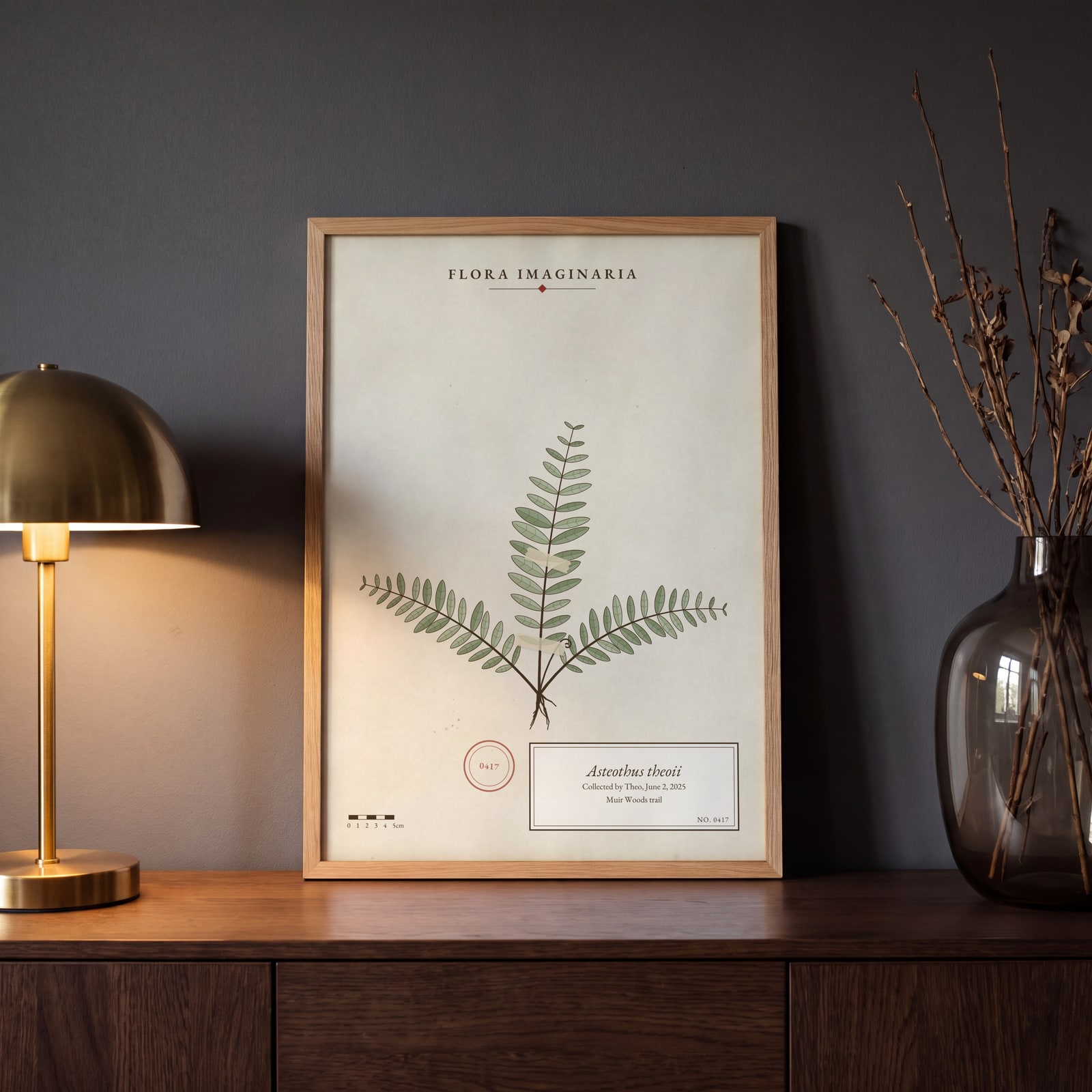 Herbarium sheet of an invented fern with its roots, taped to aged paper under the heading Flora Imaginaria, with a red stamp and a ruled specimen labelEdit this →
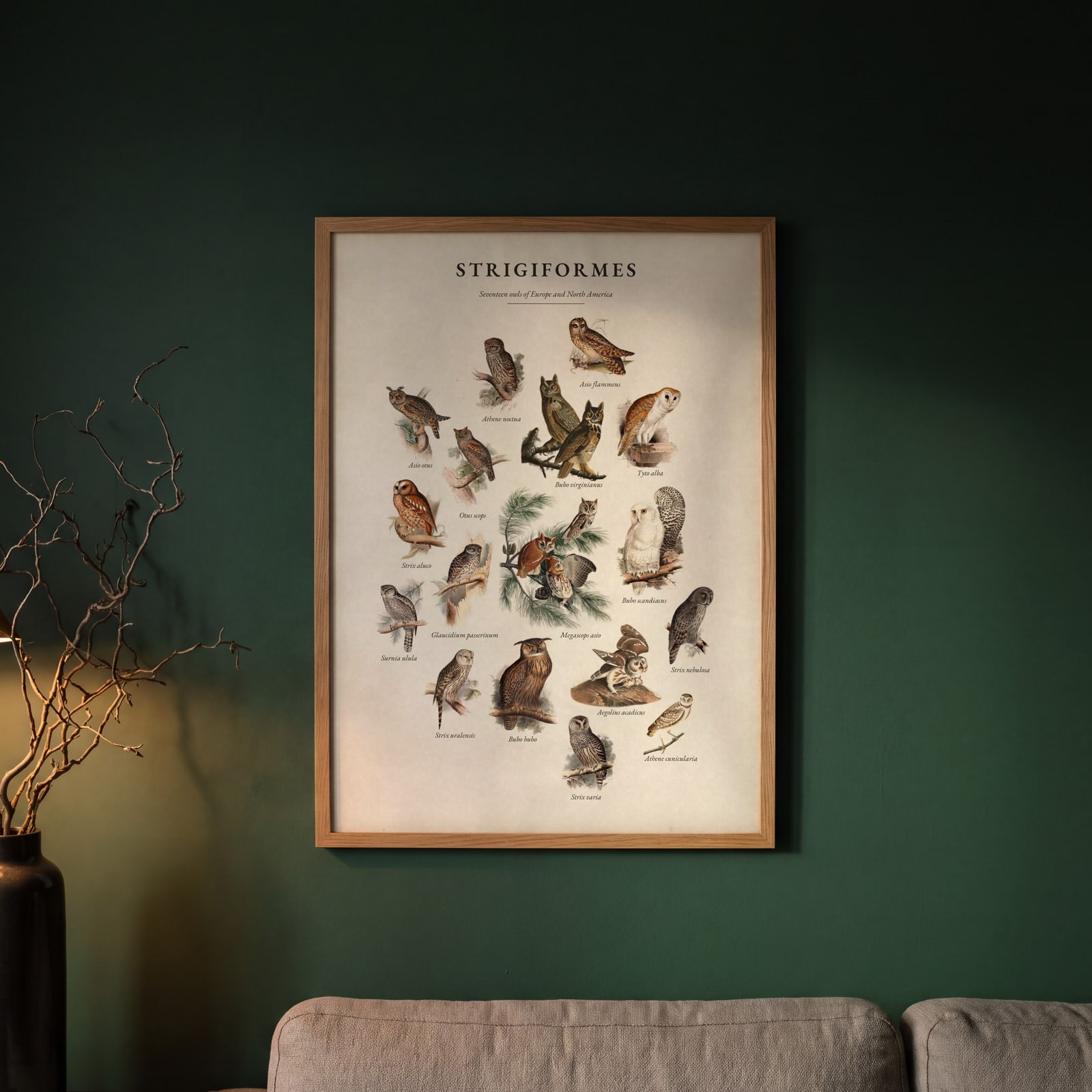 Plate of owls titled Strigiformes, barn, snowy, eagle and tawny owls among them, cut from old hand-colored bird books and named in Latin, on aged paperEdit this →
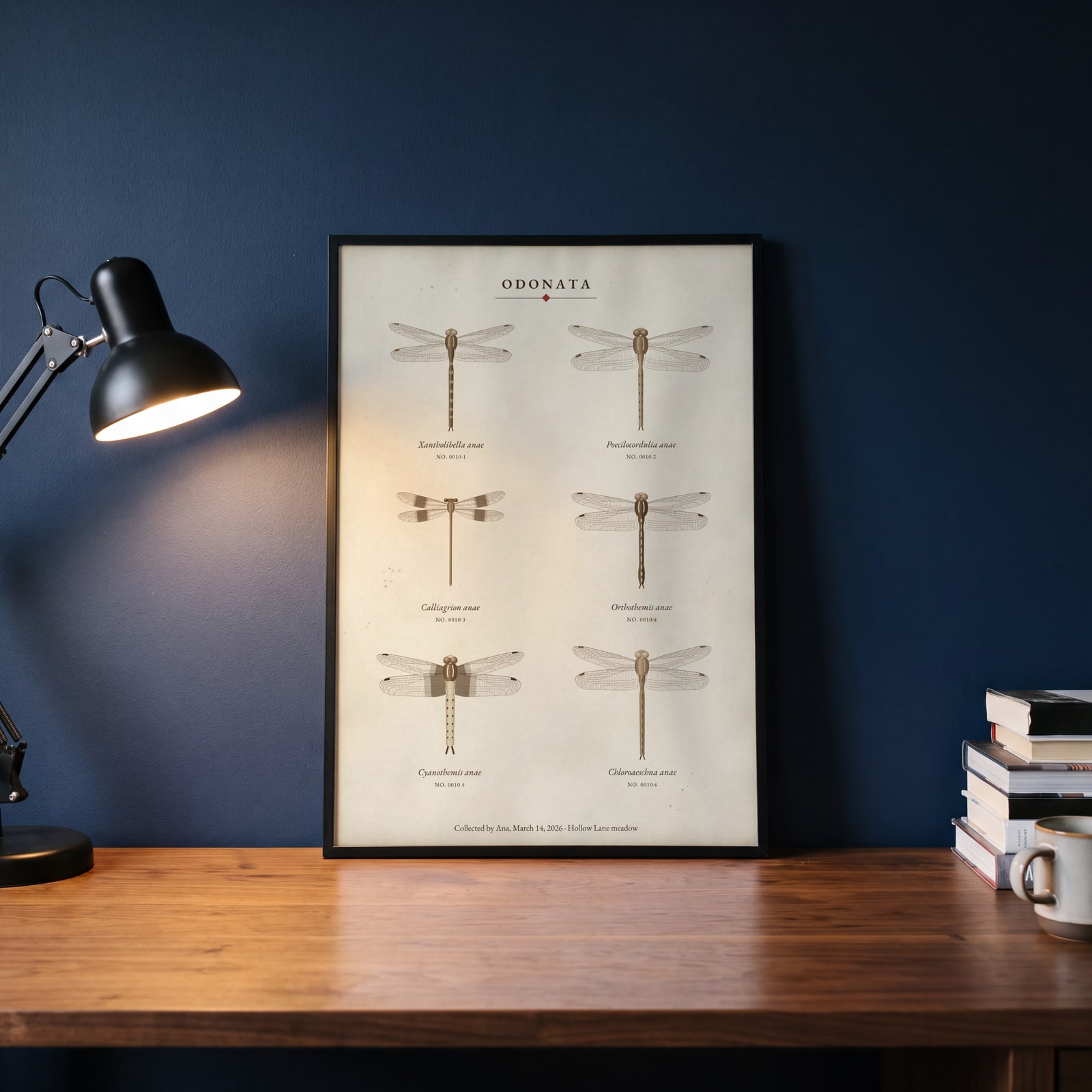 Plate of six invented dragonflies in sepia, titled Odonata, their netted wings spread, each labeled in Latin, on aged paperEdit this →
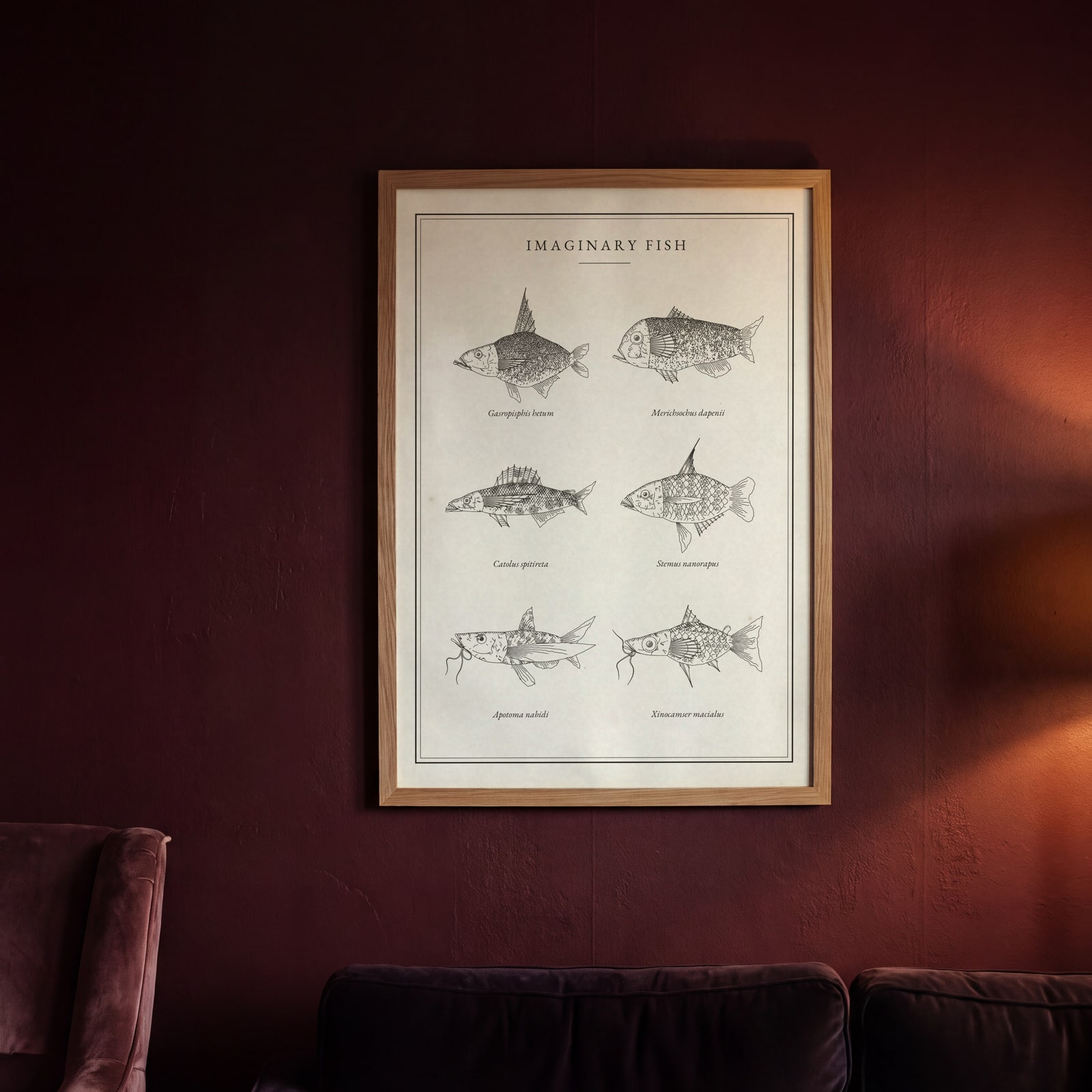 Pen engraving of six imaginary fish in two columns on aged paper, each with its Latin name, titled Imaginary FishEdit this →
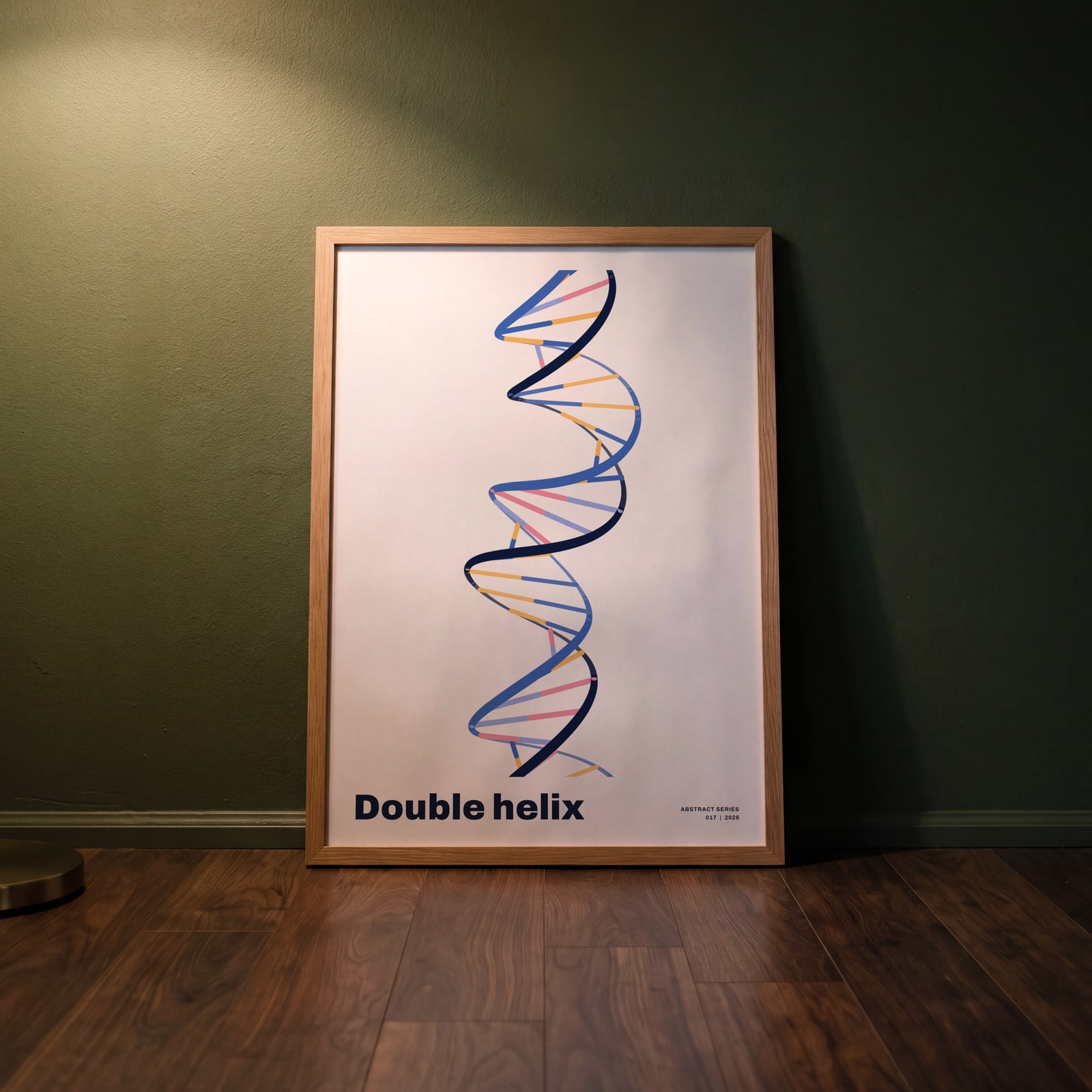 DNA double helix winding up a cream sheet, its two strands in navy and blue joined by base pairs in pink, yellow and blue, titled Double helixEdit this →
Examples
Open any of them to change the words, the place, the date and the style, then download the print file.
Specimens on old plates
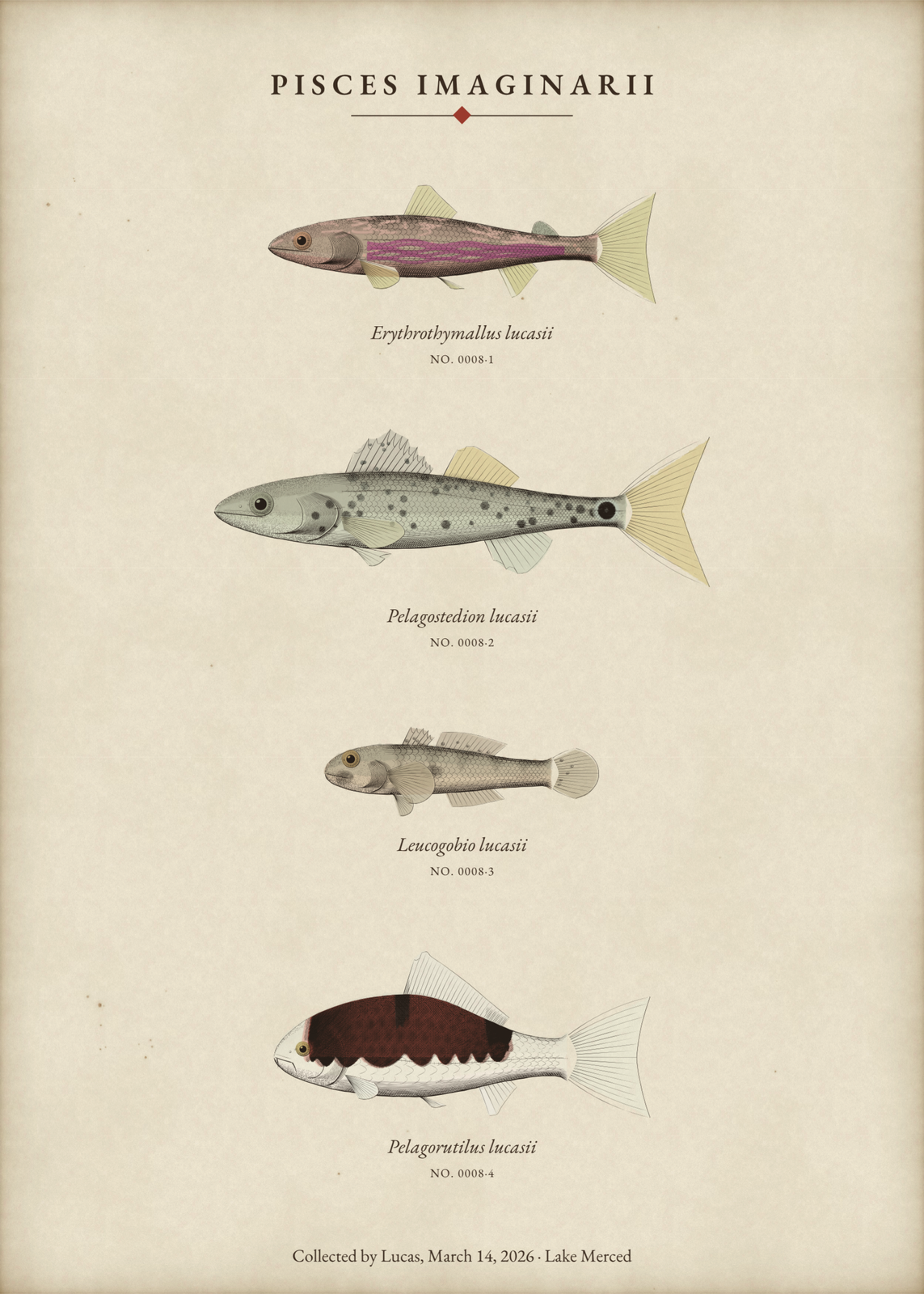 Hand-colored engraving of four invented freshwater fish stacked down an aged plate titled Pisces Imaginarii, each with its Latin nameEdit this →More fish art →
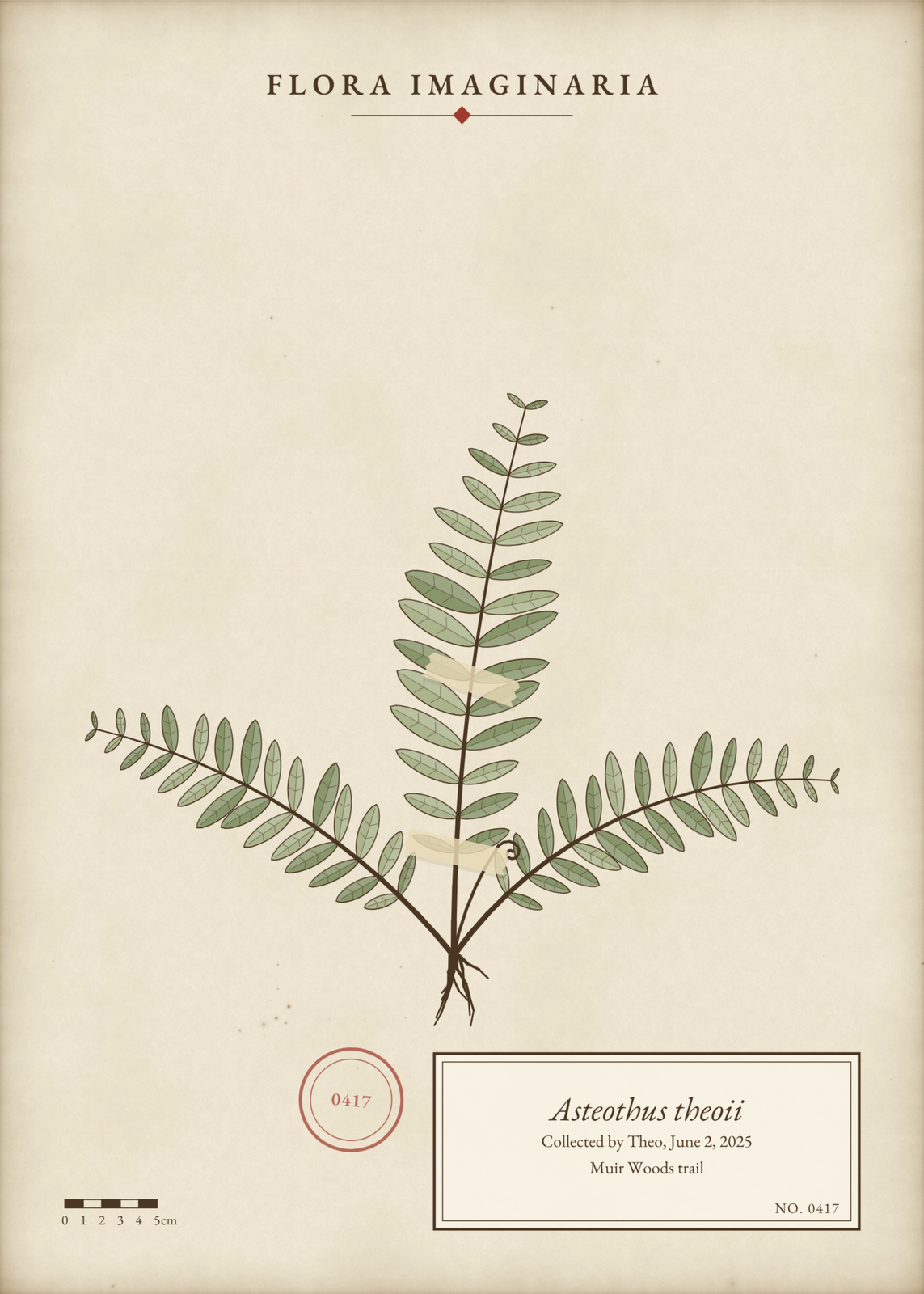 Herbarium sheet of an invented fern with its roots, taped to aged paper under the heading Flora Imaginaria, with a red stamp and a ruled specimen labelEdit this →More botanical prints →
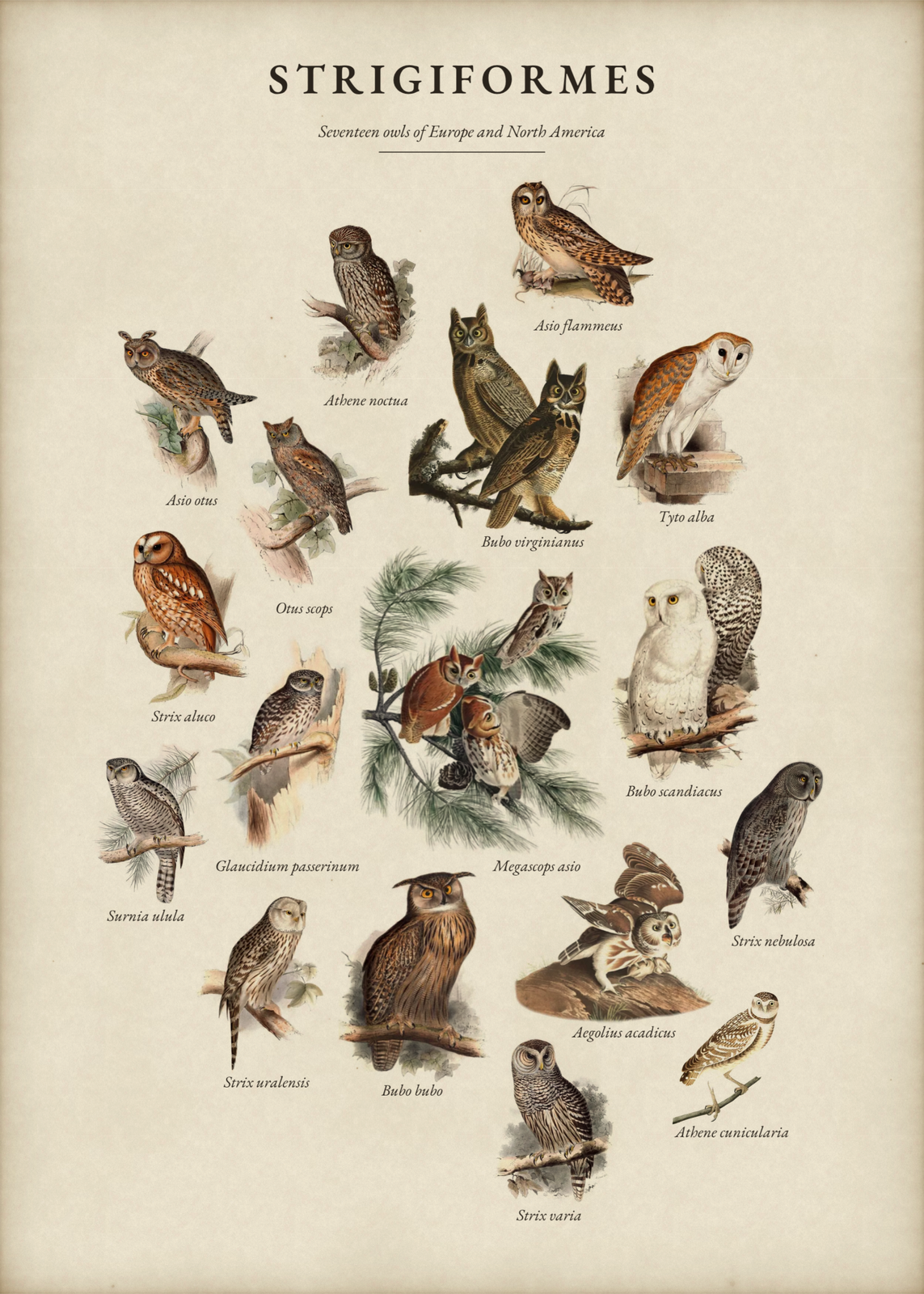 Plate of owls titled Strigiformes, barn, snowy, eagle and tawny owls among them, cut from old hand-colored bird books and named in Latin, on aged paperEdit this →More bird prints →
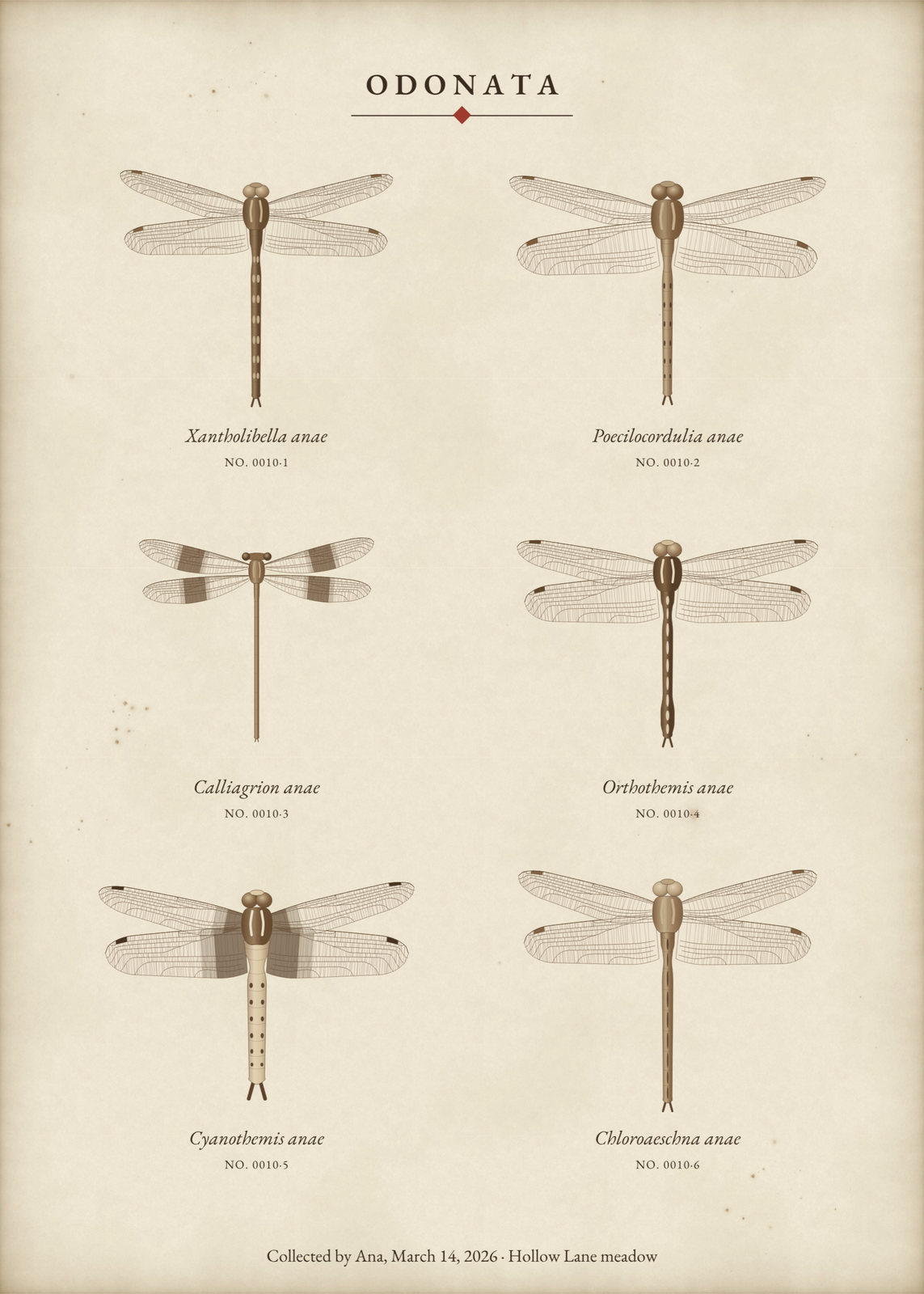 Plate of six invented dragonflies in sepia, titled Odonata, their netted wings spread, each labeled in Latin, on aged paperEdit this →More insect art →
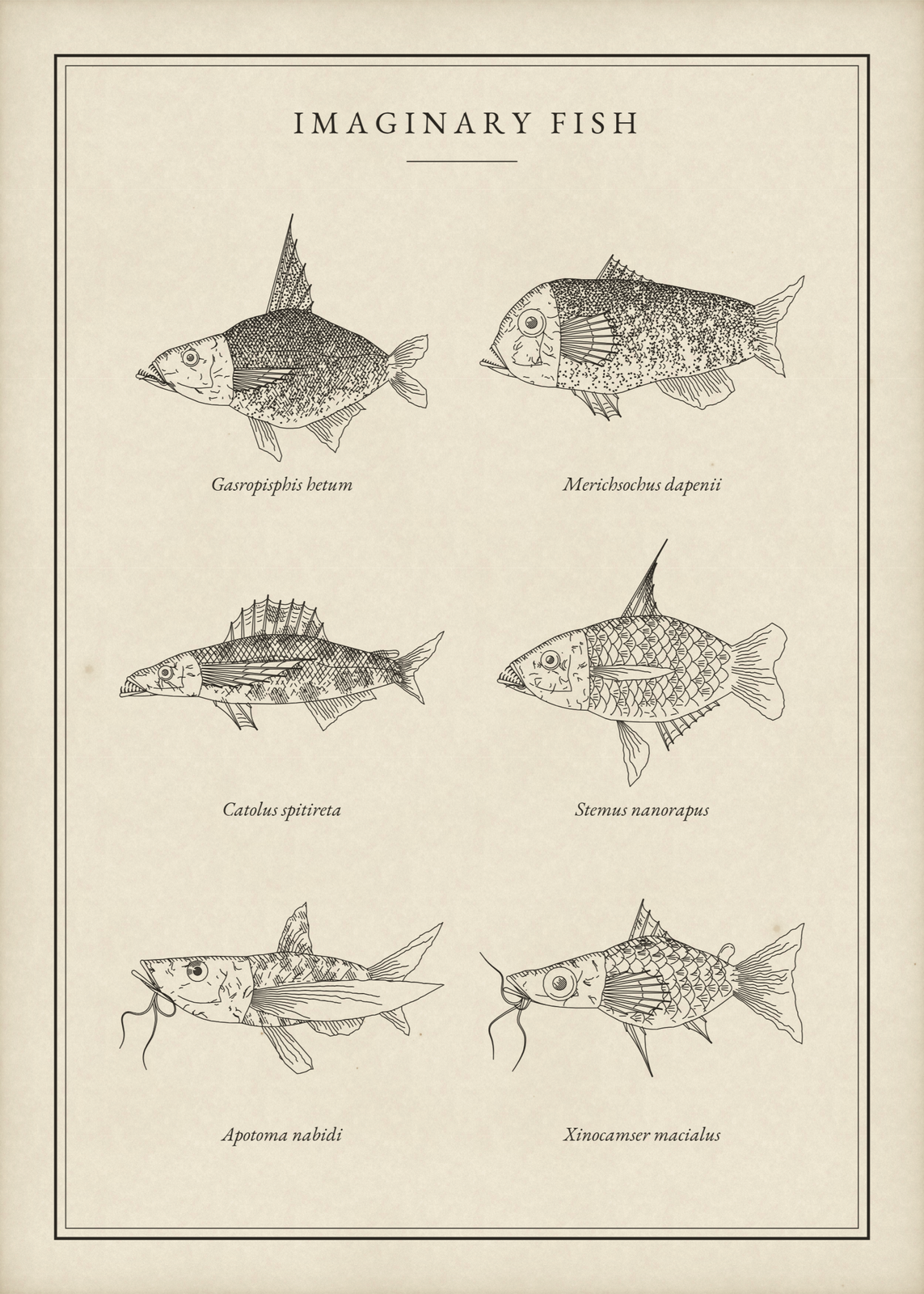 Pen engraving of six imaginary fish in two columns on aged paper, each with its Latin name, titled Imaginary FishEdit this →More fish line art →
DNA, cells and growth
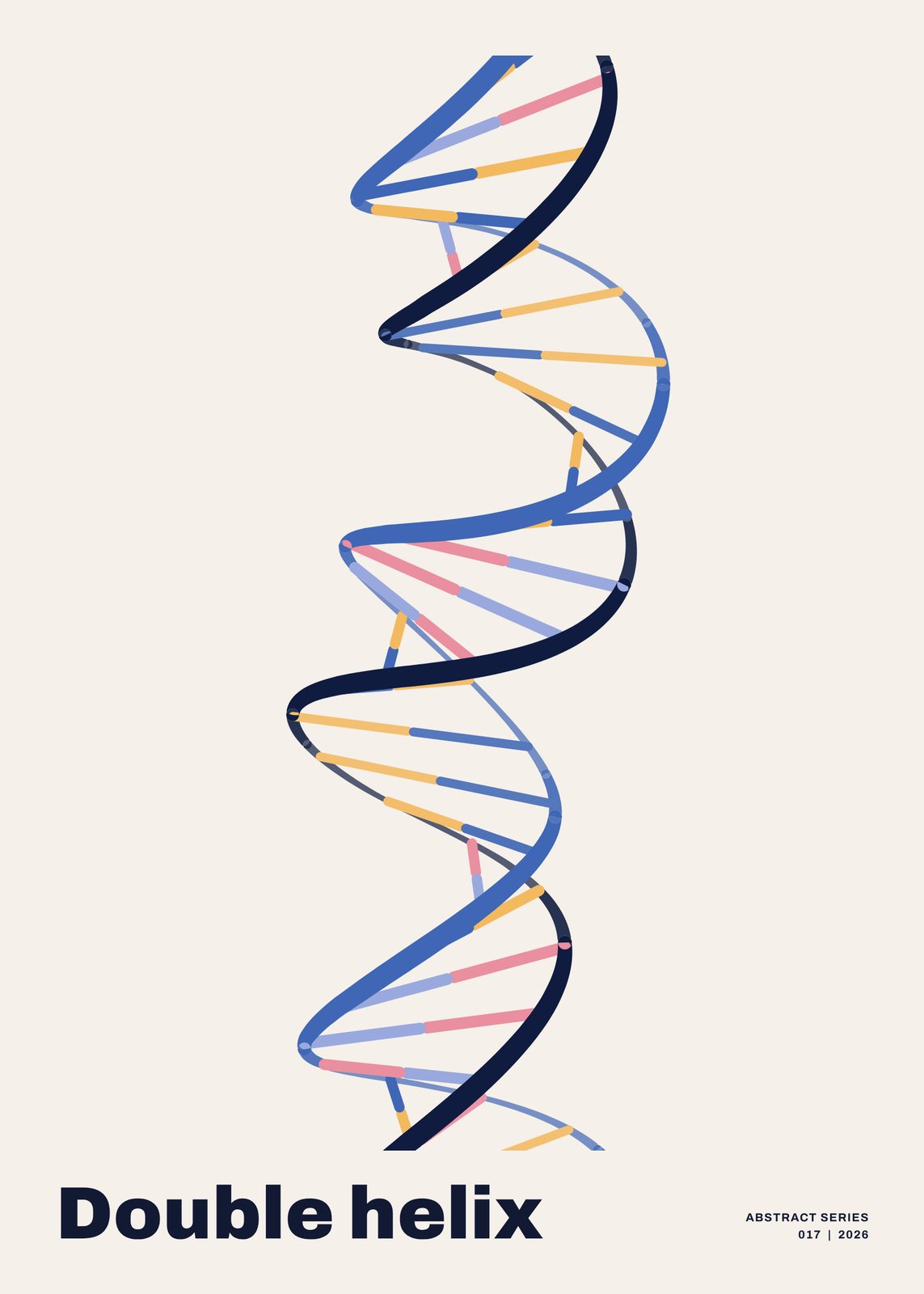 DNA double helix winding up a cream sheet, its two strands in navy and blue joined by base pairs in pink, yellow and blue, titled Double helixEdit this →More abstract art →
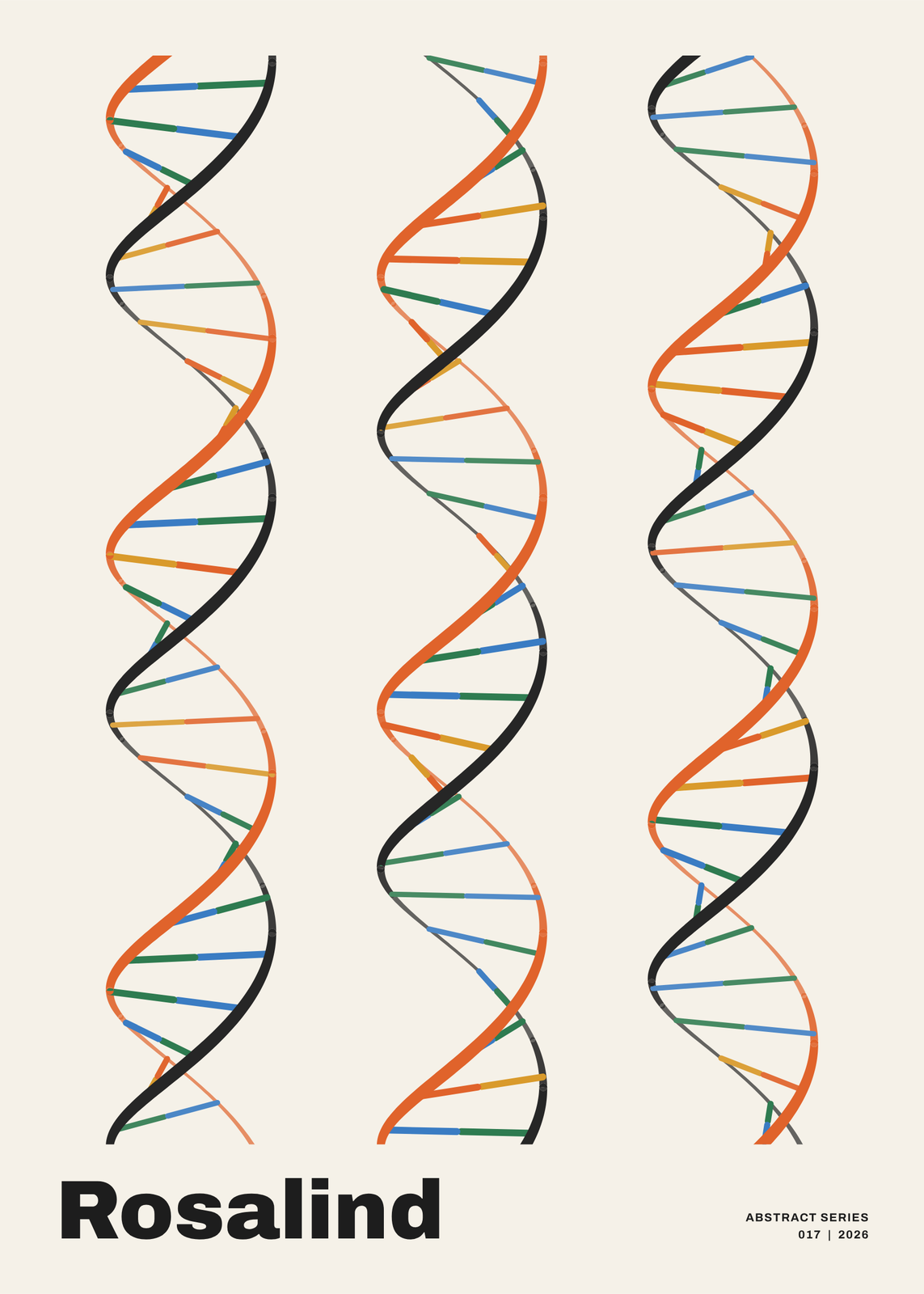 Three DNA double helixes side by side in orange and black on cream, their base pairs spelling the name Rosalind in colored rungsEdit this →More abstract art →
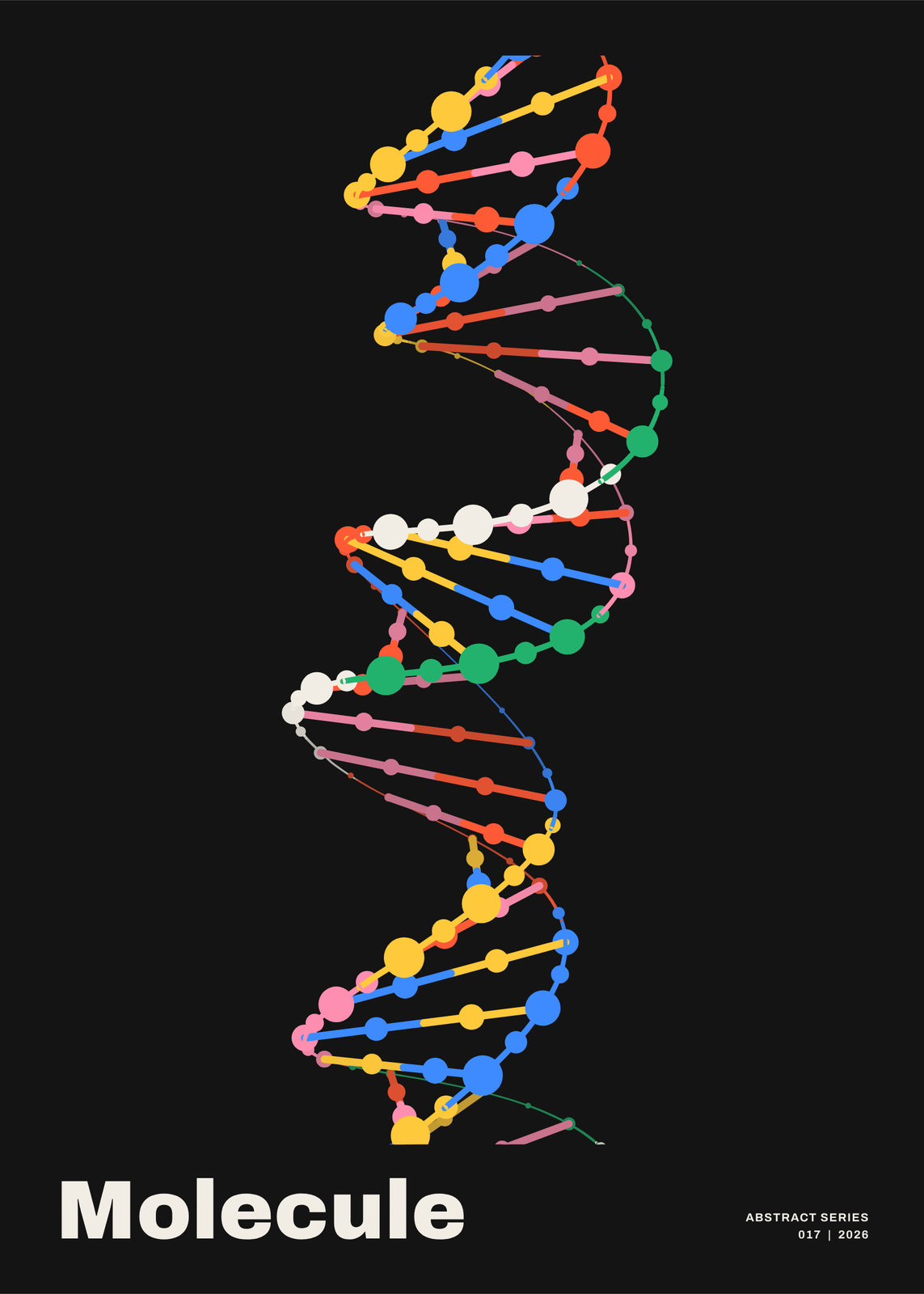 Ball-and-stick model of a DNA molecule on black, beads in yellow, pink, blue, green and white twisting round two strands, titled MoleculeEdit this →More abstract art →
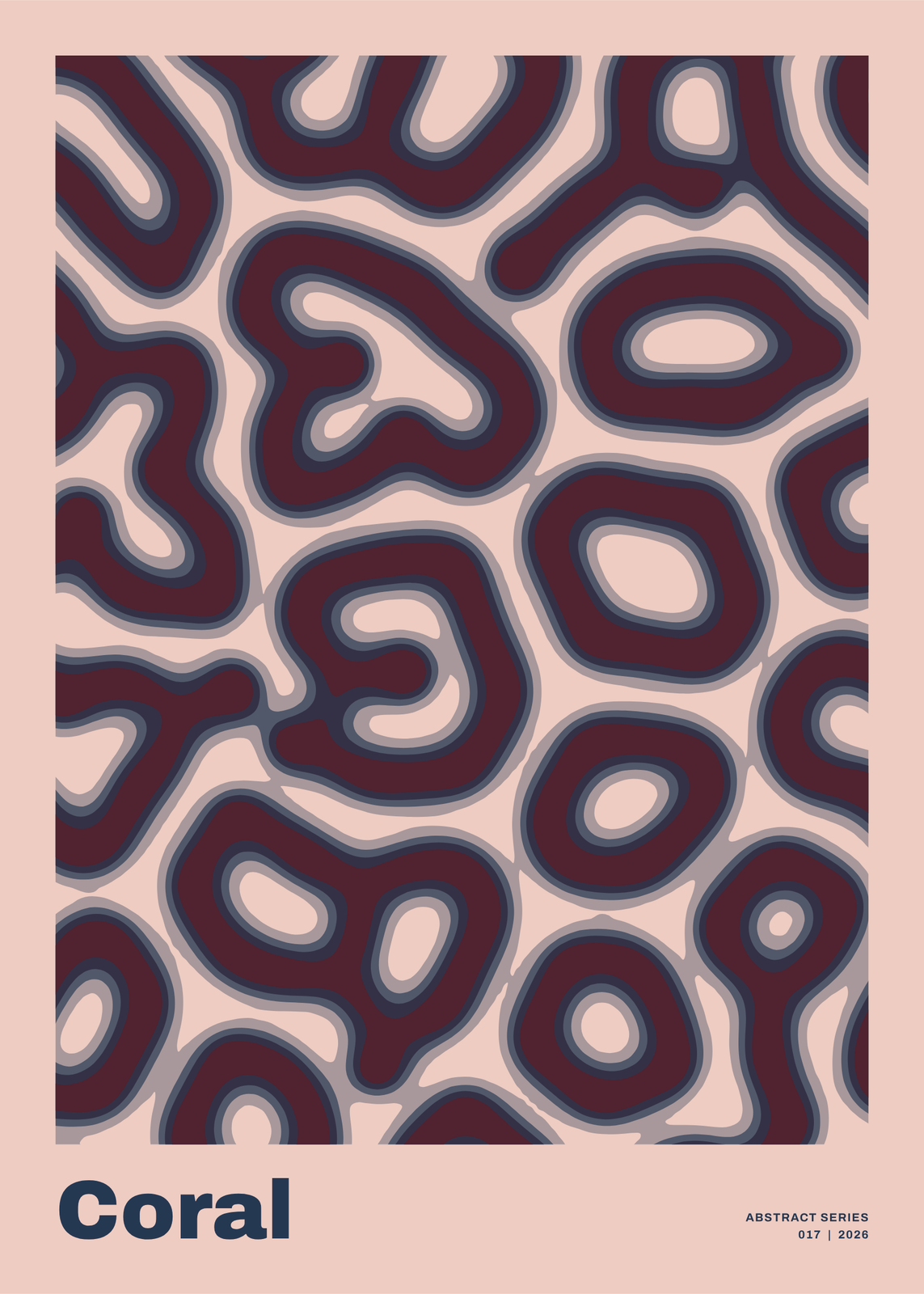 Reaction-diffusion pattern: worm-like stripes and spots, the kind of pattern Turing described for animal markings, titled CoralEdit this →More abstract art →
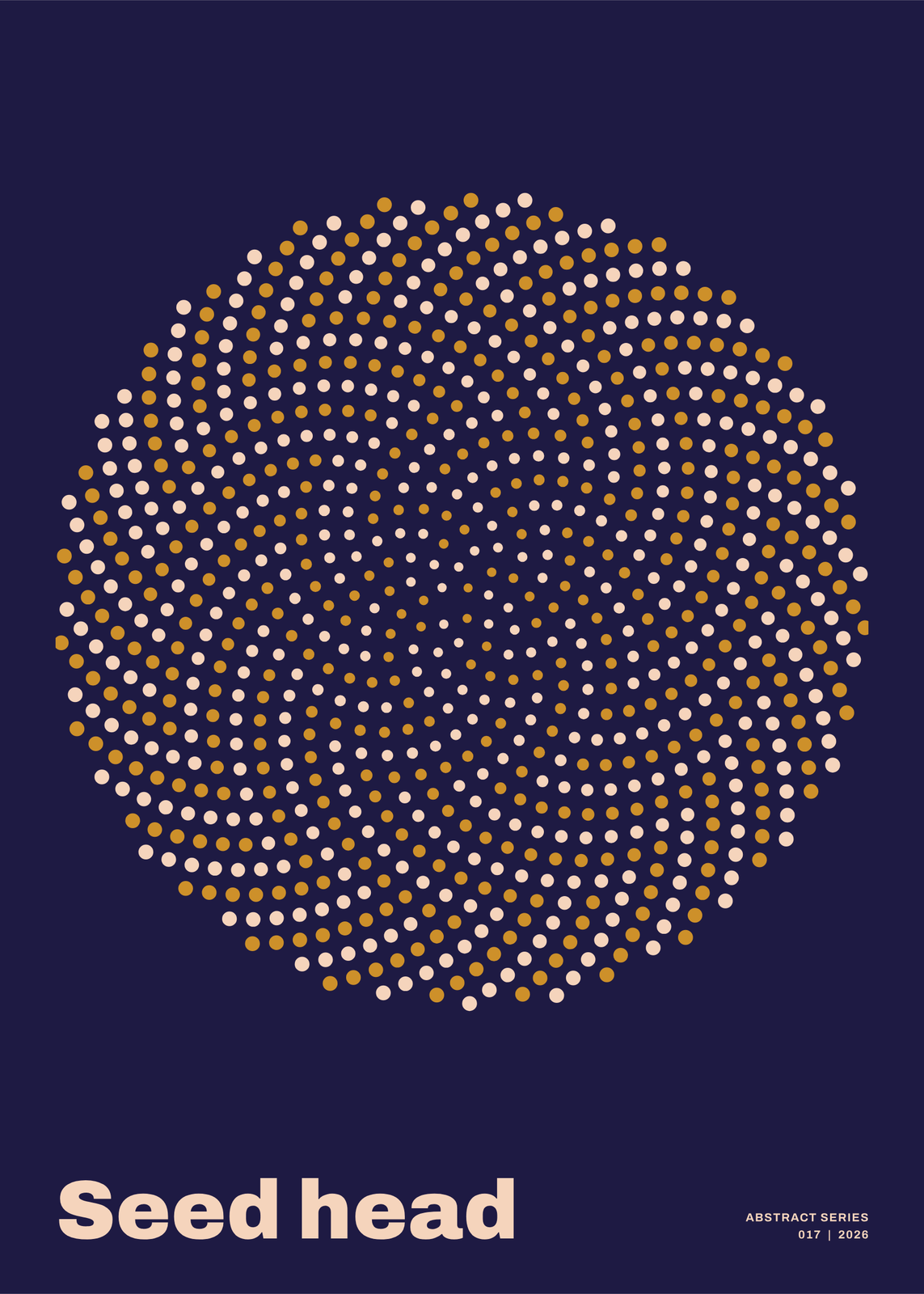 Phyllotaxis: hundreds of gold and white seeds spiraling out from the center like a sunflower's seed head, on dark indigo, titled Seed headEdit this →More abstract art →
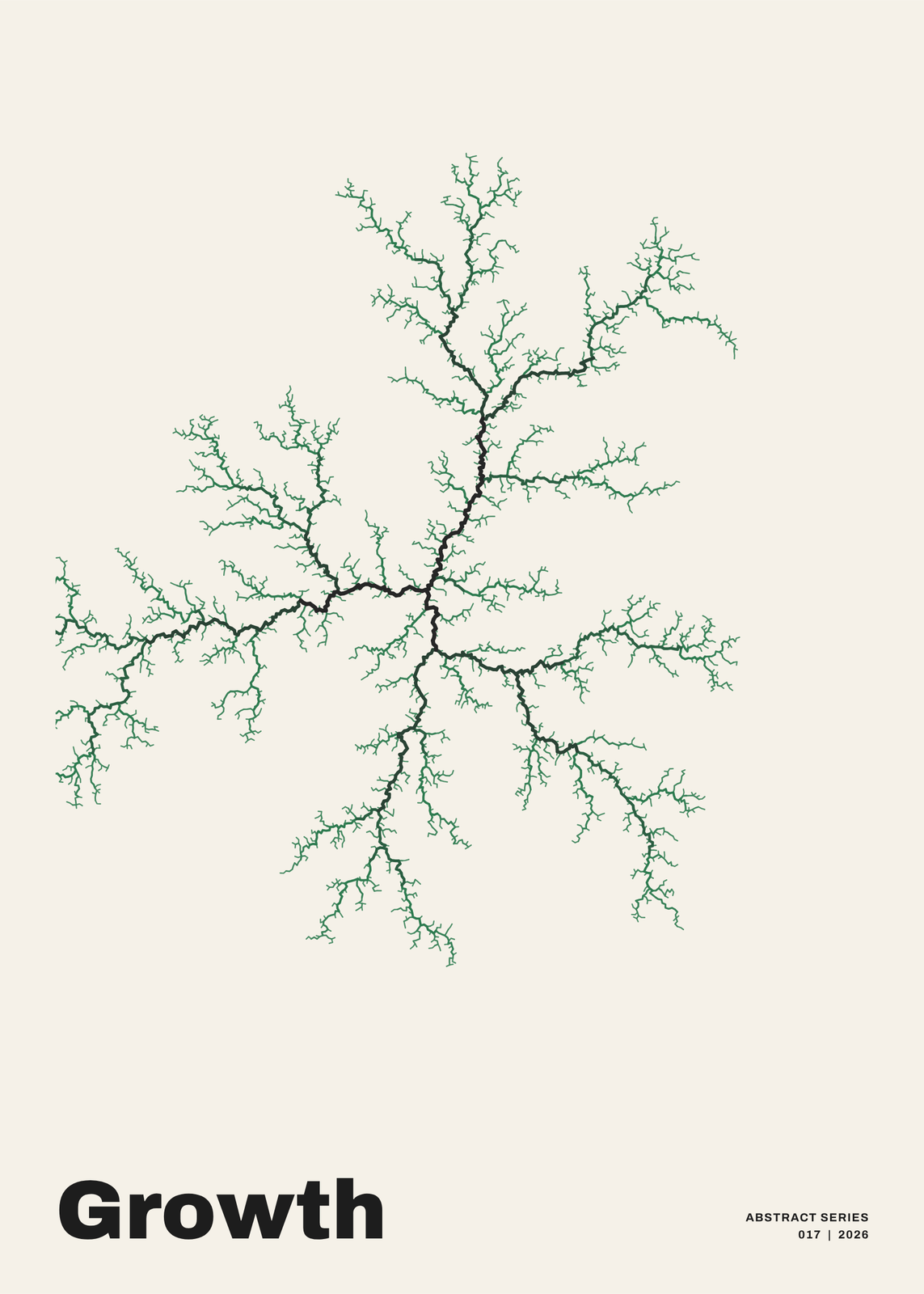 Coral growth in fine green branches spreading from a single point on cream, grown one particle at a time, titled GrowthEdit this →More abstract art →
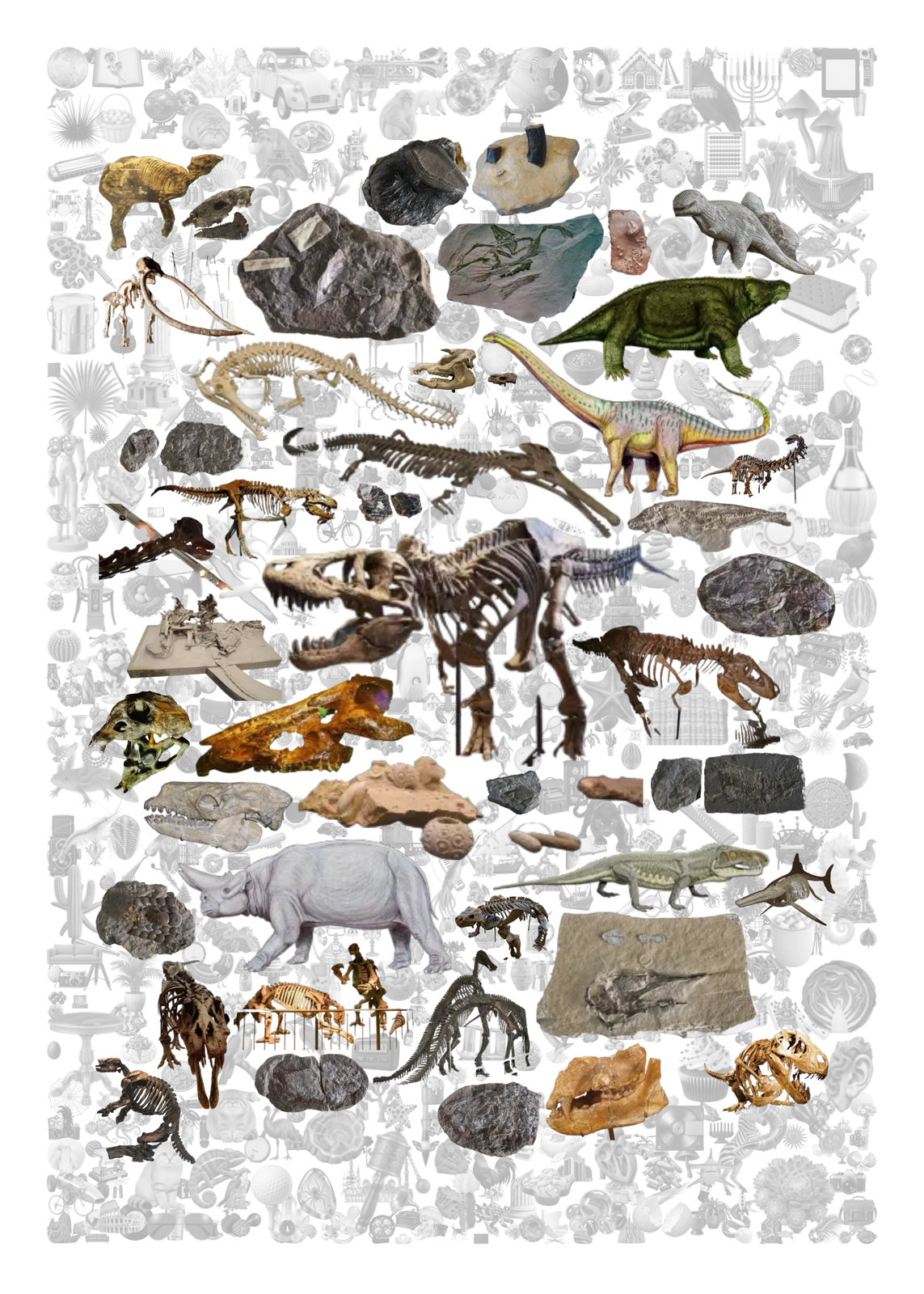 Collage of real fossils and dinosaur skeletons, skulls, ammonites and rocks cut from photos and packed together on a gray field of moreEdit this →More collage art →
Earth and its climate
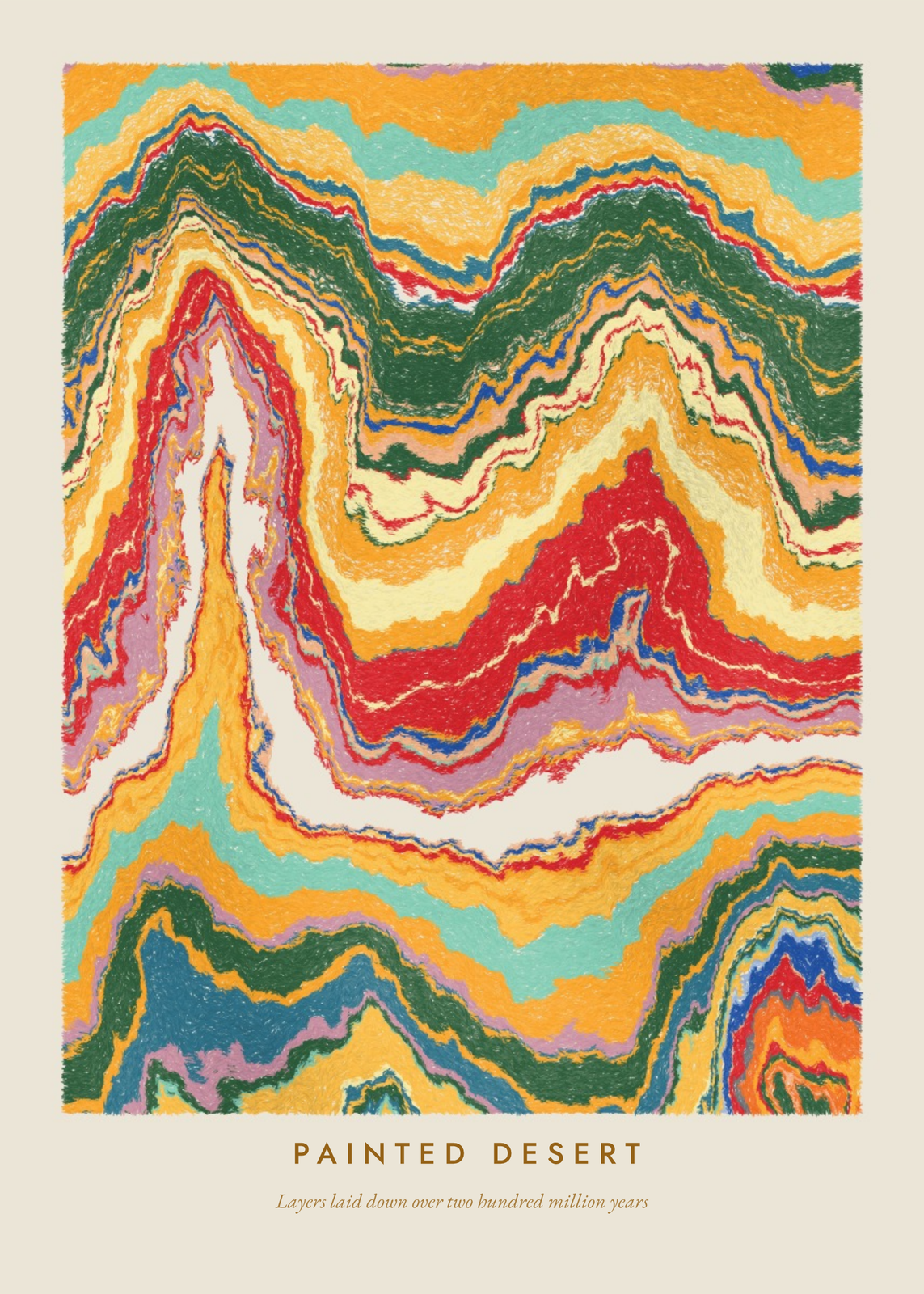 Geology art of rock layers folded upward in orange, red, teal, green and cream, titled Painted Desert with a line on how the layers were laid downEdit this →More geology art →
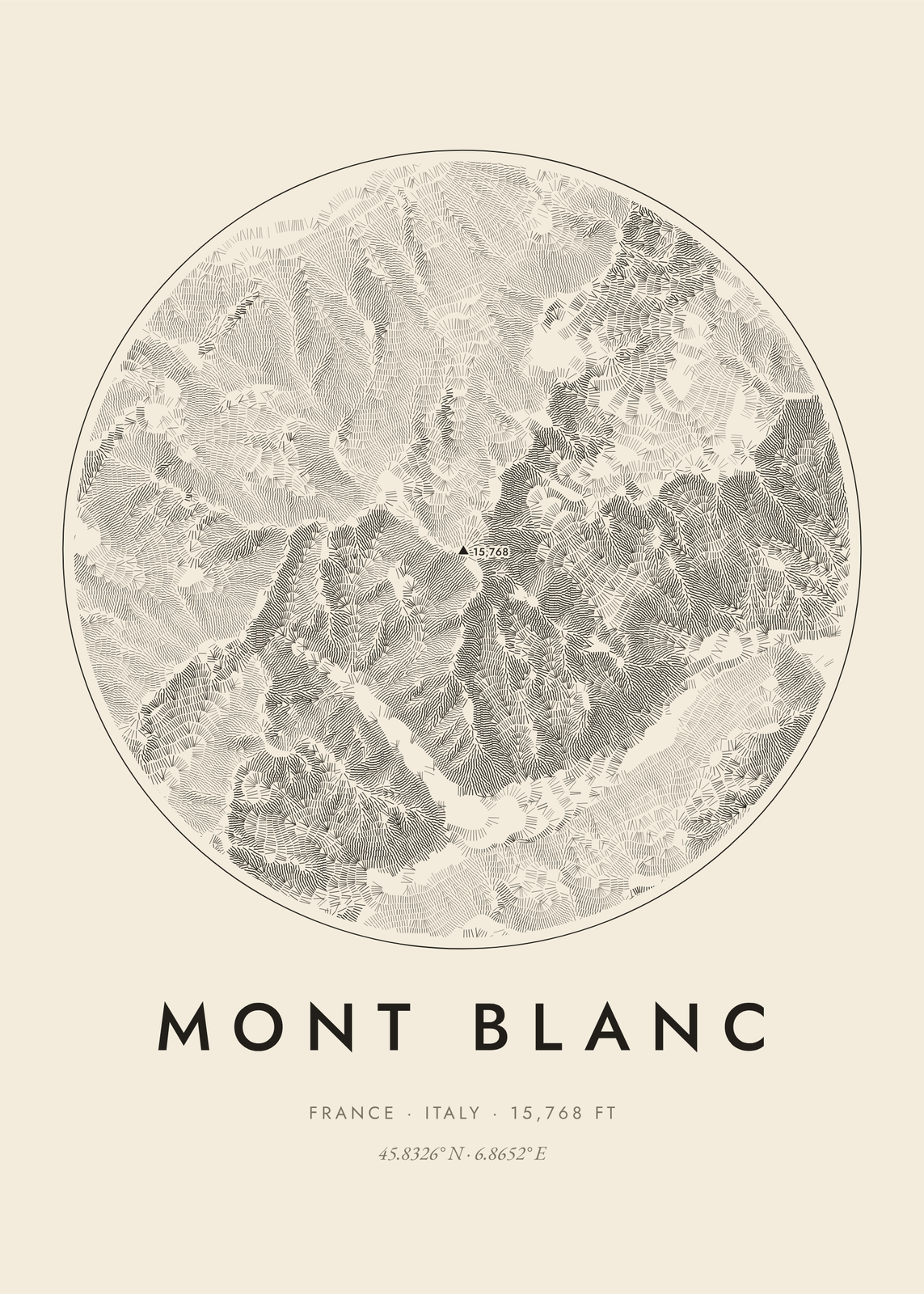 Old survey map of Mont Blanc in gray hachures inside a circle, titled Mont Blanc with its height and coordinates, on creamEdit this →More topographic map art →
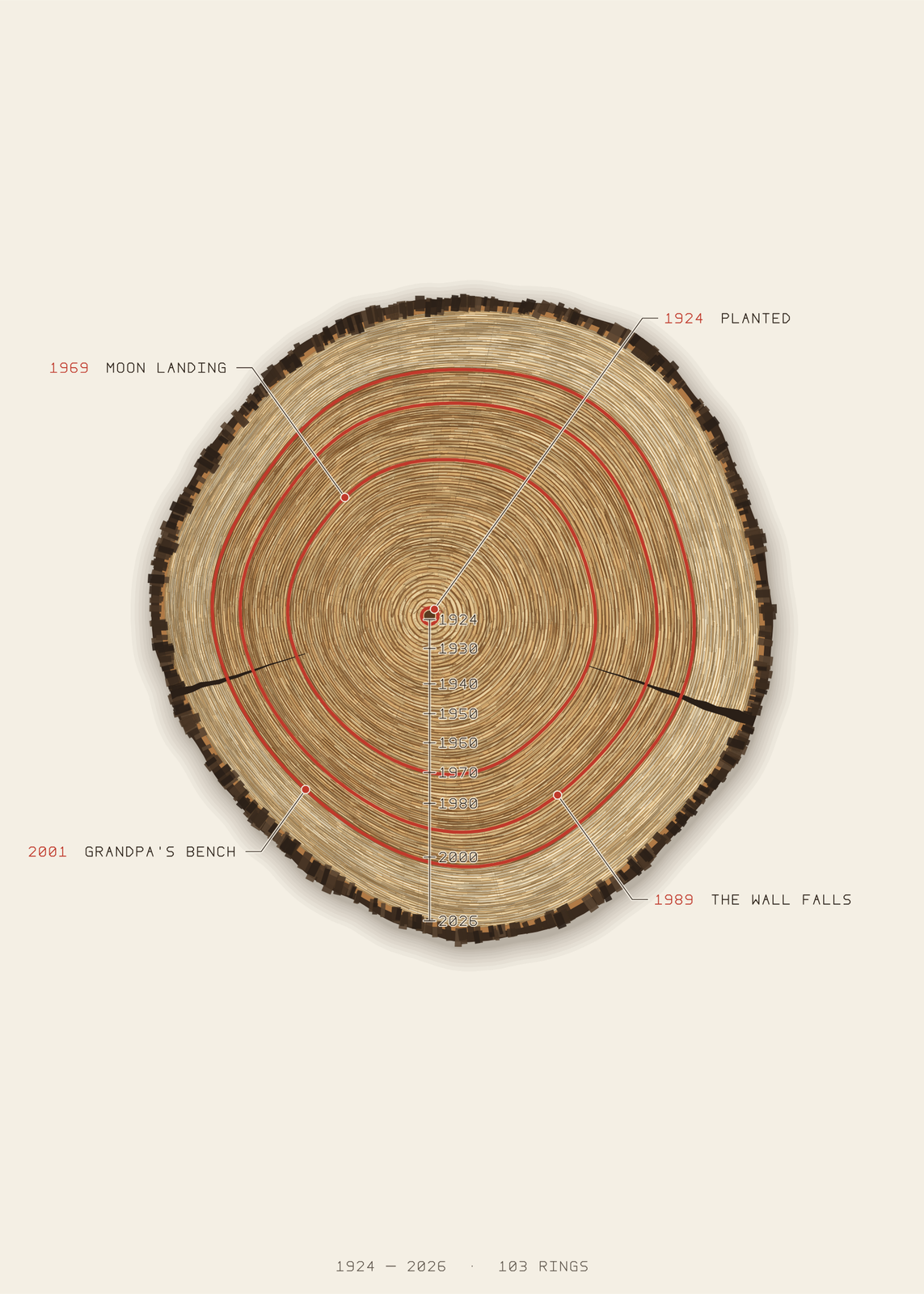 Tree ring slice of a century-old oak, years marked in red from 1924 Planted through 1969 Moon landing and 1989 The wall falls to 2001 Grandpa's bench, on creamEdit this →More tree ring art →
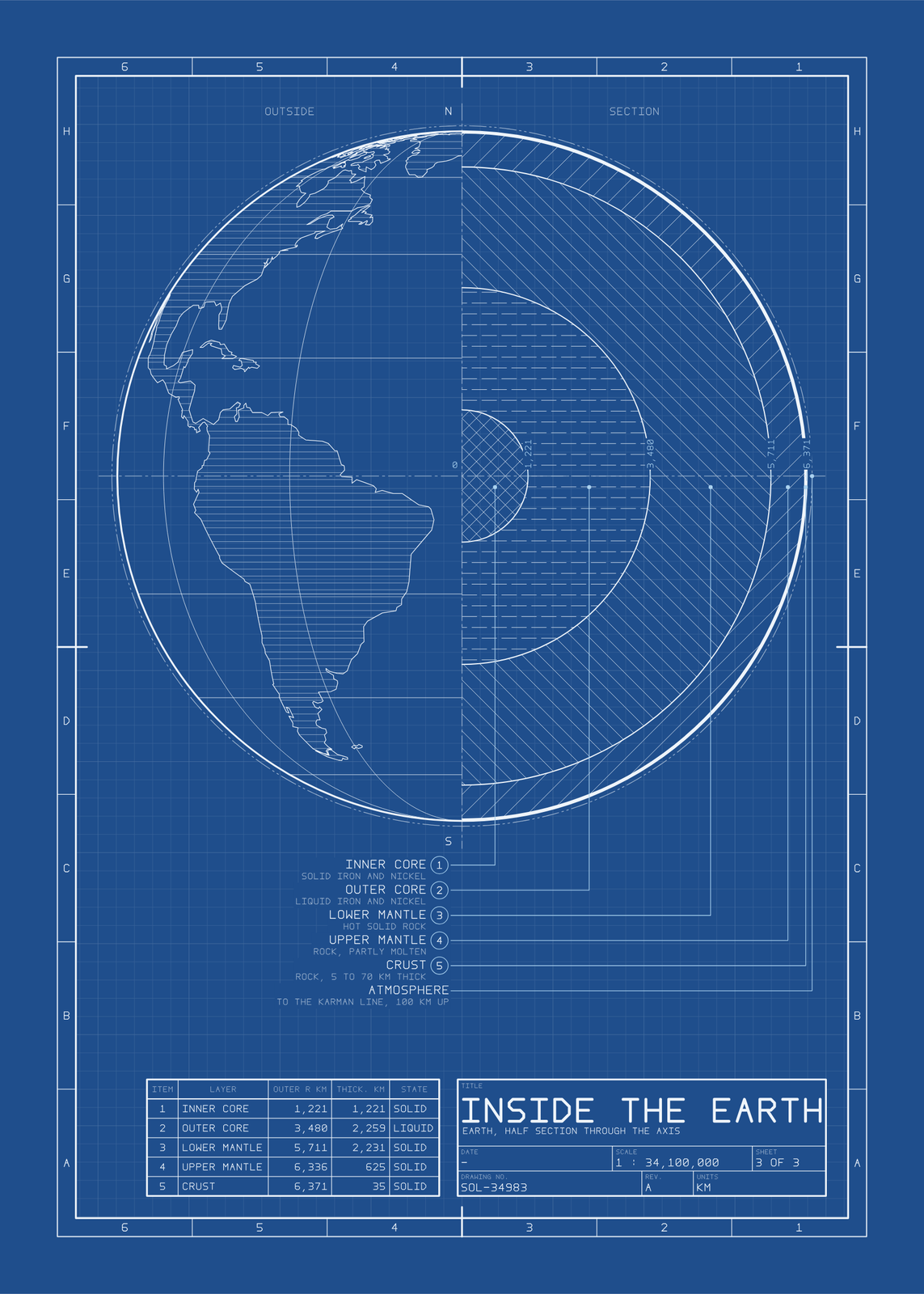 Blueprint of the Earth cut in half, the Americas on one side and its core and mantle hatched in layers on the other, white lines on blue, titled Inside the Earth in a title blockEdit this →More solar system posters →
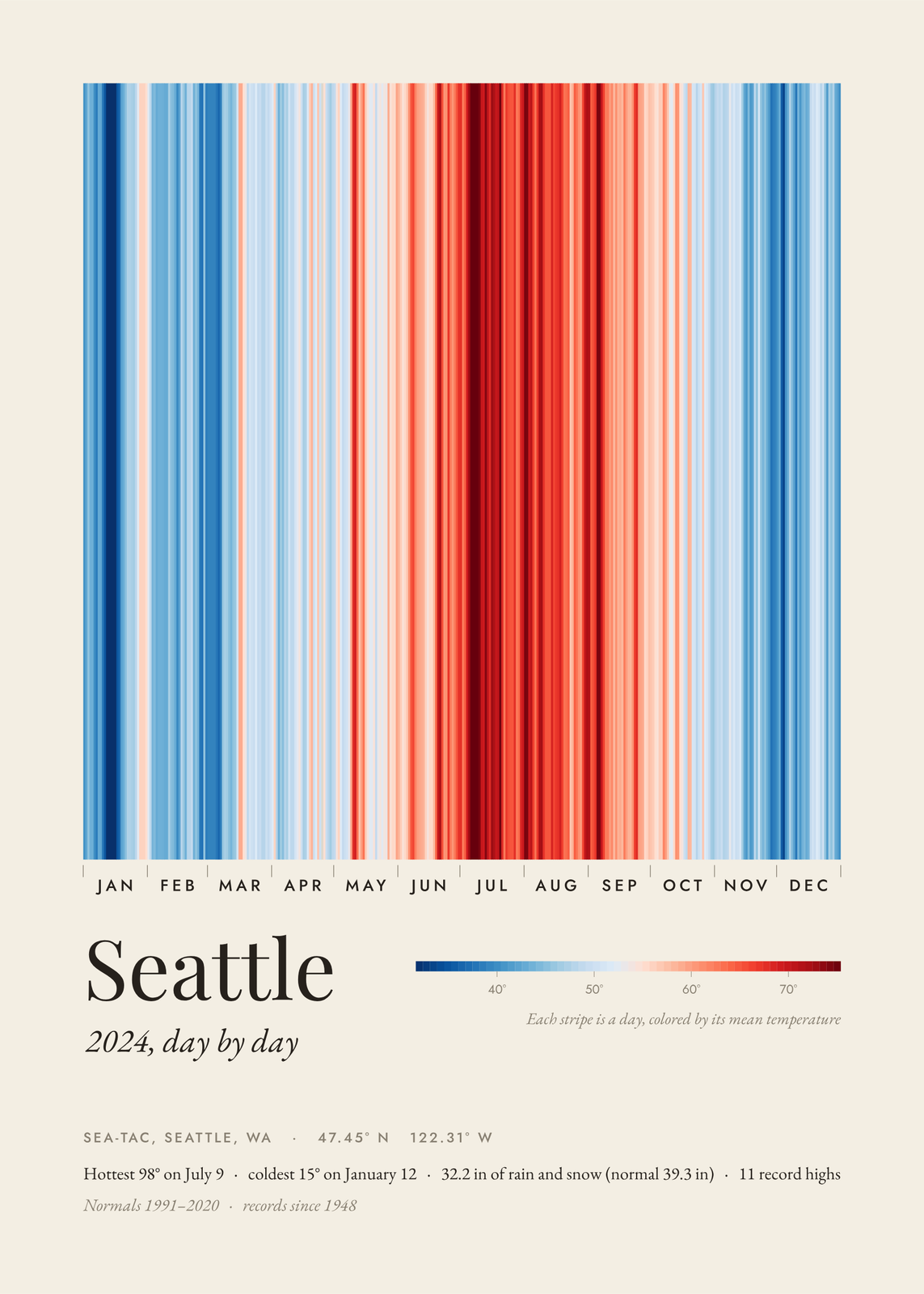 Climate stripes of a year in Seattle, one stripe per day from deep blue to dark red by its temperature, with the hottest and coldest days noted belowEdit this →More weather posters →
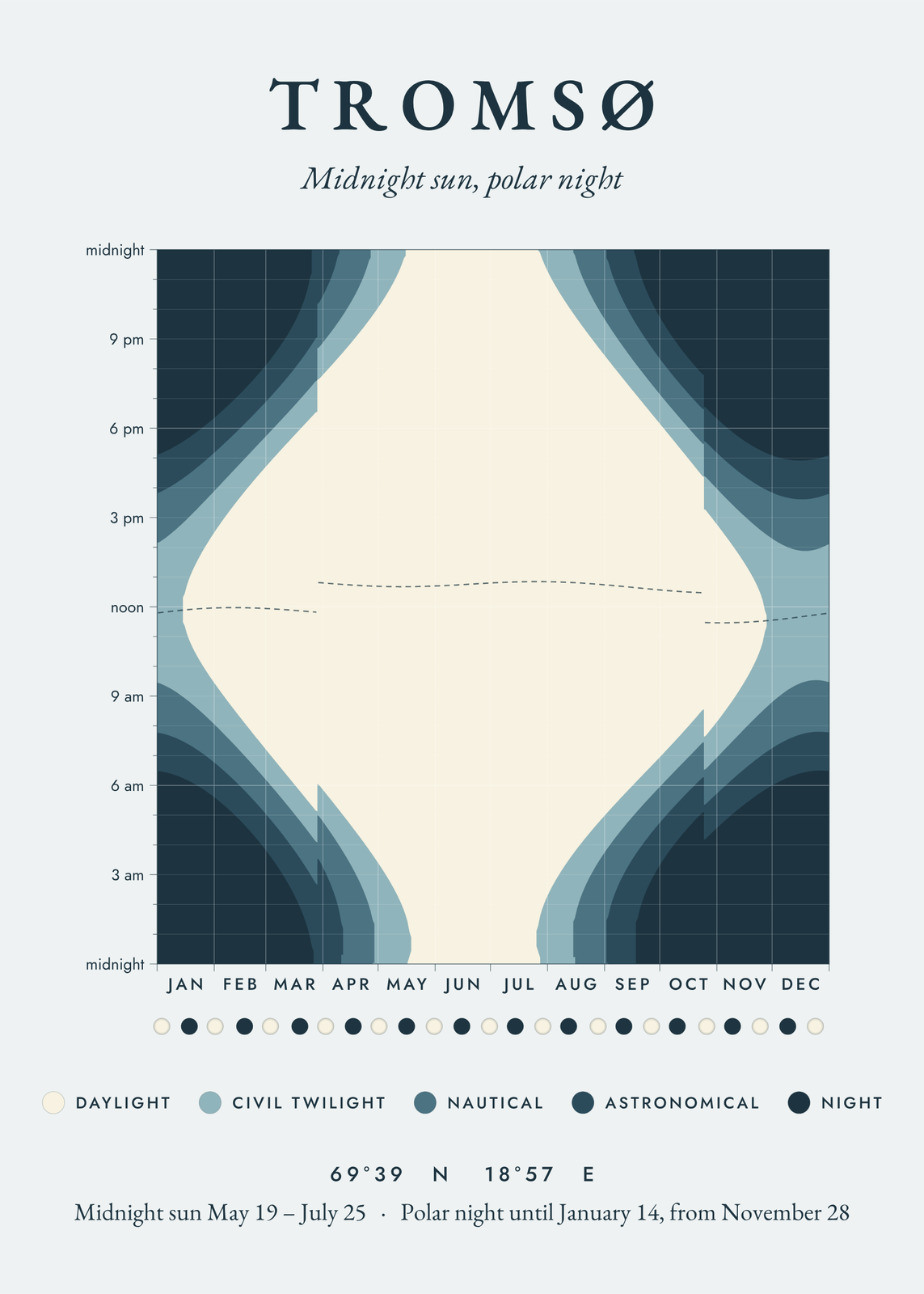 Daylight chart of a year in Tromsø: a cream hourglass of day between dark blue bands of twilight and night, the midnight sun in summer and polar night in winterEdit this →More sunrise charts →
Sky charts
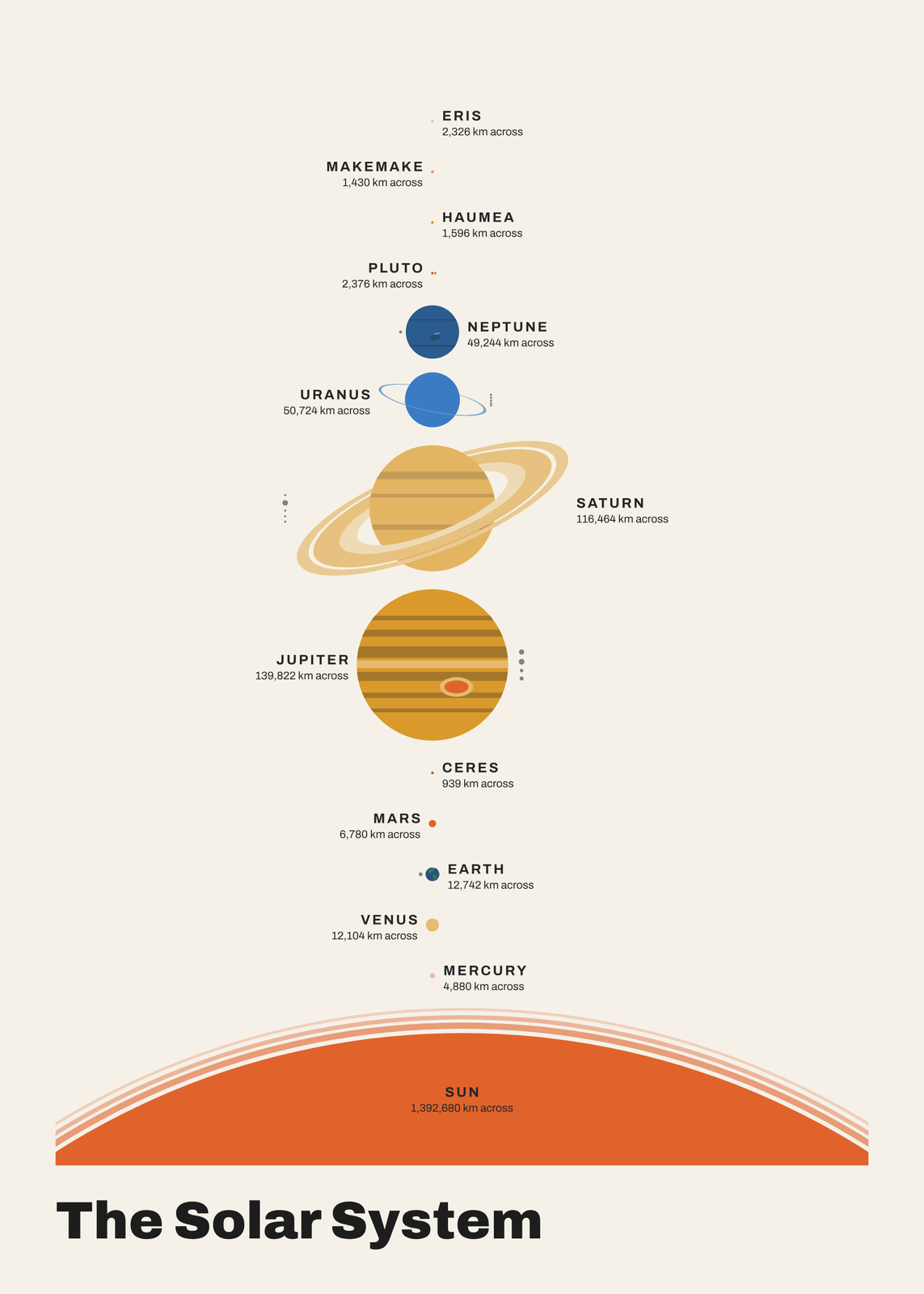 Solar system chart to scale on cream: the planets, dwarf planets and big moons stacked up from the Sun's orange rim, each named with its size, titled The Solar SystemEdit this →More solar system posters →
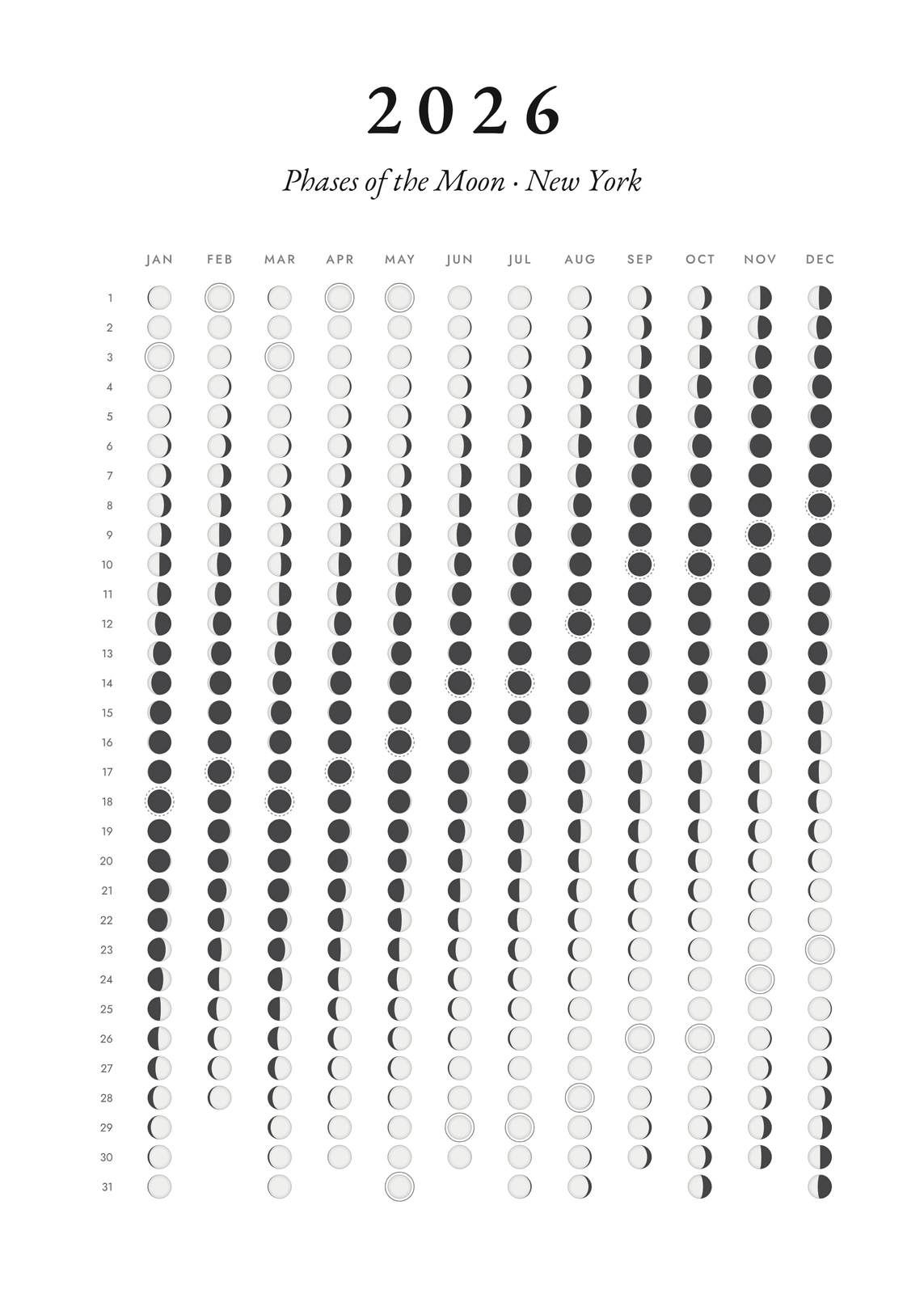 Every phase of the Moon in 2026 for New York, a column of gray and white discs for each month, titled 2026, on whiteEdit this →More moon phase posters →
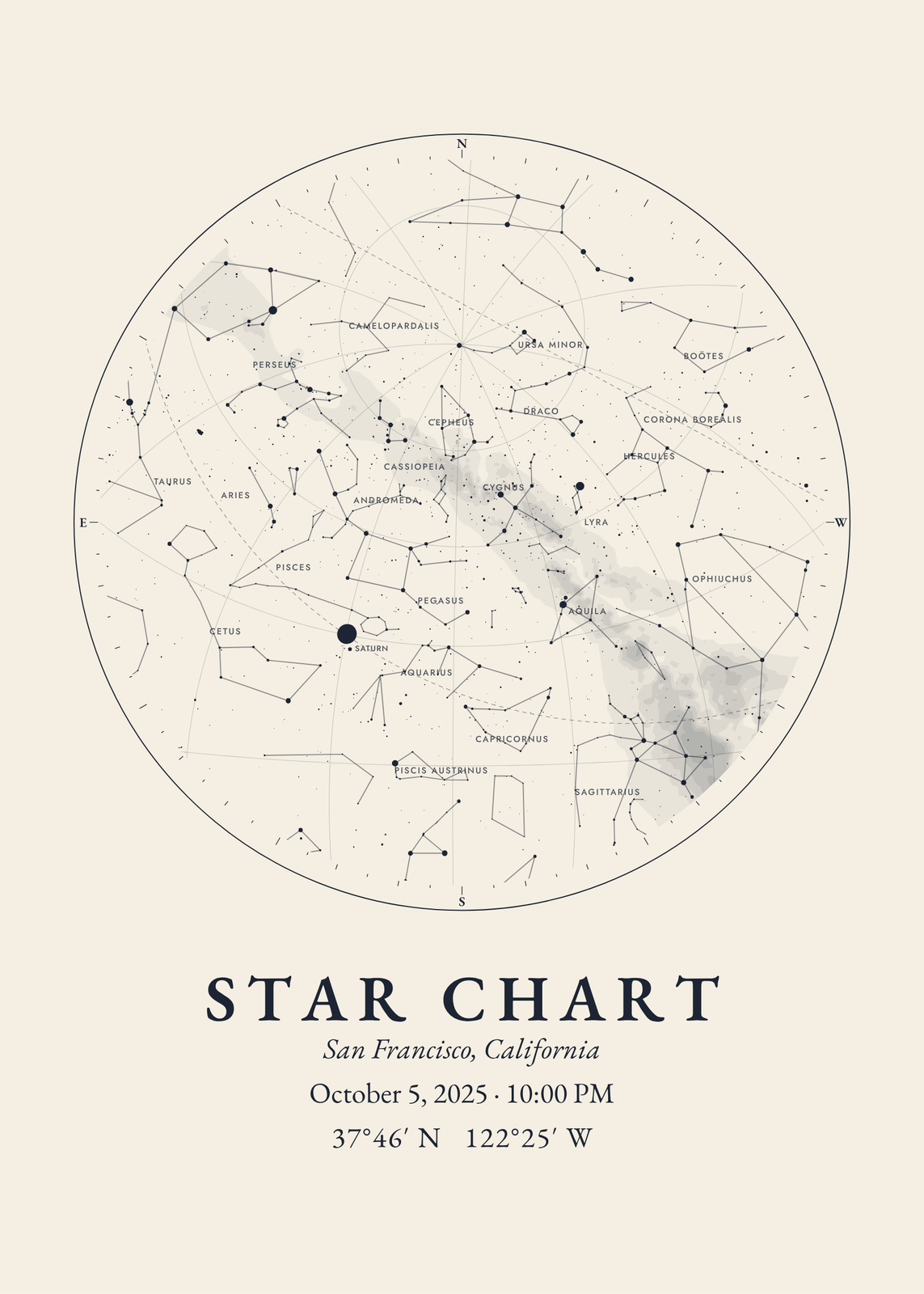 Star chart of the sky over San Francisco on a night in 2025: constellations, the Milky Way and a celestial grid with the ecliptic, in gray on creamEdit this →More star maps →
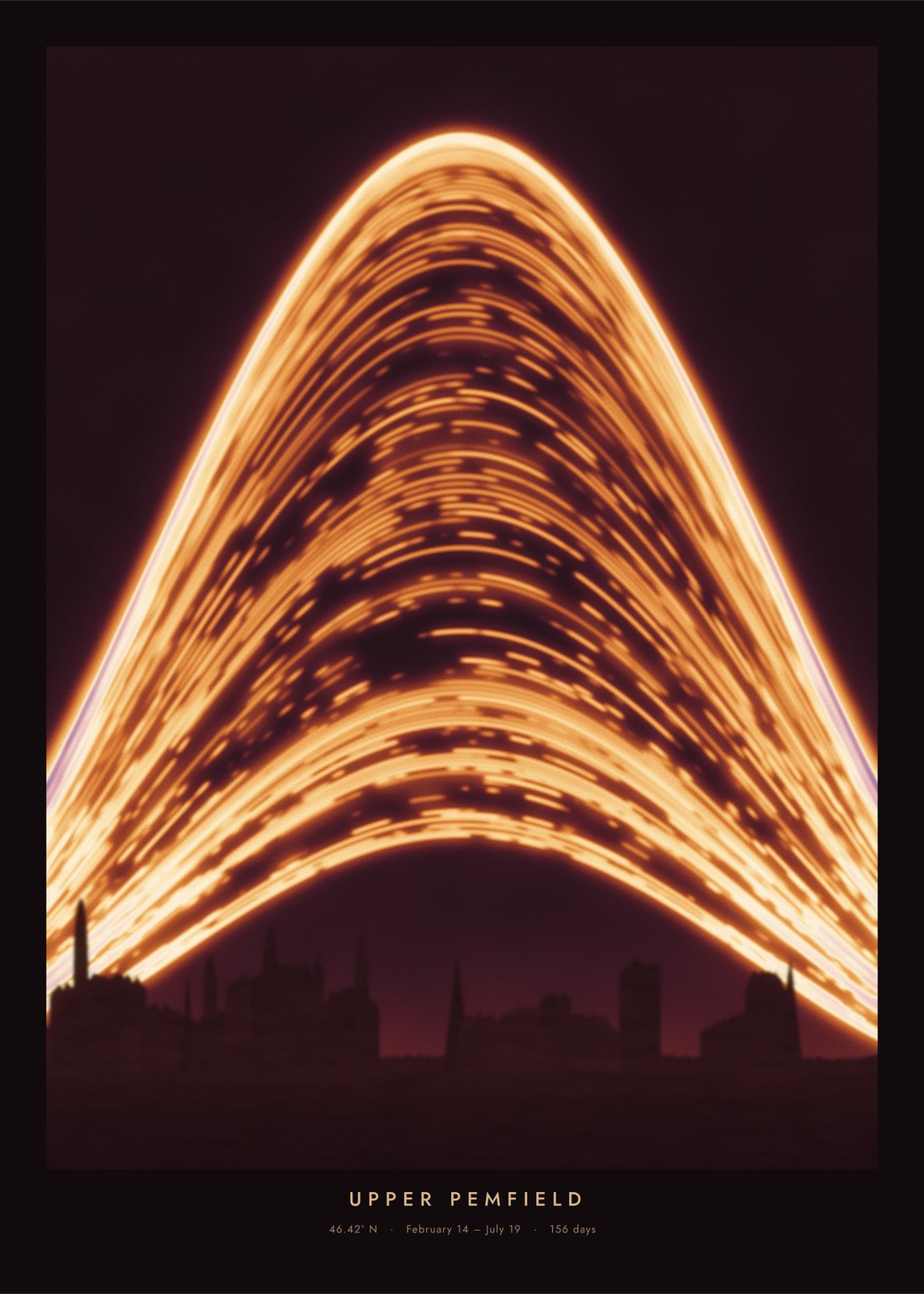 Solargraph: half a year of the Sun's path burned in glowing orange arcs over a dark skyline, one arc a day, low in winter and high in summerEdit this →More solargraphy →
The physics lab
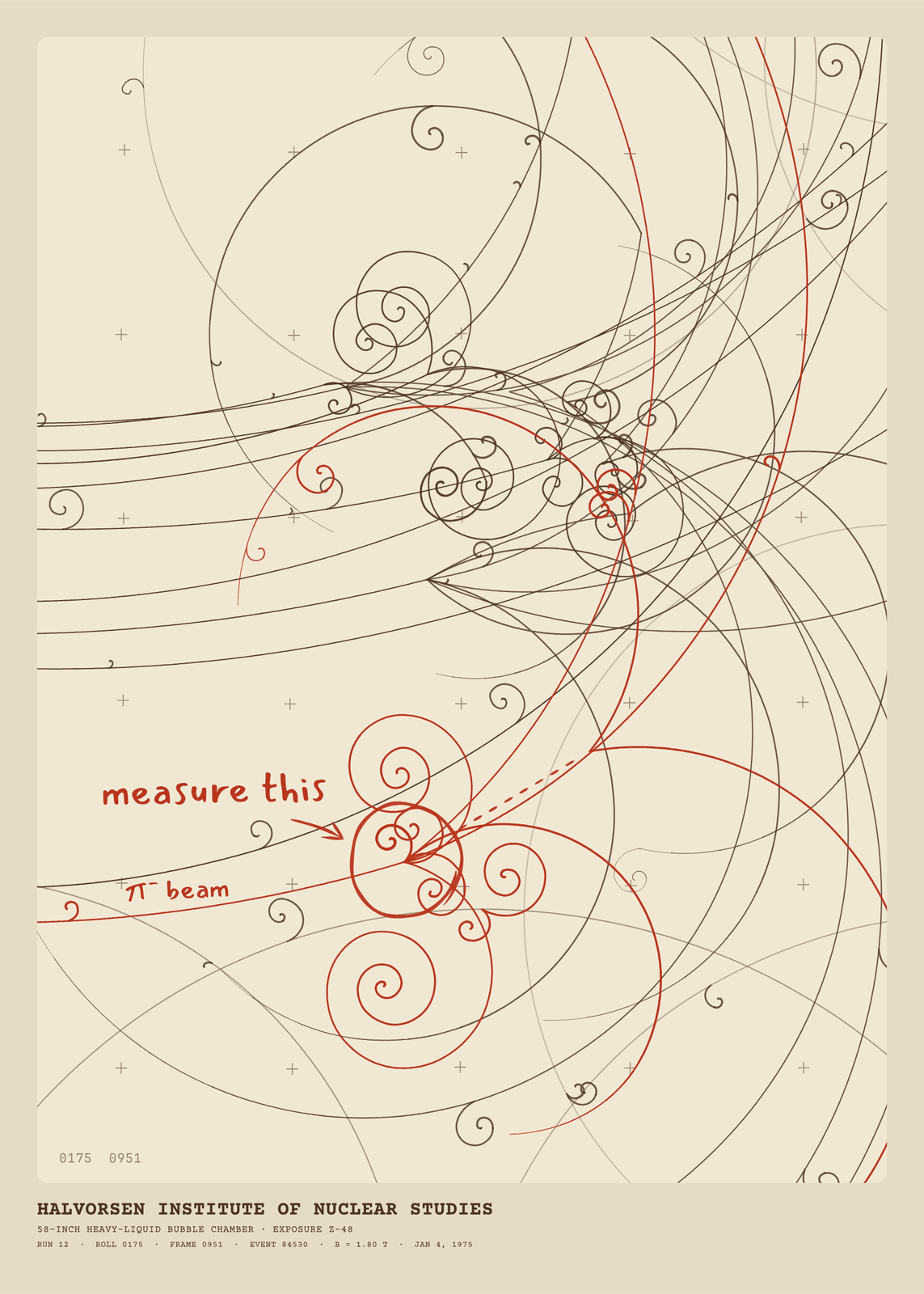 Bubble chamber plate traced in sepia on cream: particle tracks curving and spiraling across the sheet, one event traced in red pencil and noted measure this, a typed lab caption belowEdit this →More bubble chamber art →
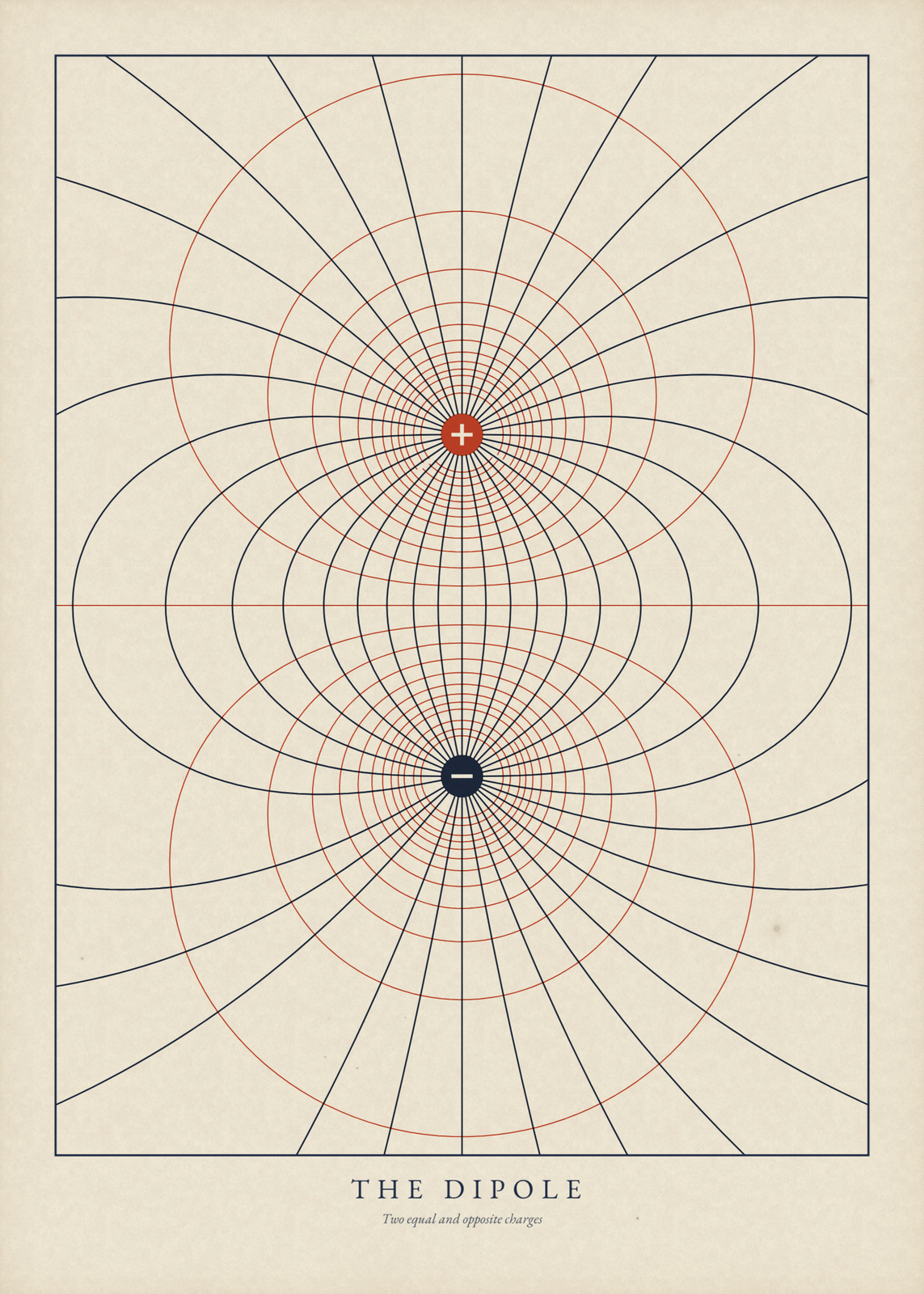 Physics poster of an electric dipole on a cream plate: navy field lines from a red plus charge to a navy minus one, crossed by red equipotential rings, titled The DipoleEdit this →More physics art →
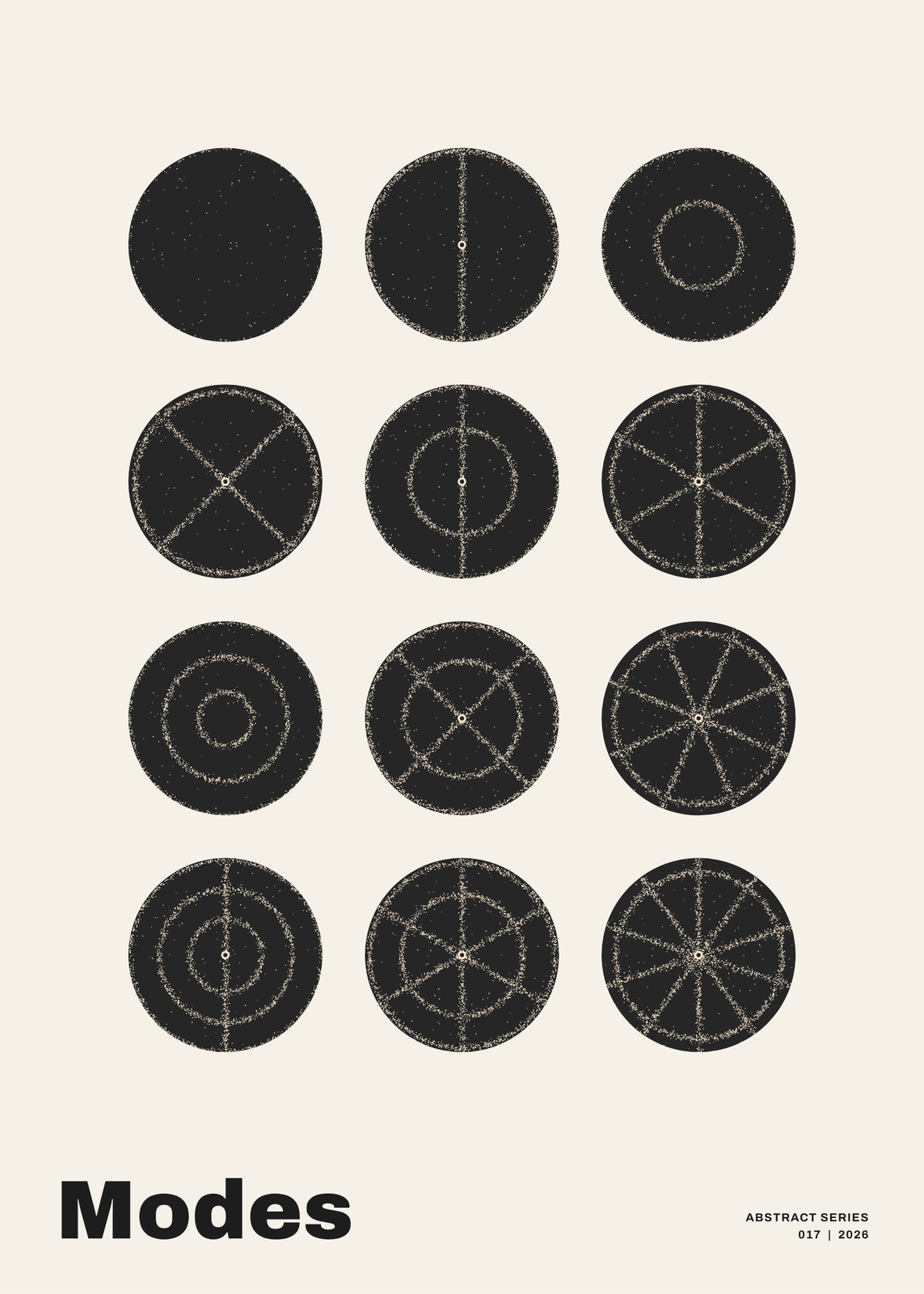 Chart of twelve Chladni figures, sand lines on round black plates in rows of three, each a different mode of vibration, titled Modes, on creamEdit this →More abstract art →
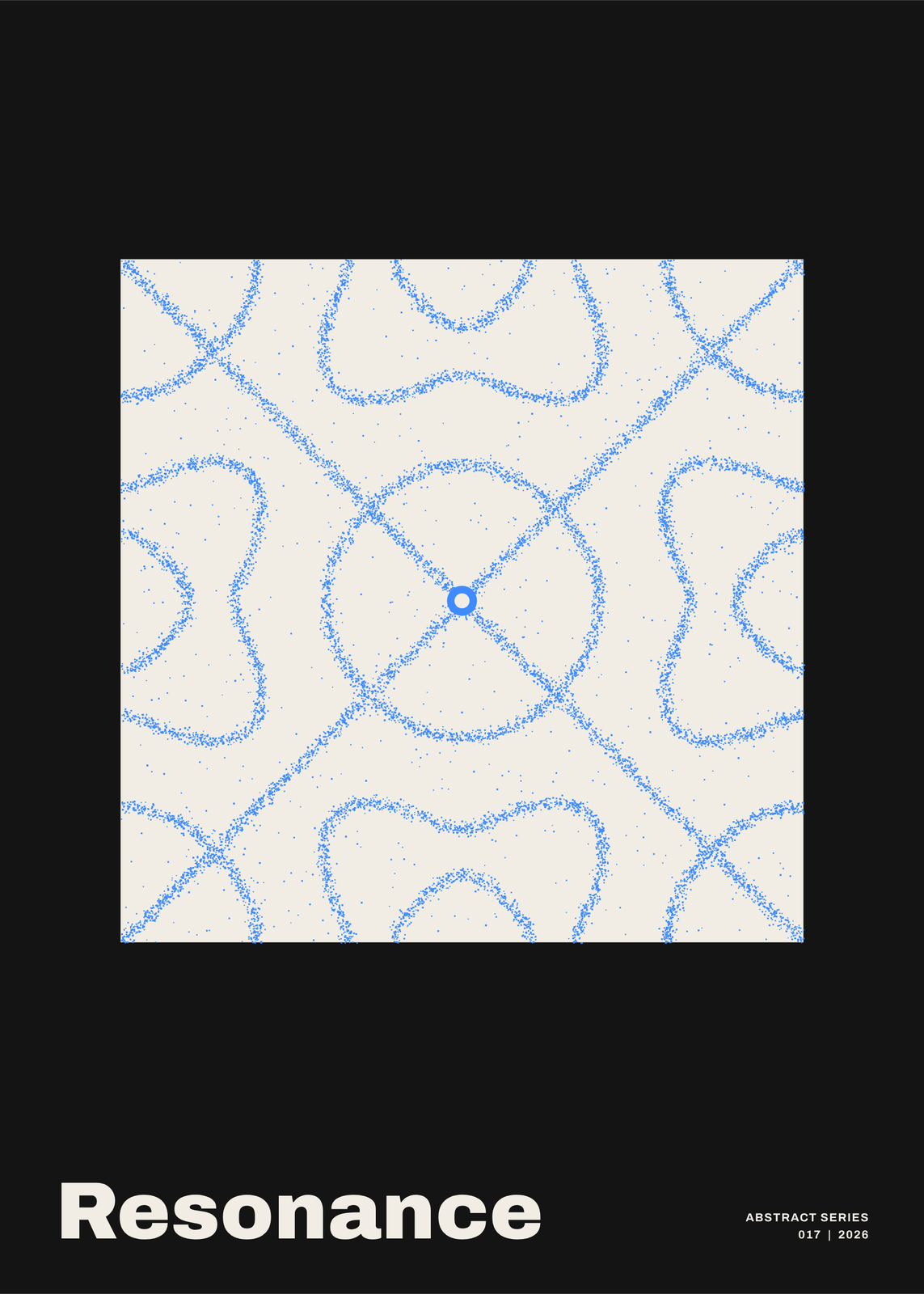 Chladni figure in blue sand on a square cream plate set on black: curving lines and loops where the ringing plate stays still, titled ResonanceEdit this →More abstract art →
Math you can see
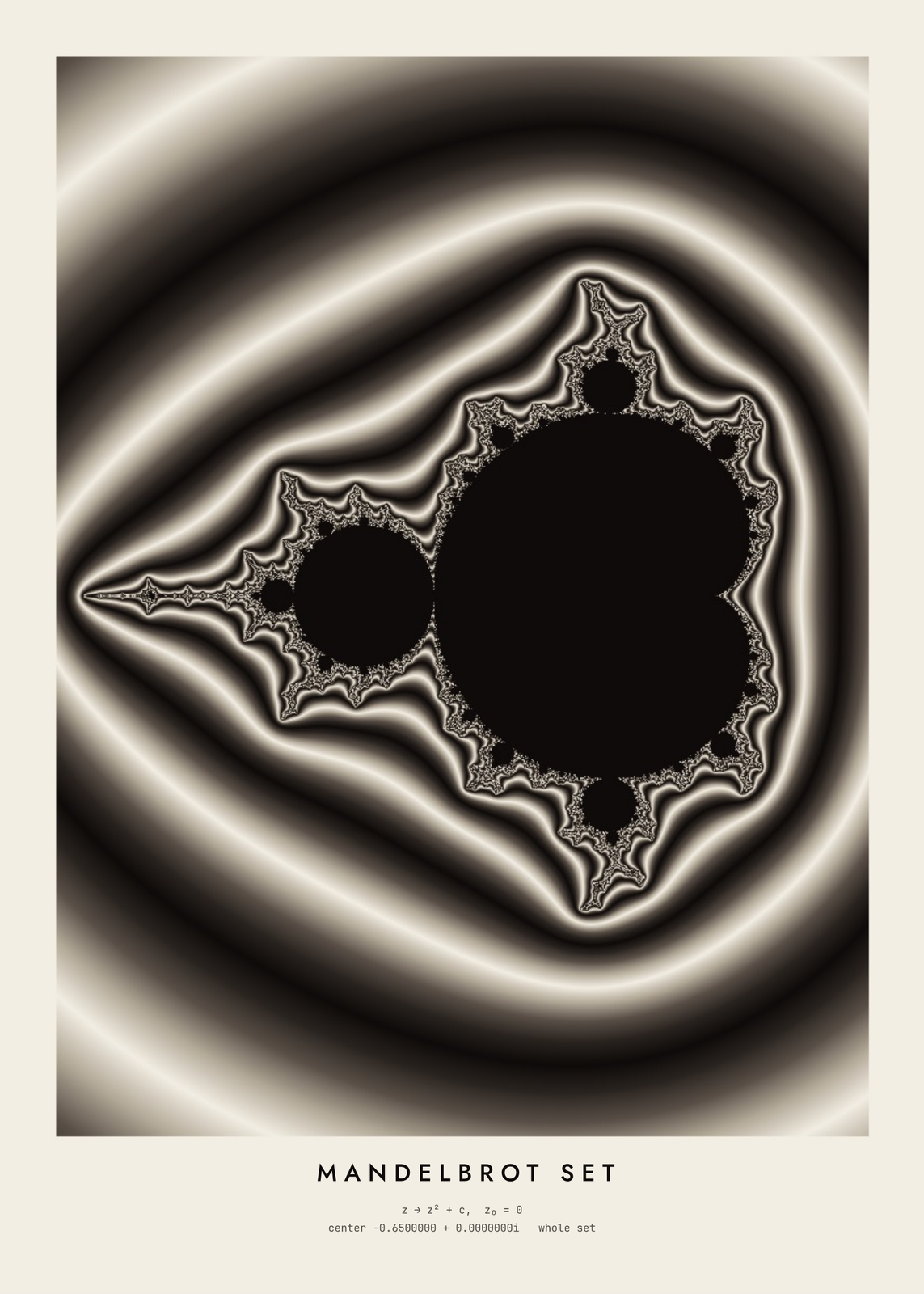 The whole Mandelbrot set in black on cream, wrapped in smooth bands of gray, captioned Mandelbrot setEdit this →More mandelbrot set poster →
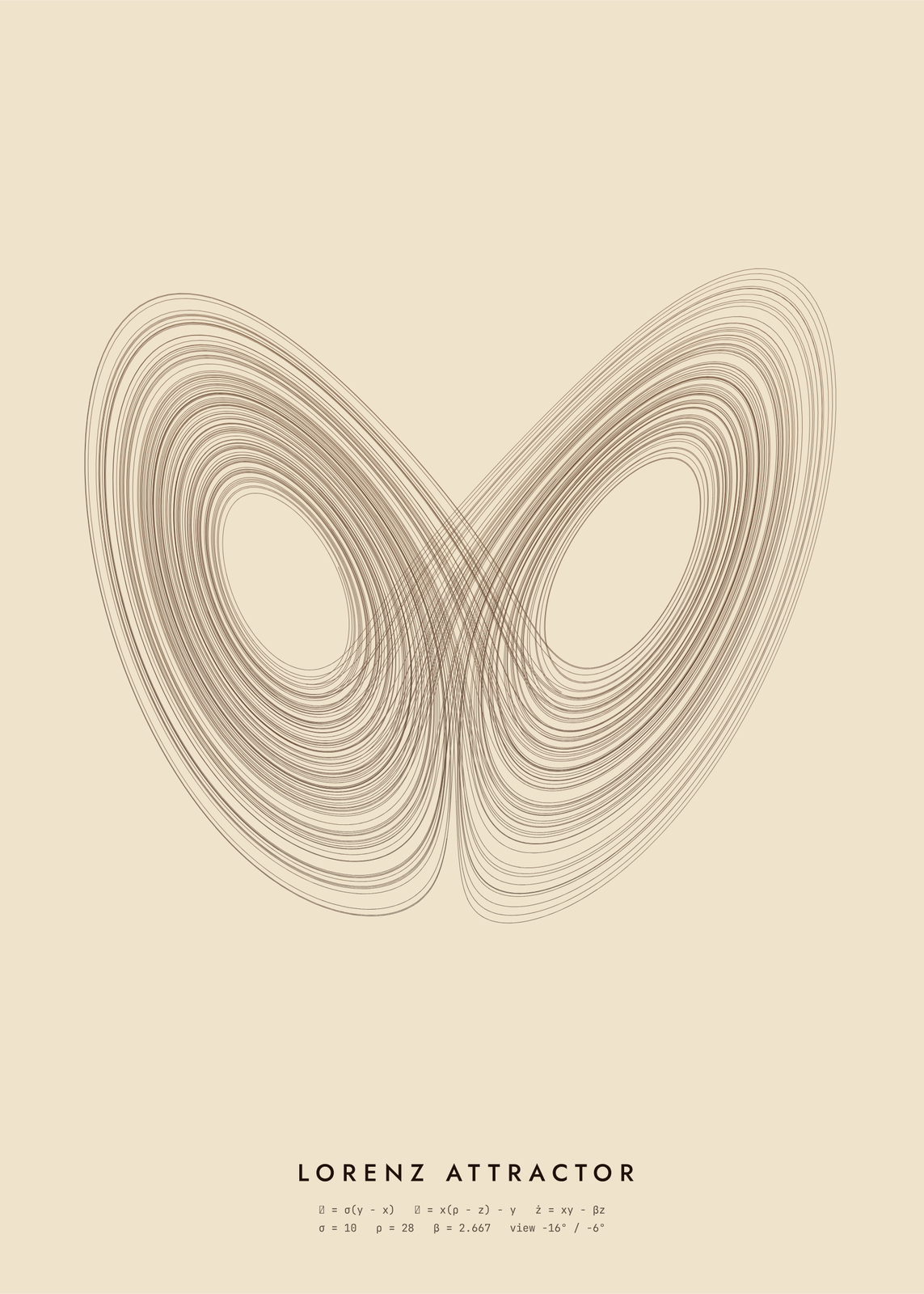 Lorenz attractor in fine sepia lines on cream: two loops of a single path, like a butterfly's wings, captioned belowEdit this →More strange attractor art →
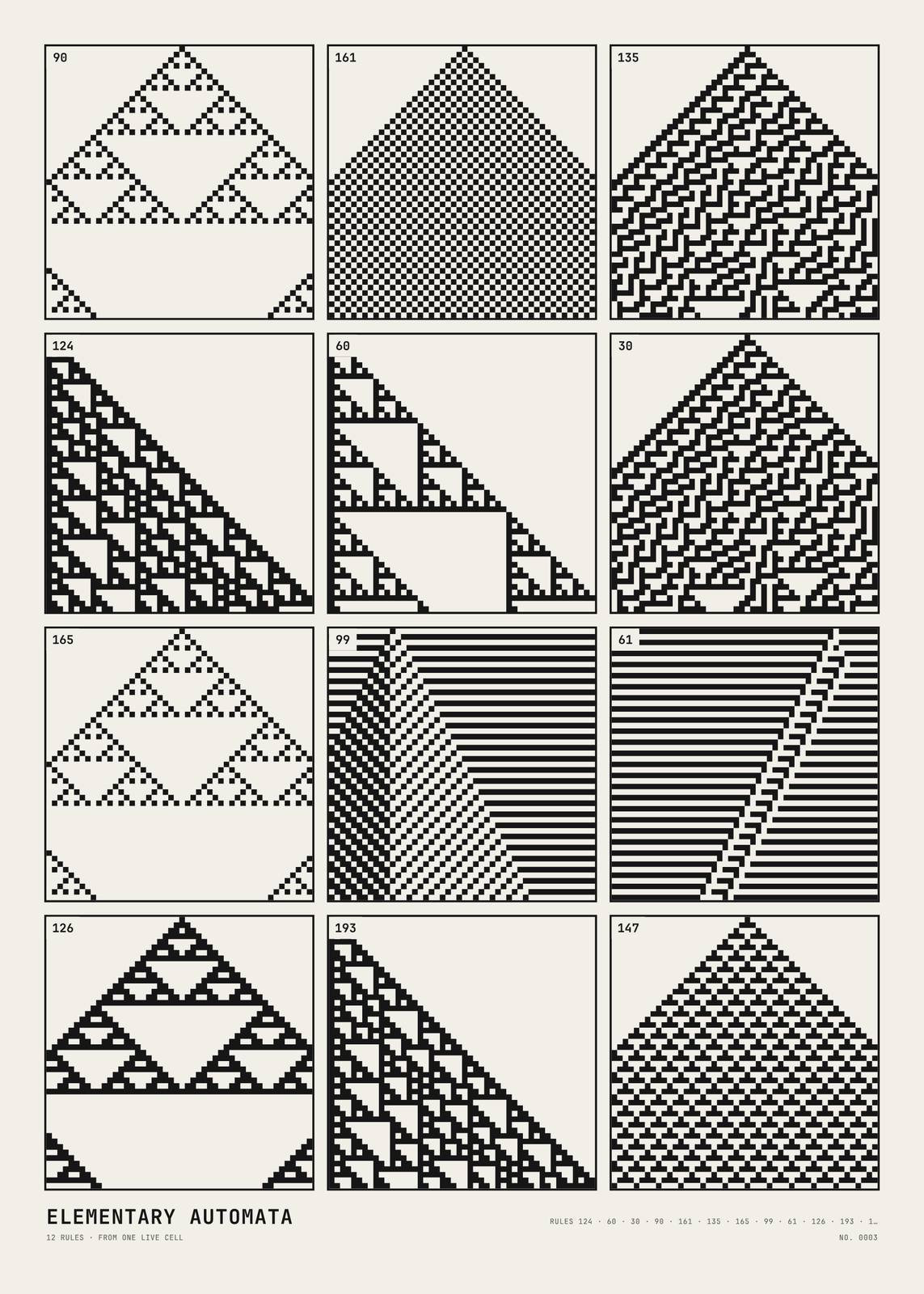 Specimen sheet of twelve elementary cellular automata in black on white: triangles, stripes and noise growing row by row down each numbered panelEdit this →More cellular automata poster →
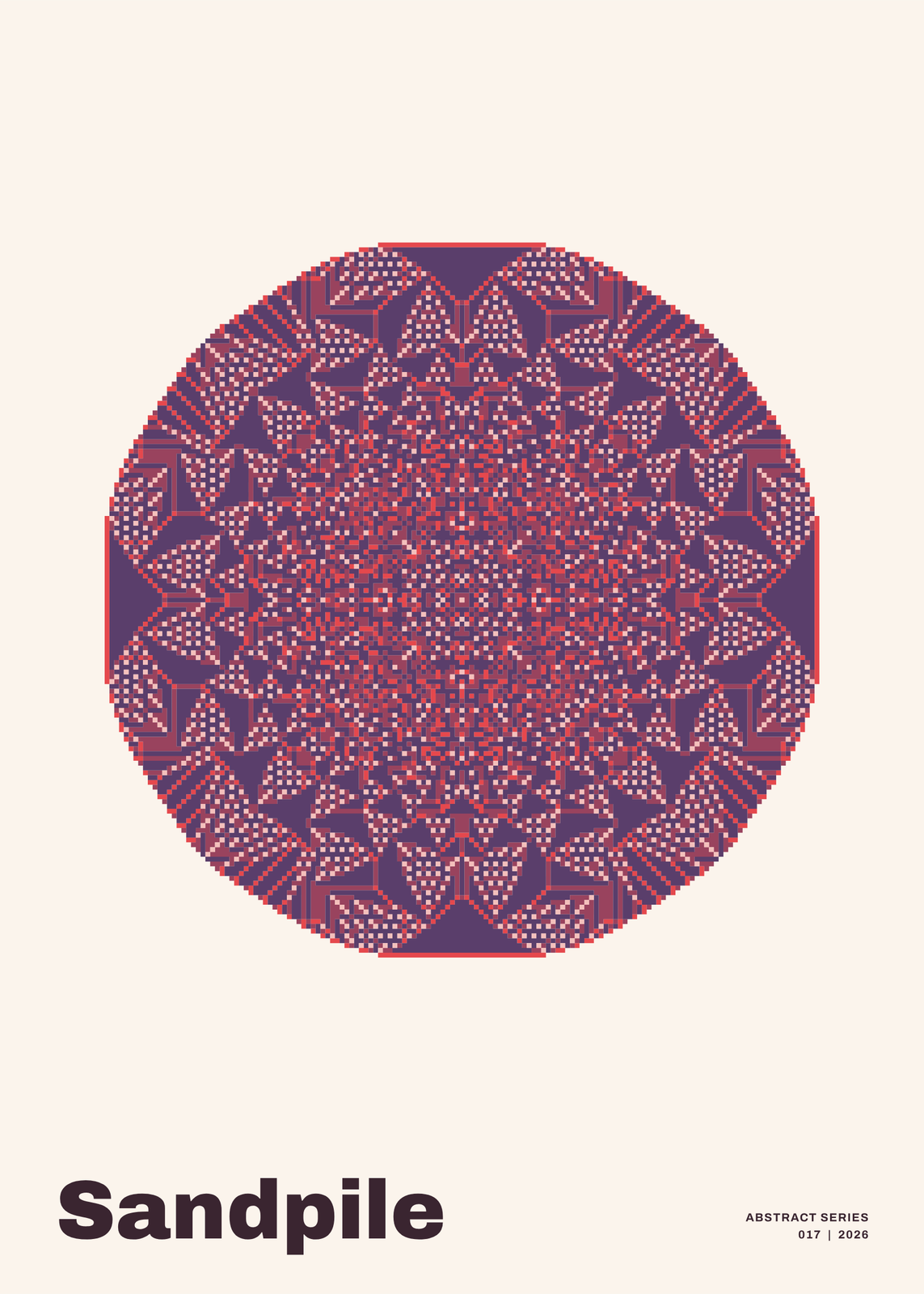 Abelian sandpile: grains toppled from one pile into an octagon of fractal purple and red triangles on blush, titled SandpileEdit this →More abstract art →
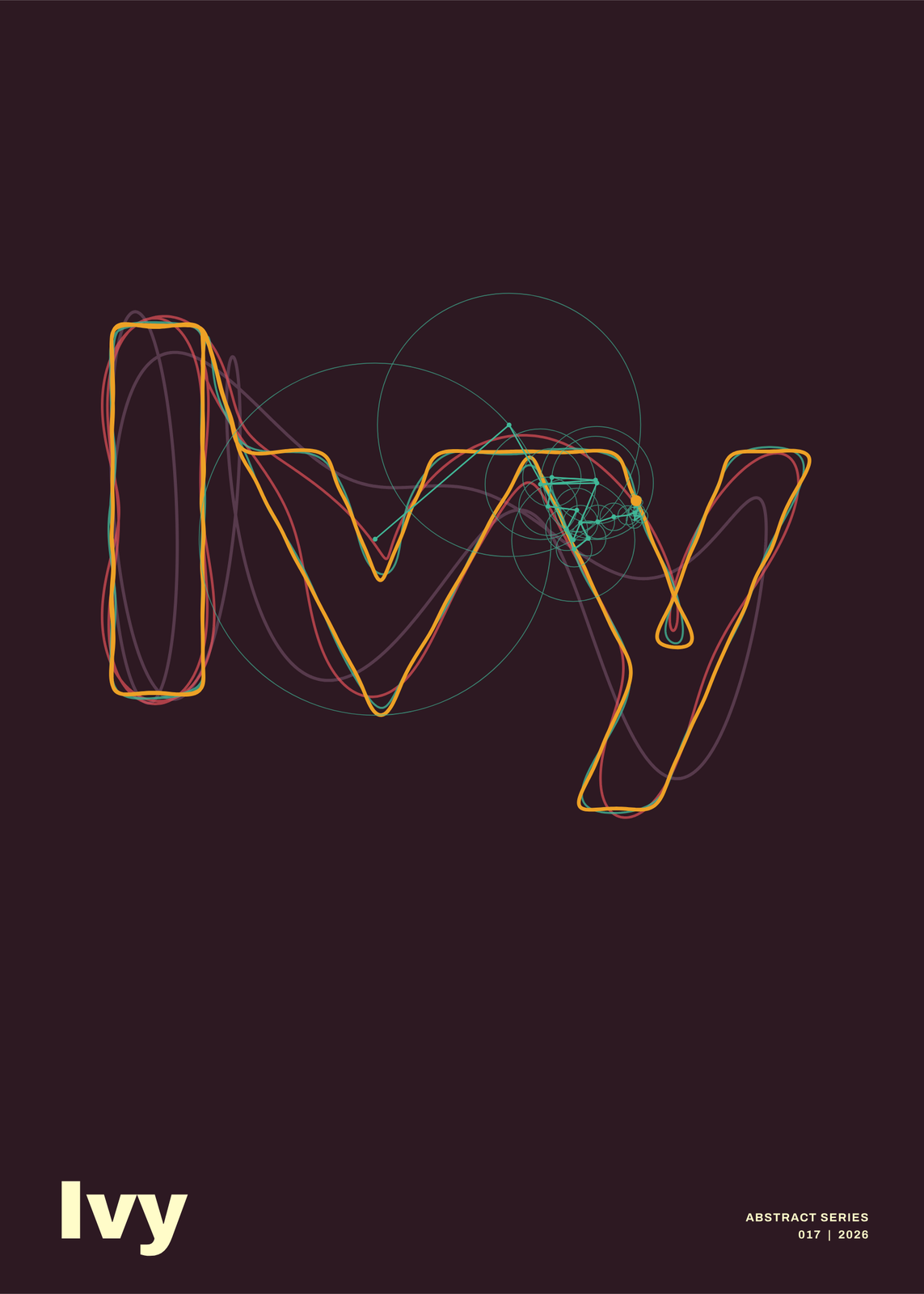 A Fourier series drawing: a chain of turning circles tracing the name Ivy in a gold line on deep plumEdit this →More abstract art →
Tilings that never repeat
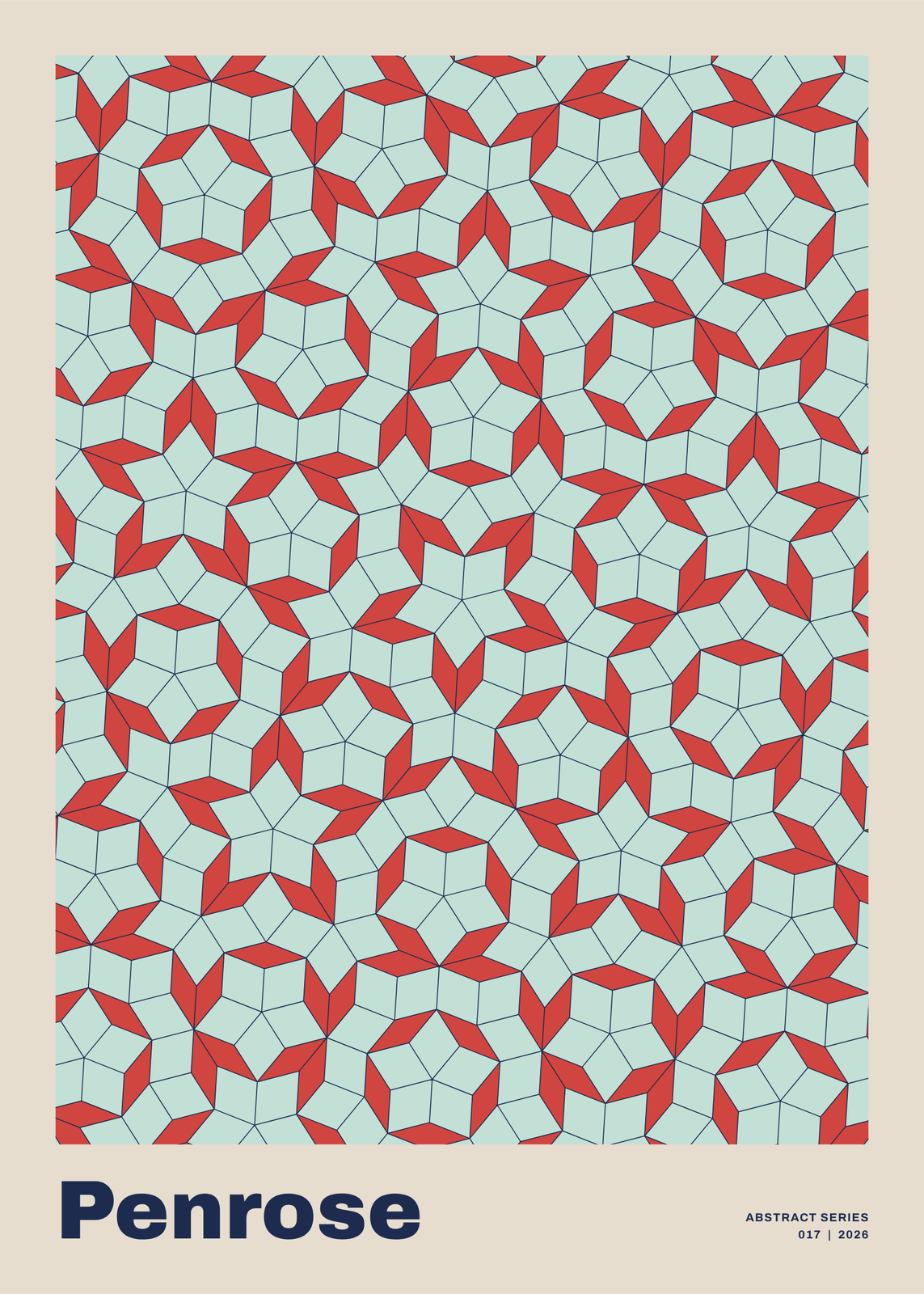 Penrose tiling of red and mint rhombs forming five-point stars that never repeat, on sand, titled PenroseEdit this →More abstract art →
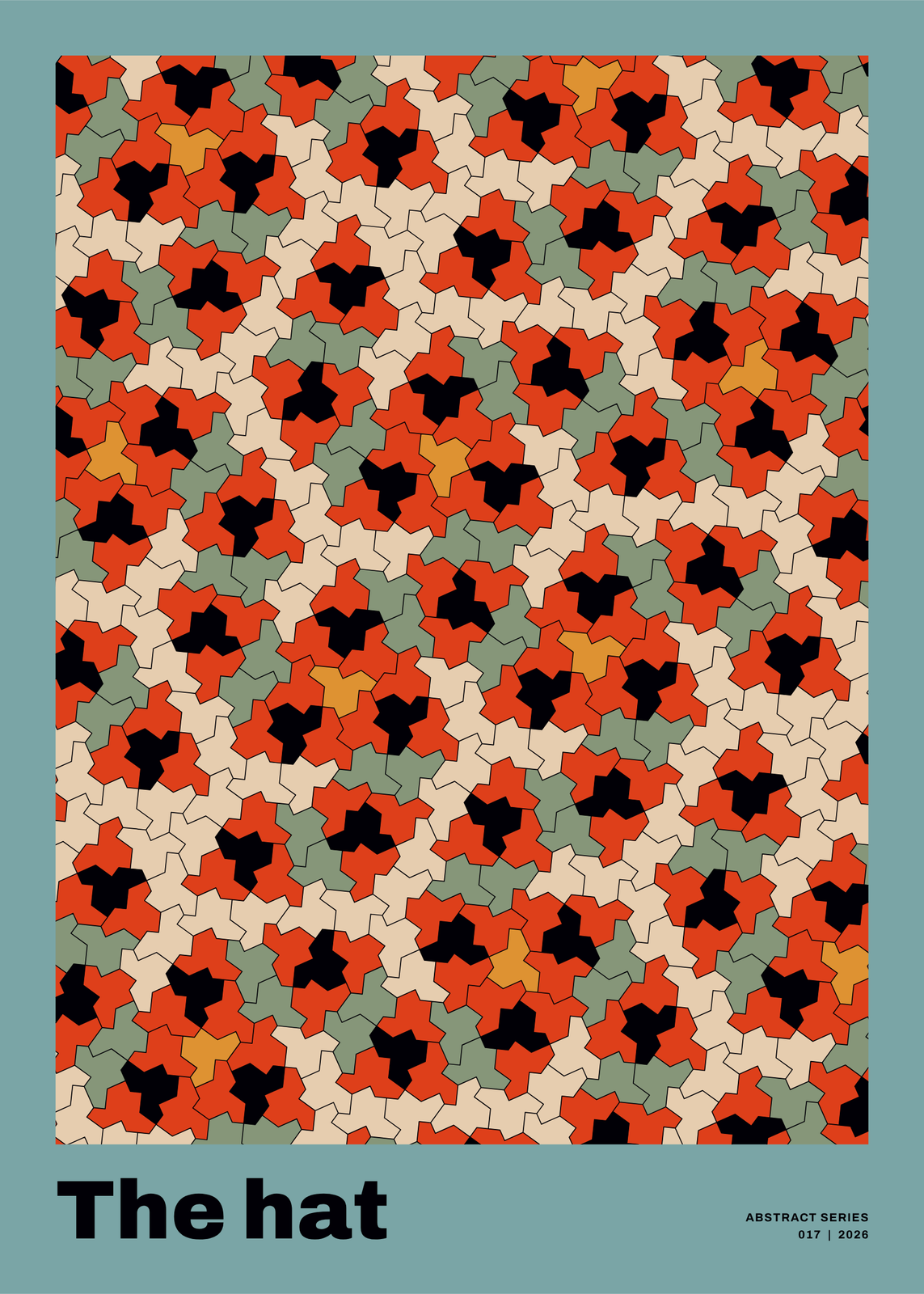 The hat, one tile shape that covers the plane without repeating, in black, red-orange, sage and cream inside a teal border, titled The hatEdit this →More abstract art →
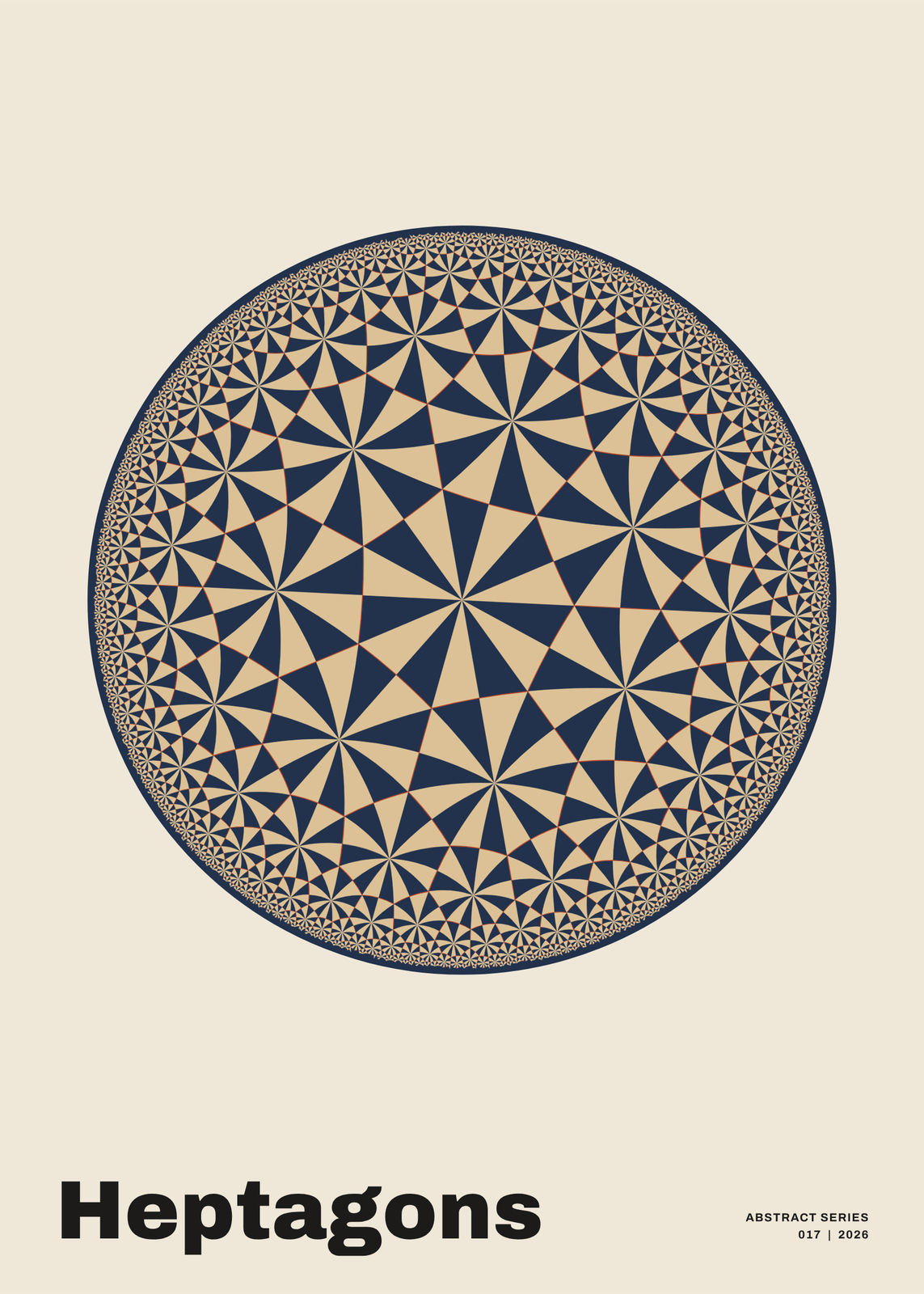 Hyperbolic tiling of navy and sand triangles growing ever smaller toward the rim of a disc, on cream, titled HeptagonsEdit this →More abstract art →
Invented specimens, labeled like real ones
The insects, fish and plants on these plates are made up. Entomology Plate and Ichthyology Plate build each one on the plan of a real family, a stag beetle, a swallowtail, a trout, a puffer, then vary its shape and markings; Herbarium Specimen invents a plant and tapes it down like a pressed one. Each gets a Latin name, a collector, a place and a date on its label, the way a museum drawer is labeled, and the Latin name can carry yours.
Local Birds is the exception: its birds are real species, the ones people have recorded around the place you type, cut from the hand-colored plates of old bird books. Before photography, plates like these were how naturalists published what they found: engraved in fine lines, printed in black, then colored by hand.
DNA, cells and growth
Abstract draws DNA as a double helix: two strands wound round an axis with the proportions of B-DNA, as a ladder, bands or a ball-and-stick model, and its base pairs can follow a sequence you type or spell a name in A, C, G and T. Next to it are patterns life makes by itself: reaction-diffusion, the spots and stripes Alan Turing proposed in 1952 to explain animal markings; phyllotaxis, the spiral seeds of a sunflower head; and coral growth, branches built one drifting particle at a time.
Collage packs real fossils, skulls and dinosaur skeletons, cut from photos, into a cabinet of curiosities on paper.
Charts of what you can't hold
Other makers draw science the way a textbook diagram does. Strata stacks and folds rock layers like a canyon wall, Topo Map shades a mountain in the hachures of an old survey, and Growth Rings counts a tree's years with the events of your own marked on them. Bubble Chamber makes up a plate from a physics lab: heavy particles crossing in long arcs, electrons winding into tight spirals, one event circled in red pencil. Solar System lines up the planets at their true sizes or cuts the Earth in half like an engineer's drawing. Weather Year turns a city's year into climate stripes, Sunrise charts every day's light, Moon Phase every phase of a year, Star Map the sky with its grid and ecliptic, and Solargraph burns half a year of the Sun's path onto a sheet. Abstract's Chladni figures show where sand gathers on a ringing plate, the nodal lines Ernst Chladni drew in 1787.
Math belongs here too. The Lorenz attractor comes from Edward Lorenz's 1963 model of convection in the atmosphere, an early landmark of chaos theory; the Mandelbrot set and elementary cellular automata are each drawn from one short rule repeated. Penrose's rhombs and the hat, a single tile found in 2023, cover a plane without ever repeating; a hyperbolic tiling crowds ever smaller triangles toward the rim of a disc; and a chain of turning circles, a Fourier series, can trace any line, even a name.
Hanging science art
A plate of twelve small specimens rewards a close look, so hang it where people stop: a hallway, beside a bookcase or over a desk. Three plates on the same aged paper, the beetles, the fish and the fern, read as one collection in a row of matching frames.
In a classroom or a child's room, the solar system to scale teaches the order and sizes of the planets from across the room. In a study or a lab, the blueprint of the Earth, the bubble chamber plate, a double helix or the Lorenz attractor suits the work done there.
Questions
What is scientific illustration?
Drawing made to explain: a specimen, a rock face or a machine shown accurately, labeled and often to scale. Before photography it was how naturalists published new species, as engraved plates colored by hand, and it is still used wherever a drawing shows more than a photo can.
Are the insects, fish and plants real species?
No. Entomology Plate, Ichthyology Plate and Herbarium Specimen invent every specimen and give it a Latin name. Local Birds shows real birds, recorded around the place you type.
Which maker should I start with?
Entomology Plate for insects, Ichthyology Plate for fish, Herbarium Specimen for plants, Local Birds for the birds of a place, Abstract for DNA, Bubble Chamber for physics, Strata for geology and Weather Year for climate. Click any example to open it with its settings and change from there.
Can I put my name on it?
Yes. The specimen plates print a collector, a place and a date on the label, and your name goes into the Latin name, so Maria's butterfly is mariae. Bubble Chamber and Growth Rings take names and dates too, and a double helix can spell a name in its base pairs.
What sizes can I print?
US Letter, 8 × 10, 11 × 14, 12 × 16 and 12 × 18 in, A4 and A3, free. You download a 300 DPI JPEG drawn at the size you pick. Larger prints, up to 24 × 36 in, are coming soon.
Related
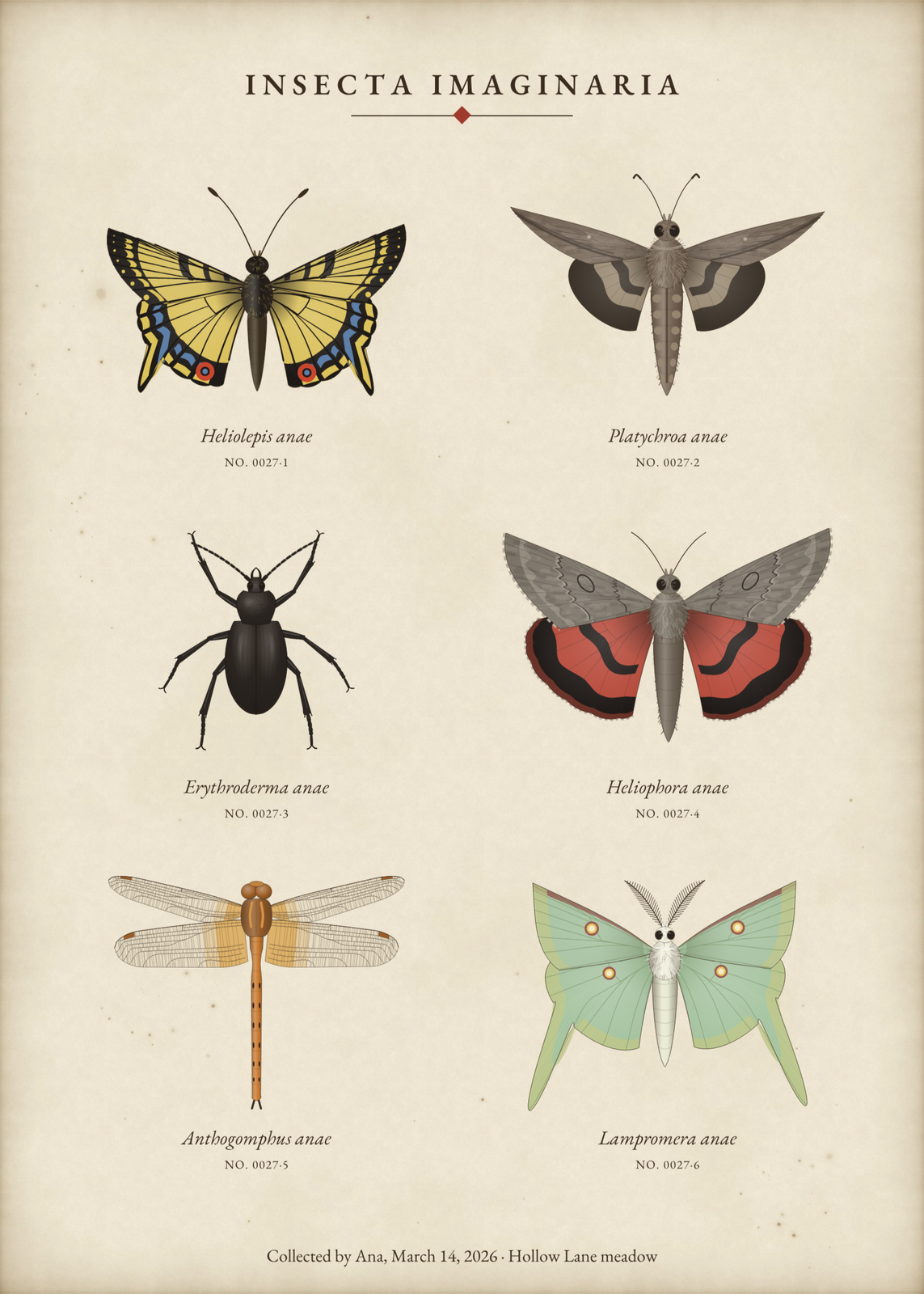 Insect artinvented beetles, butterflies, moths and dragonflies, pinned and labeled with your name
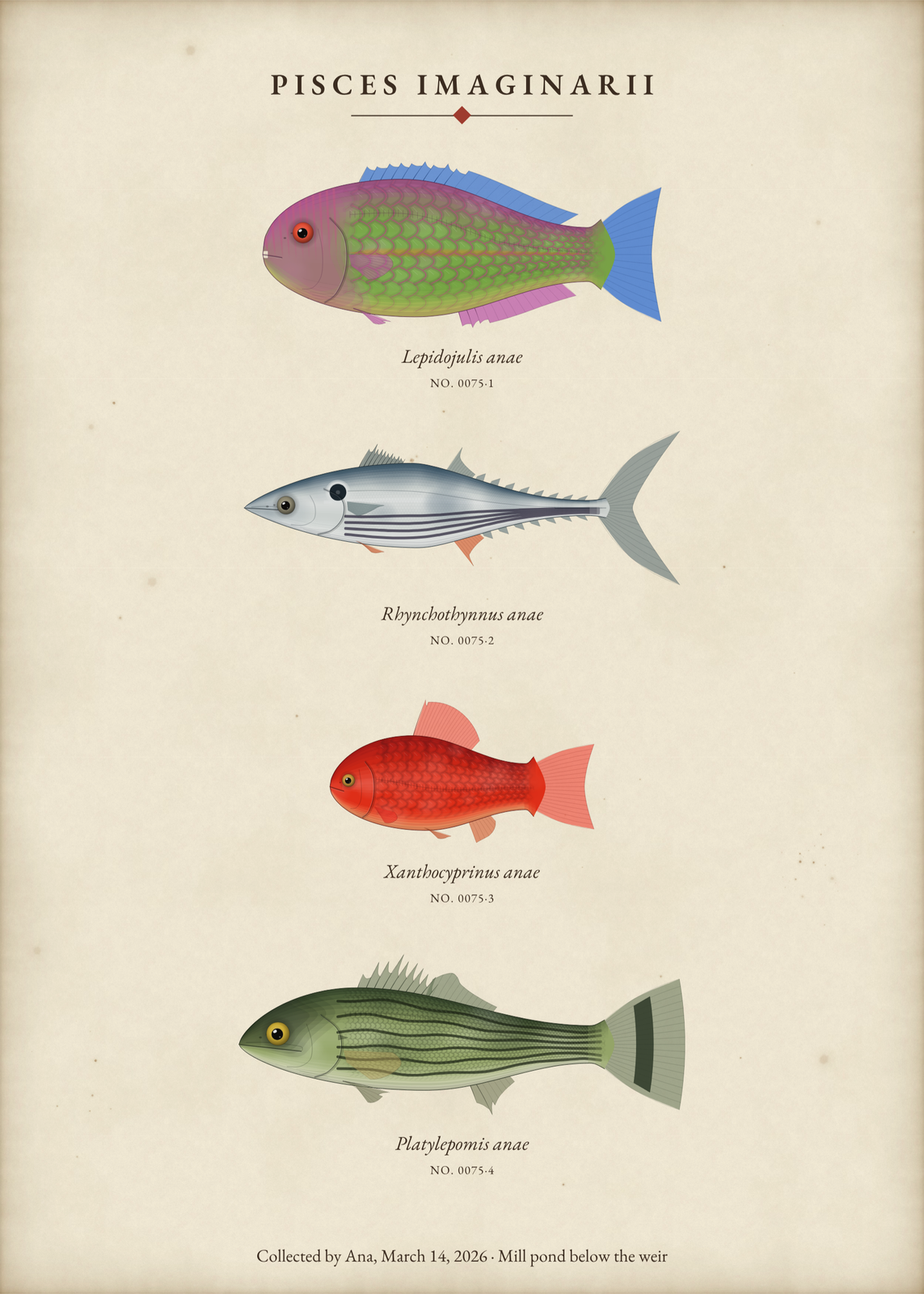 Fish artinvented fish, painted and labeled like an old natural-history plate, named after you
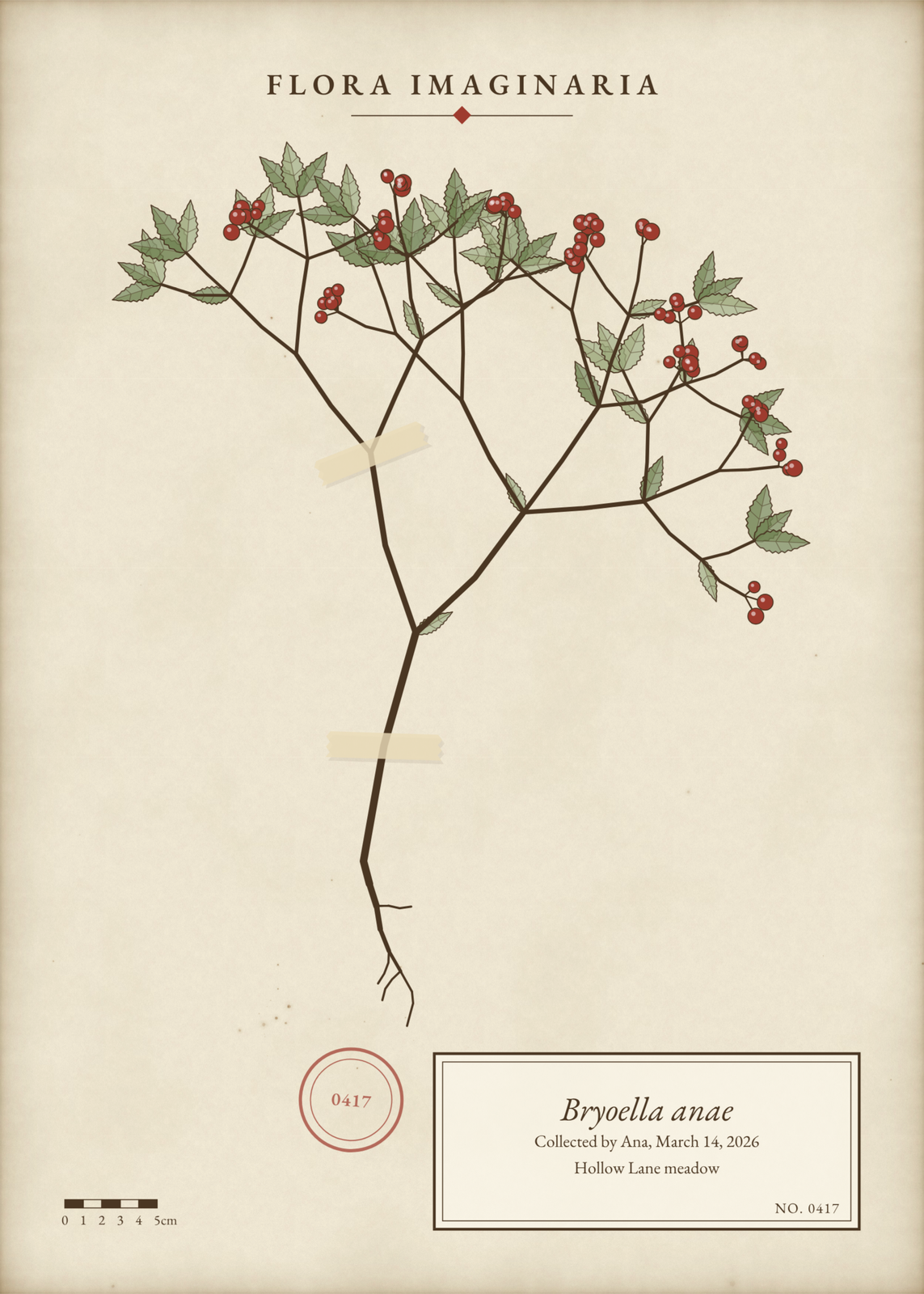 Botanical printsinvented plants, pressed and labeled like a museum sheet, with your name on the label
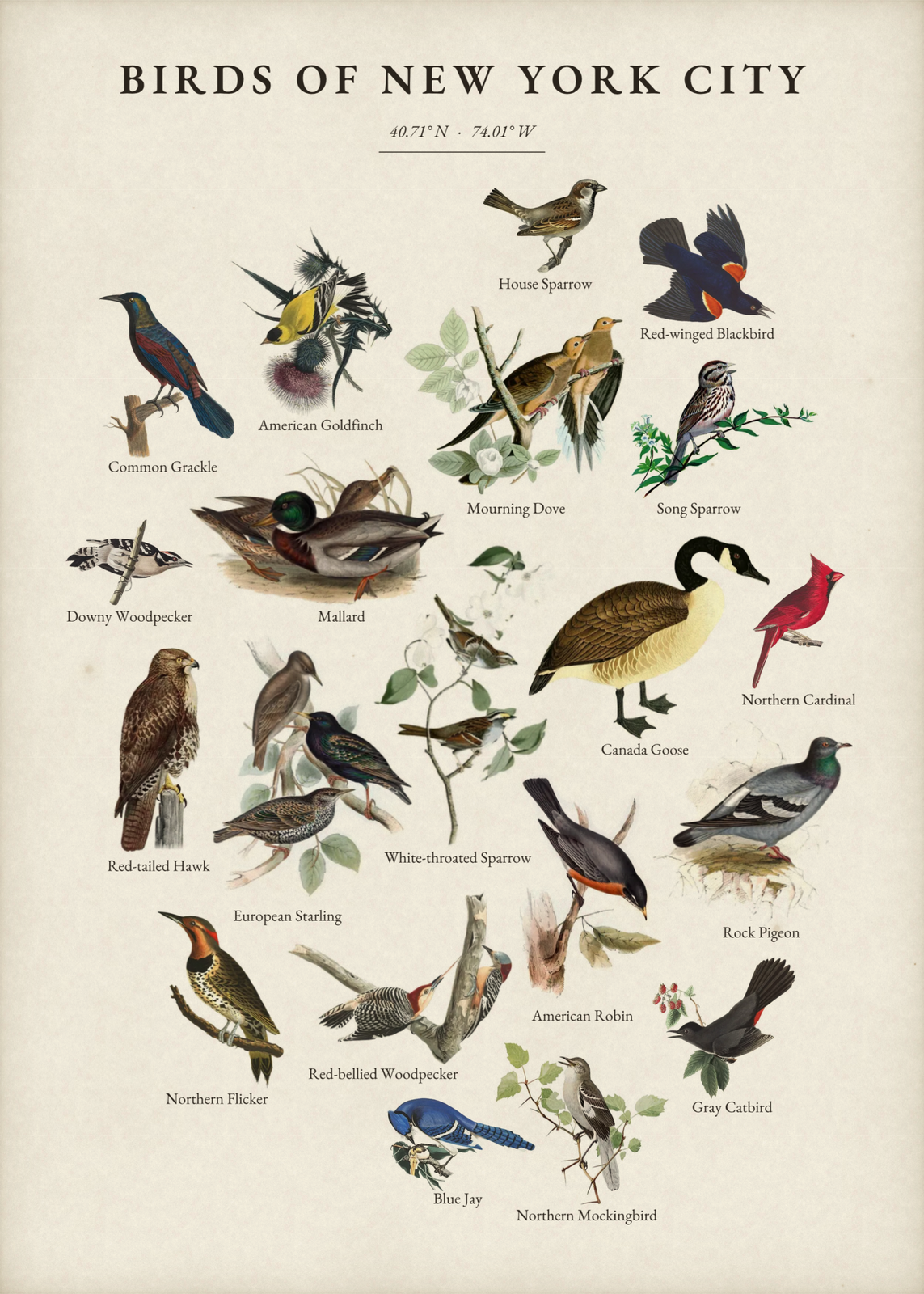 Bird printsthe birds of your place, from old hand-colored plates
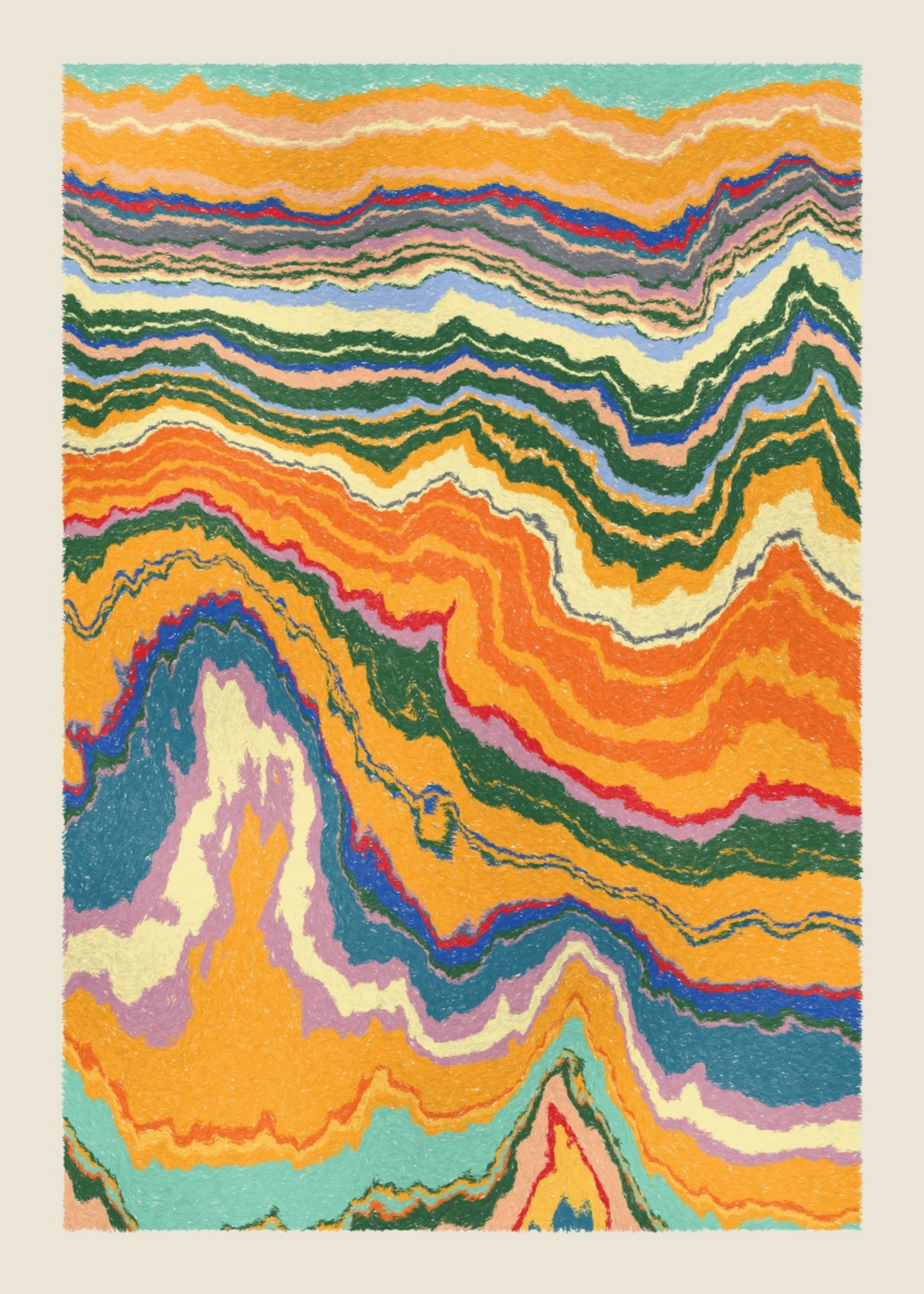 Geology artmountains of banded rock, laid down in hundreds of thousands of short strokes
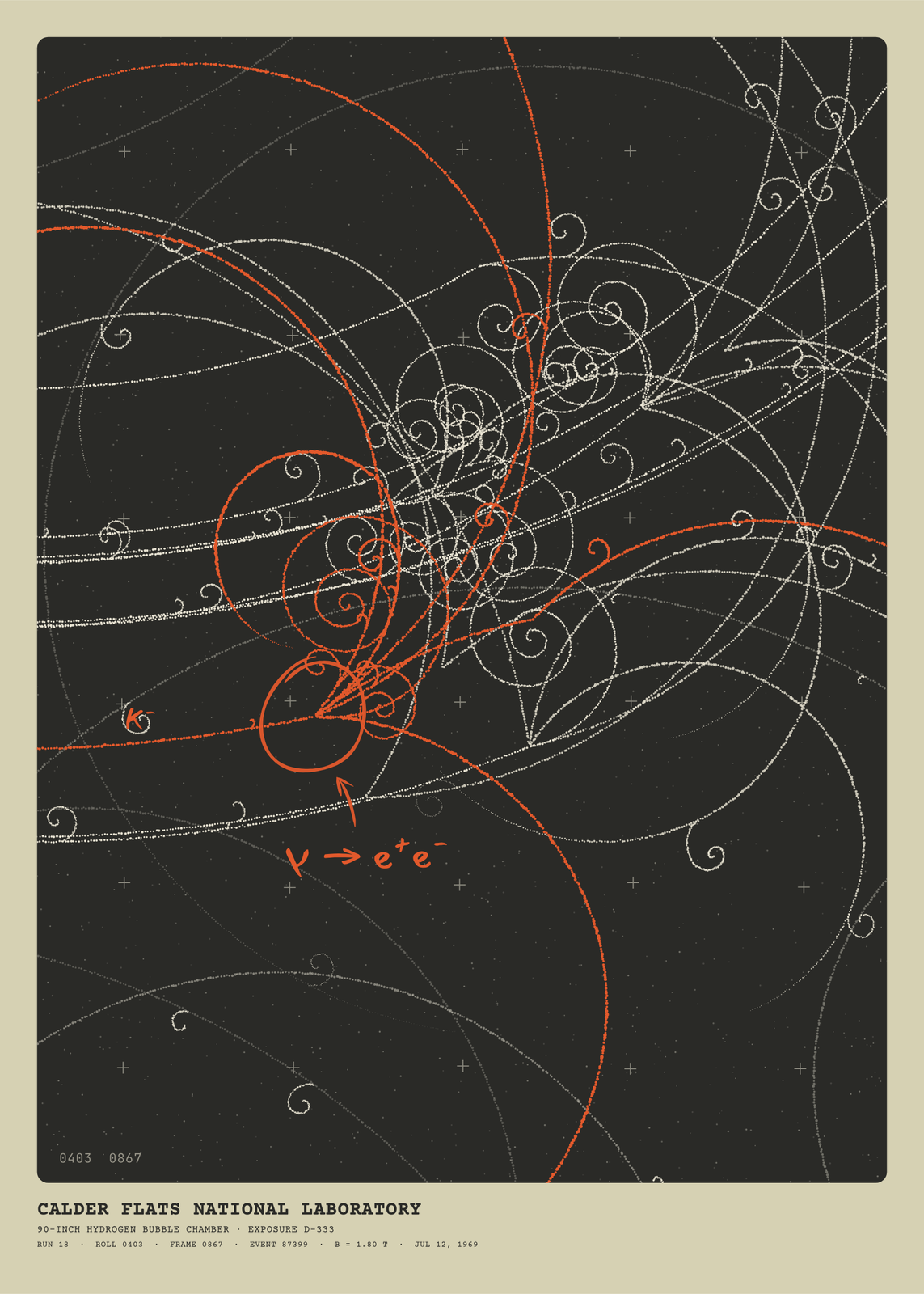 Bubble chamber arta made-up plate of particle tracks, one event circled in red pencil
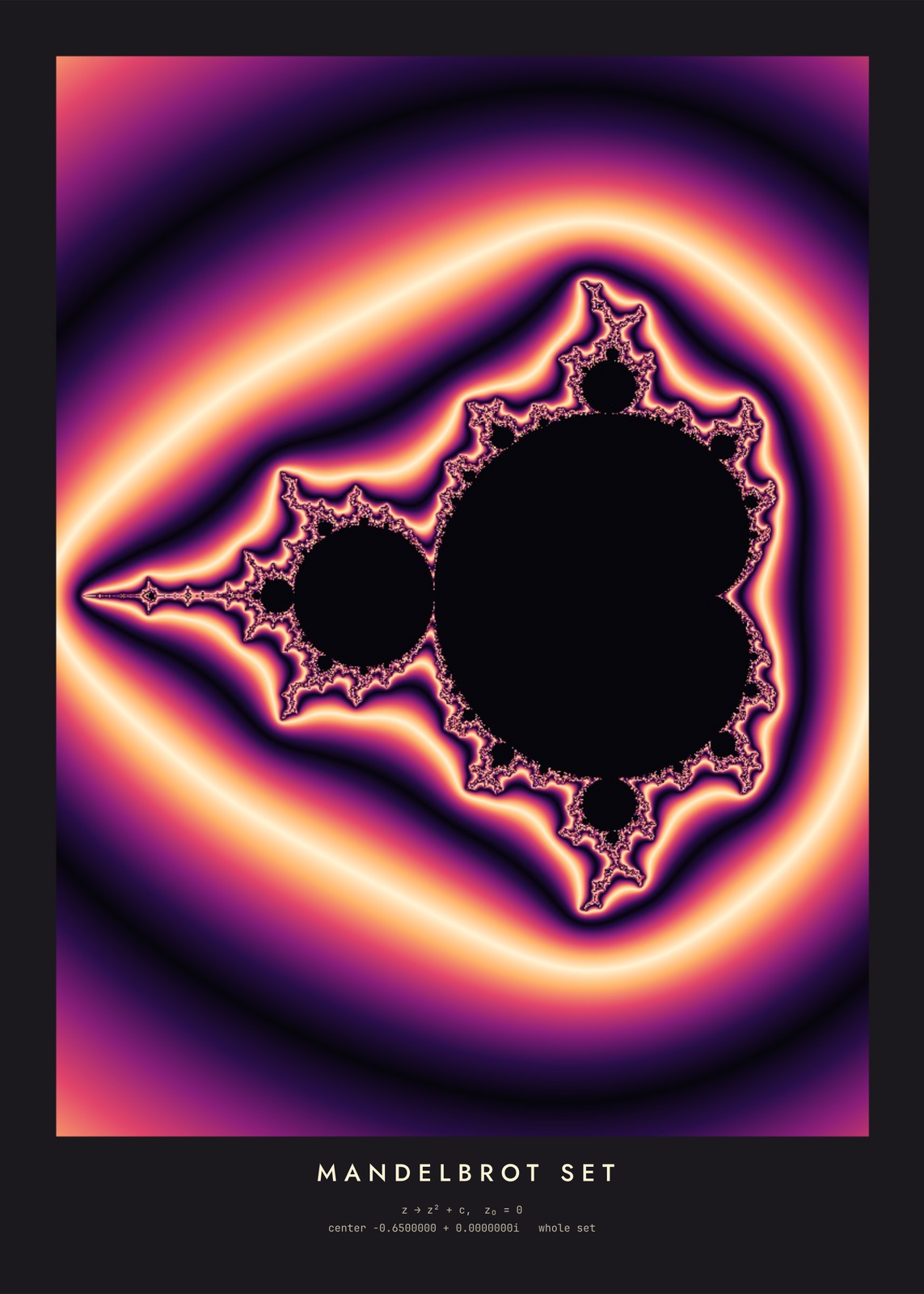 Math postersfractals, chaos and geometry, drawn from the formulas
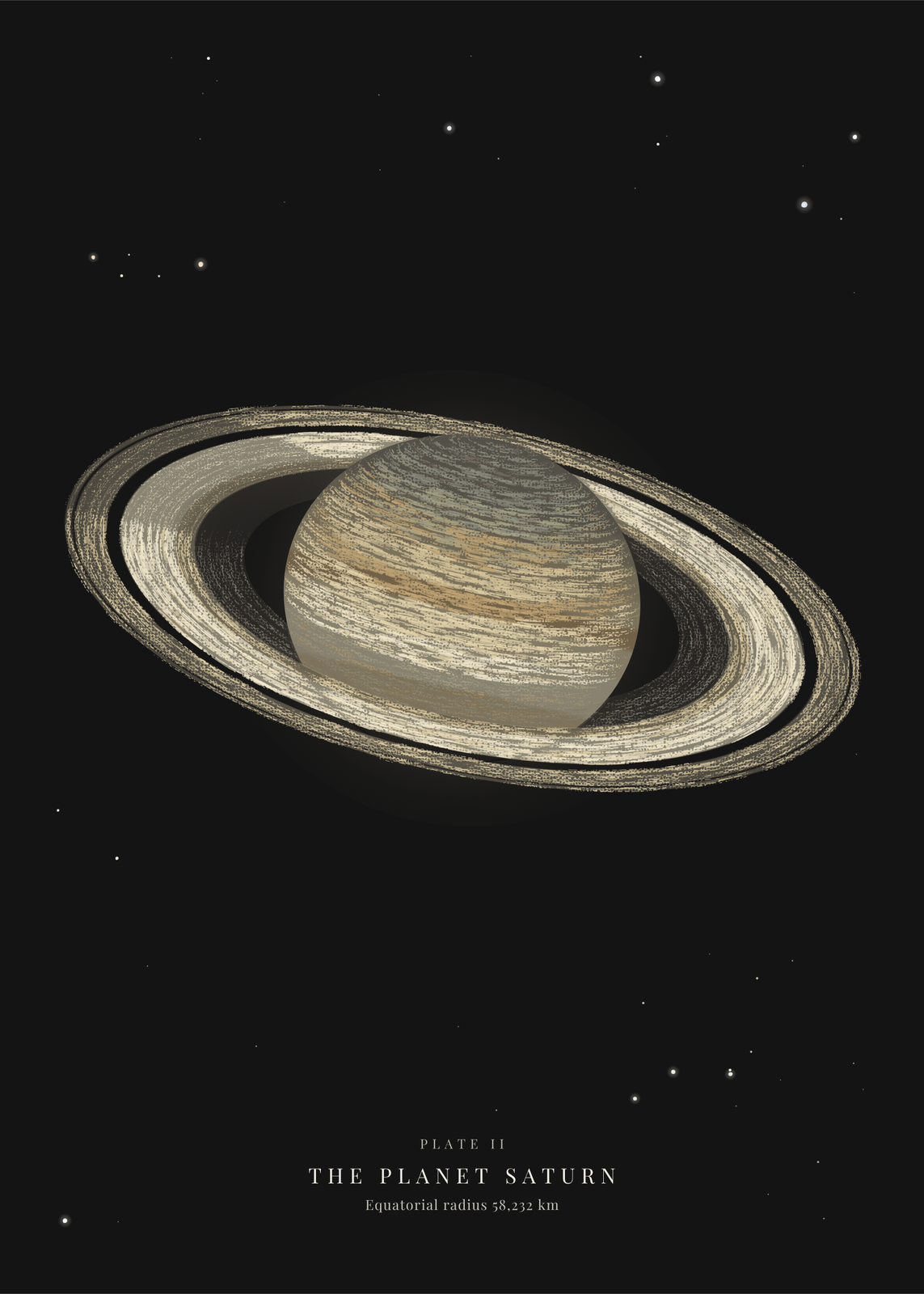 Space artplanets, galaxies and moons, from atlas plates to retro travel posters
Gift ideas by occasion
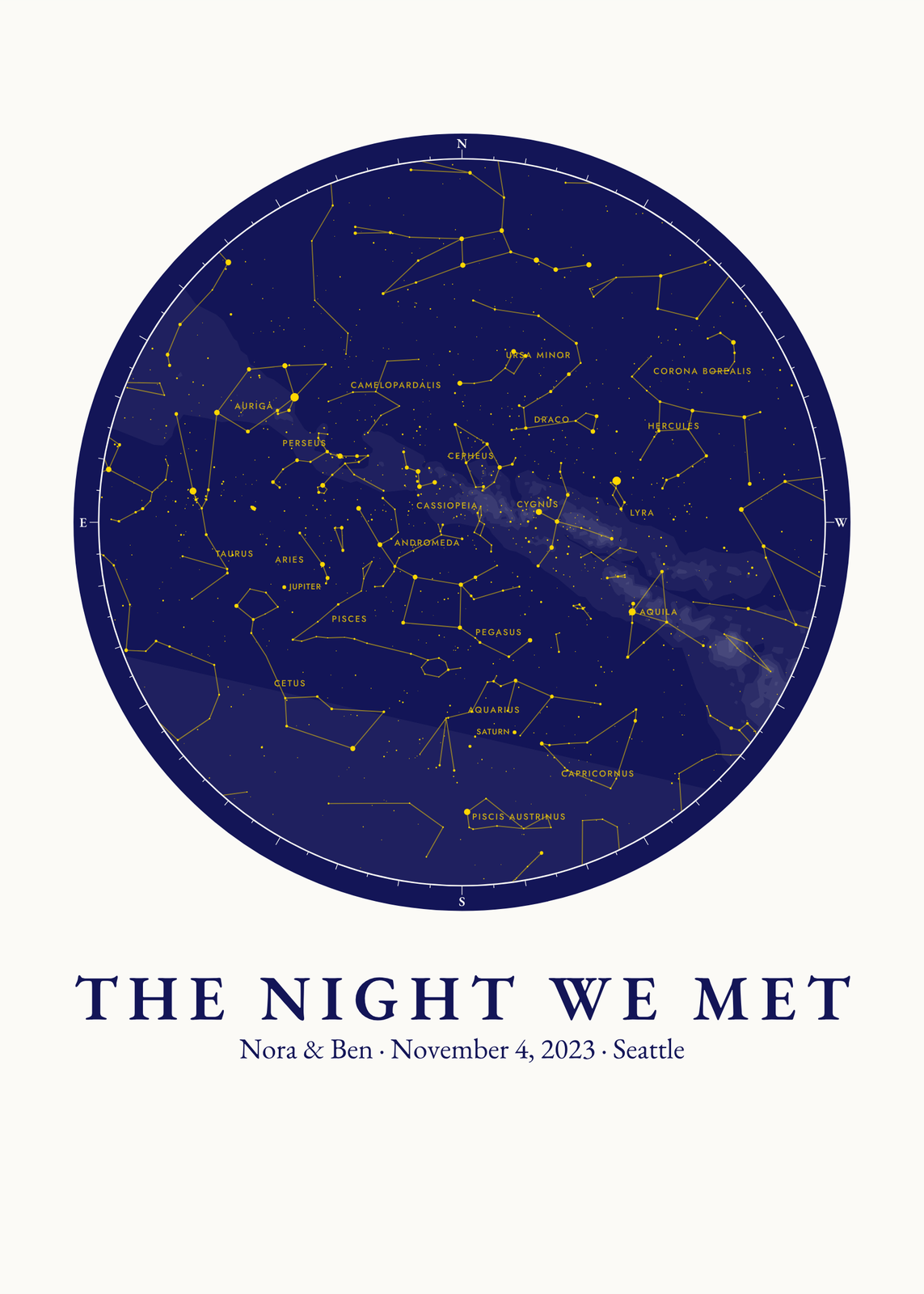
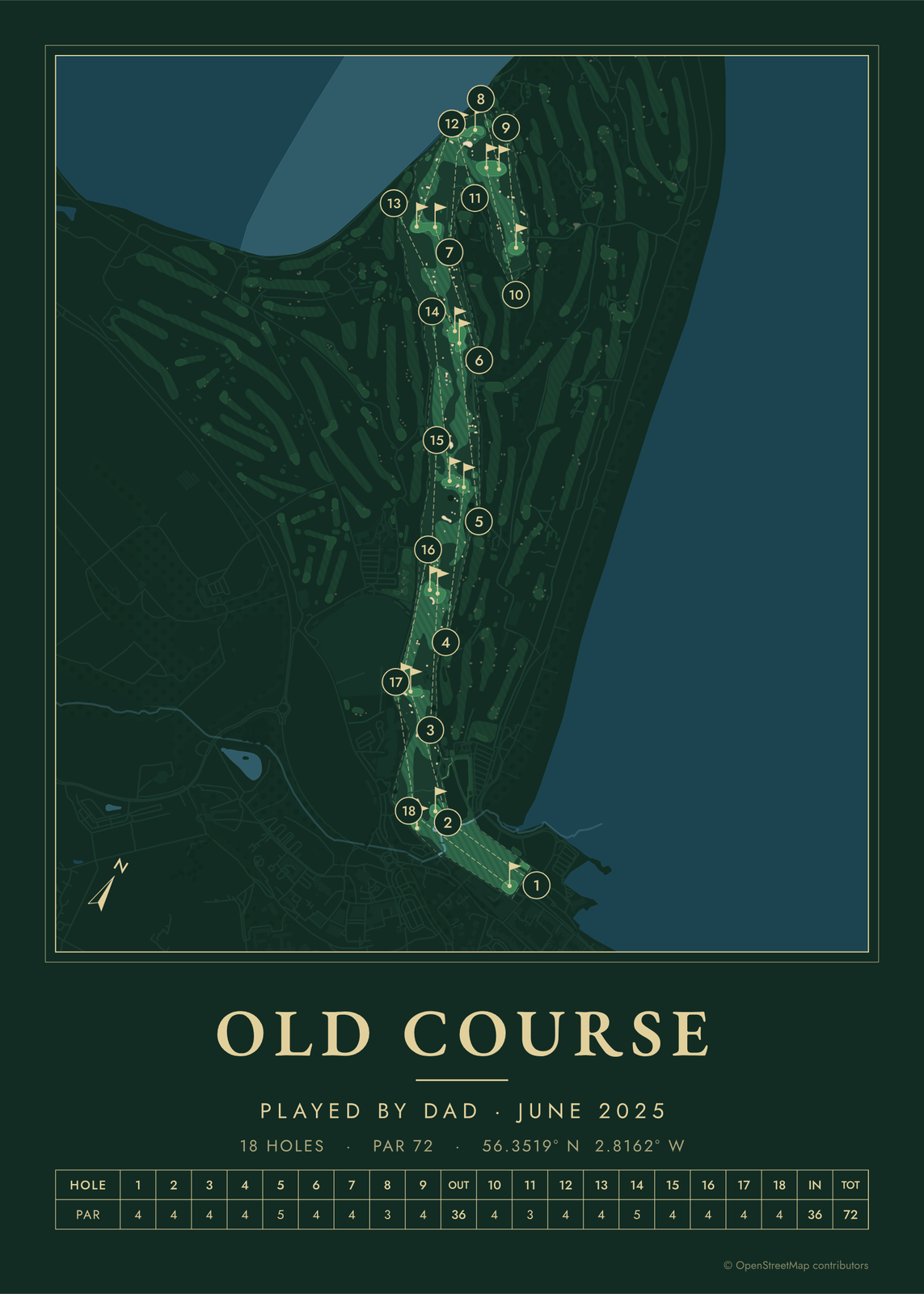
Every example is made with the Posterage generators. Change anything, then download it as a 300 DPI JPEG.