Wave function collapse tiles that must match their neighbors, solved cell by cell until the whole sheet fits
Every cell starts out able to hold any tile. The solver picks the cell with the fewest choices left, settles it, and rules out whatever no longer fits beside it, again and again until every edge agrees with its neighbors. Pick one of eleven tile sets, from noodles and circuits to islands, mazes and transit maps, or Meander, a labyrinth of Greek keys learned from a single key. Stop the solve part way and the open cells show every tile they could still become.
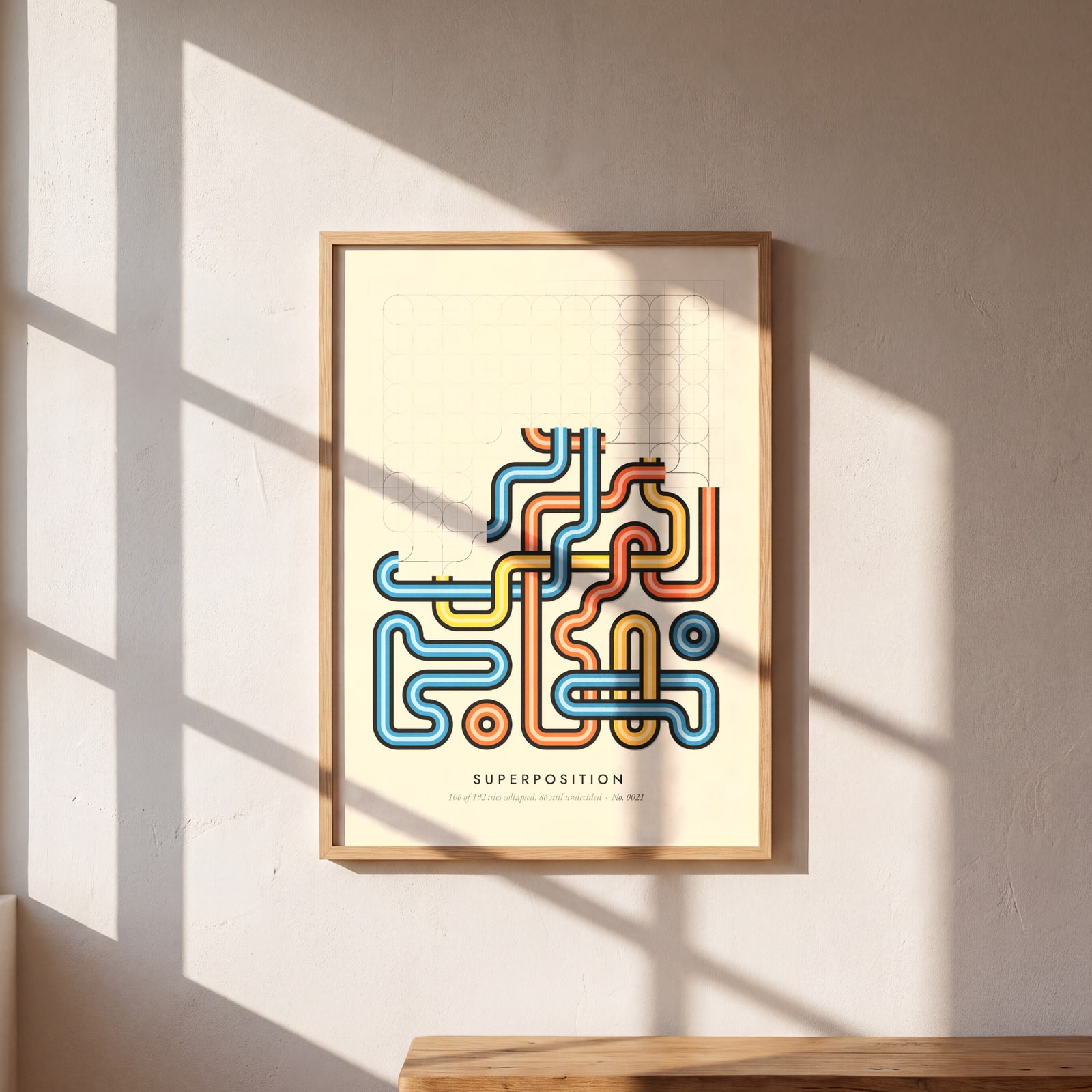
On the wall
A few of them framed at home. Open any one to make it yours.
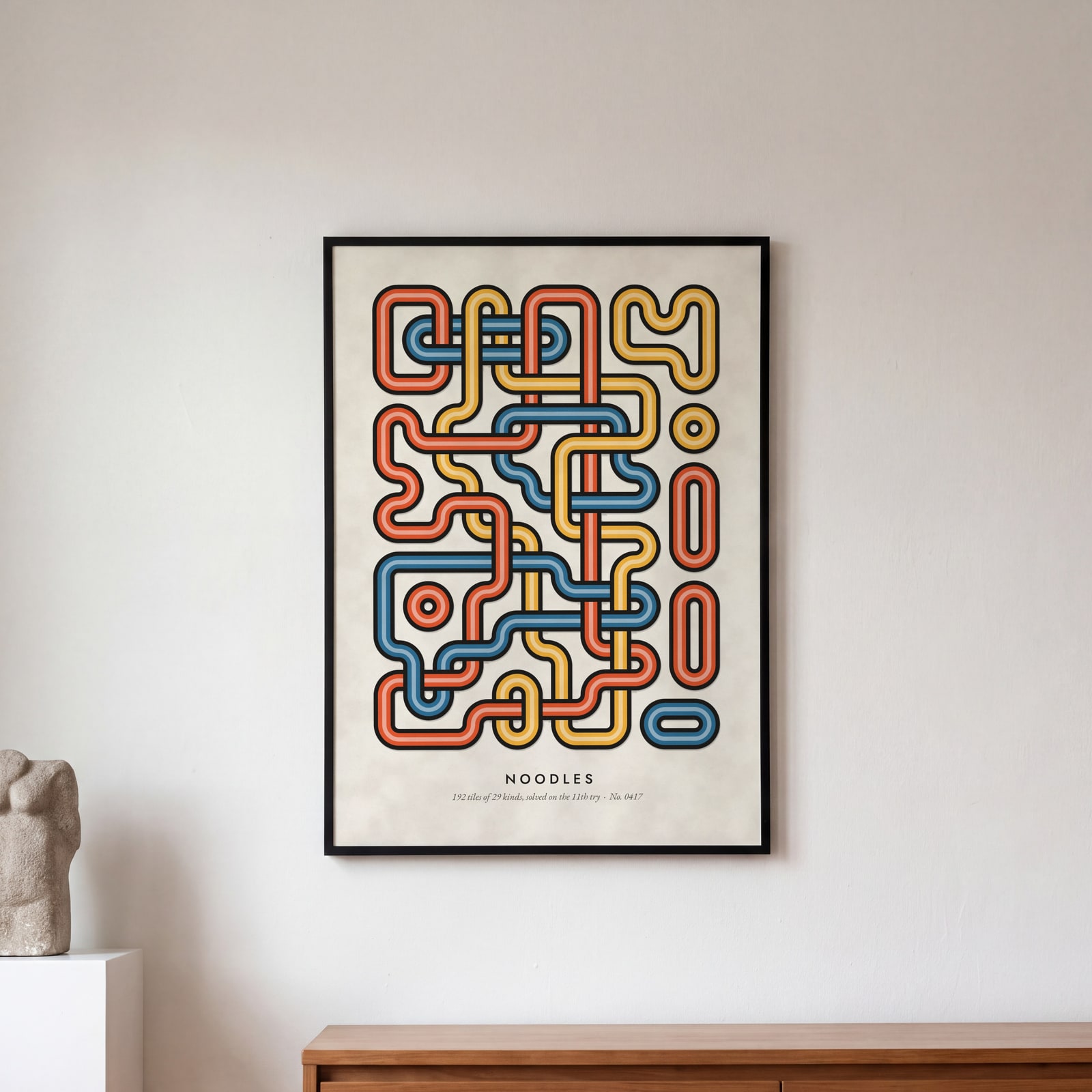
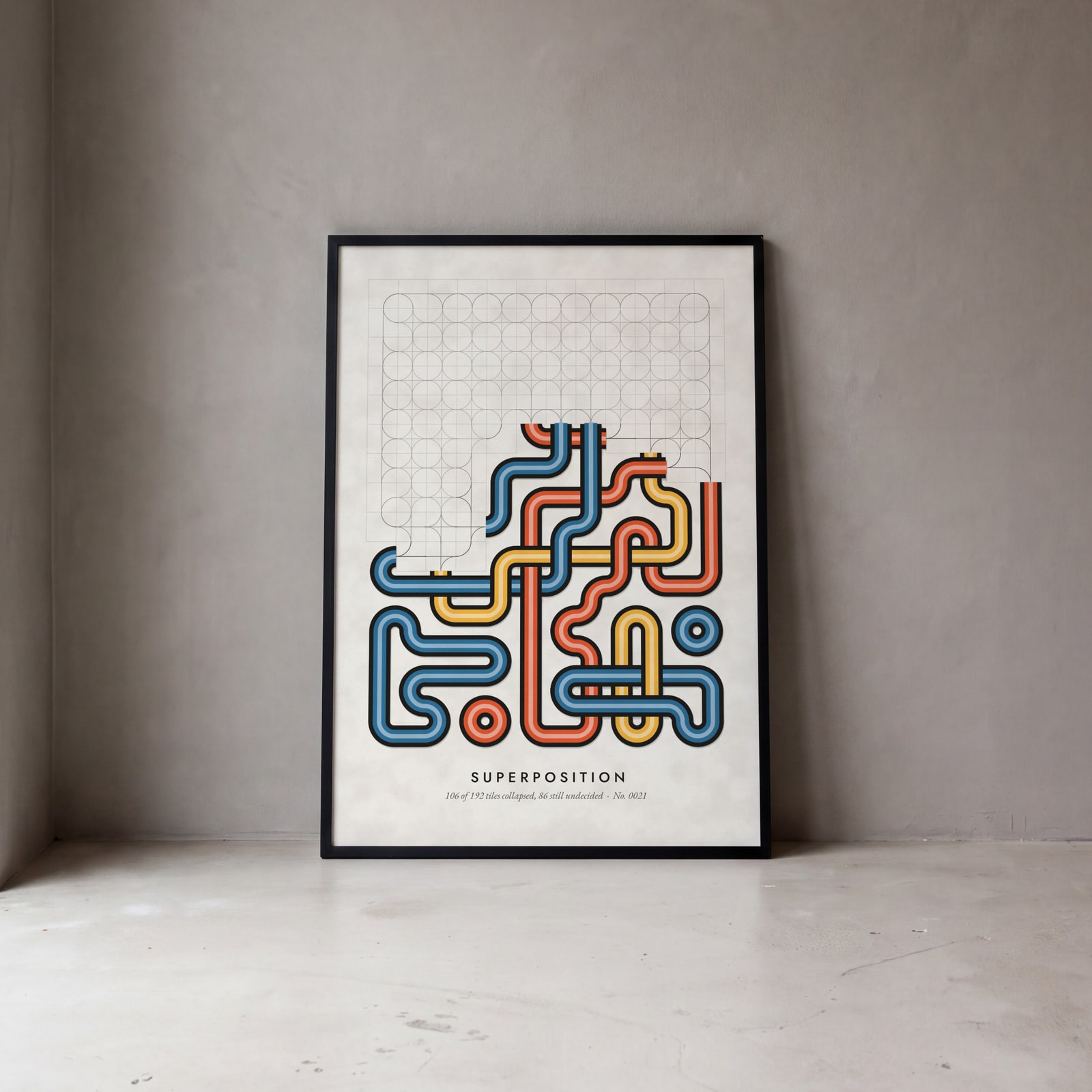
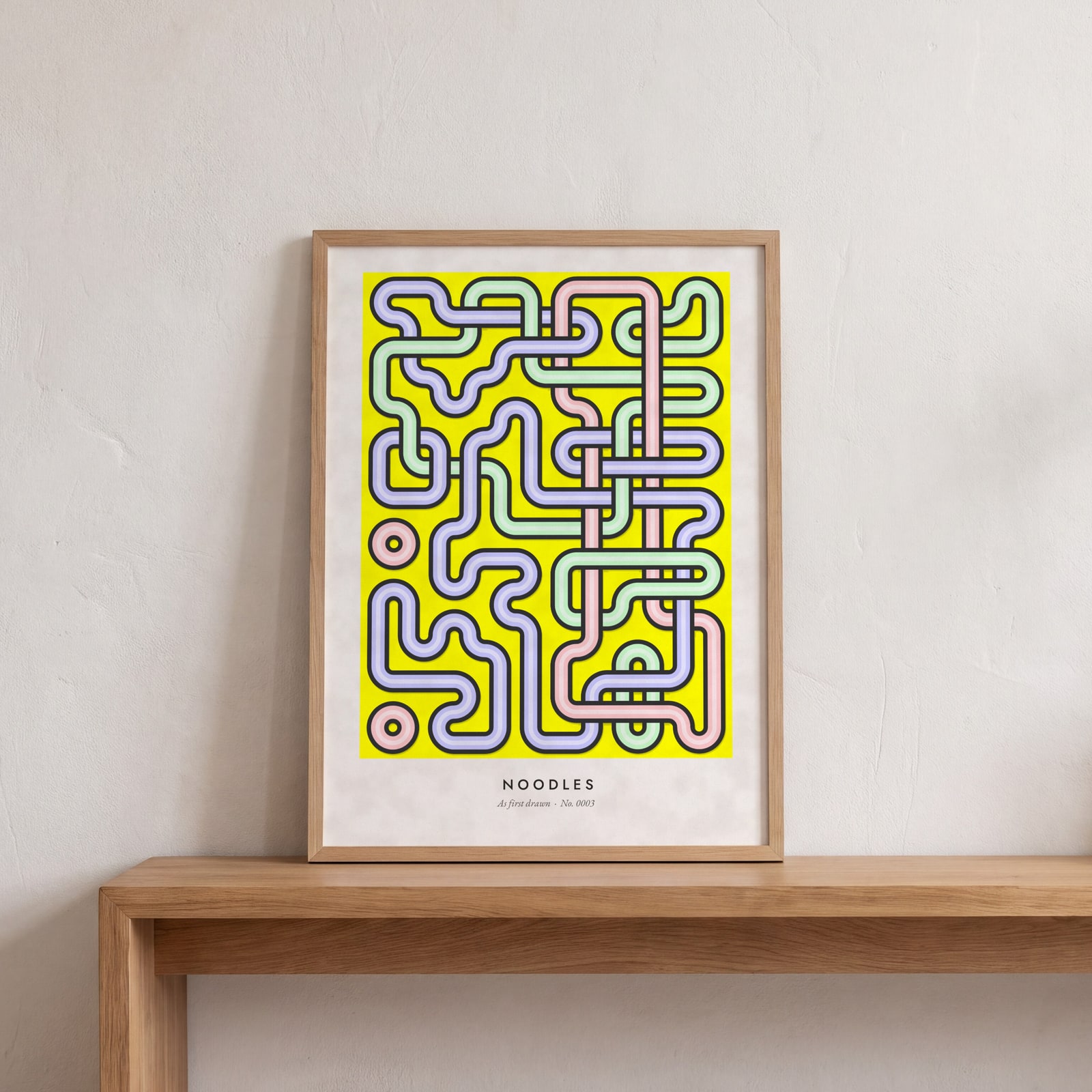
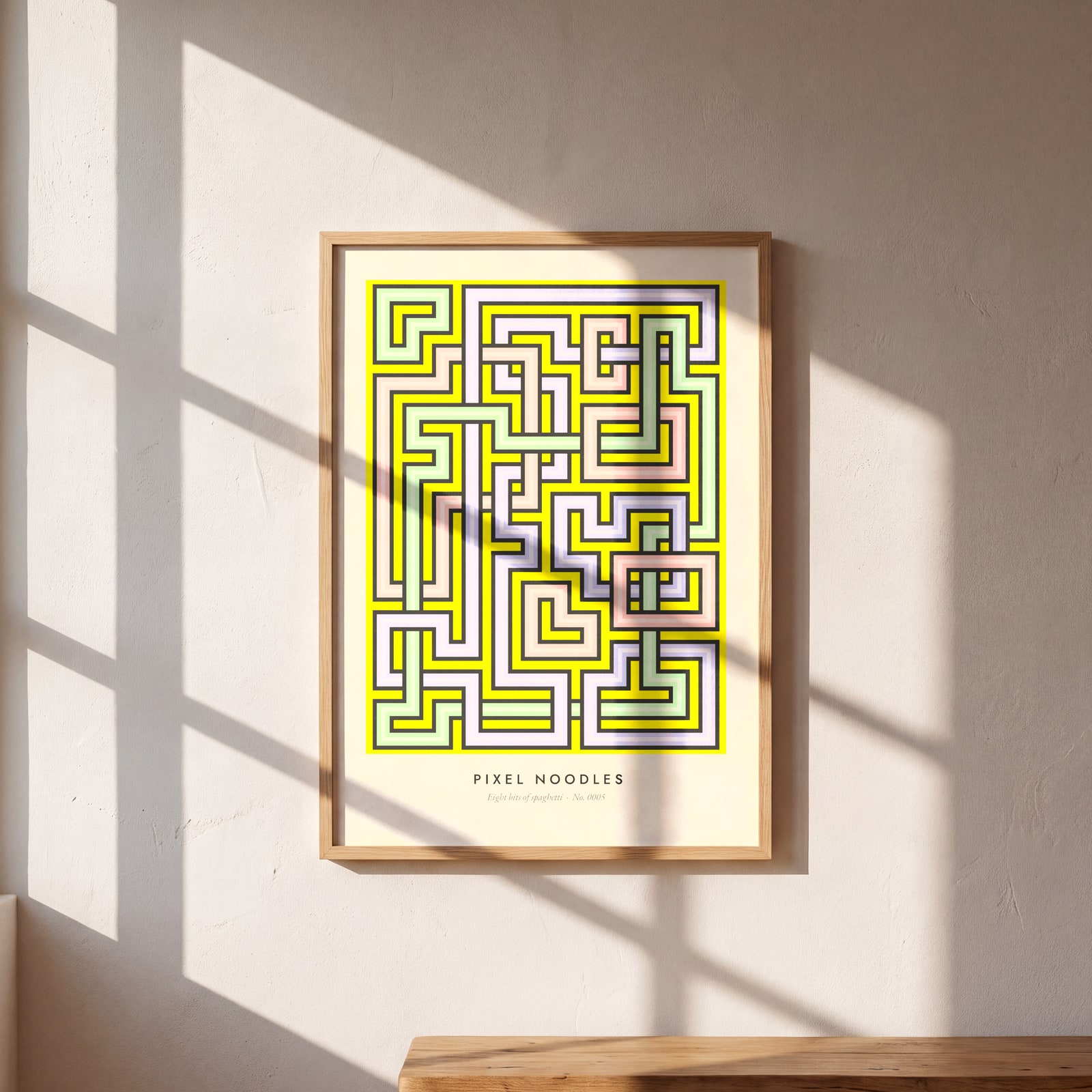
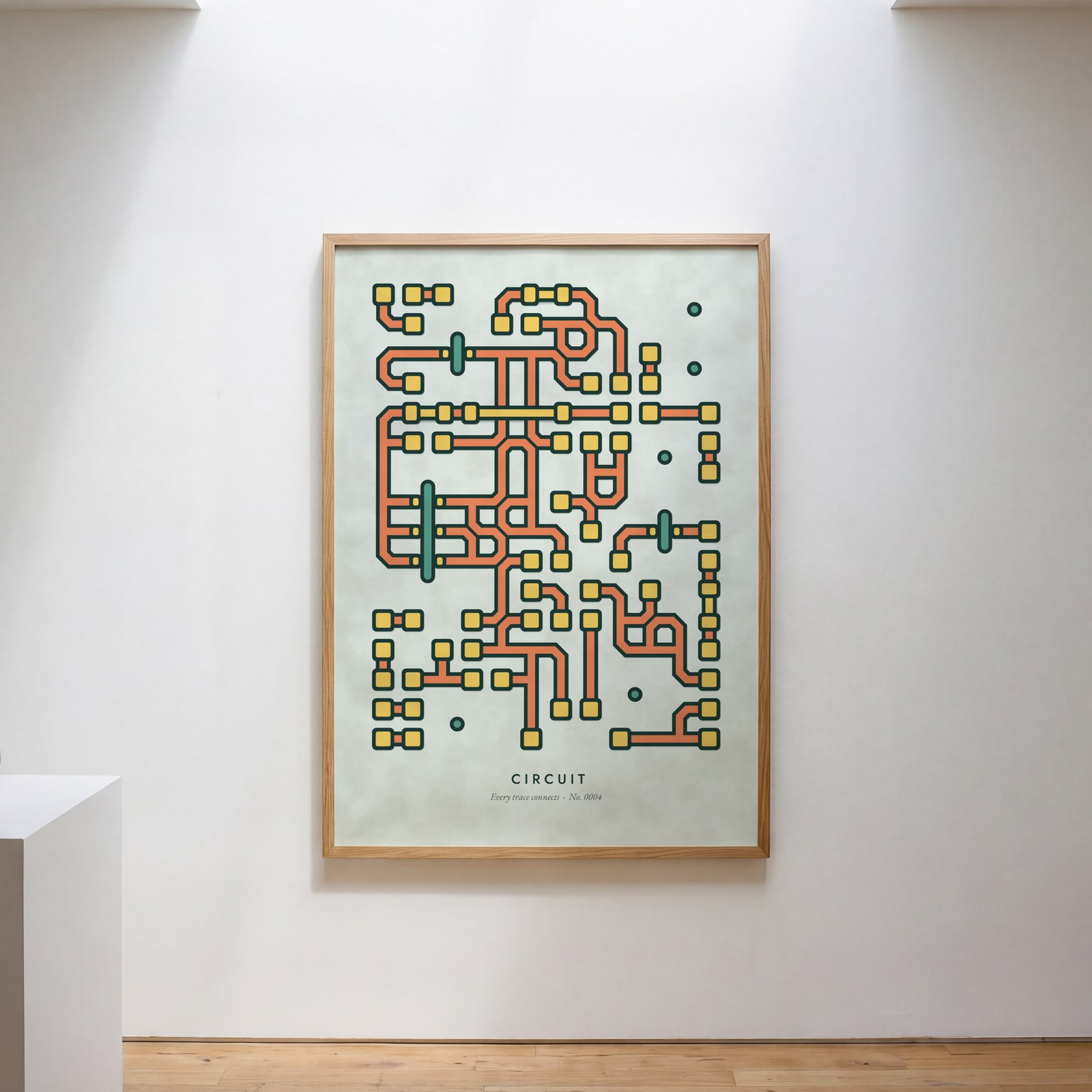
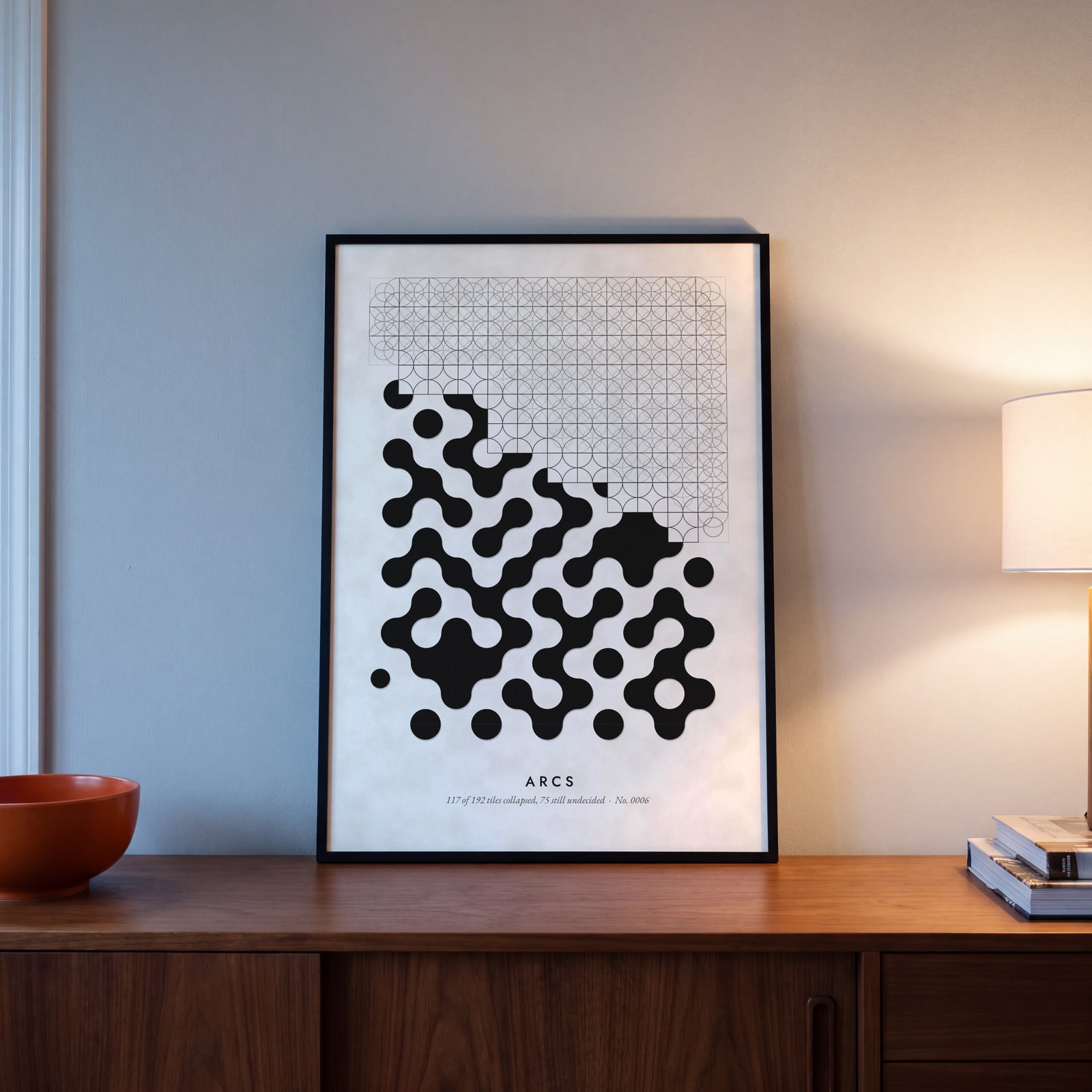
Examples
Open any of them to change the words, the place, the date and the style, then download the print file.
Tile sets
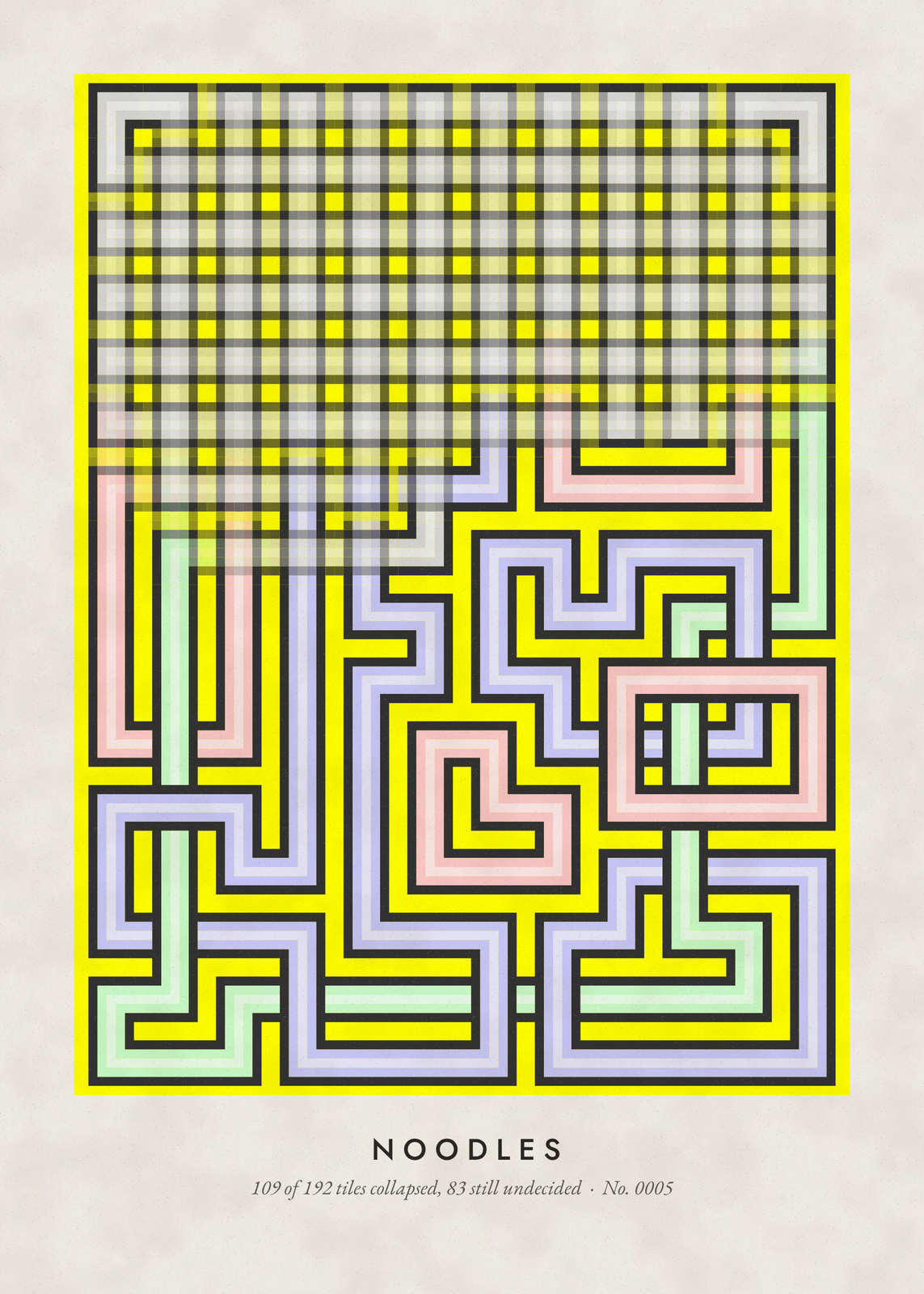
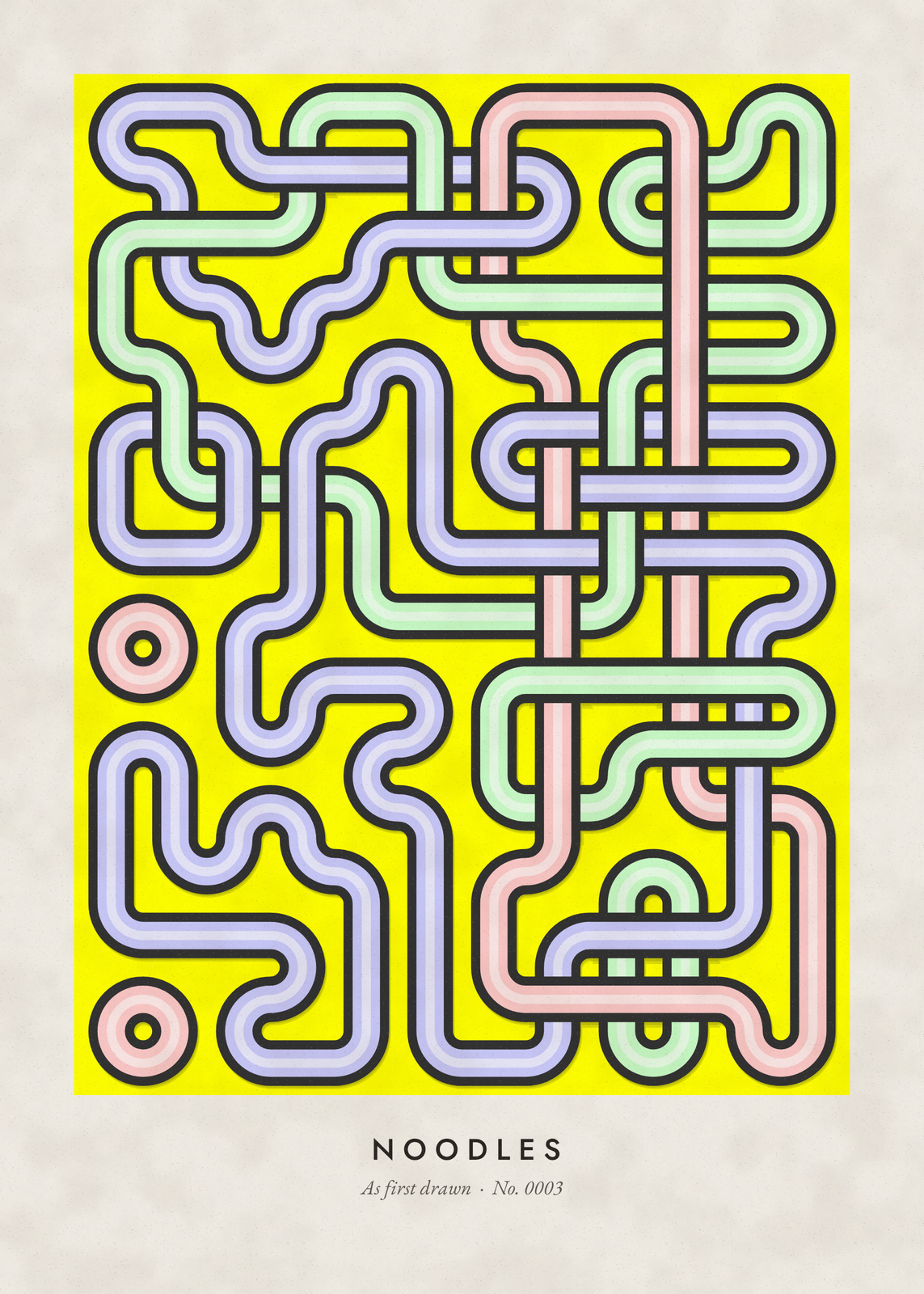
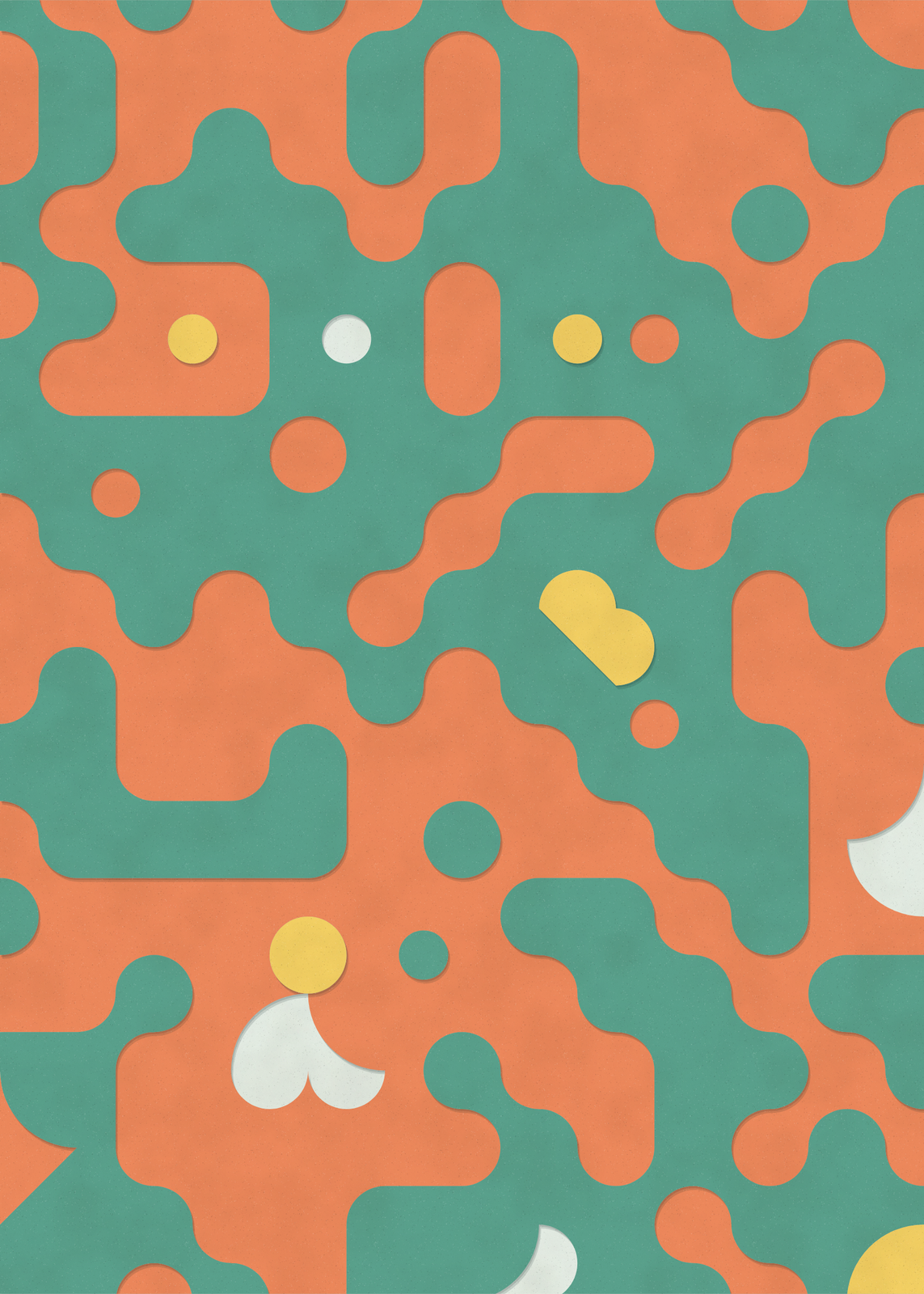
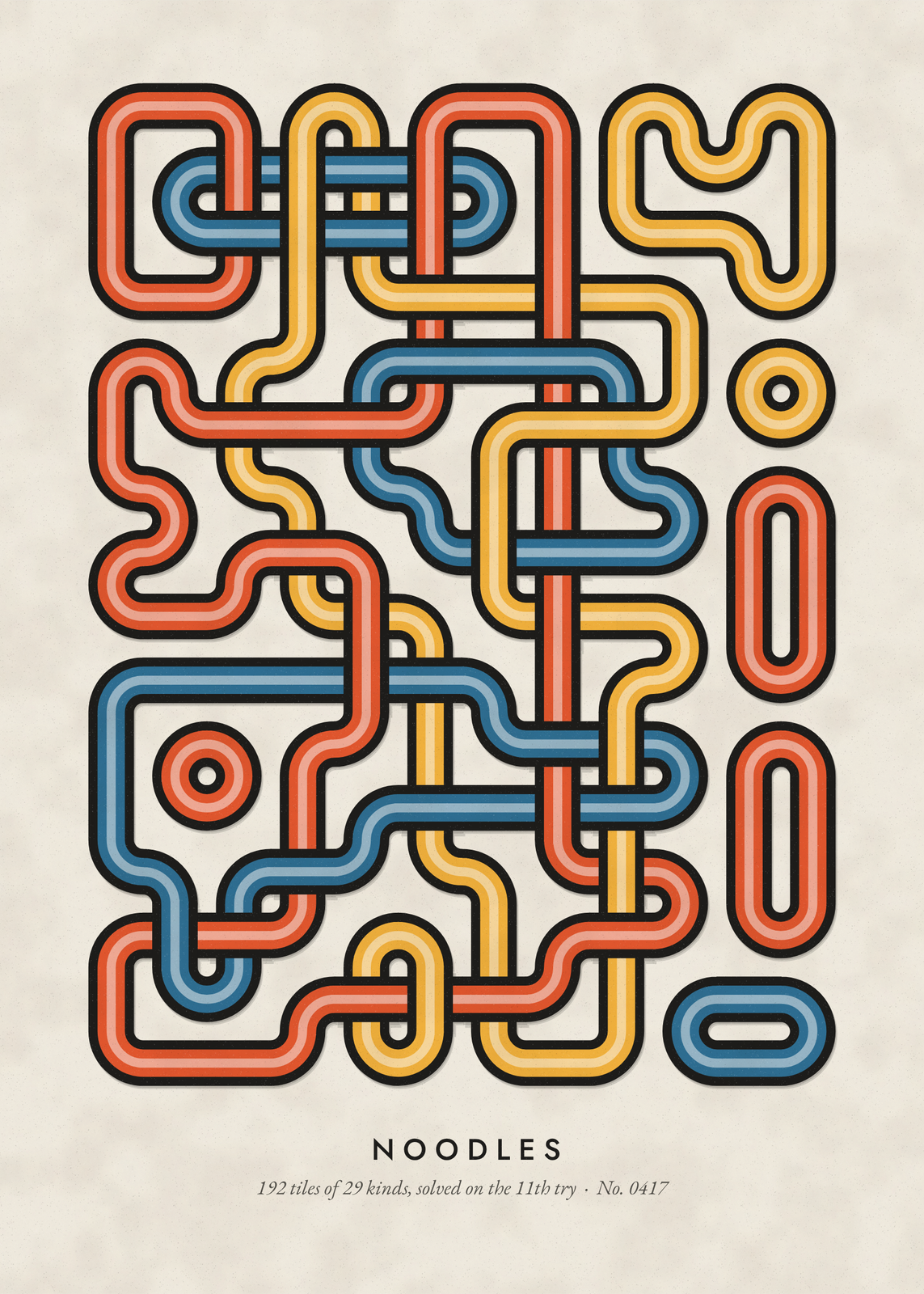 Noodles in studio colorsEdit this →
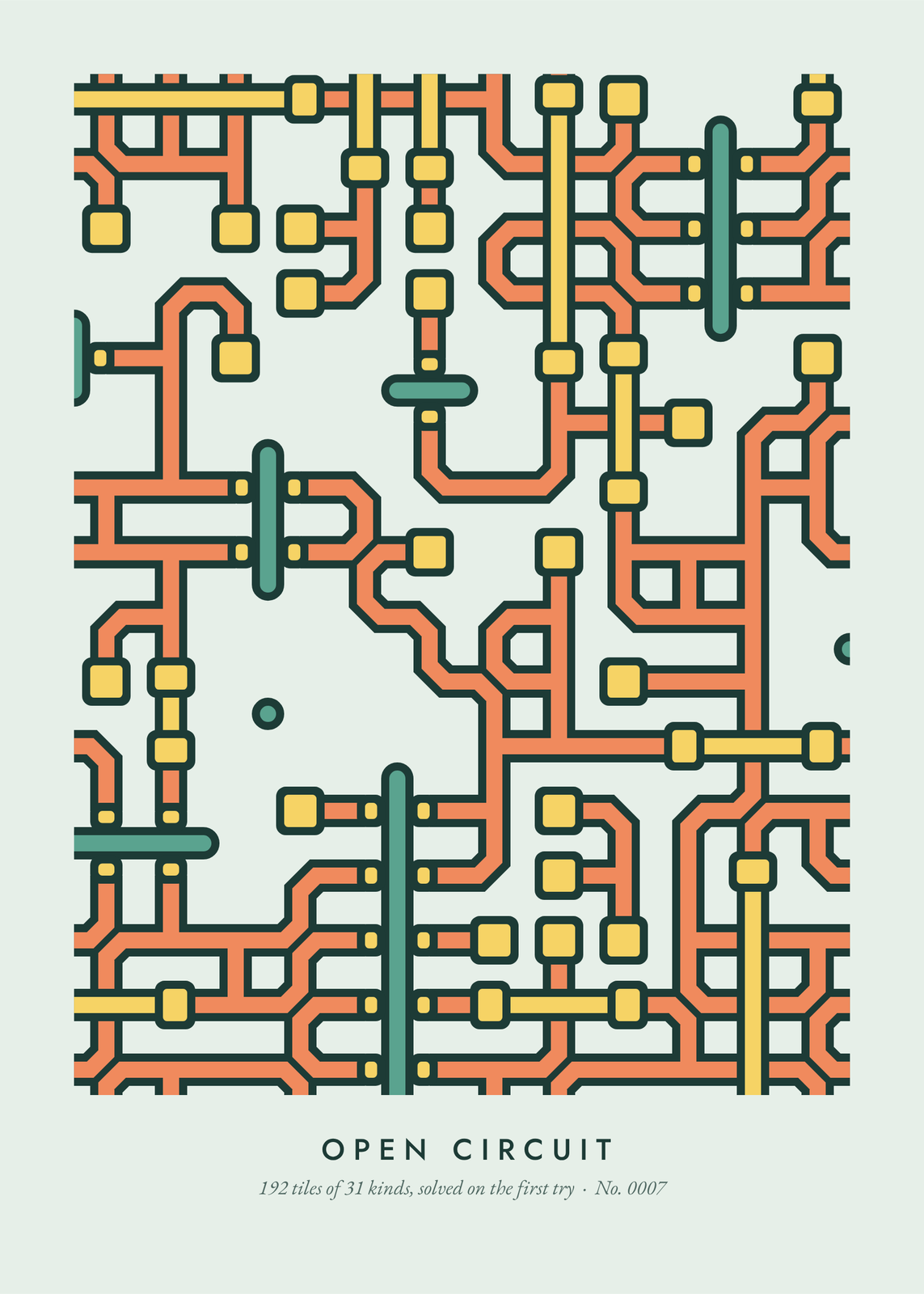
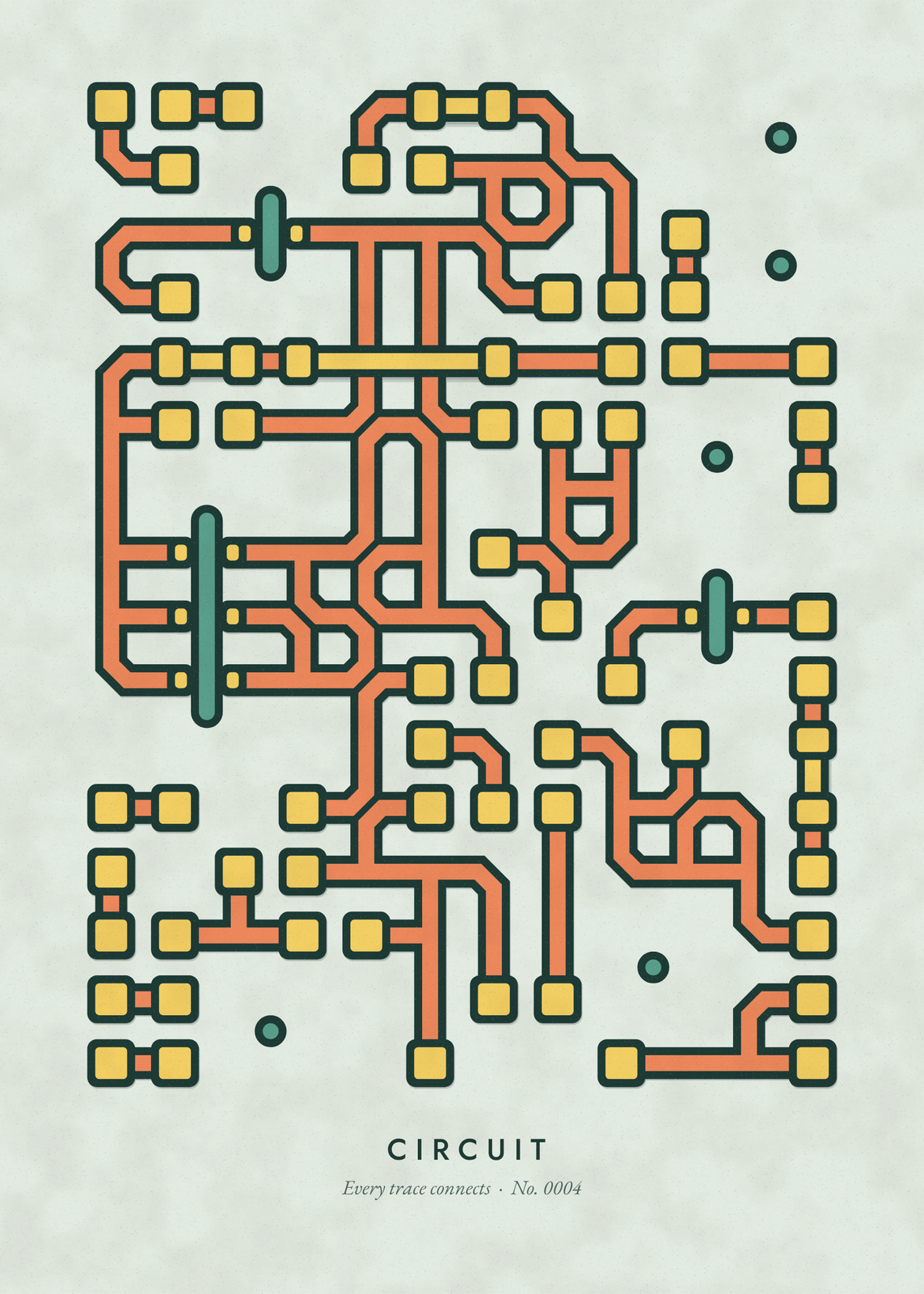 Circuit boardEdit this →
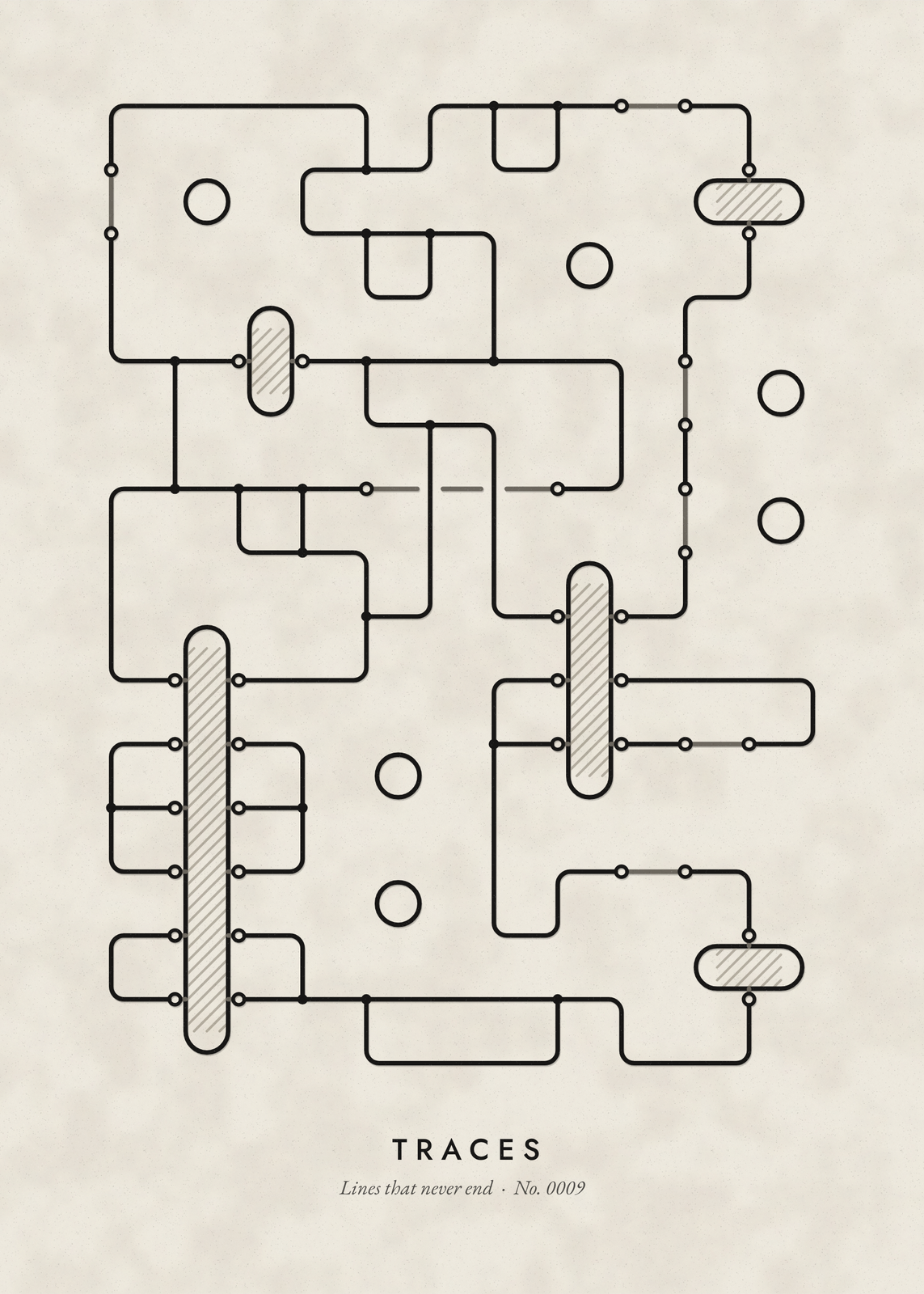 Traces in ink on paperEdit this →
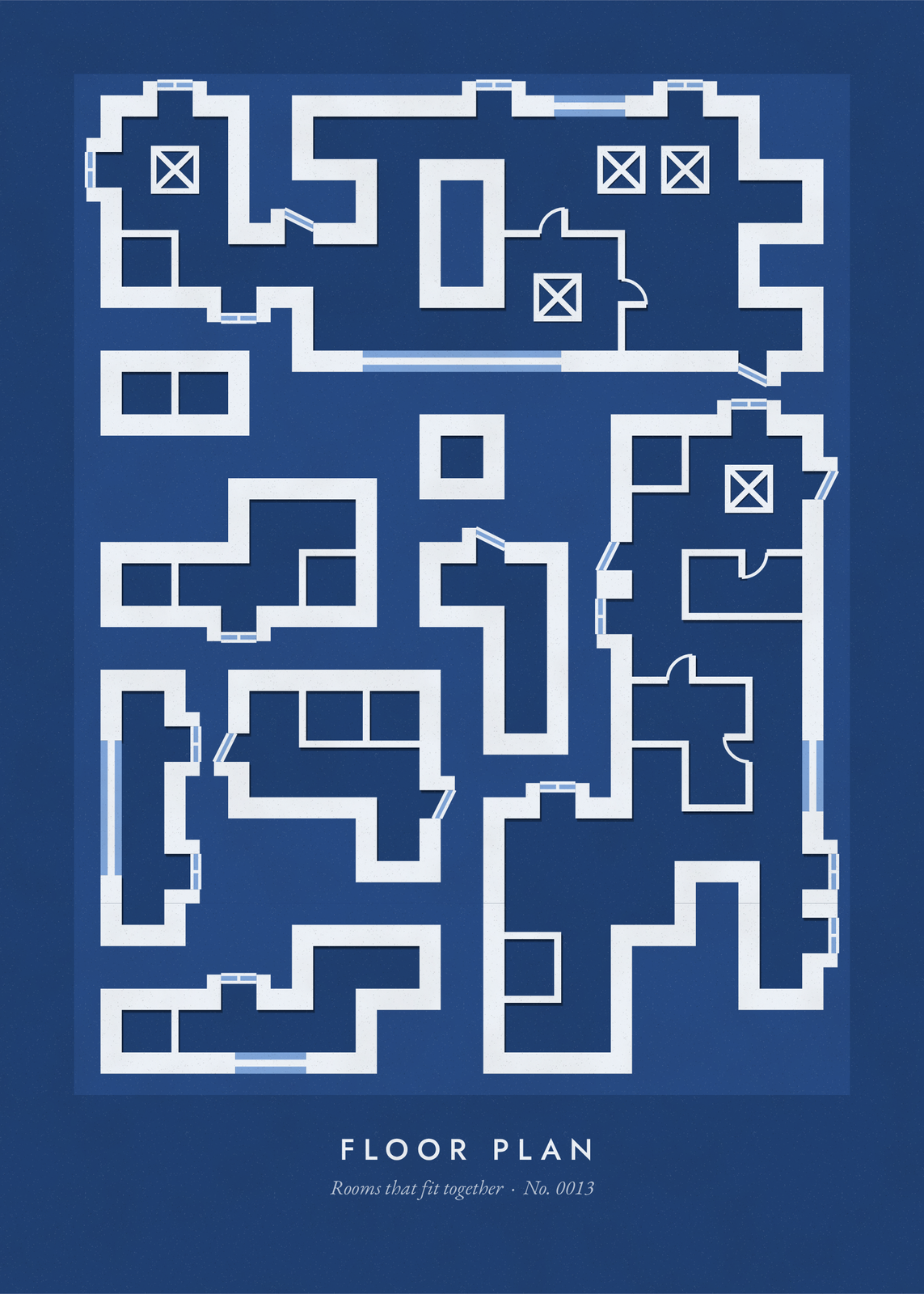 Floor plan of roomsEdit this →
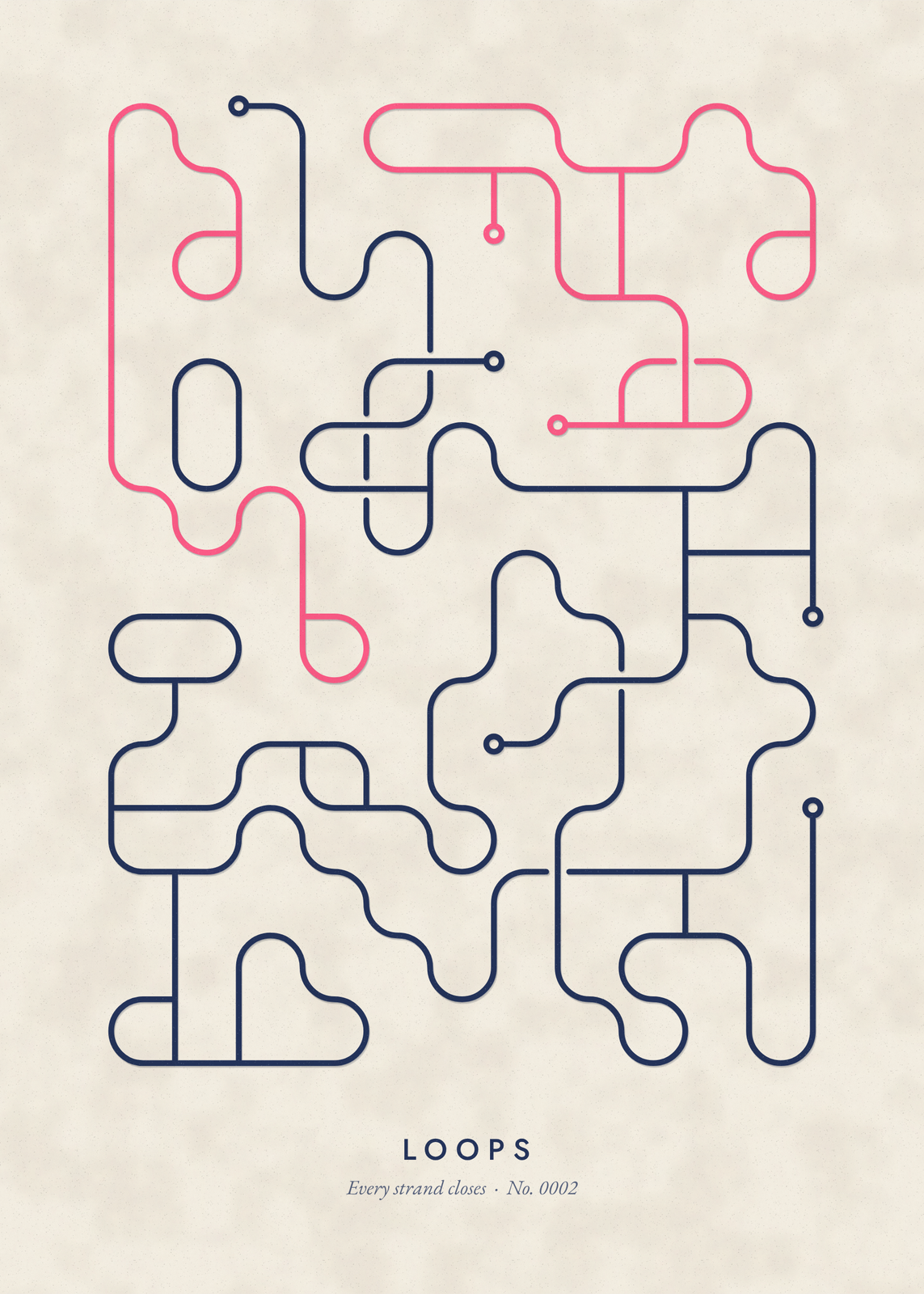 Loops, each strand its own colorEdit this →
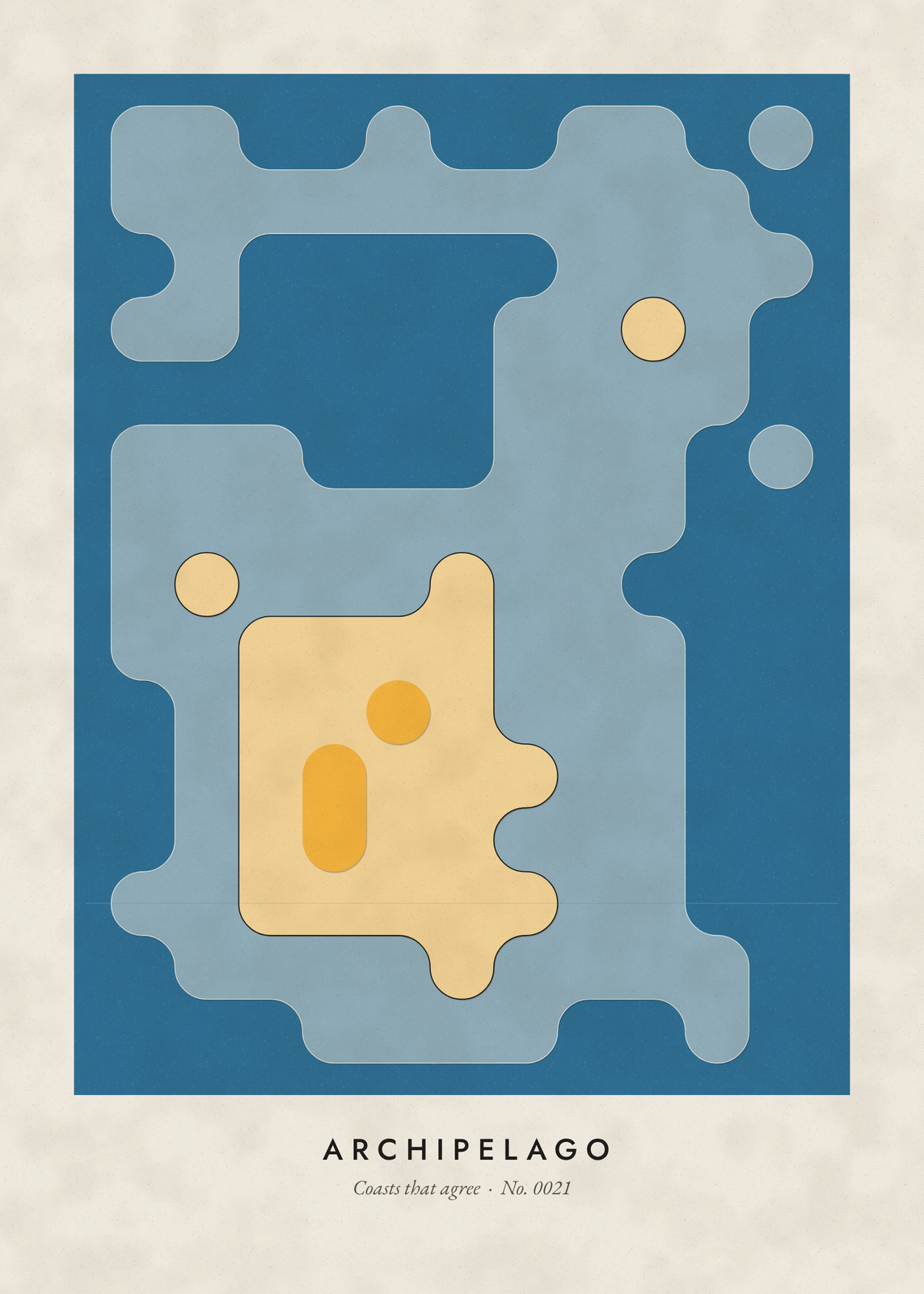 Islands and coastsEdit this →
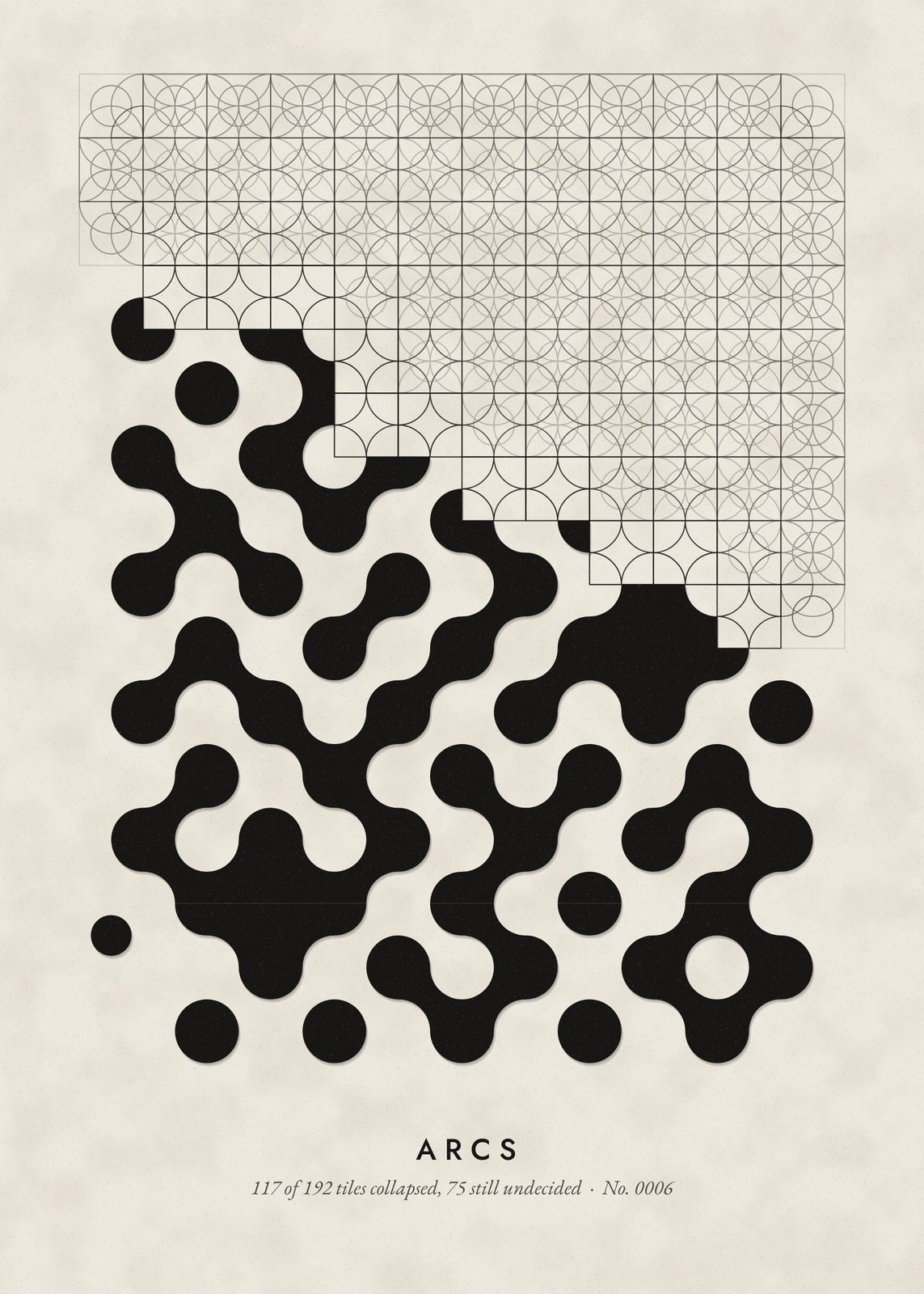
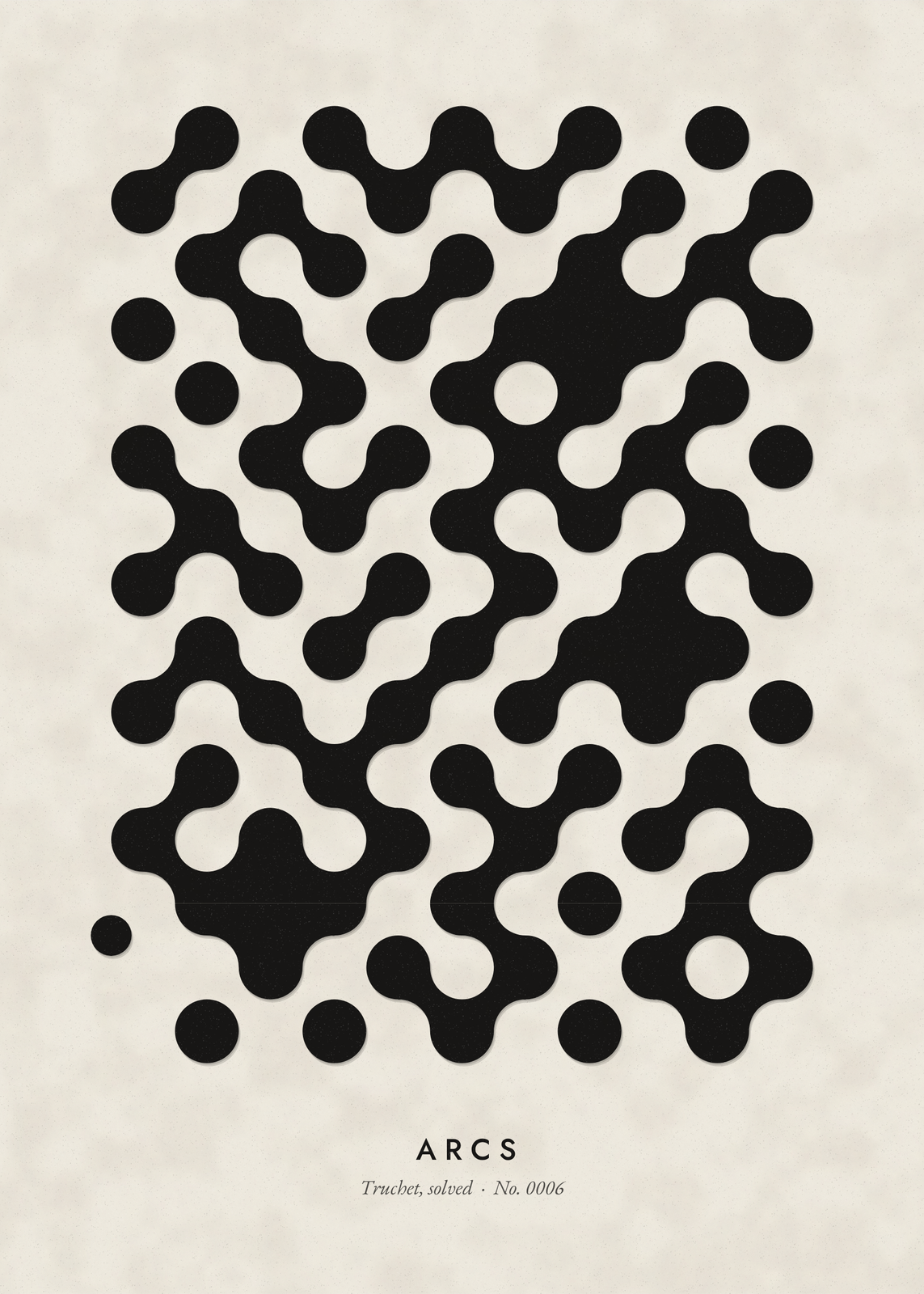 Black and cream arcsEdit this →
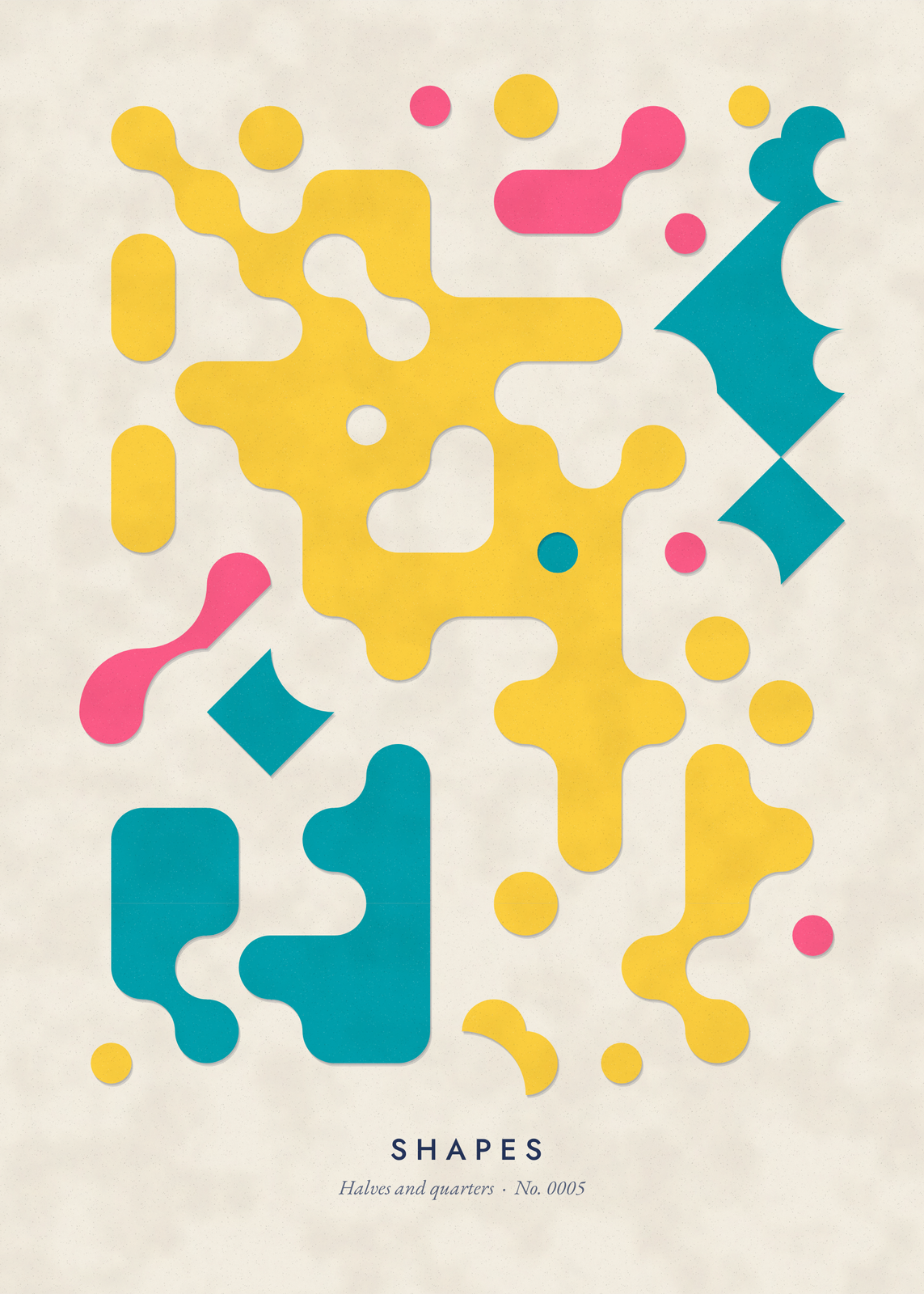 Bauhaus shapesEdit this →
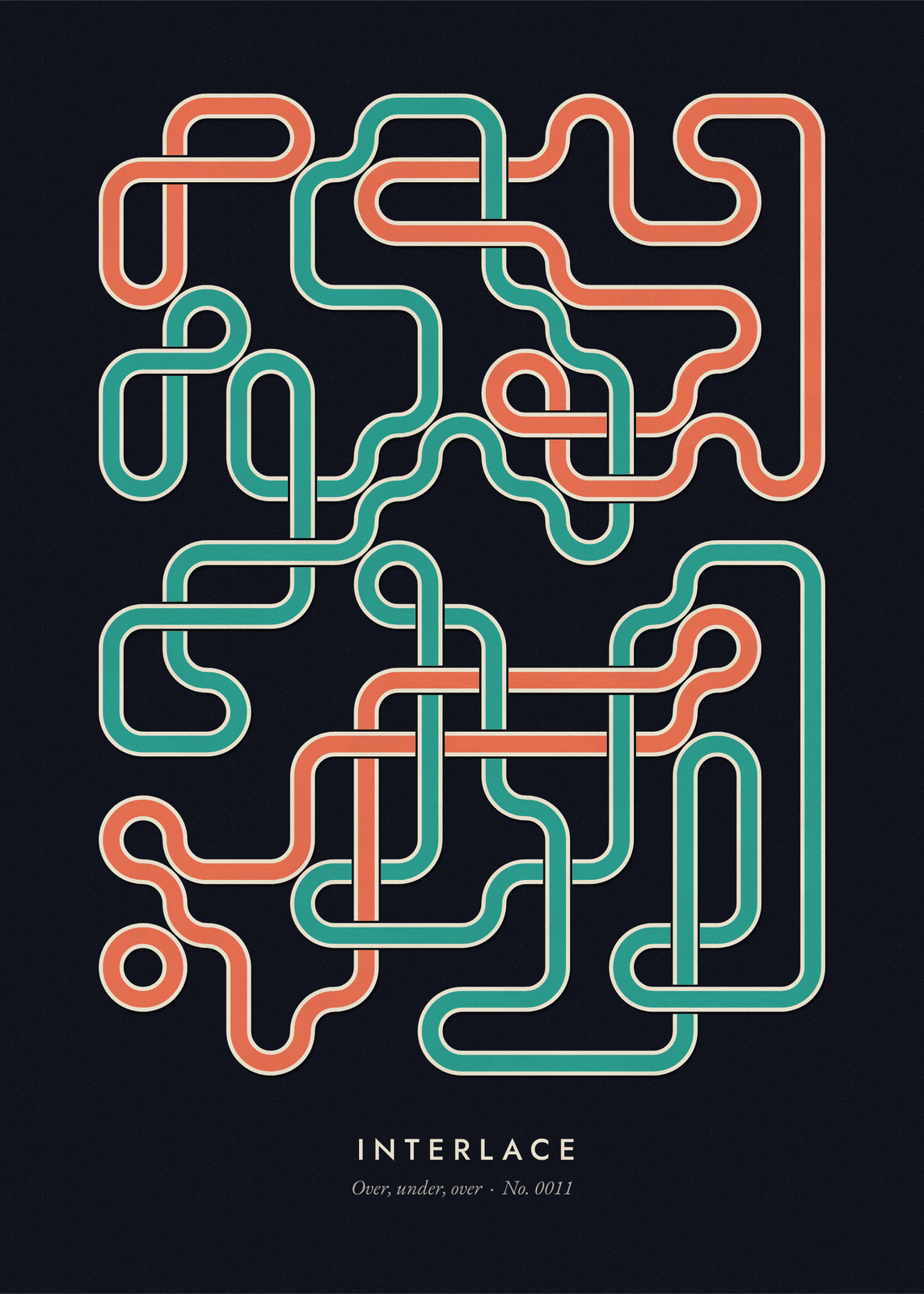 Celtic interlaceEdit this →
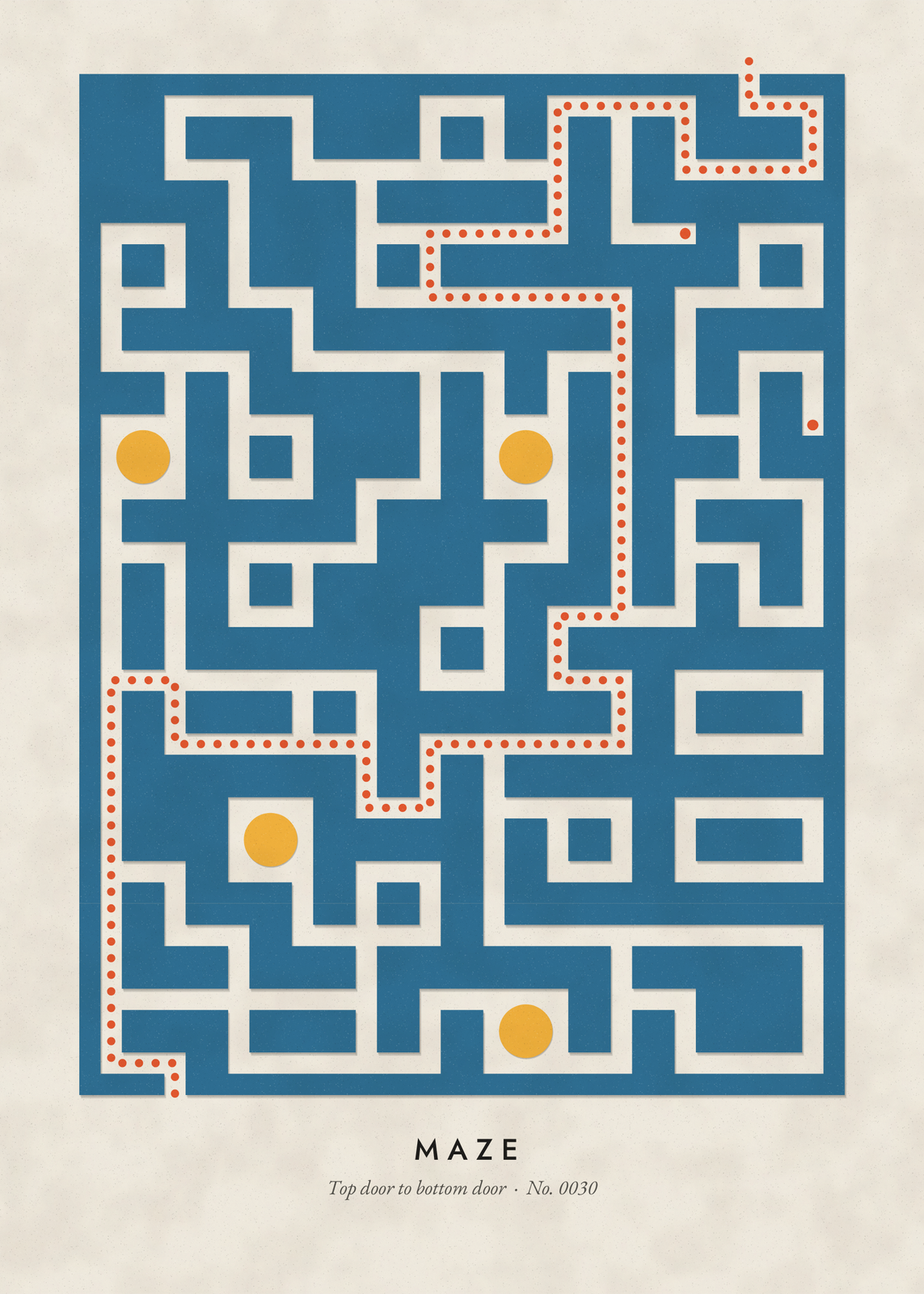 A maze with its way through dottedEdit this →
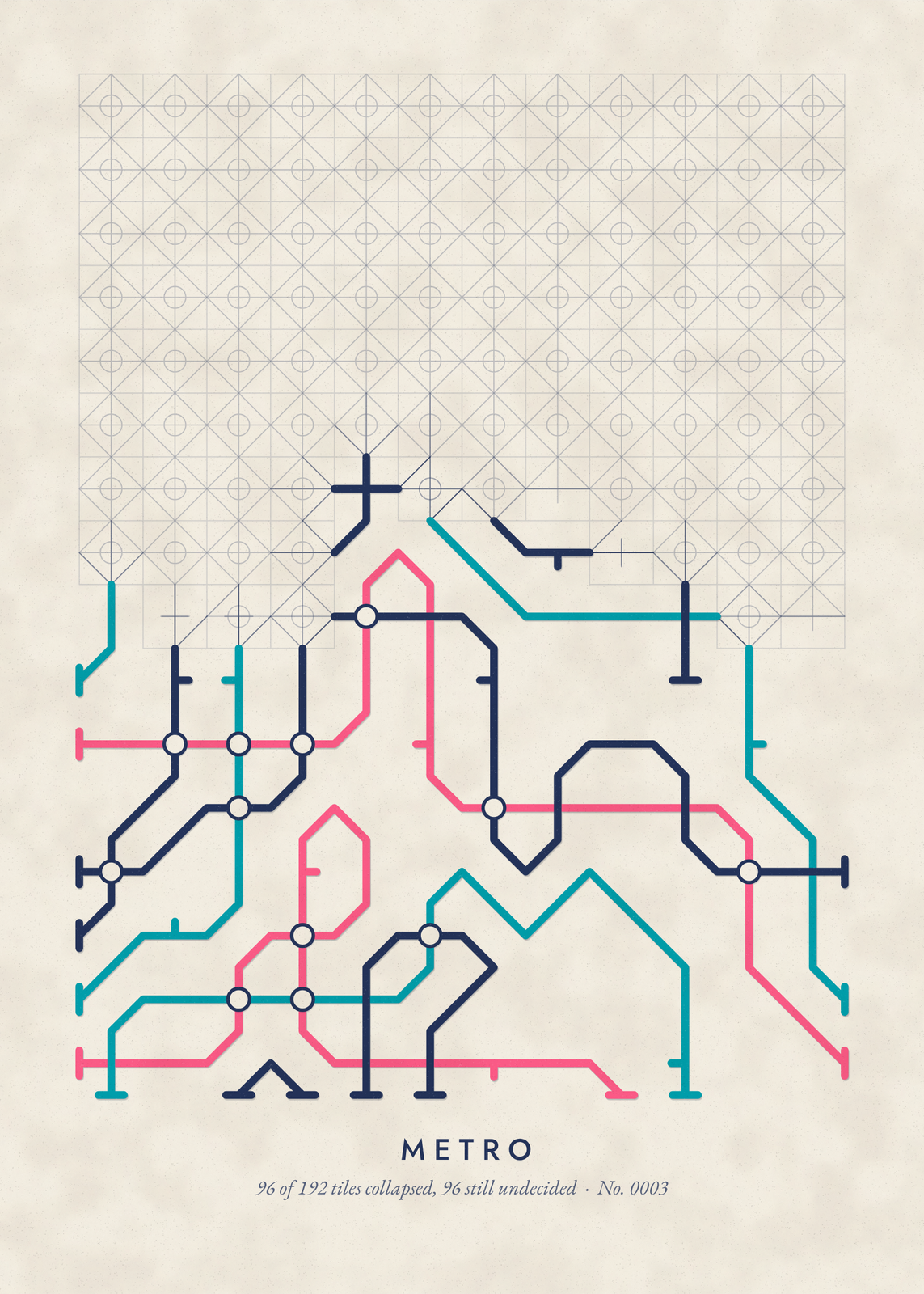
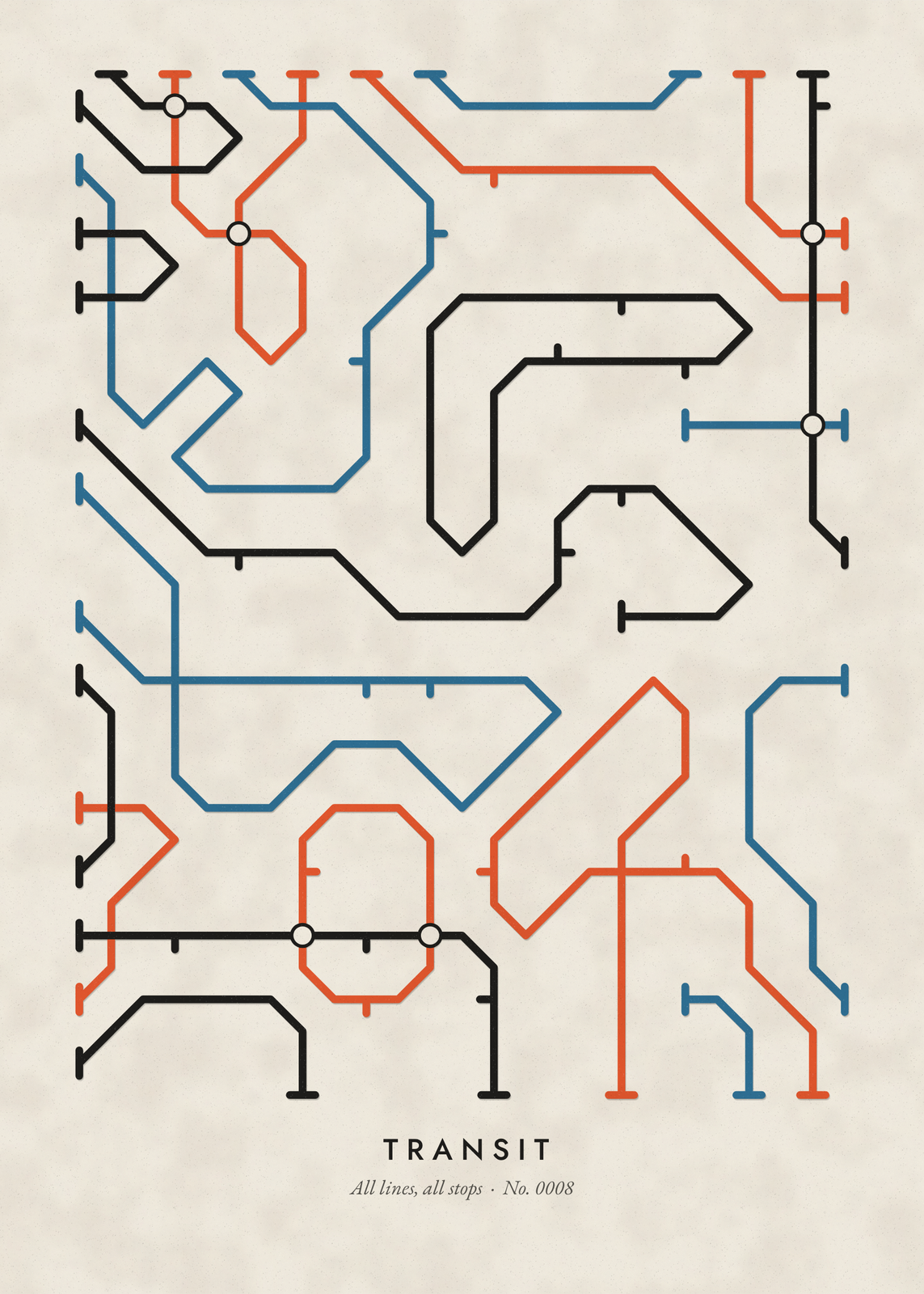 Imaginary transit mapEdit this →
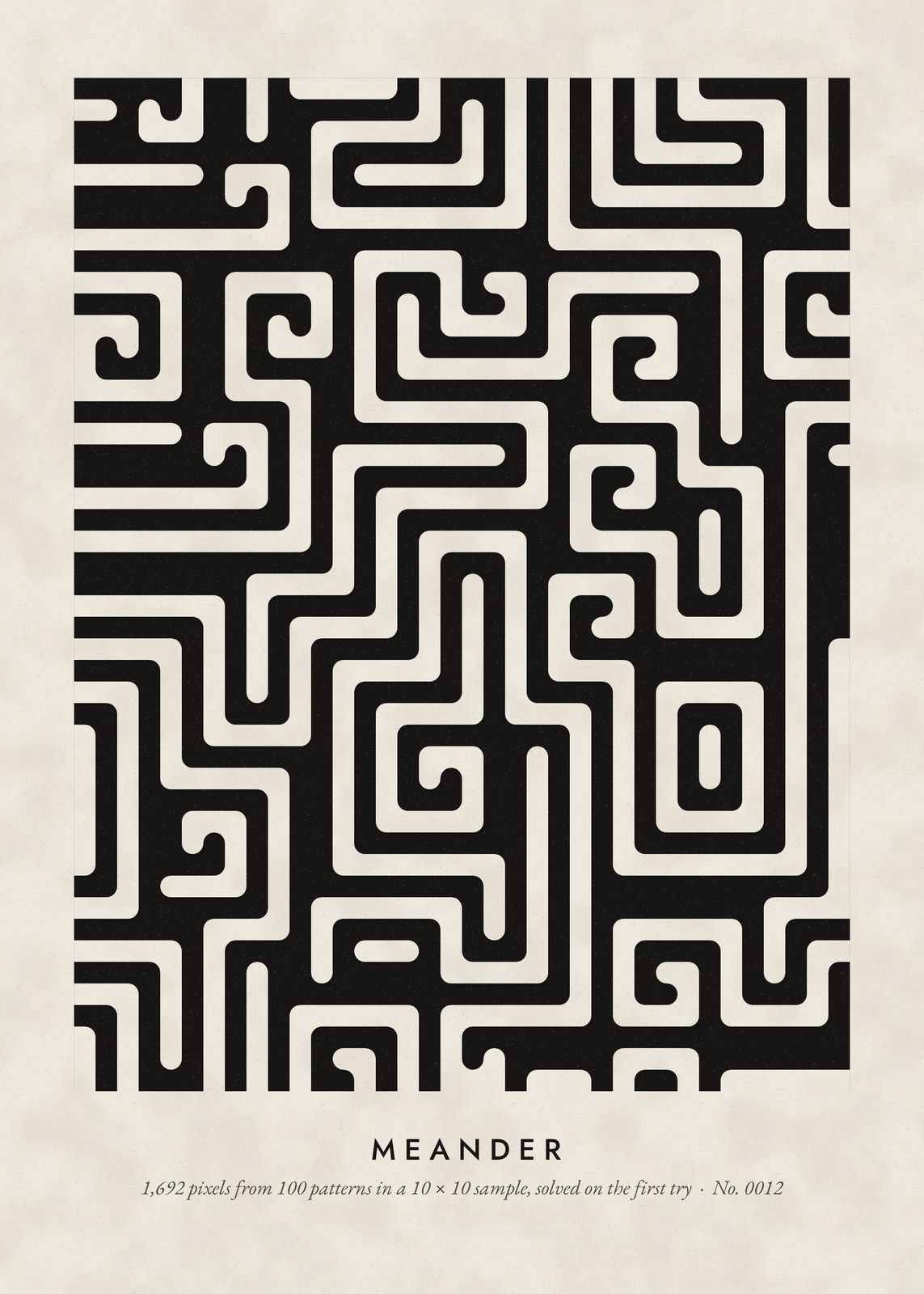 A labyrinth of Greek keys, learned from one keyEdit this →
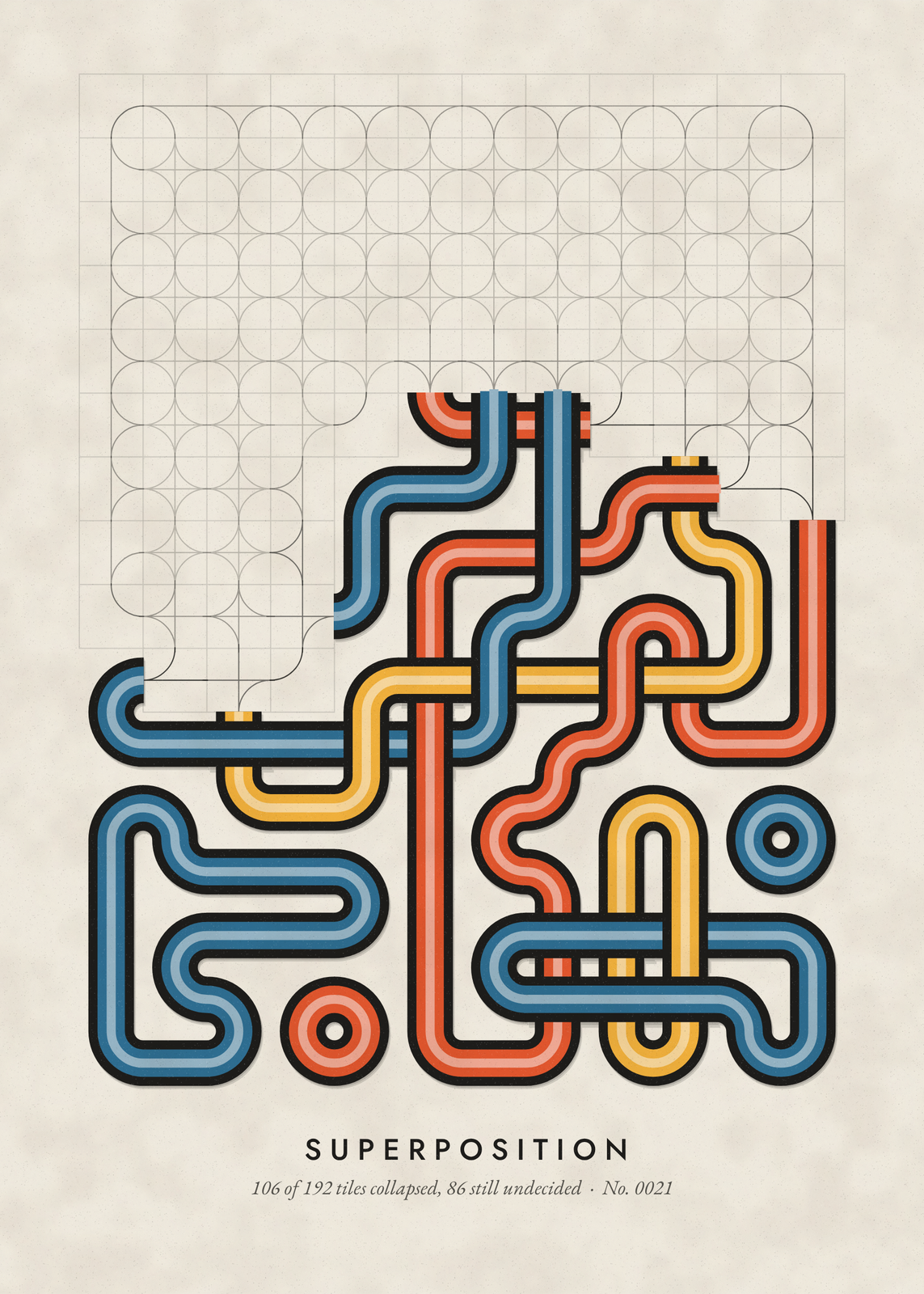
Part way through the collapse
Colors
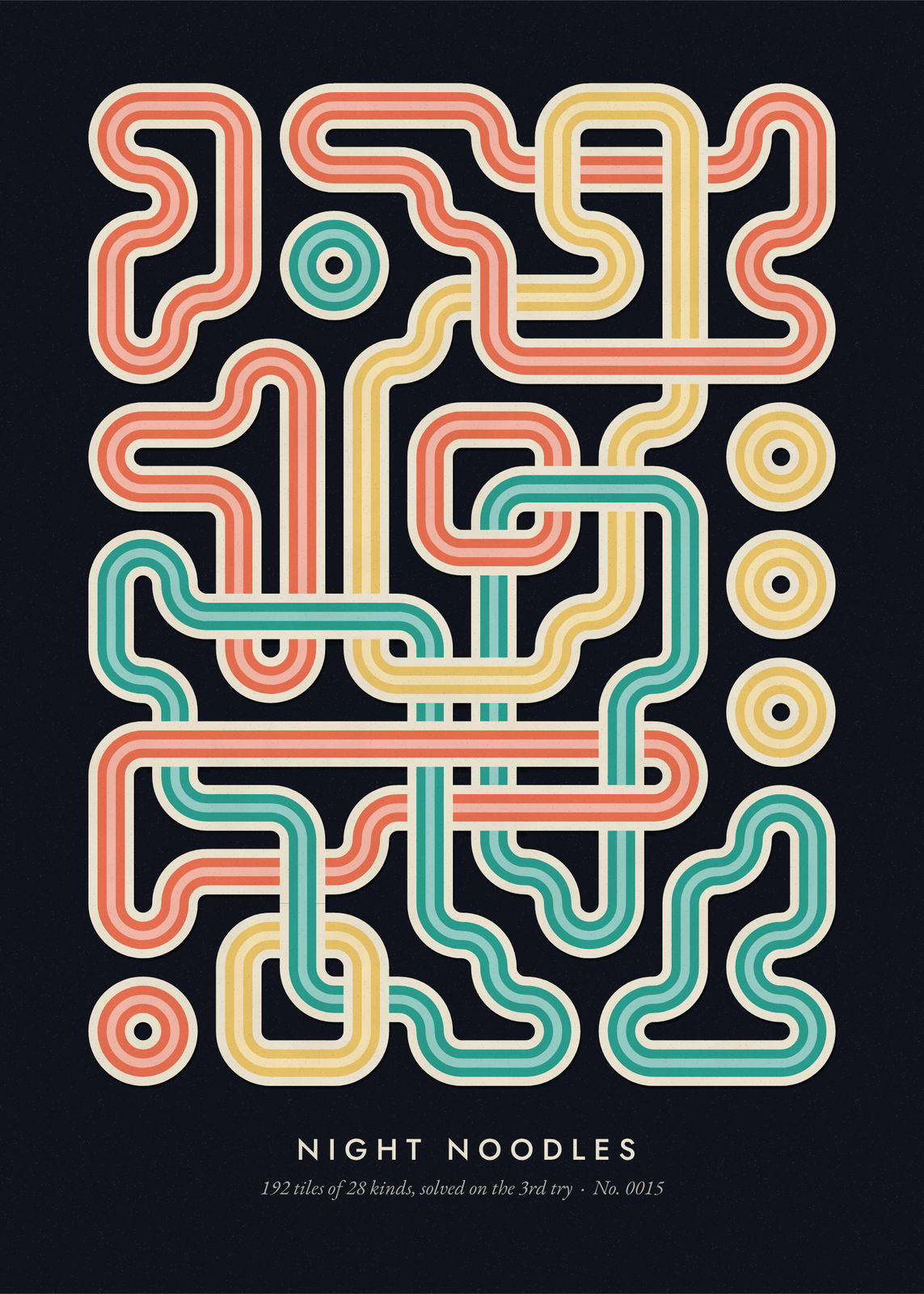
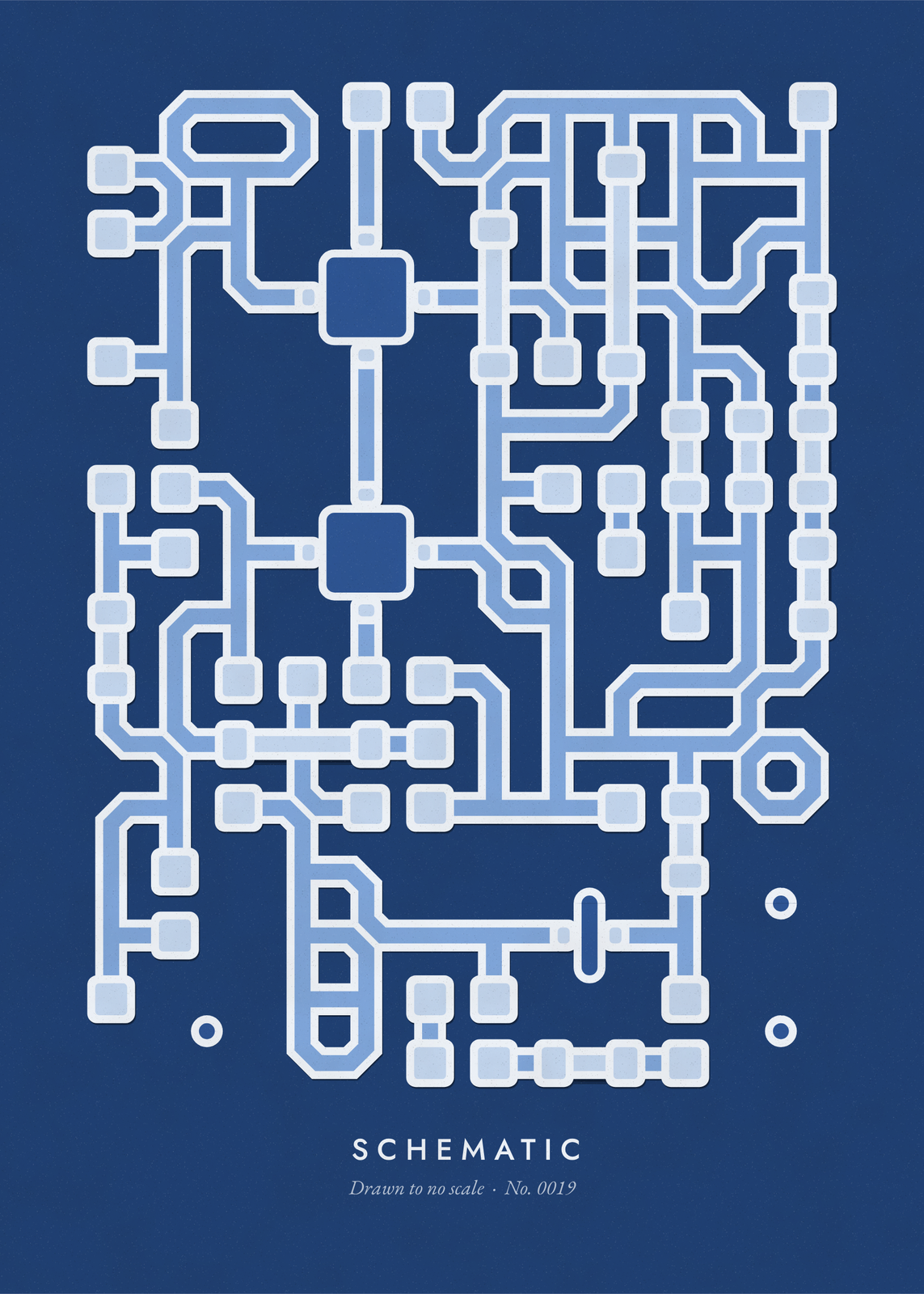
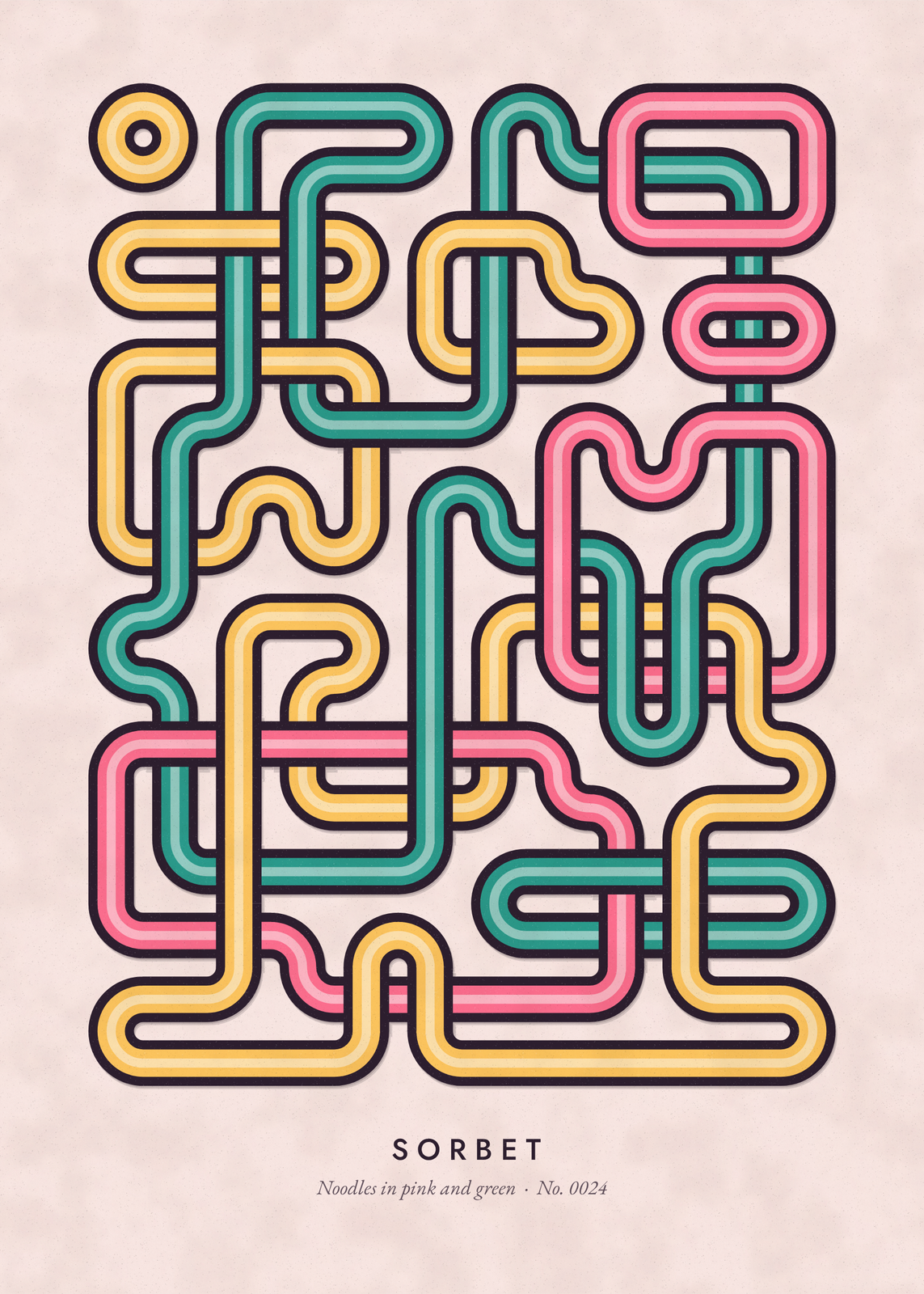
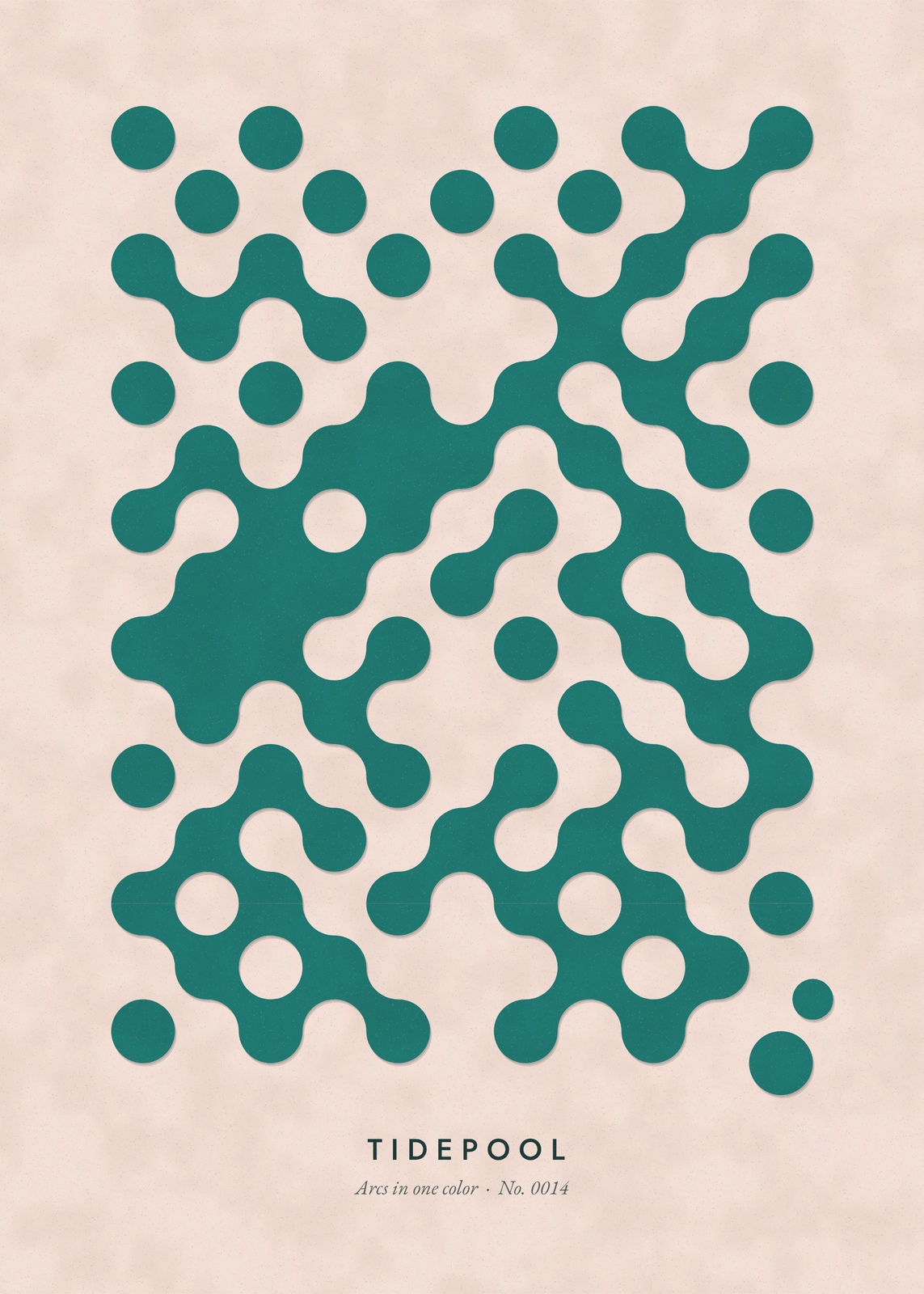
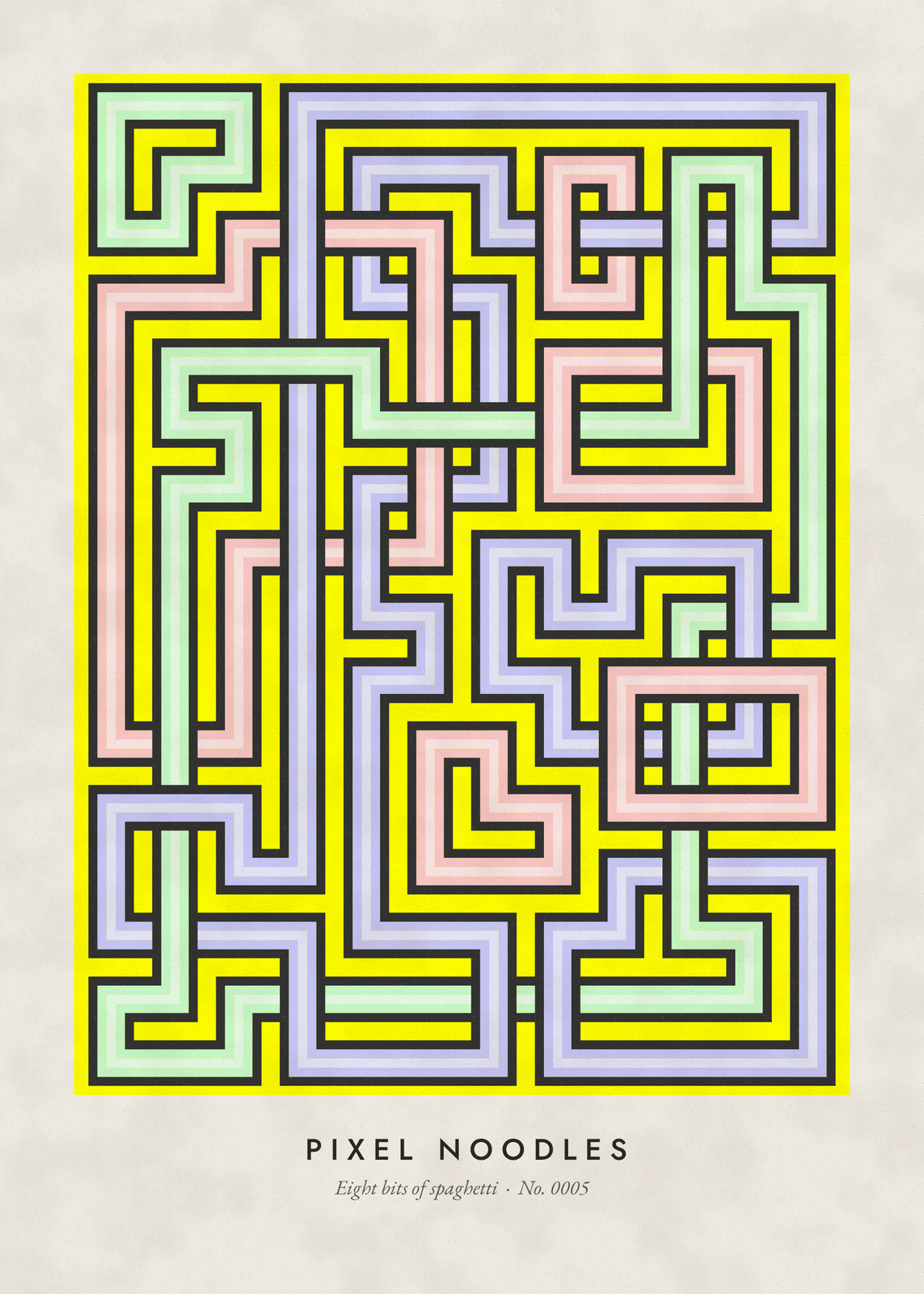
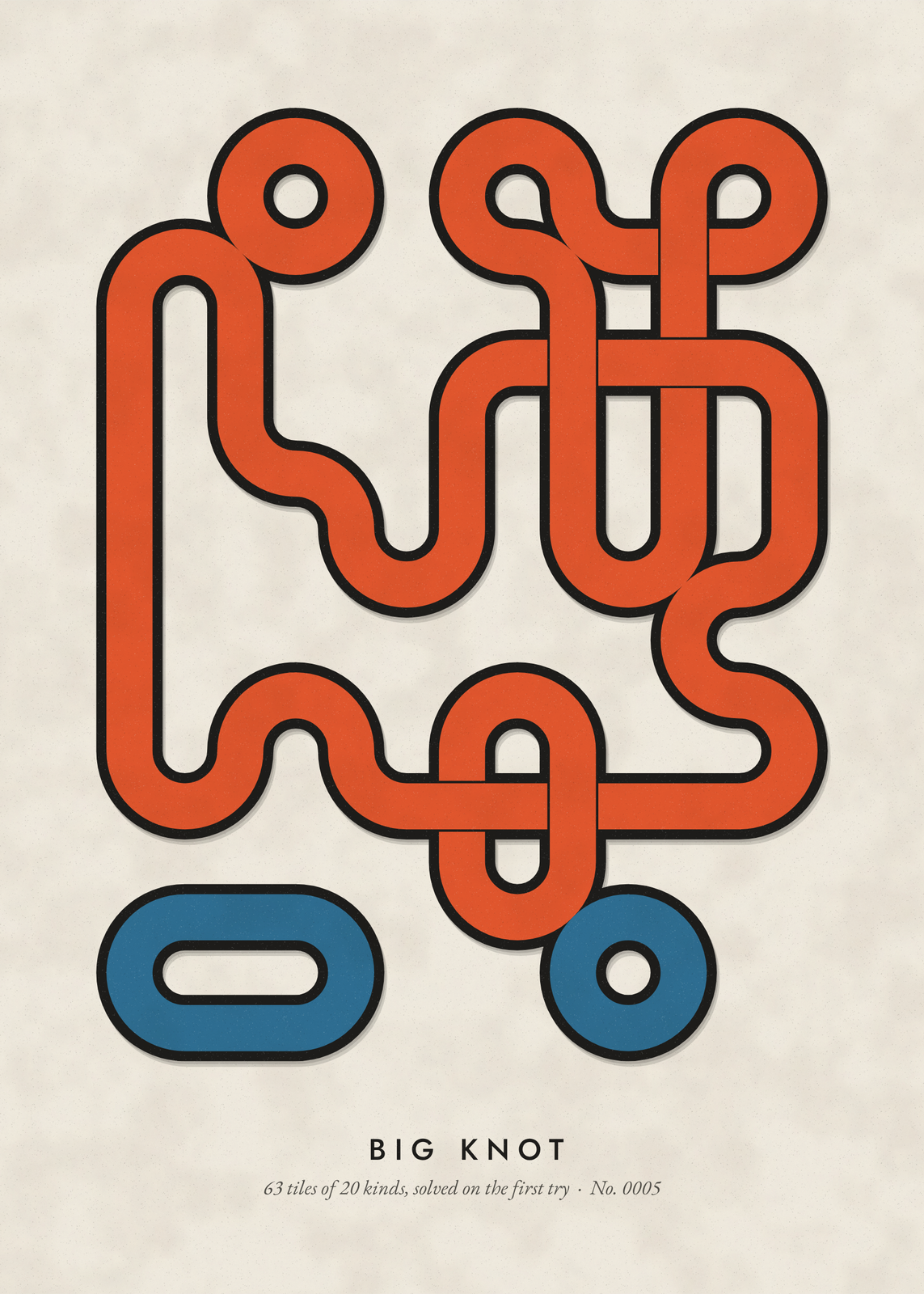
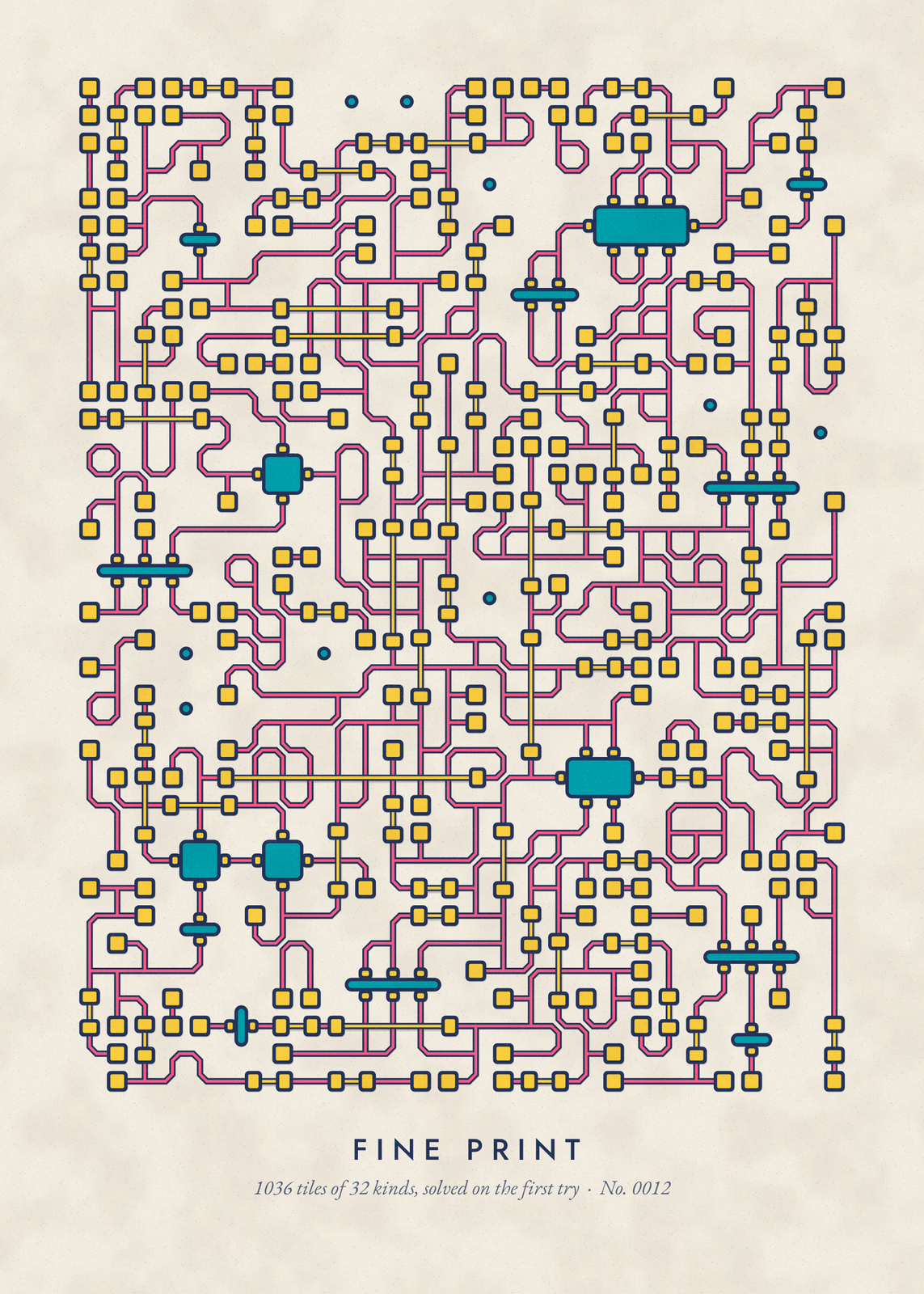
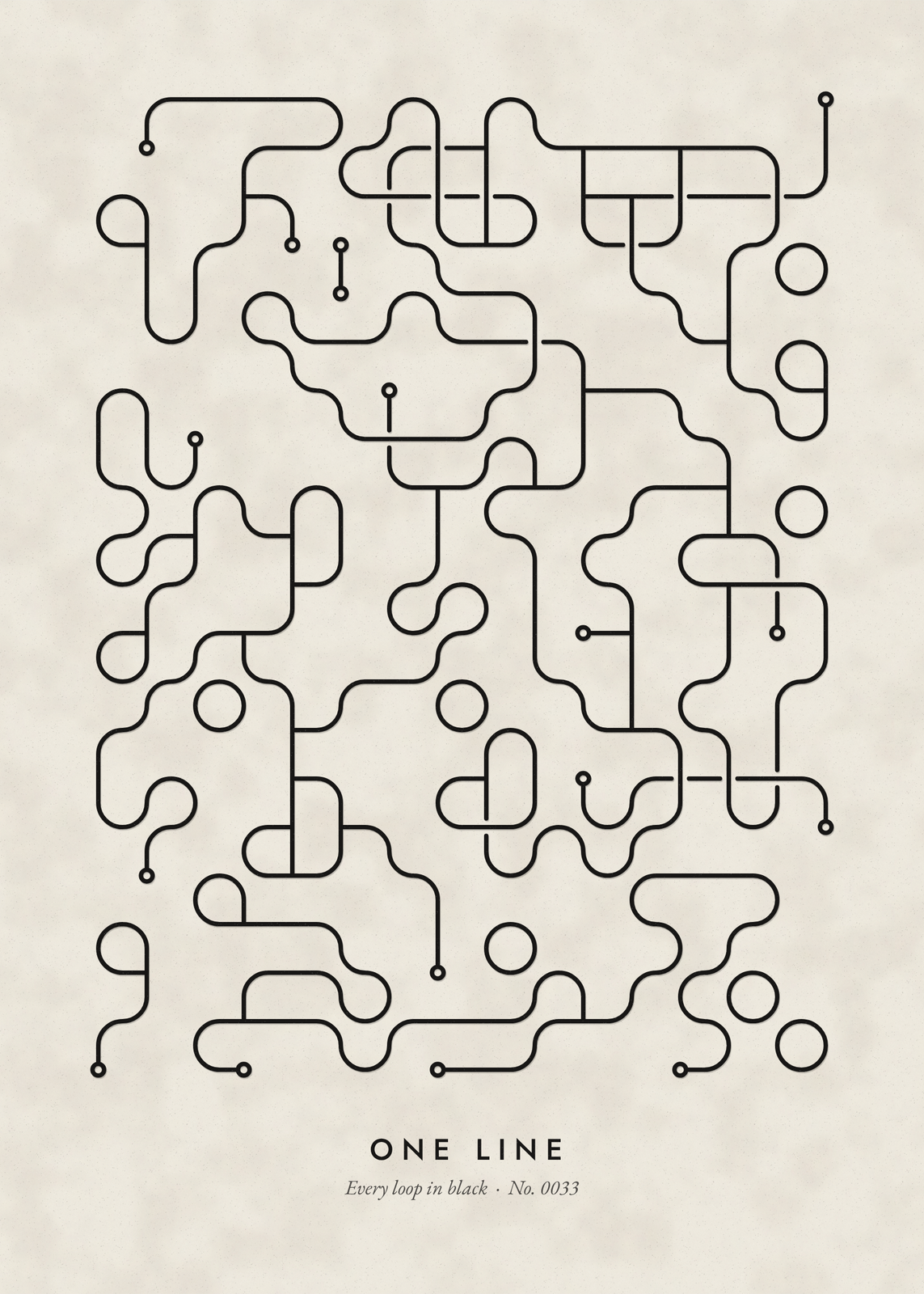
Twelve sets of tiles
- Noodles, Circuit, Traces and Floor plan: the four tile sets of the original demo, symbol for symbol.
- Loops and Interlace: single strands that close into knots, and ribbons that cross over, under, over.
- Islands, Arcs and Shapes: coasts from deep water up to hills, two-color Truchet arcs, and mid-century figures in four colors.
- Maze and Transit: thick walls with a door at the top and the bottom, and three colored lines with stations and interchanges.
- Meander: a pattern set, solved so that every 3 × 3 window of it matches a single Greek key, turned or mirrored.
Caught mid-collapse
Collapsed below 100% stops the solve part way. A ragged front sweeps up the grid: below it the tiles are settled, and above it each open cell is drawn as an underdrawing of every tile it could still become, the likelier ones darker. Drawn as Pixel, each open square takes the average color of its options, the way the original demo pictured the wave.
Closed or open edges
Closed edges keep every line inside the art: noodles turn back, strands close into knots, the sea runs round the islands, a floor plan becomes a whole building and the maze gets a wall all round. Open edges let the pattern run off the sheet. Tiles across sets the grid from 4 to 32, and Raised casts a small shadow from every tile onto the paper.
Questions
What is wave function collapse?
A tiling algorithm, first published in 2016 and named after the idea from quantum physics: every cell starts as a blend of all the tiles it could be, and solving collapses each one to a single tile that fits its neighbors.
Does every poster come out whole?
Yes. If the solver reaches a cell no tile fits, it starts that part again, and if that keeps failing it tries again from a new seed, so every poster comes out whole.
What does the caption say?
The tile set's own title, and under it how the grid was solved: the tiles, the kinds and the try it came out on, or how many cells are still undecided. Type your own over either.
Does it plot?
Traces, Loops and Transit drawn Smooth are lines only and come with a plotter file. The shadows, the paper grain and the underdrawing stay out of it.
What sizes can I print?
US Letter, 8 × 10, 11 × 14, 12 × 16 and 12 × 18 in, A4 and A3, free. You download a 300 DPI JPEG drawn at the size you pick. Larger prints, up to 24 × 36 in, are coming soon.
Related
 Math postersfractals, chaos and geometry, drawn from the formulas
 Generative art27 motifs drawn only in pen lines, the way a plotter draws them
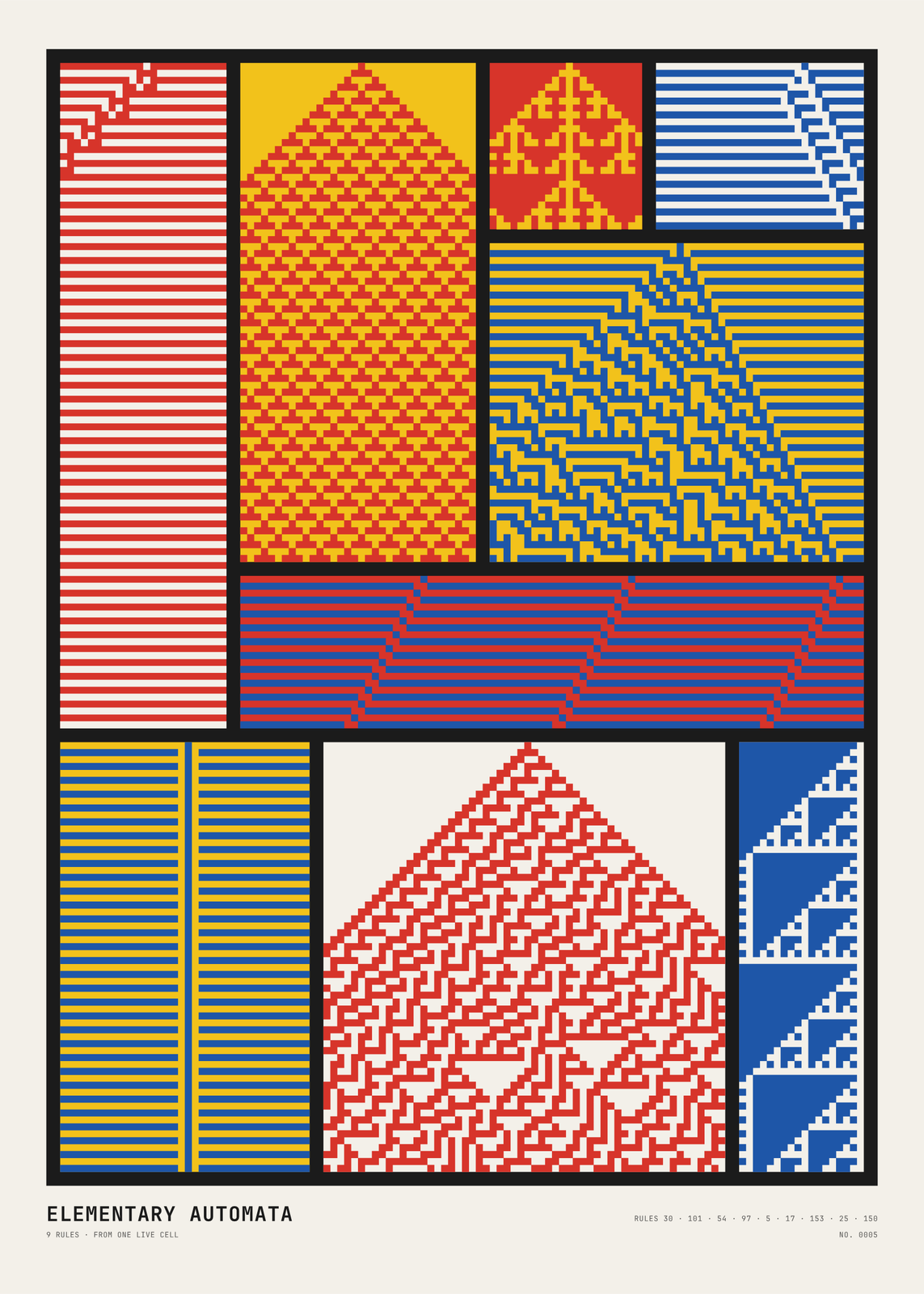 Cellular automata posterelementary rules grown in Mondrian panels
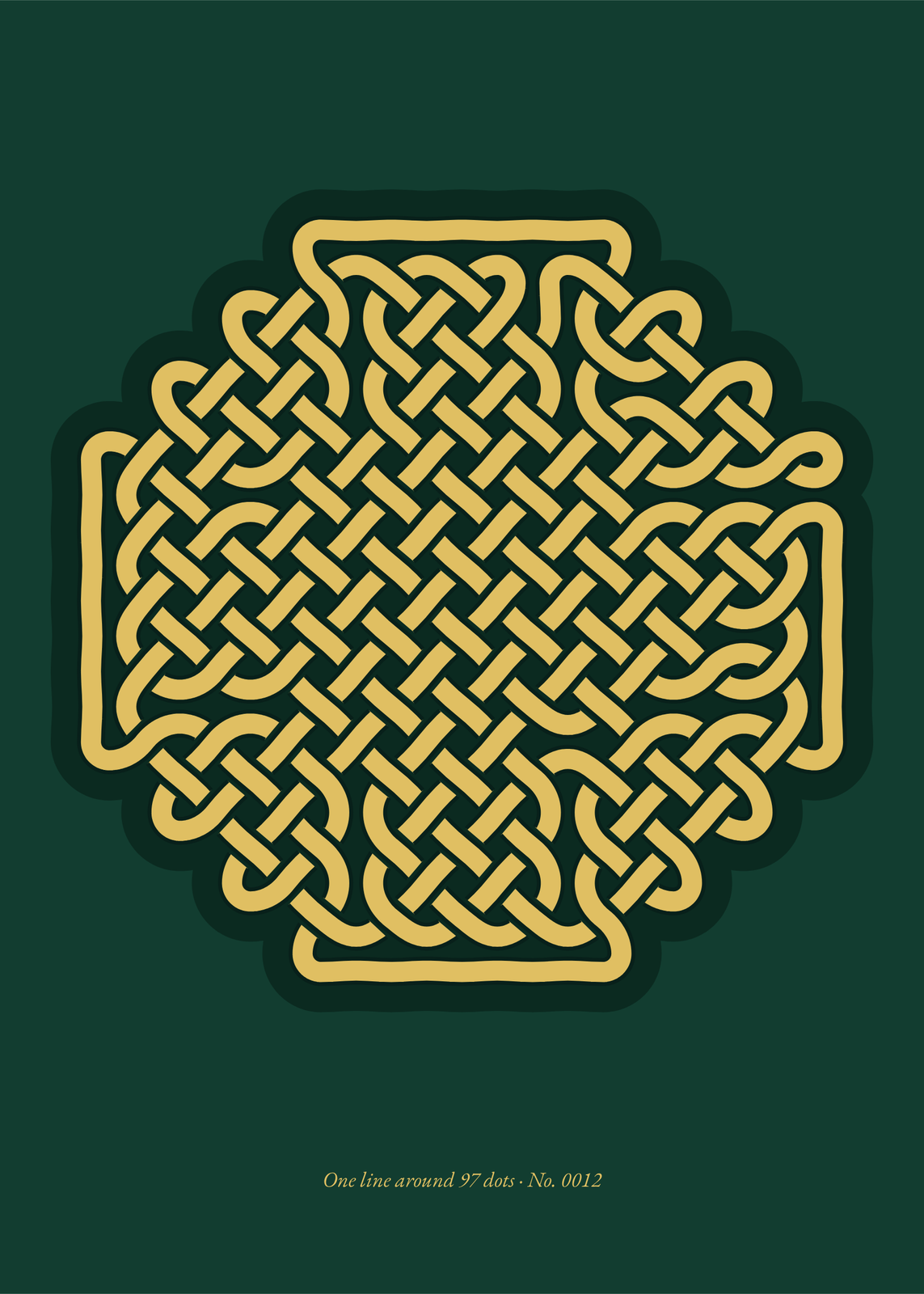 Celtic knot artone line round a grid of dots, over and under
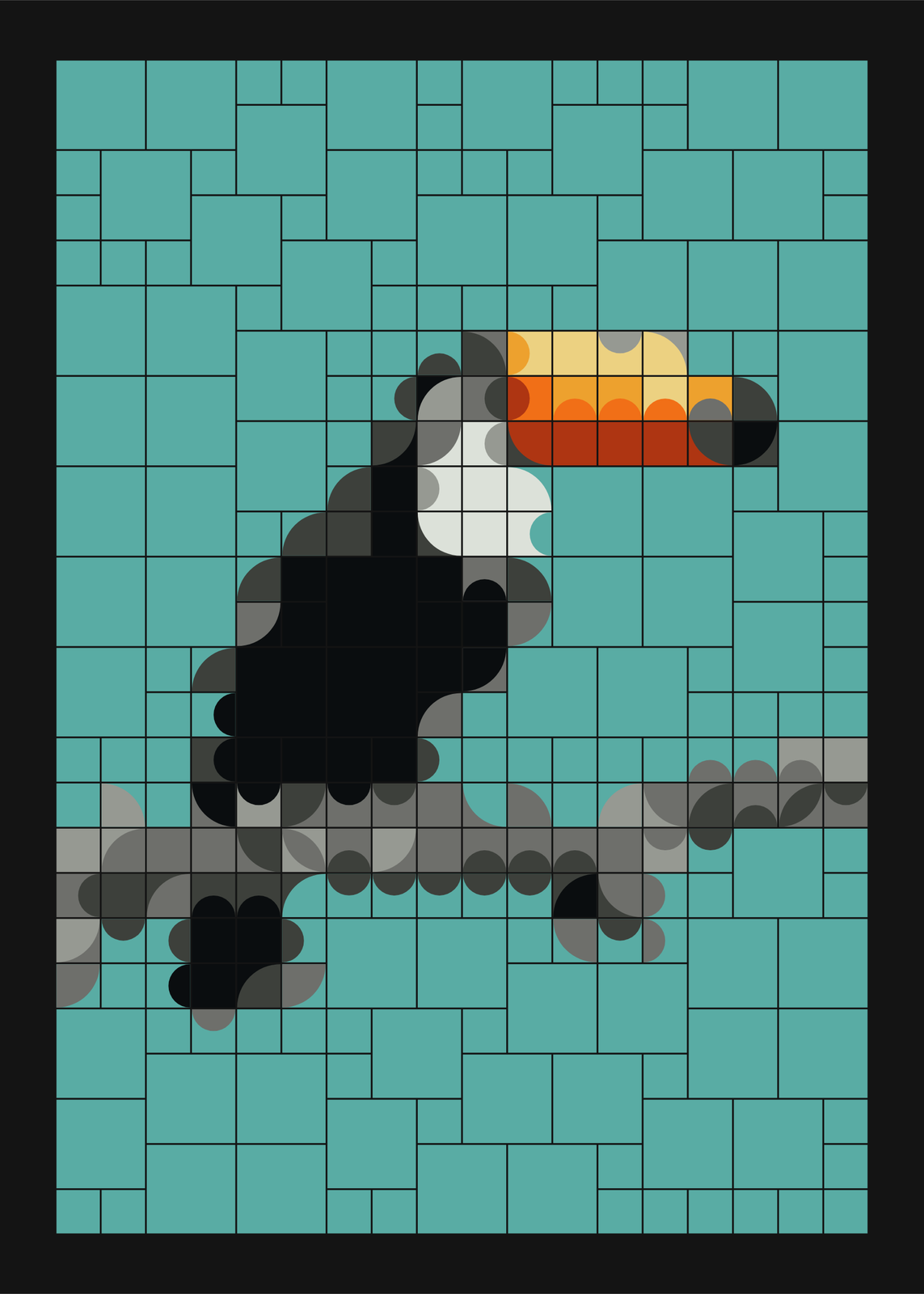 Mosaic artbold tiles that join into curves, composed by chance or rebuilt from your photo
Gift ideas by occasion
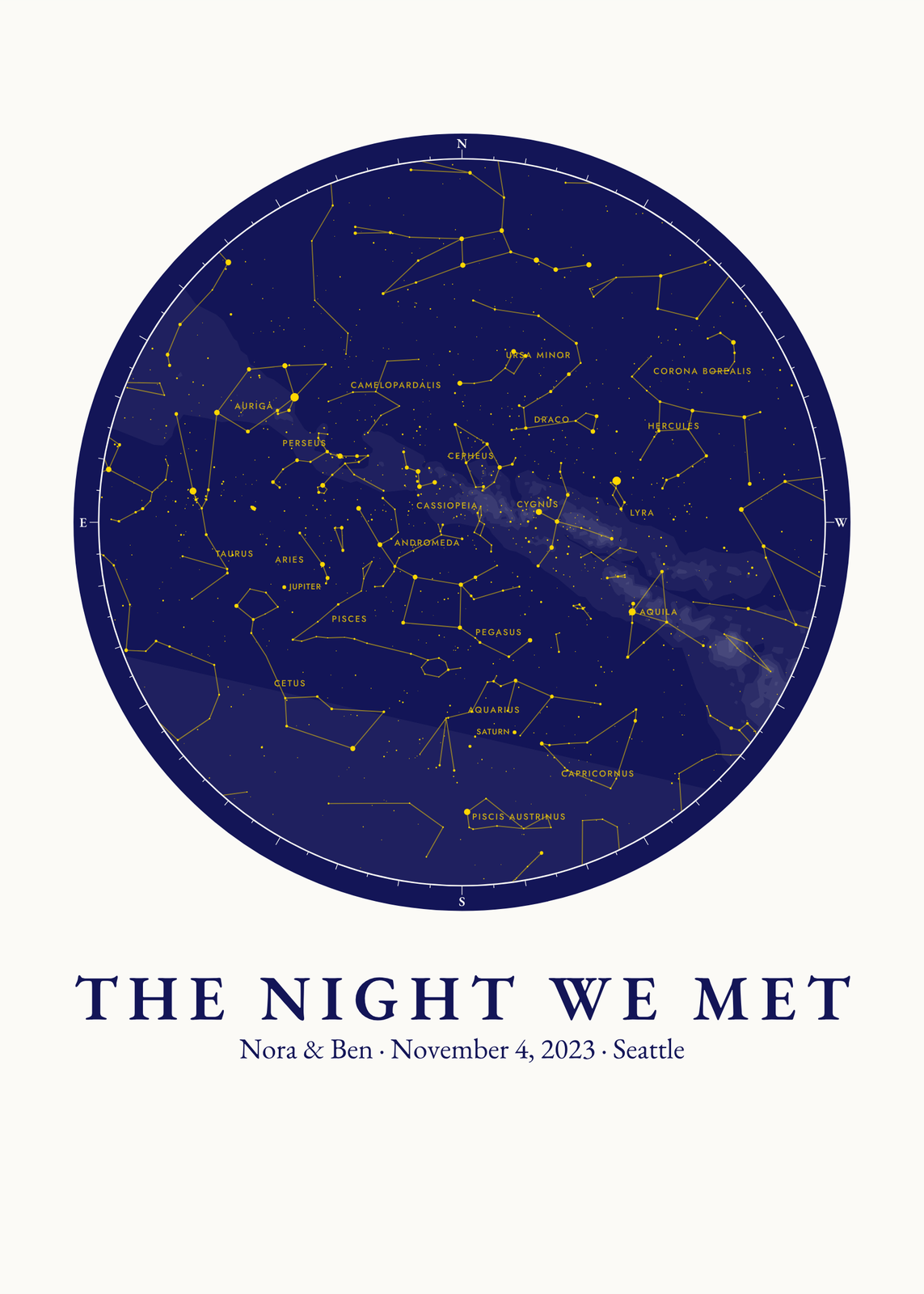
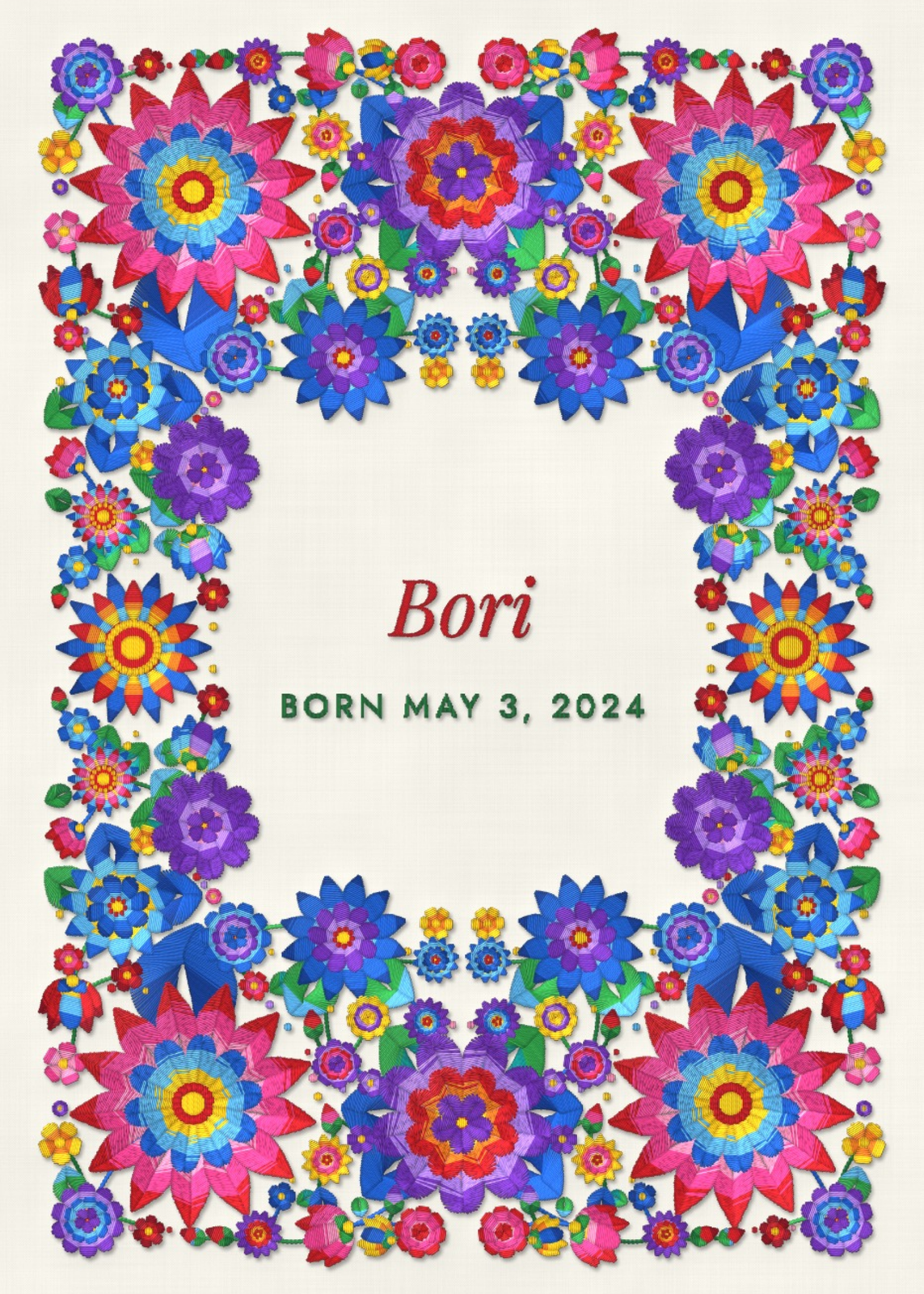
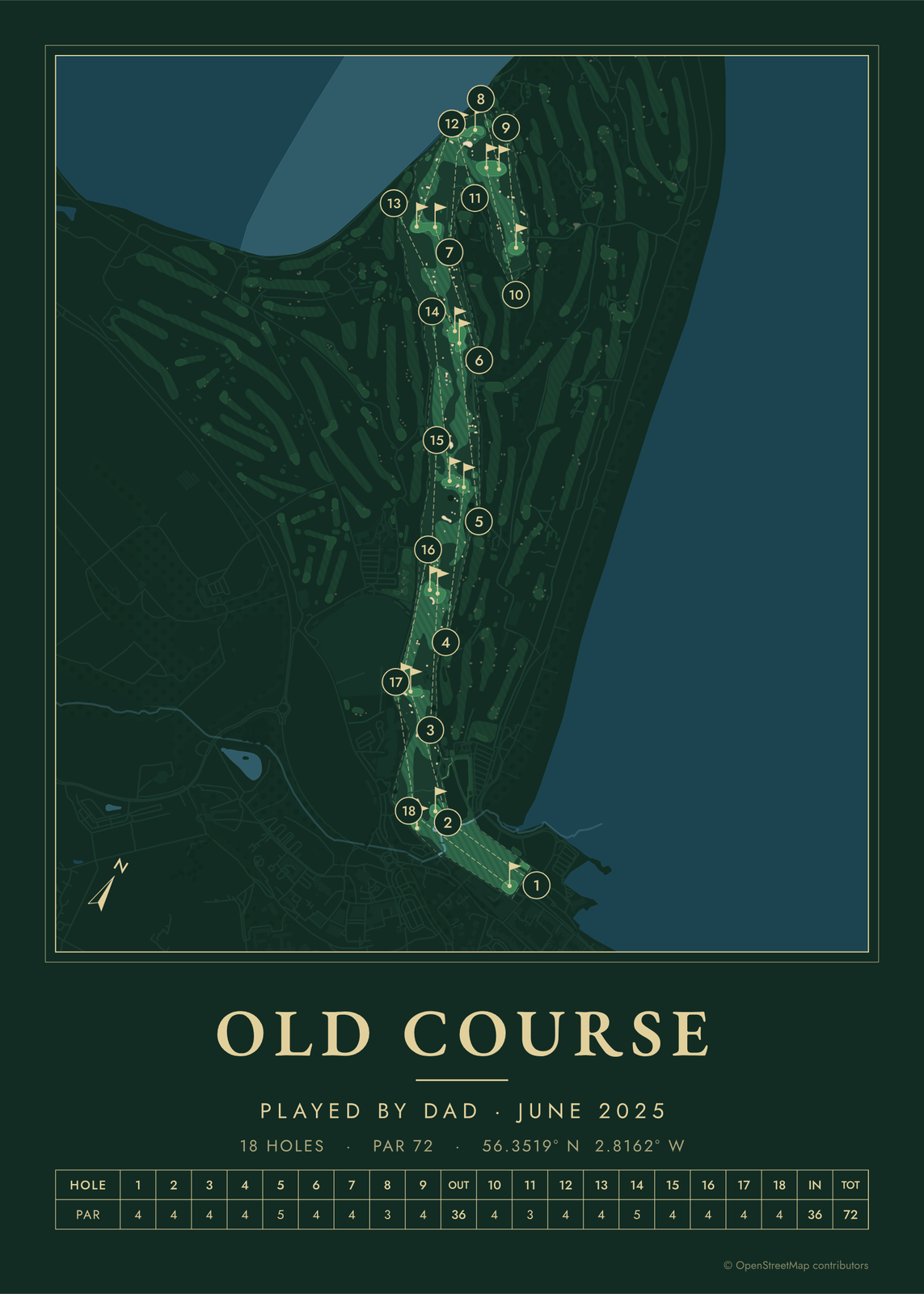
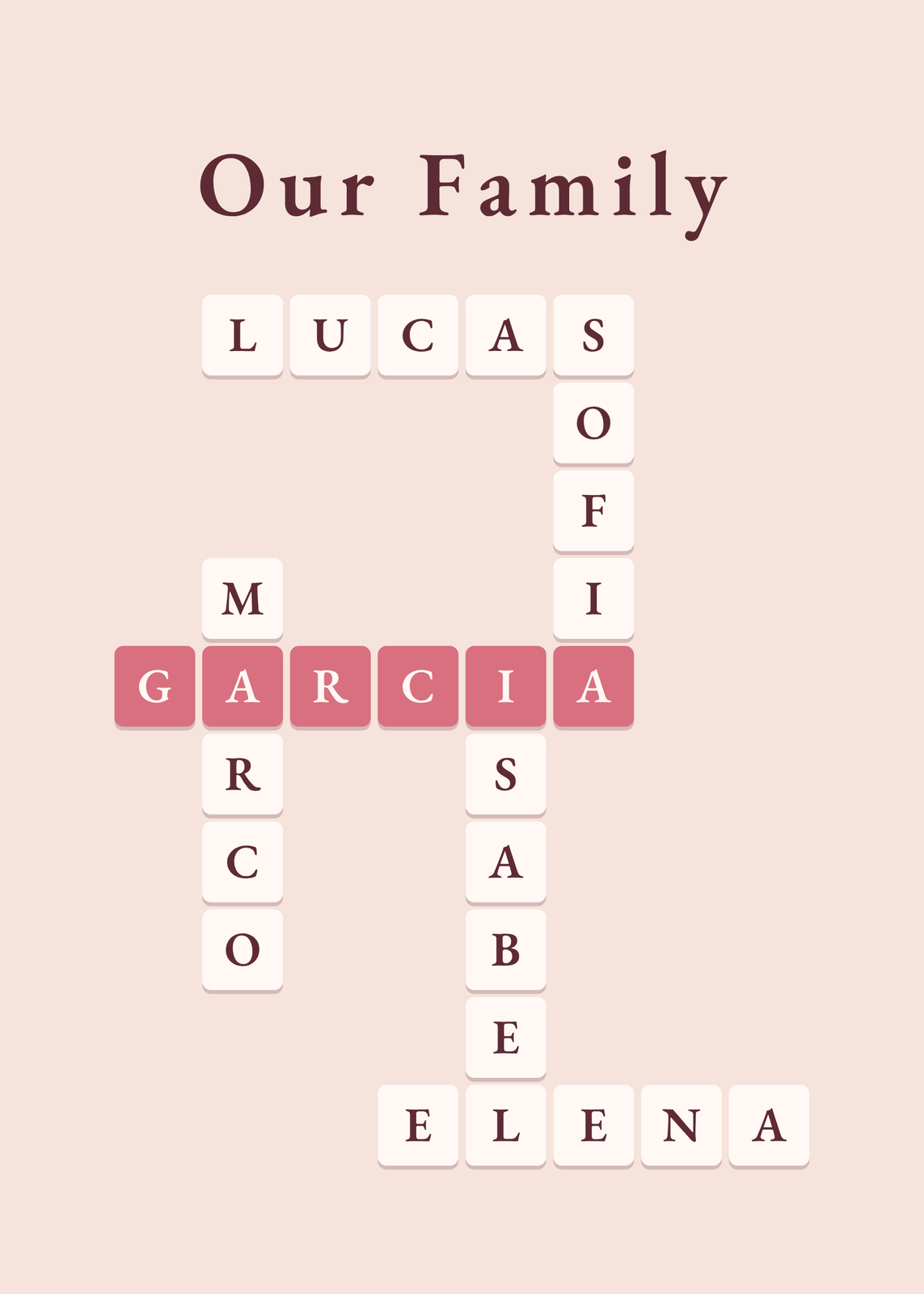
Every example is made with the Posterage generators. Change anything, then download it as a 300 DPI JPEG.